Introduction: Alkali Chemicals Manufacturing in India
India’s chemical manufacturing industry is known well for its growth in specialty and performance chemicals. However, from a structural, industrial and investment point of view, alkali chemicals are the real backbone of the industry.
According to information on industrial production released by the Department of Chemicals & Petrochemicals, the share of alkali chemicals in total chemical production in India is about 71.1%. This dominant share reflects their indispensable role in the sustenance of the manufacturing economy of India.
The sodium hydroxide and soda ash and chlorine compounds present in our products function as essential industrial materials who permanent use across various industries which produce textiles and detergents and glass and pulp and paper and pharmaceutical products and alumina refining and water treatment systems. As these downstream industries cannot run without them, alkali chemicals benefit from stable and recurring demand even during slowdowns.
Read More: Handbook On Chemical Industries (Alcohol Based)
Why Alkali Chemicals are Non-Discretionary Products
Unlike specialty or consumer-driven chemicals, alkali chemicals are continuously consumed in the course of fundamental production processes. Their need is based directly on industrial production and not on market sentiment or consumer behaviour.
For example:
- Textile processors are needing caustic soda for the bleaching and mercerizing processes.
- Detergent manufacturers rely on the consistency of soda ash in formulations.
- Chlorine compounds are used by water treatment facilities to disinfect and control pH.
From an industrial economics point of view, alkaline chemicals can be said to have three great advantages:
- Application based demand instead of optional consumption
- Predictable procurement cycles and recurring orders
- Extremely low risk of substitution
These attributes make the alkali chemicals one of the most reliable segments of the Indian chemical manufacturing scenario.
Read More: The Complete Technology Book on Chemical Industries
Structure of the Sector, Market, and Demand Stability in India
India’s leadership in the production of alkali chemicals is strengthened by the depth of integration with the large organized industries and MSME clusters. Whether an export oriented textile center, detergent manufacturing unit or a municipal water authority, alkali chemical consumption is unavoidable.
Assessments by the industry routinely indicate high capacity utilization levels in the major alkali chemical plants. This represents the fact that downstream manufacturers are more focused on continuation and reliability of supply rather than short-term price negotiations. As a result, long-term stability of demand is structurally built in to the market.
Regional Demand-Supply Gaps Creating New Opportunities
Despite great national production capacity, India still struggles with regional demand – supply imbalances for alkali chemicals. Rapid industrial growth in textile belts, FMCG clusters and new industrial corridors have superseded the setting up of local chemical plants.
Some of the reasons for these gaps are as follows:
- Heavy dependence on long-distance transportation from western India
- Rising freight and logistics costs
- Faster growth of downstream industries compared to upstream chemical capacity
- Development of new industrial corridors linked to PCPIR zones
As a result, many regions have inter-state supply chains for caustic soda and chlorine-based chemicals. This opens up a clear opportunity for MSMEs manufacturing units that are regionally located as they can provide quicker delivery and lower logistics costs.
Read More: Project Reports & Profiles
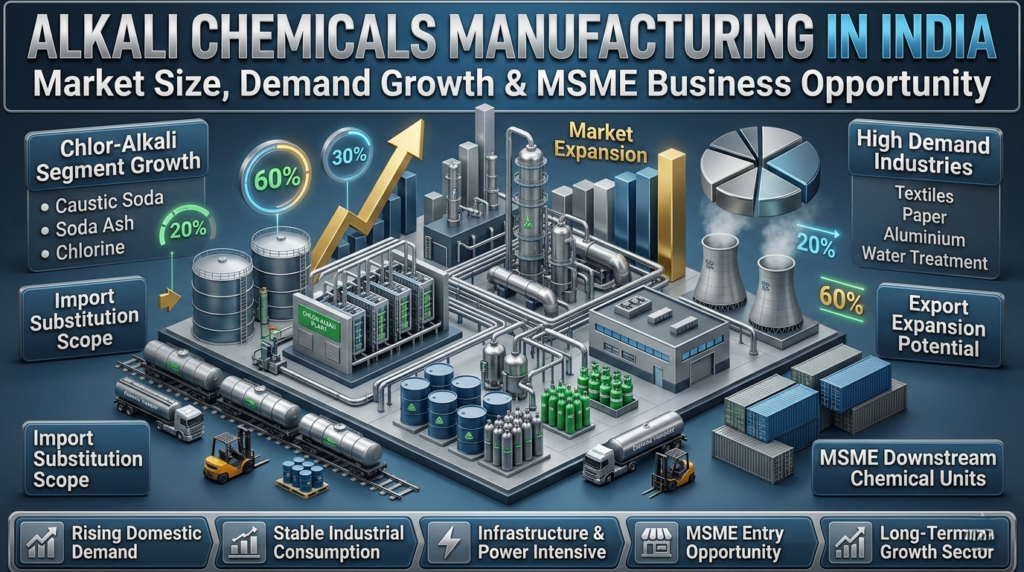
Downstream Industries Propelling Alkali Chemical Demand
The demand profile of alkali chemicals is closely linked to the industrial growth story of India.
Textiles and Apparel
India has one of the largest consumers of caustic soda in the textile industry with great export demand and growing domestic apparel consumption.
Detergents and FMCG
Soda ash demand is still on a rise because of rising penetration of detergents and cleaning products in households.
Water and Wastewater Treatment
Municipal corporations and industrial plants are under requirements of environmental and public health regulations. Chlorine based chemicals are therefore a compliance driven necessity and not a discretionary purchase.(Alkali Chemicals Manufacturing in India)
Read More: Profitable Small-Scale Chemical Manufacturing Business Opportunities in India (MSME Guide)
Continuous-Process Industries
Glass manufacture, pulp and paper and alumina refining need uninterrupted alkali chemical supply. Any break in this causes production losses, hence the need for reliable suppliers.
Established Manufacturers, Market Maturity
India organized alkali chemical sector comprises of established players like Tata Chemicals Ltd, Gujarat Alkalies & Chemicals Ltd and Nirma Ltd.
Their long-term success has shown that the alkali chemical market is not constrained by demand, but by efficient production, energy management and distribution networks. For MSMEs, this means that they have a mature and consumption-driven market rather than one that is suffering from saturation.(Alkali Chemicals Manufacturing in India)
Import Dependency and Role of PCPIR Zones
While India is self-sufficient in production of alkali chemicals, there are localised shortages of alkali chemicals, as logistics are the constraint. In many cases, it is more cost-effective to have locally produced chemicals than it is to have supplies transported for long distances.
Petroleum, Chemicals and Petrochemicals Investment Regions (PCPIRs) have the strategic advantage of providing:
- Shared infrastructure and utilities
- Common effluent treatment facilities
- Regulatory facilitation of chemical units
- Closeness to downstream consumers
These factors play a large role in increasing the technical and financial feasibility of new alkali chemical manufacturing projects.
Why Alkali Chemicals are Appealing to MSME Entrepreneurs
For MSMEs and first generation entrepreneurs, the alkali chemical manufacturing is an uncommon package of scale, stability and long-term growth.
Modular capacity expansion without total plant replacement is possible with modern production technologies such as membrane-cell processes. This allows for incremental scalability that is determined by market demand.
Projects which are specifically amenable at MSME scale include:
- Liquid and flake caustic soda
- Soda ash for detergent and glass industries
- Chlorine based water treatment chemicals
Once quality and consistency is established, buyers often prefer long term supply contracts, limiting marketing risk and sales volatility.
Read More: Top 15 Chemical Manufacturing Business Ideas in India with Huge Import Substitution Potential
Techno-Economic Feasibility Issues
The first step for entrepreneurs who want to start an alkali chemical manufacturing unit requires them to examine multiple critical factors:
- Environmental Factors Such As: – Energy consumption, power tariffs
- Efficiency of membrane cells and technology choice
- Waste treatment systems and environmental compliance systems
- Working capital cycles & receivables management
- Logistics and regional demand mapping
The project costs and profit margins and project success depend on these elements. A structured feasibility study helps to identify risks at an early stage and facilitates realistic financial planning.(Alkali Chemicals Manufacturing in India)
Investor Outlook: A Resilient Manufacturing Segment
Alkali chemicals are one of the most resilient sectors of the Indian chemical industry because of its huge share in production, cross sector integration and compliance driven demand.
Entrepreneurs who wisely invest in manufacturing units near industrial corridors or PCPIR zones can find cost efficiency in the long run and have stable institutional buyers.
For MSMEs looking for manufacturing businesses where the demand is low and the growth can be scaled up, alkali chemical manufacturing remains a good and long-term opportunity.
Commonly Asked Questions (FAQs)
Is the alkali chemical manufacturing a stable business in India?
Yes. Demand comes from necessities such as the textile, detergents, water treatment, and infrastructure industries, and therefore is structurally stable.
Can MSMEs compete with the large alkali chemical manufacturers?
Yes. MSMEs have the advantages of regional proximity, lowered logistics cost and quicker response times to local buyers.
Which Chemical Project of Alkali is Best For Small Manufacturers?
Caustic soda derivatives and chlorine-based water treatment chemicals are especially appropriate because of repeat and compliance-based demand.
What are the major hazards and risks for alkali chemicals manufacturing?
Energy costs, environmental compliance and logistic planning are important risks, which can be mitigated with proper feasibility analysis.
Are PCPIR zones for new chemical units?
Yes. Through PCPIR zones there are shared infrastructure, regulatory support and direct access to downstream industries.