

The Farmer Who Left Rs. 3,80,000 on the Table — Every Year
A farmer of tomatoes in Nashik, Maharashtra, sells his tomatoes at the price of Rs. Peak harvest will be 4 per kg. The same tomato costs Rs. 80 km away in Pune when it’s in its puree form. The manufacturer’s price is 32 per kg. The farmer retains 12% of the value of the final product. The remaining portion of the signal is recorded by the processor.
This is the middle ground where the agro processing unit fits. And it is widening. According to the
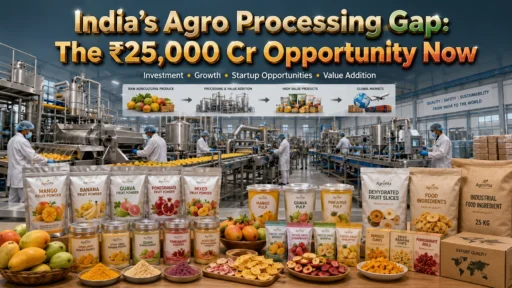
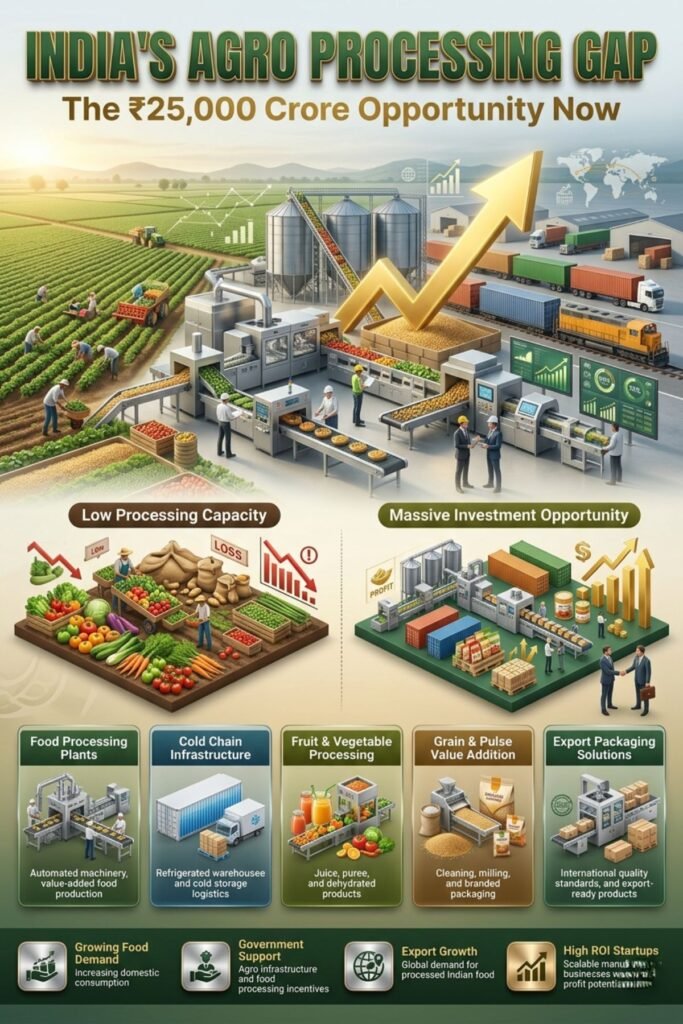
In India, the MoFPI processes approximately 10% of the agricultural produce compared to other countries like the United States or Malaysia, where 65–70% is processed. That 60-percentage-point difference is not a policy problem, it’s a Rs. Entrepreneurs with the courage to take the plunge can play a game of 25,000 crore commercial opportunity available every year.
This sector has demand; the question is what’s it? It does, in fact, structurally and permanently. Now, the simple question is: Do you have a strategy in place that will help you capture it for under Rs. 50 lakhs. This article provides you just that.
Get Detailed Insights from This Book: Modern Technology of Agro Processing & Agricultural Waste Products
The Gap Is Not Small — It Is Systemic
India is the second-largest producer of fruits and vegetables in the world with an annual production of more than 320 million metric tonnes. However, the Food and Agriculture Organization (FAO) estimates losses post-harvest in India to be as high as 30-35% for perishables such as tomatoes, onions, leafy vegetables etc and as high as 16-18% for foodgrains. That is Rs. in absolute terms. A loss of 90,000 crore per year in produce due to lack of processing facilities between the farmers’ field and the market — not because of adverse weather but because of the lack of processing facilities.(Agro Processing Unit Business in India)
Problem areas tend to concentrate in certain geographic areas. The situation is similar for the soybean and tur dal farmers of Vidarbha and Marathwada (Maharashtra) where there is very little scope for value addition locally, with farmers supplying raw pods to distant mandis where processors in Indore or Rajkot reap the profits. In Andhra Pradesh, (Guntur and Khammam) chilli farmers are selling the ungraded bulk at 18 to 25% less price than that for the graded and packaged product.
According to the data of the National Horticulture Board (NHB), India has only 2.2% horticulture produce processing capacity. The international standard for middle income agricultural economies is 25-30%. A small increase from 2.2%, up to 6%, would need hundreds of new micro and small processing units throughout the country.
This isn’t a demand issue. Processed, graded and packaged Indian agriculture products are in high demand from organised retail, quick commerce, direct to consumer brands and export buyers. It is limited by supply. And for the entrepreneur, supply-side constraints boils down to pricing power.
TABLE 1: State-wise Demand & Key Agro Processing Clusters
| State | Key Crop/Input | Industrial Cluster | Processing Gap |
| Maharashtra | Soybean, Tur Dal | Latur, Osmanabad | 60% raw export, low value-add |
| Punjab & Haryana | Wheat, Rice | Ludhiana, Karnal | Milling capacity deficit in Tier-3 belts |
| Madhya Pradesh | Soybean, Maize | Indore, Dewas | Export-ready processing < 22% of produce |
| Andhra Pradesh | Chilli, Turmeric | Guntur, Khammam | Bulk sold ungraded; price loss 18-25% |
| Karnataka | Coffee, Maize | Hassan, Davangere | Post-harvest loss ~28% without cold chain |
| Gujarat | Groundnut, Cotton | Rajkot, Amreli | Oil extraction < capacity; exports mostly raw |
Sources: NHB, APEDA, MoFPI state-level reports
Why the Timing Has Shifted in Your Favour
Small-scale agro processing is currently more viable than ever in the last 20 years and three forces are converging.(Agro Processing Unit Business in India)
One of the government’s priorities is making food processing a priority sector. The Pradhan Mantri Formalisation of Micro food processing Enterprises (PMFME) Scheme was launched under Aatmanirbhar Bharat programme and provides 35% credit linked capital subsidy up to Rs. Offering credit to informal/ micro food processors for formalizing and scaling out (credit of 10 lakh per unit). This scheme is targeted to first generation food entrepreneurs in particular.
Second, India’s agricultural exports have surpassed Rs. 2,000 crores as per reports by the Agriculture and Processed Food Products Export Development Authority (APEDA). The processed food category is one of the fastest-growing ones, accounting for 3.75 lakh crore annually. Small units can sell processed spice powders, dried vegetables, pulses and cereal products of Indian origin at competitive prices to customers in the UAE, USA and south-east Asia, who are willing to pay premium prices.
Get Detailed Project Report (DPR): Food Manufacturing and Agro Processing Projects
Thirdly, input costs have been stabilised. Post-pandemic improvements in the supply chain, advances in cold-chain logistics (particularly along Tier-2 belt highways), and the rapid growth of packaging material suppliers have eased the working capital stress that proved fatal for many small agro-processing projects.
KVIC and DIC run the PMEGP (Prime Minister’s Employment Generation Programme), which offers a 25% capital subsidy to manufacturing units, including agro-processing units. The scheme provides a higher subsidy of 25% for SC/ST applicants, women entrepreneurs, and units located in the North-Eastern States. The loans provided by MUDRA under the Kishore category are free of collateral and range from Rs. 5 lakh and Rs. Working Capital: Rs. 10 lakhs. The Credit Guarantee Fund Trust for Micro and Small Enterprises (CGTMSE) does away with the requirement of collateral for loans up to Rs. 2 crores.(Agro Processing Unit Business in India)
Policy structure is in place. The market demand is verified. The missing part is the entrepreneur that builds the unit.
How to Set Up an Agro Processing Unit: Step-by-Step
Step 1 — Choose Your Processing Type and Product Category
The prime entry level segments are Rs.The most feasible entry level segments are Rs. These include pulse milling (dal processing), spice grinding and packaging, rice hulling and sorting, flour milling (atta / maida / suji) and dried vegetable / dehydration units with a capacity of 50 lakhs. Each relies on different equipment and source of raw materials. Don’t attempt all of them. Choose one category (usually the same as the major crop in the district).
Step 2 — Land and Space Requirements
A minimum area of 2,000 sq ft is required but a small processing line requires 3,000 to 4,500 sq ft. Industrial sheds are on lease at Rs. in most Tier-2 and Tier-3 towns. $8 – $18 per sq ft per month. A 3,000 sq ft shed will cost Rs. in Latur or Davangere. 30,000–50,000 per month. It is not a time to buy land — lease first, prove the model, then invest in land!
Step 3 — Machinery and Equipment
The core machines for a pulse milling unit (dal processing) are dehusking machine (30-50 TPD), polishing drum, grading machine, and packaging line. For 20-30 TPD plant, total machinery cost will be: A total of 10-18 lakh from agro machinery suppliers from Rajkot (Gujarat) and Coimbatore (Tamil Nadu), the two agro machinery hubs in India. IndiaMART and TradeIndia provide the verified suppliers with the factory direct price, compare at least three before placing an order.(Agro Processing Unit Business in India)
Find high-return business ideas based on your budget & ROI
Step 4 — Raw Material Sourcing
For pulses: get straight from Latur, Nanded (Maharashtra) mandis or Kalaburagi, Karnataka. Primary origination areas include Guntur (chilli), Unjha (cumin and fennel — Gujarat) and Wayanad (Kerala) for pepper and cardamom spices. Strengthen and build direct linkages with Farmer Producer Organisations (FPOs), which are now more structured, provide quality products, and have a lead-in system in the lean season.
Step 5 — Licences and Regulatory Approvals
FSSAI Basic/State License: All food processing units are required to have this license. Apply Online at foscos.fssai.gov.in. Fees: Rs. 2,000–5,000 depending on turnover.
MSME / Udyam Registration: Online on udyamregistration.gov.in, Free and unlocks all government scheme benefits.
GST Registration: It is mandatory when the turnover is more than Rs. 40 lakhs (goods). Apply via gst.gov.in.
Factory License: If you have 10+ workers with power, or 20+ workers without power, then you need a factory license. Apply to State Labour Department for a license.
Pollution NOC: Owing to the low pollution that is generally seen in agro processing, it falls under the green category. Get from State Pollution Control Board. Timeline: 30–60 days.
BIS / AGMARK: Voluntary but strongly recommended for spices and packaged commodities through organised retail markets or exported.
Step 6 — Timeline and Team
Time from registration to first production: Registration with Udyam and FSSAI (Week 1-2); procurement and installation of the machinery (Week 4-10); trial runs and quality testing (Week 11-12); first commercial dispatch (Week 13-14). It can be done in three months. Six months is safe.(Agro Processing Unit Business in India)
A team should be comprised of 1 Plant Manager (can be the founder), 2-3 Machine Operators, 1 Quality Checker, and 1 Packing/Dispatch person. Total: 5–6 people. It doesn’t require much manpower to begin.
TABLE 2: Detailed Investment Breakdown for a Small Agro Processing Unit
| Cost Head | Min Estimate (INR) | Max Estimate (INR) |
| Land (leased, 2,000–3,000 sq ft) | 1,50,000/yr | 3,00,000/yr |
| Civil Works / Shed Construction | 3,00,000 | 6,00,000 |
| Primary Processing Machinery | 8,00,000 | 14,00,000 |
| Secondary Machinery (grading, packing) | 3,00,000 | 5,00,000 |
| Electrical, Plumbing & Utilities | 1,50,000 | 2,50,000 |
| Working Capital (3 months) | 5,00,000 | 10,00,000 |
| Pre-operative & Licensing Costs | 80,000 | 1,50,000 |
| Contingency (5–8%) | 1,20,000 | 2,50,000 |
| TOTAL CAPITAL OUTLAY | Rs. 24,00,000 | Rs. 44,50,000 |
Estimates based on unit setup in Tier-2 location; machinery sourced from Rajkot/Coimbatore belt. Figures are central estimates — final cost depends on state, product category, and capacity.
Related Article: 6 Agro-Manufacturing Business Ideas That Can Earn ₹1 Crore/Year in India
ENTREPRENEUR SPOTLIGHT
Ranjit Singh Gill, Punjab
Ranjit began a business of wheat flour and suji milling with an investment of Rs. in Fatehgarh Sahib, Punjab. 28 lakhs — of which Rs. 8 lakhs came as PMEGP subsidy. Today his unit handles 12 tonnes per day, feeds local kirana chains as well as a regional FMCG brand and has a turnover of about Rs. 1.1 crore per year. His number one tip: ‘Lock your first buyer before buying your first machine’. He got a letter of intent from a local distributor before he went to the bank and that just changed his life.
Financial Snapshot: What the Numbers Actually Look Like
The figures mentioned below are based on a 20 TPD Pulse Milling Unit (dal processing) in a Tier 2 location in the central or western parts of India.(Agro Processing Unit Business in India)
Capital Expenditure: Rs. 24 lakhs to Rs. All in 44Lakh working capital contingency (all in)
The monthly operating cost (at 60% capacity) is Rs. This is 7.2 lakh, raw material (Rs. 5.1 lakh), labour (Rs. 80,000), power and utilities (Rs. 45,000), packaging (Rs. 55,000), and overheads (Rs. 30,000).
Revenue when it was 60% full: Every month, 9.6 lakh (processing margin of Rs. Throughput 2.4 lakh/month. At 100% capacity: Rs. 16 lakh per month.
Gross Margin: 22-28% based on product mix and procurement efficiencies. Net margin at full capacity (excluding depreciation and financing costs): 16–21%.
Average dispatch time: 28-38 months from first commercial dispatch (60% average utilisation). If utilisation is 80% then the payback is closer to 22 months.
These are median values for a typical unit. Actual performance will depend on the efficiency in raw material procurement, buyer mix (organised retailers pay 8-12% more than mandis pay through resale) and brand investment you make in the product.
TABLE 3: Government Schemes Applicable to Agro Processing Units
| Scheme | Nodal Body | Subsidy / Benefit | Who Can Apply |
| PMEGP | KVIC / DIC | 25–35% capital subsidy | New units; SC/ST get 35% |
| PMFME Scheme | MoFPI | 35% credit-linked subsidy up to Rs. 10 lakh | Informal/micro food processors |
| MUDRA – Kishore | Scheduled banks / NBFCs | Collateral-free loans Rs. 5–10 lakh | Existing/new micro enterprises |
| CGTMSE | SIDBI / Banks | Credit guarantee; no collateral up to Rs. 2 cr | MSMEs with viable project |
| Kisan SAMPADA | MoFPI | 50–75% grant for cold chain / processing infra | FPOs, SHGs, cooperatives |
| Udyam Registration | MSME Ministry | Free; unlocks all MSME priority credit benefits | All manufacturing/service MSMEs |
Sources: MoFPI (pmfme.mofpi.gov.in), KVIC (kviconline.gov.in), SIDBI (sidbi.in)
Need a Detailed Project Report? Here Is Where to Look
The entrepreneurs looking for Niir Project Consultancy Services (NPCS) at niir.org can find project reports (DPRs), techno-economic feasibility studies, plant layout designs and turnkey consultancy for agro processing and food manufacturing units with much greater ease and speed. They provide reports of cost of plant and machinery, profitability forecasting, sourcing maps of raw materials and checklists for regulatory compliance, designed for presentation to banks and approval for government schemes. NPCS reports are a good source of baseline report for the DIC officers and bank credit team. The publication entrepreneurindia.co also features sector-specific guides and investment profiles for food processing entrepreneurindia.co at different stages of their journey.(Agro Processing Unit Business in India)
The Decision You Need to Make This Week
The agro processing industry is waiting for no hero. It is awaiting a person with a mandi relationship, a 3,000 sq ft shed and willingness to complete an Udyam registration form.
Machinery is on hand. Funding allocated for policy support. Demand is present and burgeoning from quick commerce, D2C brands, regional distributors and APEDA registered exporters.
The first step you take is specific: You define the leading agricultural product in your district, talk to three buyers (not farmers, buyers) and find out if there is a FPO in your region which seeks a processing partner. If two of the three conversations yield a real interest, then, you are ready to go.(Agro Processing Unit Business in India)
Register Udyam as soon as possible! It only takes 15 minutes and is free! Next, download the PMFME scheme guidelines from the MoFPI website and determine if your proposed project is eligible for the 35% subsidy. If it does, you have to reduce the effectual capital to arrange drops by a third.
Work backwards from the buyer. Next construct the unit. That is the order.
Frequently Asked Questions
Q1. What is the minimum investment required to set up an agro processing unit in India?
For a 10-15 TPD unit, you need at least Rs 18 lakh and Rs 28 lakh, as initial investment which will include machinery, some civil works, licenses and working capital for three months. For a 20-30 TPD unit, the investment required will be around Rs 30-44 lakh. This estimate includes only leased premises in Tier 2/Tier 3 cities; if you own land, you have to factor in its price.
Q2. What are the licenses required prior to commencing production?
For your unit, the basic licenses are a FSSAI registration or state license (food safety), an Udyam registration (for MSME ID) and GST registration (if turnover exceeds applicable limits), and a NOC from the state Pollution Control Board. A Factory License will be necessary if there are more than 10 workers and power-driven machinery is used. An AGMARK certification is not essential but can boost consumer confidence in products like pulses and spices.
Q3. How can I source raw materials at the best price?
The ideal place to purchase raw materials is directly at their origin points-e.g., dal at Latur/Kalaburagi, spices at Guntur/Unjha, wheat in Haryana/Punjab mandis. The cheapest and the best option to work with is a Farmer Producer Organisation (FPO) at the ground level. FPOs aggregate supply from individual farmers, which means quality consistency is better and they are often ready to accept forward contracts, which will also guard against seasonal price increases.
Q4. What kind of profit margins can I realistically expect?
If an agro processing unit runs at 70-80% capacity, gross margins are between 22-28%, while net margins hover between 16-21% after accounting for finance and depreciation. If your unit is branded and it supplies to organised retail, net margins are generally 5-8% higher than that of an unbranded product supplied to wholesale merchants. The payback period is 28-38 months based on 60% capacity utilization from first date of production.
Q5. Which government schemes are applicable to agro processing units?
Key relevant government schemes are the PMFME (35% credit-linked subsidy of up to Rs 10 lakh, at pmfme.mofpi.gov.in), PMEGP (25-35% capital subsidy, at kviconline.gov.in), MUDRA Kishore (uncollateralised loan up to Rs 10 lakh) and CGTMSE (uncollateralised credit guarantee up to Rs 2 crore, at cgtmse.in). Units associated with FPOs can access additional grants under the Kisan SAMPADA scheme to fund cold chain and processing facilities.
Q6. Can NPCS provide assistance in creating a project report for bank loan/ subsidy?
Yes, NPCS (Niir Project Consultancy Services) prepares all types of project reports required for financing under PMFME, PMEGP and standard bank credit appraisal norms. Their reports include plant layout design, specifications for machinery, detailed financial analysis and plan of action to meet legal and regulatory compliance. You can visit niir.org to get sector specific DPRs or entrepreneurindia.co for guides on setting up businesses for MSME entrepreneurs.
Key Sources & Citations
1. Ministry of Food Processing Industries: mofpi.gov.in
2. National Horticulture Board: nhb.gov.in
3. APEDA — Agricultural and Processed Food Products Export Development Authority: apeda.gov.in
4. PMFME Scheme Portal: pmfme.mofpi.gov.in
5. KVIC — Khadi and Village Industries Commission (PMEGP)
6. FSSAI Food Safety and Standards Authority of India: foscos.fssai.gov.in