Spice Processing Business in India
India’s spice industry is among the most stable and scale-up industries in the food processing space. While there is a lot of trend chasing going on with startups, spice processing is a demand-driven business with steady domestic consumption and emerging export markets. For anyone looking for a startup in manufacturing in India, spice processing and packaging is worth giving a thought.
India is the largest producer and exporter of spices in the world. The country is producing more than 75 varieties in different parts of the country – from turmeric in Telangana and Odisha to red chili in Andhra Pradesh, cumin in Rajasthan, and cardamom in Kerala.
This diversity in agriculture provides a structural advantage to Indian processors in terms of easy availability of raw material, pricing flexibility and stability of supply chain.
Read More: Handbook on Spices, Seasonings and Condiments Processing, Extraction with Kitchen Spices Manufacturing
Why Spice Processing is Profitable in 2026
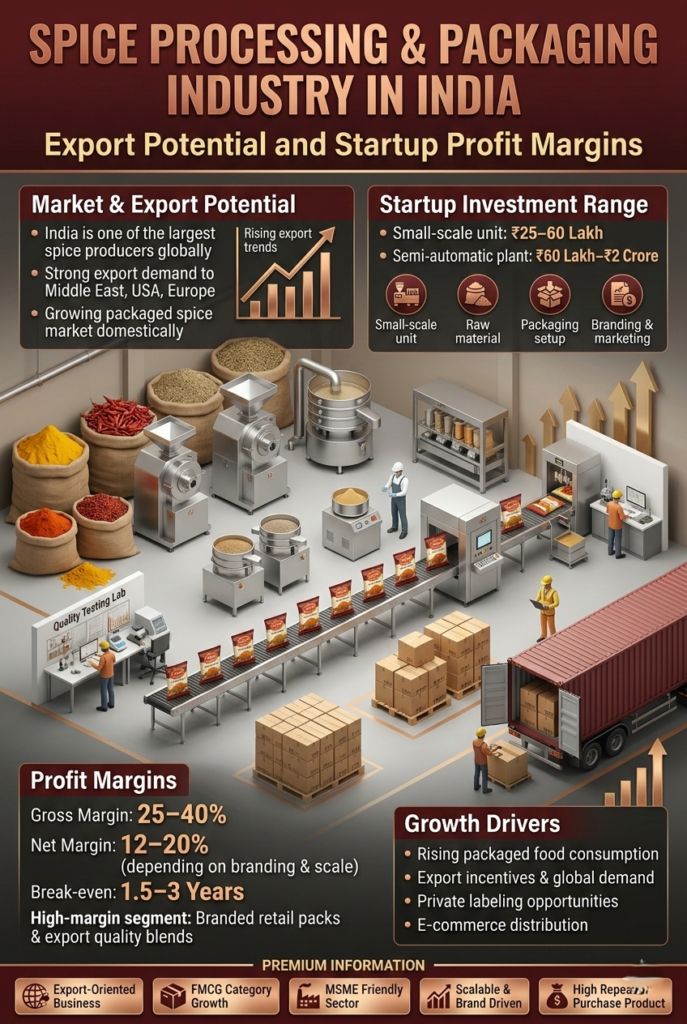
The world spice market is therefore moving away from trading of raw commodities towards value addition processing. Buyers are demanding more and more sterilization, lab certification, residue tested and branded products. This change has led to a great improvement in profit margins for processors who invest in quality infrastructure.
At various stages of processing, margins usually look like this:
- Cleaning and grading: 12–18%
- Grinding and blending: 22–30%
- Branded retail packaging: 28–38%
- Organic-certified spices: 35–50%
- Spice oils and oleoresins: 38–45%
Export markets provide further enhancement to profitability often with 30-50% realization compared to that of domestic wholesale trade.
India’s Opportunity of Spice Export
India exports spices to over 180 countries which include United States, China, UAE, Bangladesh, Vietnam, and United Kingdom. High demand products include chili, turmeric, cumin, pepper, spice blends, essential oils and oleoresins.
Exporters have to register with the Spices Board of India, which facilitates quality certification, export promotion, and market access. Licensing from the Food Safety and Standards Authority of India is compulsory for all food businesses. Export-oriented companies also get the benefits of schemes offered by APEDA.
Compliance requirements can sound demanding, but they are a protective barrier to allowing low quality competition in premium markets.(Spice Processing Business in India)
Read More: Spices and condiments, Indian Kitchen Spices, Masala Powder
Best Models of Spice Business for Startups
1. Blended Masala Manufacturing
Blended masalas are the best point of accessibility and scale. Urban consumers are being more inclined towards readymade mixes such as biryani masala, garam masala, chole masala and regional specialty blends.
Why this segment is good for startups:
- Moderate investment requirement
- Strong domestic demand
- Scope for regional branding
- 25-35% operating margins after distribution stabilizes
Positioning products around regional authenticity (for example Chettinad or Rajasthani blends) often permits the premium pricing.
2. Spice Oil and Oleoresin Extraction
This segment needs more capital but has great export potential. Oleoresins are used by:
- Food processing companies
- Pharmaceutical manufacturers
- Fragrance and flavors industries
While investment can go up to more than 1.5 crore, margins can go up to 40% under steady export contracts. It is suitable for entrepreneurs who are aiming for the B2B global markets.(Spice Processing Business in India)
Read More: SPICE (100% EOU)- Manufacturing Plant, Detailed Project Report, Profile, Business Plan, Industry Trends, Market Research, Survey, Manufacturing Process, Machinery, Raw Materials, Feasibility Study, Investment Opportunities, Cost and Revenue, Plant Layout
3. Organic Certified Processing of Spices
Demand for organic spices is increasing sharply worldwide, particularly in Europe. Buyers are willing to pay big premiums for residue tested and certified products.
Key requirements include:
- NPOP certification
- Strict documentation
- Residue and microbial testing
- Transparent sourcing
Though certification is time-consuming, the level of competition is comparatively low, which leaves long-term positioning advantages.
4. Private Label Manufacturing for D2C Brands
The emergence of e-commerce food brands has created strong demand for private label manufacturing companies. Startups prefer to outsource their production needs instead of creating their own manufacturing facilities.
Benefits of this model:
- Lower marketing expense
- Multiple brand clients
- Stable B2B revenue flow
Margins are usually between 25-35% depending on order volume.
Read More: Spice Processing Business Opportunities For Entrepreneurs
Government Support and Financial Assistance
The policy ecosystem is very supportive to food processing businesses. The capital subsidies and incentives are offered by the Ministry of Food Processing Industries. The Credit Guarantee Fund Trust for Micro and Small Enterprises assists MSMEs in getting collateral-free loans. Export incentives and industrial food parks provide additional relief in decreasing barriers to set up.
These schemes reduce the financial risk to the first-generation entrepreneurs to a great extent.(Spice Processing Business in India)
Lessons Learned from Established Brands
MDH Spices, founded by Dharampal Gulati, found success in the strict quality of blends and quality checks. The company considered its masala formulation as an intellectual property.
Everest Spices, set up by Vadilal Gandhi, was more on the side of retailer relationships and distribution penetration rather than aggressive advertising in the beginning.
The key takeaway is clear:
- Building process discipline before
- Ensure consistent quality
- Strengthen distribution networks
- Scale marketing only after stability of supply
Read More: Inside India’s Spice Trade: History, Tech & Quality Standards in One Volume
Investment and Profit Summary
A small cleaning and grinding unit may require between 15-30 lakhs. Grinding and blending set up typically involve investments of 35-70 lakhs. Branded packaging units can go across a mark of more than 50 lakhs based on the level of automation. Oleoresin extraction facilities need much greater investment but provide better margins when there are export demands.
Best choice depends on availability of capital, target market and long-term vision.
Final Conclusion
The spice processing and packaging industry in India brings together the agricultural strength, opportunity for exports and scalable profit margins. It is not a shortcut to instant wealth but it is a structured and reliable manufacturing business with long-term growth potential.
Entrepreneurs who emphasize quality, certification and well-disciplined operations can create a sustainable and profitable business in this evergreen sector.
Frequently Asked Questions (FAQ)
Q1: What is the minimum investment required to set up Spice processing business?
A small unit can start with the investment of Rs 15 – 25 lakhs whereas export-ready infrastructure requires an investment between Rs 50 – 80 lakhs or higher.
Q2: Is it profitable for new entrepreneurs to export spices?
Yes. Processed and certified spices realize much higher prices in world markets than do the bulk sales in the domestic market.
Q3: Is it compulsory to have FSSAI license?
Yes, it is mandatory for all food businesses to register themselves for licensing from the Food Safety and Standards Authority of India.
Q4: What spice business segment has the highest margins?
Spice oils and oleoresins together with organic-certified spices achieve maximum profitability when their management process is conducted in an efficient manner.
Q5: How long does it take to begin to export?
With appropriate certifications and buyer development, businesses can get export-ready in 12-18 months.