Why Biodegradable Disposable Cutlery Is One of India’s Most Timely Business Ideas
Biodegradable disposable cutlery is at a unique juncture in Indian manufacturing, with regulatory support, heightened consumer awareness, and infrastructure that is favourable to MSMEs. This segment is worth considering for entrepreneurs who are actively exploring business ideas that have short-term cash flow prospects and have long-term structural significance. Every year, India produces more than 3.5 million tonnes of plastic waste, and single-use food-service utensils such as straws, plates, forks, and spoons account for a significant portion of it.
The Single-Use Plastics (SUP) ban implemented by the Ministry of Environment, Forest and Climate Change, has created a commercial vacuum that the manufacturing sector can tap, which by most feasibility indicators is scalable and investable. Throw in food delivery apps, catering aggregators, fast food joints, and institutional kitchens, who are all looking for compliant solutions, and it’s hard to argue with the demand case.
The Market Logic Behind the Opportunity
This is no time to think in terms of sentiment when deciding to go into this business. It is based on ‘structural demand’ which cannot be reversed. The organised food service industry in India has been expanding gradually with a marked change towards takeout and delivery. This has led to a significant rise in the consumption of single use cutlery items on a daily basis across the country. Polypropylene producers easily met this requirement at low prices before the plastics ban. Since then, legal changes have broken that chain, and imports along with a weak domestic producer base have filled the resulting void.
The market for biodegradable cutlery in India is expected to experience a CAGR of more than 12% according to the data compiled by the Confederation of Indian Industry (CII) and industry bodies, tracking the sustainable packaging space. The demand from the food service sector and changes in institutional procurement are the main factors behind this growth. Further momentum is provided by export markets in Europe, the Gulf and the Southeast Asian region – especially for certified materials sourced from areca leaf, bamboo, sugarcane bagasse and wheat straw.(Biodegradable Disposable Cutlery Business in India)
This is even further boosted by India’s natural material advantage. Areca nuts are produced in a few pockets in Karnataka, Assam and Kerala. Sugarcane bagasse is plentiful all over Maharashtra and Uttar Pradesh. The feedstock benefits put domestic manufacturers in a competitive position to compete with foreign manufacturers around the world, as buyers are actively looking to diversify their supply chain from China.
Key commercial advantages of this sector include:
- Profitability margins between 18% and 35% (depending on material, product category and sales channel)
- Low raw material cost with agro-waste feedstock such as bagasse and areca sheath
- Moderate startup capital needed for the production units.
- Increasing price premium for certified products, by eco-conscious institutional buyers
- Rising demand for certified sustainable alternatives from the EU, North America and the Gulf markets.
Get Detailed Project Report (DPR): Biodegradable and Disposable Bagasse
Government Policies and Incentives Supporting This Business
India’s policy landscape has swung firmly in favour of the manufacturers of biodegradable products. New-age manufacturing units in this category can benefit from several schemes being offered by the Ministry of MSME for financing and infrastructure. The MSME Credit Guarantee Fund Trust (CGTMSE) helps MSMEs avarance a loan of up to ₹2 crore without any collateral, which is especially beneficial for first-generation entrepreneurs who are starting their businesses in capital-light industries such as areca or bagasse cutlery.
Eco-products, such as biodegradable packaging and cutlery, are given preference under the Make in India programme. They can avail the technology upgrading assistance under Credit Linked Capital Subsidy Scheme (CLCSS) for the purchase of eligible plant and machinery and the subsidy amount is 15% for the first time. The DPIIT has also been working towards making the process of registering startups easier for green manufacturing enterprises, such as providing support for fast-track IP filing of new processes involving bio-material.(Biodegradable Disposable Cutlery Business in India)
In the export-oriented units, Agricultural and Processed Food Products Export Development Authority (APEDA) has put areca products under its umbrella of support. It provides market development support for international trade fairs, and certification subsidies – which are directly applicable for manufacturers aiming to reach EU and Gulf buyers. Further, Startups registered in this space under Startup India scheme are eligible for income tax exemption for three consecutive years and access to Fund of Funds for Startups (FFS).
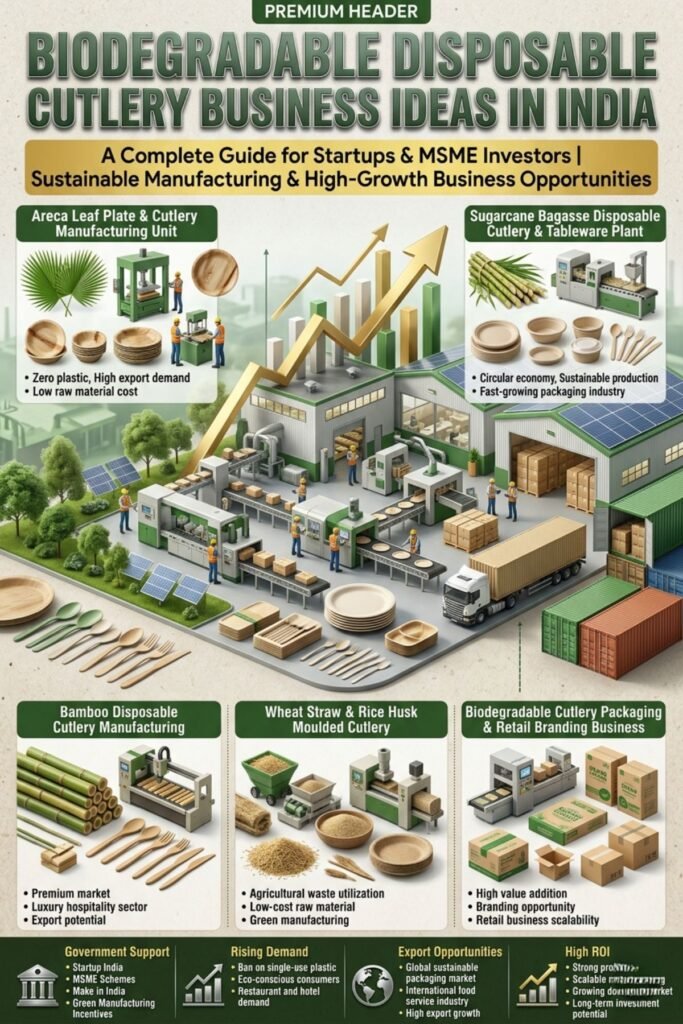
5 Business Ideas for Startups: Specific Project Opportunities in Biodegradable Cutlery
1. Areca Leaf Plate and Cutlery Manufacturing Unit
The most promising aspect of this type of business is that the areca leaf processor is one of the easiest first-time businesses to launch in the country’s South and Northeast regions. Workers collect naturally shed areca palm sheaths, wash and sun-dry them, and then use hydraulic plate-making machines to press them into plates, bowls, and spoons. It does not use chemical binders, adhesives, or any synthetic additives. The outcome is a 100% compostable in 60 days product.
The cost of the machines and the automation level go on to ₹15 lakh to ₹35 lakh for a small-scale 500 units per hour production line. The areca growing belts have a very low cost of acquiring raw materials while the finished product sells well in organic food stores, eco-resorts and export markets with a strong premium. Within 18 to 24 months, a quality-oriented unit that has established a steady stream of quality certifications can start negotiating institutional supply contracts with hotel chains and airline caterers.
2. Sugarcane Bagasse Disposable Cutlery and Tableware Plant
Manufacturers obtain bagasse, a fibrous residue, after extracting sugarcane juice. It has become one of the world’s most commercially developed biomaterials used for disposable tableware. As India is the second largest sugar producer in the world, domestic sugar producers have a distinct cost advantage. The process for the establishment of a bagasse moulding plant is the pulping of dried bagasse, moulding under heat and pressure, cutting and quality checking of the products.
Products are made in the form of plates, trays, bowls, clamshell containers and cups. The cost of the initial investment in a semi-automated line is from ₹60 lakh to ₹1.2 crore. This presents a business opportunity for entrepreneurs located near sugar mill clusters in Maharashtra, Uttar Pradesh, and Tamil Nadu, where they can procure bagasse at a nominal cost through long-term partnerships with sugar mills. It allows for the supply of a variety of SKUs, including single items of cutleries and meal trays, to meet the needs of QSR chains, institutional canteens and modern trade grocery retail.
Read the Complete Book Here: Bioplastics & Biodegradable Products Manufacturing Handbook
3. Bamboo Disposable Cutlery Manufacturing
Bamboo disposable chopsticks, forks, and spoons form a special product category that requires manufacturers to process bamboo fiber through various methods. These products offer an attractive appearance and enjoy strong demand in the international market. India is blessed with abundant bamboo resources. Additionally, the National Bamboo Mission of the Ministry of Agriculture is actively promoting the cultivation of bamboo and the development of bamboo enterprises in 22 states.
In a 1,500–2,000 square feet unit, workers split, slice, dry, cut bamboo culms into shape, polish them, and package them as part of the manufacturing process. This business concept is strategically interesting due to its export aspect. In Germany, the UK, Canada and Australia, the demand for bamboo cutlery has been steadily increasing. An FSC manufacturer or an ISO 14001 compliant manufacturer can get import distributors in these areas at margins that are much higher than domestic counterparts.(Biodegradable Disposable Cutlery Business in India)
4. Wheat Straw and Rice Husk Moulded Cutlery
Another area of significance, although not widely investigated, is wheat straw pulp and rice husk composites for producing moulded cutleries and tableware. These materials are readily available as agricultural residues in Punjab, Haryana, and the Indo-Gangetic Belt. Farmers often burn them in fields, resulting in significant impacts on air quality. This manufacturing gap creates an opportunity for entrepreneurs to transform this residue into high-quality moulded cutlery and deliver a genuine circular economy outcome.(Biodegradable Disposable Cutlery Business in India
The technology is based on extraction of fibres, pulp preparation, compression moulding and surface treatment. The process involves a little more investment compared to pressing areca leaves but give microwave safe products having superior structural properties to bagasse. This enables access to some of the high dollar catering and airline supply markets. Those with BPI composability certification for export have the opportunity to create defensible market positions ahead of the competition.
5. Biodegradable Cutlery Packaging and Retail Branding Business
Not all business people have to produce cutlery. One of the asset-light businesses ideas with high margins withing this ecosystem is to launch a retail and institutional supply with a brand name. This includes certified manufacturers, creating unique eco-brand packaging and creating B2B channels for restaurants, caterers, event managers and corporate offices.
This model demands the comprehension of buyer behavior. Institutional buyers focused on sustainability prefer certified and branded supplies rather than generic supply. Early adopters can secure supply deals with two or three big QSR chains (or institutional buyers) and, as a result, have strong revenue scalability without needing to be capital-intensive in production. This course is perfect for hospitality management graduates, supply chain professionals, or entrepreneurs who already have food industry connections.
Build a profitable business with the right idea
Import–Export Opportunity Analysis
The global packaging & cutleries market for sustainability has been growing with demand for which the domestic Indian capacity has not been able to cater to. The Federation of Indian Export Organisations (FIEO) says eco-friendly disposables such as biodegradable cutlery are one of the emerging non-traditional export areas in India, and the demand for such products is increasing from EU, North America and Middle Eastern countries.
European countries such as Germany, the Netherlands and France have produced their own SUP directives, which have resulted in an import dependency for certified biodegradable cutlery. India, owing its natural resources advantage and cost competitiveness in manufacturing, has ample potential to fill this void. But, manufacturers will have to get EU compostability certification (EN 13432) and traceability in their supply chains. The export realisation of certified areca or bamboo cutlery is much higher than the domestic price; exports are thus a high priority growth channel.(Biodegradable Disposable Cutlery Business in India)
India imports mould-making dies and high precision hydraulic pressing machines from China and Taiwan now on import. For those who can create or distribute local goods (including capital goods) which can compete with imported products, there is a secondary opportunity particularly because of government push to localize production under Make in India and Atmanirbhar Bharat.
Indian MSME Success Stories in Biodegradable Disposables
Pappco Greenware — Harish Garg, Haryana
Harish Garg, the promoter of Pappco Greenware from Faridabad, is one of the most talked about names for domestic scale bagasse disposables. From a modest production base the portfolio grew to include plates, cups and trays as well as cutlery sets for both domestic institutional supply and export. Garg pledged to promote bagasse years before the government implemented the plastics ban. It was a head start that Pappco Greenware took, and one that late movers have yet to catch up with. The lesson is that, in regulated industries, it pays to get in early, before enforcement.
Chuk — Saurabh Singhvi, Mumbai
Saurabh Singhvi founded Chuk with institutional support and positioned it as a premium sugarcane bagasse tableware brand for the food service and D2C markets. Their success stems from their distinctive design. Chuk designed its products to project a high-quality brand image while maintaining the same level of functionality as plastic products. This is one of the important learnings that is important for this industry: the brand and design is as important as production capability. The more entrepreneurial a company can be to be efficient in manufacturing and have product aesthetics and storytelling, the better margins they will be able to hold on to.
Beco — Akshay Verma and Akshit Bansal, Delhi
Beco is working across several sustainability product categories, but its biodegradable range clearly illustrates the impact of a digital-first brand approach for eco-products brands. With e-commerce platforms, eco-focused consumer communities and D2C narratives, the founding team was able to expand revenue by working without the traditional distribution system. Amazon, Flipkart, its own website, and corporate gifting are all channels that Beco has employed, and it could be a model for MSMEs who are starting out with biodegradable cutleries but aren’t sure where to begin.
Expert Feasibility Support: NPCS
Pre-investment analysis is the difference between the two for entrepreneurs awaiting entry into the disposable biodegradable cutlery market for the profitable execution of their business plan. Niir Project Consultancy Services (NPCS) offers professional consulting services for preparation of Market Survey cum Detailed Techno-Economic Feasibility Report (DPR) for establishing a new industry.
The following are included in NPCS feasibility reports:
- Manufacturing processes and process flow diagram in detail
- Identify the demand for a product or service and make sure that it aligns with the market’s needs.
- Product mix, capacity planning and sourcing of machinery details
- Materials supply and logistics for procurement
- Fill in the project finances, including profitability forecasts.
- Compliance mapping and market intelligence for exports
The goal is to assist entrepreneurs in determining whether a business is viable, profitable and scalable before investing in it, thus avoiding potentially expensive changeovers after the investment.
Related Article: Biodegradable Packaging Manufacturing: India’s ₹10,000 Crore Sunrise Opportunity Post-Plastic Ban
Market and Cost Reference: Biodegradable Disposable Cutlery Segment
| Product Category | Raw Material | Est. Setup Cost | Typical Margin Range |
| Areca Leaf Cutlery & Plates | Areca palm sheath | ₹15–35 Lakh | 28–35% |
| Bagasse Tableware | Sugarcane bagasse | ₹60L–1.2 Crore | 20–28% |
| Bamboo Cutlery | Bamboo culm | ₹25–60 Lakh | 22–32% |
| Wheat Straw Moulded Ware | Wheat straw pulp | ₹50L–1 Crore | 18–26% |
| Branded Supply / Distribution | Sourced (no production) | ₹5–15 Lakh | 15–25% |
Note: Setup cost estimates reflect semi-automated entry-level configurations. Margins vary by product mix, channel, and certification status.
Frequently Asked Questions (FAQs)
Q1. What is the investment needed to establish a small biodegradable cutlery unit?
With a manual to semi-automatic production line on an area leaf-based unit, an entry cost between 15-30 lakh, covering the machinery, working capital, and upfront purchase of raw materials, is required. The entry cost for bagasse and bamboo units is higher owing to machinery, where costs typically start from 50 lakh upwards. Besides these initial project costs, it is advisable for an entrepreneur to allocate another 15-20% of the project cost towards certification, packaging development and marketing, even before the first sale takes place.
Q2. Which biodegradable material possesses the best commercial viability in the Indian market?
Sugarcane bagasse offers the most diverse range of commercial applications, serving both local QSR/canteen businesses as well as exporters, with an established technological base. The artisanal, premium positioning of areca leaf products makes them best suited for export channels and the niche hotel/resort business. Bamboo cutlery, although with the best export credentials, needs sustainable systems to gain market share over established South Asian suppliers.
Q3. Is there government subsidy available for this business?
Yes, various channels are available for business subsidy. Under MSME schemes, a 15% capital subsidy on machinery can be availed under CLCSS. Businesses can avail working capital loans of up to ₹2 crore without collateral under CGTMSE, while APEDA provides assistance for marketing development to export-oriented units. The respective industrial development corporations offer individual state government incentives, particularly those from Karnataka, Maharashtra, and Assam.
Q4. How does one get the required certifications to export products?
To export products to European countries, manufacturers must obtain compostability certification that meets EN 13432 standards. Buyers in the US market accept BPI certification from the Biodegradable Products Institute as proof of compliance. Testing, in either case, must be performed by an accredited laboratory. This certification process can take anywhere from three to six months, and APEDA offers subsidy for certification fees to registered exporters. It would be practical to pursue certification during the machinery set up stage itself to avoid further delays while moving into market.
Q5. What are the major challenges a new entrants may encounter?
Challenges faced by new entrants may include quality consistency owing to the variations in bio materials which would necessitate stringent control over processes, costs of certifications for the premium markets and competition with cheap imports from China in the case of certain products. It is advisable for entrepreneurs to tie up supply contracts with an anchor buyer such as a catering company, hotel chain or canteen operator of a large organization before investing on larger machinery and expanding production. Institutional buyers require FSSAI registration and minimum orders which may initially be a hurdle.
Q6. Can this idea be explored in a Tier 2 or Tier 3 city?
Yes, in fact, it is much preferable to set up a unit in a Tier 2/Tier 3 city if its raw material sources are available in nearby vicinity. Such locations offer cost advantages on raw material procurement compared to a unit in a metropolitan city; such as the areca belts in Karnataka & Assam, sugar clusters in Maharashtra & UP, and bamboo corridors in the North-East. Subsidized plots and infrastructure are also available for MSME units registered with state industrial estates in such towns/cities.
Conclusion: a manufacturing opportunity whose time has come
Overall, The biodegradable disposable cutlery market currently represents one of the most compelling aligned-opportunity plays in India’s MSME manufacturing sector. Moreover, Demand has already been built by regulators. In addition, A wide availability of natural materials mitigates the risk of raw materials becoming expensive. Additionally, Aided by government schemes, capital is more accessible than it has been in the past. Furthermore, increased export demand in the European Union, North America, and the Gulf States sets a meaningful ceiling for revenue considerably higher than what India on its own can provide.
Still, it is not a market where failure is impossible. Moreover, Those founders who plan to build institutional supply chains and invest in the systems and quality required for certifications from the outset will succeed where those viewing it as a commodity play fail. Furthermore, This commonality amongst market leaders Pappco Greenware, Chuk, and Beco: they were clear about what market niche they wished to serve, and operationalized the execution effectively.(Biodegradable Disposable Cutlery Business in India)
For the entrepreneurs, ready to take the plunges into an industry where market winds are clearly blowing in a single direction, biodegradable cutlery production presents an unusual mix of investable fundamentals, government endorsement, and real market pull. The opportunity for a first mover is there – but will be short-lived as capacity tries to close the demand gap.