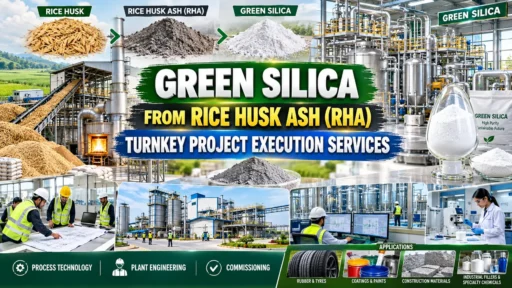
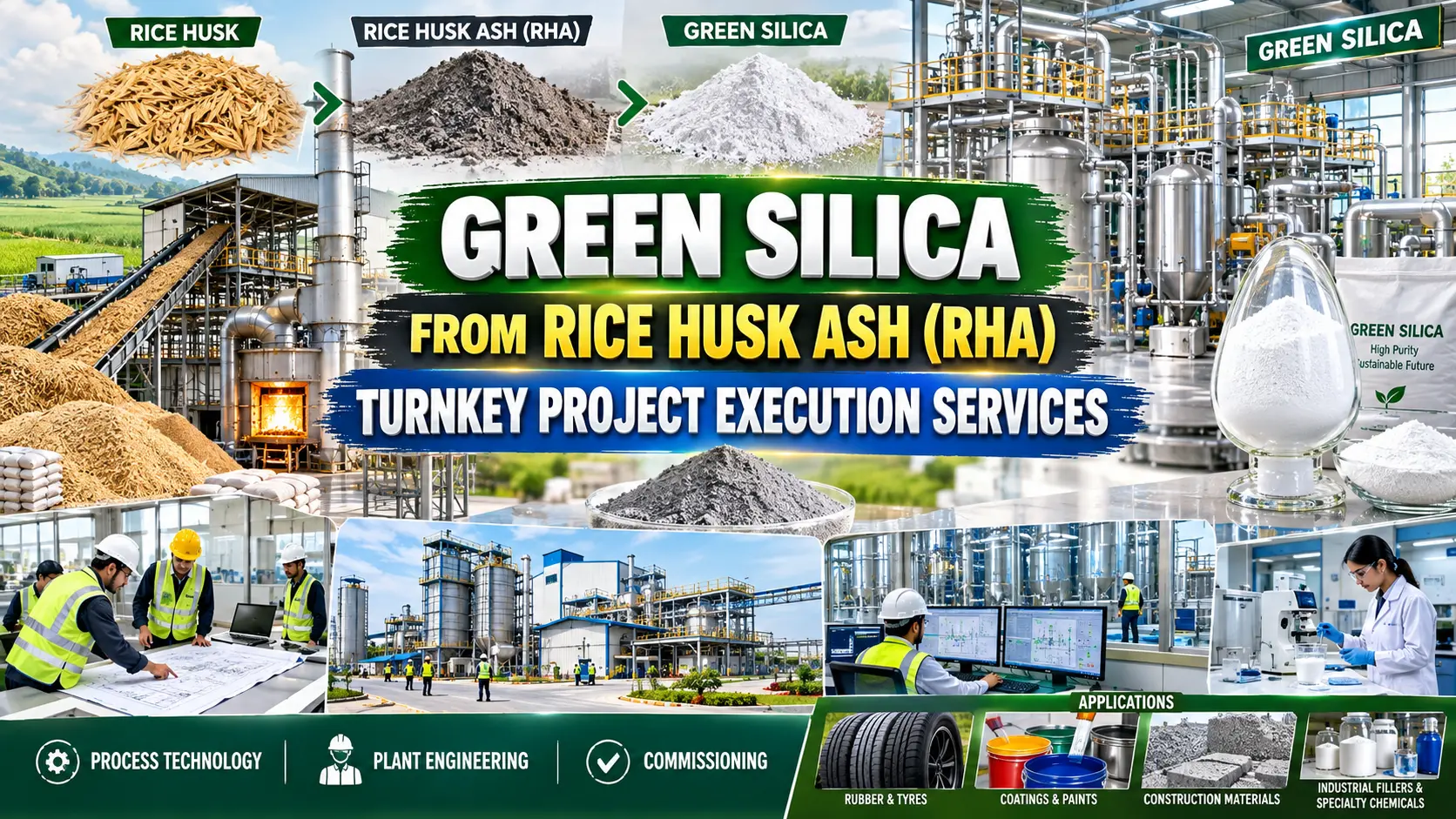

When entrepreneurs explore business ideas in specialty chemicals, they almost always underestimate one thing — execution complexity. The chemistry of producing green precipitated silica from rice husk ash (RHA) is well-documented. The market demand is real and growing. The government support is available. What separates a plant that commissions on time and produces on-spec from one that bleeds capital for two years is the quality of project execution. That is precisely why turnkey project execution services have become the most critical investment a green silica entrepreneur can make — more important, in many cases, than the machinery itself.
India generates approximately 20 million tonnes of RHA annually — a largely wasted agricultural residue containing 85–90% amorphous silica. Global precipitated silica demand is projected to reach USD 5.90 billion by 2030. India’s domestic market is expanding at 10.2% annually. The business ideas around this opportunity are compelling. But without a structured, phase-by-phase turnkey execution model, most first-time chemical plant promoters find themselves stuck between vendors, missing process know-how, and commissioning a plant that cannot hold product specifications.
This article covers the full case for turnkey project execution as the defining differentiator for anyone entering the green precipitated silica manufacturing business in India — with the process, the 12-phase model, the market context, government schemes, client references, and the questions every serious entrepreneur should ask before signing a single equipment purchase order.
The Execution Gap — Why Green Silica Plants Fail Before They Start
The green silica from RHA opportunity is genuinely attractive. Yet many promoters who enter this space stitch together a project piecemeal — buying a reactor from one vendor, a filter press from another, a spray dryer from a third, and hoping a plant engineer coordinates it all. It rarely works cleanly.
What Goes Wrong Without Turnkey Execution
Process chemistry in precipitated silica production is unforgiving. The sodium silicate intermediate must meet specific concentration and purity standards before it enters the precipitation reactor. The acid addition profile during silica precipitation — pH, temperature, time, and agitation — directly determines surface area, pore structure, and particle size of the final product. Miss these parameters and you produce off-spec material that no rubber compounder or tyre manufacturer will accept.
Beyond the chemistry, utility design is equally critical. Steam system sizing, cooling water circulation, compressed air pressure, and ETP capacity must all be engineered to match the production rate — not approximated. When individual vendors supply equipment without integrated utility planning, the result is almost always a commissioning delay of 6–12 months, cost overruns, and a product that fails customer specifications.
The Manufacturing Reality First-Time Promoters Miss
Most entrepreneurs entering specialty chemicals for the first time have strong business instincts. However, they do not have the process engineering depth to write a material balance, design a batch cycle, or specify a spray-dryer inlet temperature profile. These gaps cannot be filled by reading equipment brochures or visiting an existing plant for a day. They require 30+ years of hands-on precipitated silica experience — the kind that only comes from operating plants, troubleshooting quality failures, and optimising utility costs across multiple production cycles.
A turnkey project execution partner brings exactly this. More importantly, a turnkey model concentrates accountability in one place. There is no finger-pointing between equipment vendors when commissioning problems arise. The turnkey contractor owns the outcome — from process engineering through to the first successful production trial.
What Turnkey Project Execution Actually Means for a Green Silica Plant
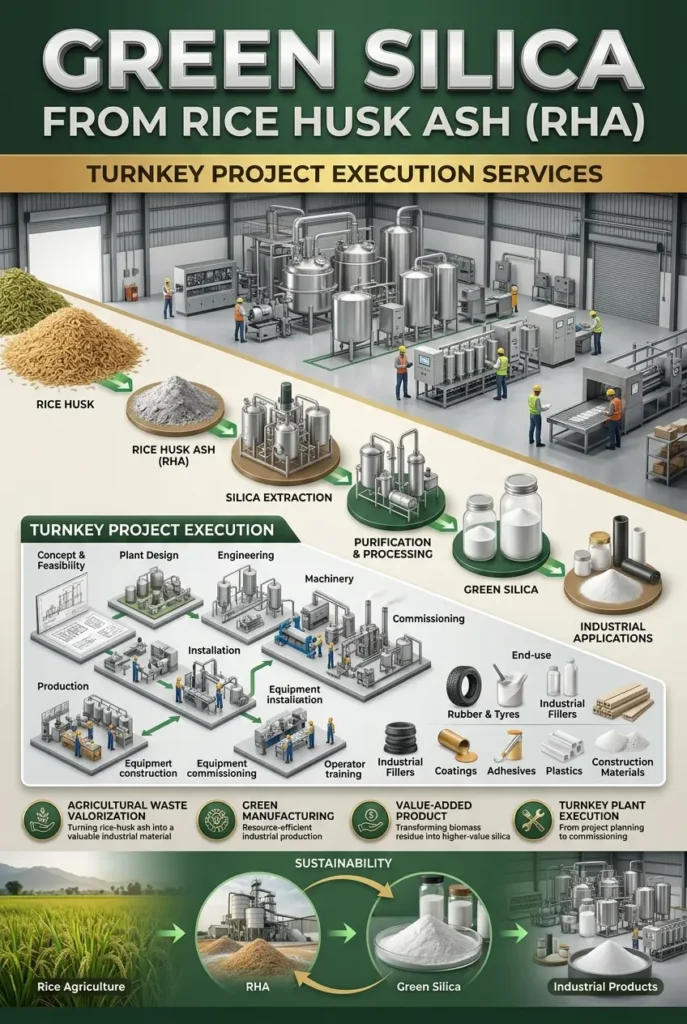
The word ‘turnkey’ is widely used and equally widely misunderstood. In the context of a green precipitated silica from RHA manufacturing unit, a genuine turnkey model covers twelve structured phases — not just equipment procurement and installation.
Phase I — Project Planning and Capacity Assessment
Every successful plant starts with disciplined pre-project planning. This phase covers client requirement understanding, production capacity planning, raw material assessment (RHA quality, silica content, residual carbon, potassium levels), utility availability, and site evaluation. Getting this phase right prevents the most expensive errors — over-specifying capacity, locating a plant away from feedstock clusters, or under-estimating utility requirements. The decision made in Phase I sets the cost ceiling for every phase that follows.
Phase II — Process Engineering
This is the technical backbone of the entire project. Process Flow Diagrams (PFDs), Piping and Instrumentation Diagrams (P&IDs), material balance, utility balance, batch cycle design, and process parameter specifications are all developed here. For a green silica plant, Phase II defines the exact caustic lye concentration for sodium silicate synthesis, the acid-to-silicate ratio for precipitation, the target pH curve, and the spray-dryer temperature profiles. Without this documentation, equipment selection is guesswork.
Phase III — Utility Engineering
Utility design is where many independently managed projects fail silently. Steam system engineering, boiler capacity sizing, hot water generation for reactor jacketing, cooling tower design, air compressor sizing, softening plant capacity, water reuse systems, and ETP design must all be calculated against the actual process load. An undersized cooling tower cannot quench the exothermic precipitation reaction adequately — degrading product surface area and particle morphology. Proper utility engineering in Phase III prevents these failures entirely.
Phase IV — Equipment List and Specification
A complete equipment list is not a purchase order. Each piece — reactors, storage tanks, silos, hoppers, pumps, conveyors, heat exchangers, blowers, filter presses, spray dryers, workshop equipment — must be sized against material balance outputs from Phase II. Stainless steel grades, pressure ratings, and materials of construction must match the process chemistry. An incorrectly specified filter press, for example, cannot achieve the required cake moisture content, which increases spray-dryer energy consumption and reduces product surface area.
Phase V — Instrumentation and Electrical Systems
Precipitated silica quality depends critically on real-time process control. Flow meters for acid and silicate streams, level gauges on reactors, temperature instruments on spray-dryer inlets and outlets, and a DCS or PLC-based SCADA system ensure that process parameters stay within specification during every production run. A turnkey-executed plant designs this instrumentation layer from the process engineering outward — not as an afterthought.
Phase VI — Plant Layout and Civil Guidance
Equipment layout affects material flow efficiency, maintenance access, safety compliance, and future expansion flexibility. A turnkey partner provides civil drawings, pipe routing guidance, critical control point placement, and future expansion space planning. These inputs, delivered as part of Phase VI, save significant civil construction costs and prevent expensive retrofits two years into operation.
Phase VII — Laboratory Setup and QC System
A green precipitated silica plant without a functioning QC laboratory cannot sell to any serious buyer. The laboratory must be equipped to test BET surface area, oil absorption number, pH, moisture content, particle size distribution, and heavy metal content for specialty grades. The turnkey partner designs the laboratory layout, selects equipment, and writes testing procedures for incoming RHA, sodium silicate intermediate, and finished silica — covering every quality checkpoint in the production chain.
Phase VIII — SOP Development and Documentation
Standard Operating Procedures, batch record formats, and quality log books are the institutional memory of a chemical plant. They ensure shift changes do not produce process drift, and that new operators can be trained to consistent standards. In a precipitation process, where timing and sequence matter as much as quantities, SOP discipline is non-negotiable. A turnkey model delivers this documentation as a structured deliverable, not an afterthought.
Phase IX — Complete Technology and Know-How Transfer
This is the most undervalued phase of any chemical plant turnkey engagement. The turnkey contractor transfers complete process know-how — reaction parameters, acid addition profiles, sodium silicate quality specifications, spray-dryer settings by product grade, and product stabilisation techniques. This know-how becomes the plant owner’s permanent intellectual asset, enabling in-house process improvements and grade development over time. Without this transfer, the plant remains dependent on external expertise indefinitely.
Phase X — Commissioning Support
Commissioning is where the investment becomes a plant. Equipment installation review, dry trials, water trials, live commissioning with actual raw materials, initial production runs, and product stabilisation are all managed by the turnkey team. For a green silica plant, commissioning typically runs 4–8 weeks from first material input to stable on-spec production. Having an experienced team on-site during this phase prevents weeks of troubleshooting guesswork and protects the commissioning timeline.
Phase XI — Operator Training
A commissioned plant is only as good as the team running it. Training for engineers, supervisors, plant operators, and quality technicians must be systematic and hands-on — not a one-day overview. Operators must understand not just what to do, but why — so they can recognise process deviations and respond correctly before quality is affected. This training investment, made in Phase XI, is what sustains product quality after the turnkey team completes its engagement.
Phase XII — Post-Commissioning Support and AMC
The first 6–12 months after commissioning are the highest-risk period for a new silica plant. Product stabilisation, process fine-tuning, utility and energy optimisation, quality improvement, and cost reduction all require ongoing expert input. A structured Annual Maintenance Contract (AMC) with the turnkey partner ensures continuous improvement rather than crisis-driven troubleshooting. This phase is where return on the turnkey investment becomes most visible.
Why the Green Silica from RHA Business Justifies Premium Turnkey Investment
Before examining the turnkey model further, it is worth grounding the business case. The market fundamentals for green precipitated silica in India are strong enough to justify serious investment in project execution quality.
A Rapidly Growing Domestic Market
India’s precipitated silica market was valued at approximately USD 76.2 million and is projected to reach USD 136.5 million by 2030 at a 10.2% CAGR (Grand View Research). In volume terms, the market currently stands at approximately 162,000 tonnes and is expected to cross 205,000 tonnes by 2031. The rubber and tyre segment accounts for more than 57% of revenue. Green tyre mandates are structurally increasing silica consumption per tyre unit across all major manufacturers.
The Feedstock Advantage That Makes India Competitive
India produces 120–150 million tonnes of paddy annually, generating roughly 20 million tonnes of RHA. RHA contains 85–98% amorphous silica and is a disposal liability for rice mills — available at low or near-zero cost in major rice clusters across Andhra Pradesh, Punjab, Uttar Pradesh, West Bengal, and Odisha. The conventional silica route from quartz operates at 1,300°C and carries heavy energy and environmental costs. The RHA route gives India a structural cost and sustainability advantage that no other major silica-producing country can match.
Import Dependence That Needs Domestic Solutions
India imports significant volumes of high-specification silica — highly dispersible silica (HDS) for green tyres, pharmaceutical-grade colloidal silicon dioxide, and specialty dental-grade abrasive silica — from Germany, the USA, and China. China controls approximately 55% of global precipitated silica exports by volume. This import dependence is an explicit opportunity for Indian entrepreneurs. However, displacing imports requires specification-consistent production. That is exactly what a turnkey execution model is designed to deliver.
Government Support That Makes the Business Case Even Stronger
Several government schemes directly support entrepreneurs setting up green silica manufacturing businesses. A turnkey project partner helps structure the project to maximise access to these schemes — and produces the documentation each scheme requires.
CGTMSE — Collateral-Free Project Finance
The Credit Guarantee Fund Trust for Micro and Small Enterprises (CGTMSE — dcmsme.gov.in/CLCS_TUS_Scheme) covers loans up to ₹10 crore without collateral, following the ceiling enhancement effective 1 April 2025. For DPIIT-recognised startups, the ceiling rises to ₹20 crore under the Credit Guarantee Scheme for Startups (CGSS). Guarantee coverage runs at 75–90% of the loan value. A bankable Detailed Project Report (DPR) — which a turnkey partner prepares — is the essential document for accessing this scheme.
SIDBI Green Finance — Aligned with RHA-to-Silica Projects
SIDBI’s green manufacturing finance schemes — including the MSE Green Investment and Financing for Transformation (GIFT) scheme (₹478 crore outlay) — are designed for agri-waste-to-specialty-chemical projects like RHA-to-silica. A turnkey project report that clearly documents the waste valorisation logic, energy balance, and ETP design strengthens an SIDBI application significantly. Ref: sidbi.in/cgtmse
Chemicals Promotion and Make in India Support
The Ministry of Chemicals and Petrochemicals (chemicals.gov.in/cpds) actively promotes specialty chemicals manufacturing. Invest India (investindia.gov.in) and Make in India (makeinindia.com/sector/chemicals) both position specialty chemicals as a priority import-substitution sector. A PIB press release confirms strong Indian chemical export growth. A well-structured turnkey project with proper process documentation and bank-ready financials is positioned to benefit from all of these tailwinds.
Business Ideas for Startups — All Built Around Turnkey-Executed Green Silica Plants
Every business idea below assumes a turnkey-executed green precipitated silica plant from RHA as the foundation. The turnkey model is not optional for any of these — it is the enabler that makes each model commercially viable.
1. Full-Scale Rubber-Grade Silica Manufacturing Unit
The primary and most scalable business model is a full-scale manufacturing unit producing rubber-grade precipitated silica for the tyre and rubber goods industry. This requires consistent BET surface area in the 150–200 m²/g range, controlled oil absorption, stable pH, and reliable particle size distribution — specifications that require a properly commissioned, instrumentation-controlled plant to maintain across every batch. A turnkey-executed plant delivers this from day one. Without it, rubber-grade customers — who run tightly controlled compounding operations — will not accept supply. The turnkey model is therefore not a luxury here; it is the price of admission to the market.
2. Specialty and Export-Grade Silica Production
Specialty grades — highly dispersible silica (HDS) for green tyres, food-grade silica, pharmaceutical-grade colloidal silicon dioxide, and dental-grade abrasive silica — require tighter process control and more rigorous QC documentation than rubber grade. They command 3–5x higher pricing. However, the additional specifications are process-level, not plant-level. A turnkey partner who designs the plant with specialty-grade capability from the outset — spray-dryer flexibility, properly equipped laboratory, NABL-traceable testing protocols — makes the specialty grade upgrade a production decision, not a capital expenditure decision. This is the highest-margin business in the green silica space, and it is only accessible through a properly executed plant. Refer to APEDA export data (farmerconnect.apeda.gov.in) for target export markets.
3. Contract and Toll Manufacturing Services
A turnkey-executed plant with demonstrated product consistency can offer toll manufacturing and contract manufacturing services to established silica brands, distributors, and trading houses. These customers bring their own formulations and purchase orders; the plant owner provides capacity, process discipline, and delivery reliability. This model is particularly attractive in the early years when the promoter is building direct customer relationships. The critical differentiator for a toll manufacturer is process repeatability — the ability to produce the same specification batch after batch. A piecemeal plant cannot deliver this. A turnkey-executed plant, with proper SOP documentation and a trained operations team, can.
4. B2B Supply to the Rubber and Footwear Industry
India’s rubber goods sector — compound manufacturers, footwear makers, conveyor belt producers, automotive component suppliers — consumes large volumes of precipitated silica. Most medium-sized rubber goods manufacturers in India import silica or source it from a single domestic supplier. A new, local, turnkey-executed green silica plant with a committed applications support service can build B2B relationships that generate stable, recurring revenue. The tyre industry’s silica demand is well-documented in ATMA sector publications (atmaindia.org.in), which confirm silica’s growing share in Indian tyre compounds.
5. Agricultural Silicon Fertiliser from Green Silica
A plant-available silicon product derived from RHA-route precipitated silica carries unique agricultural credibility. Silicon fertilisers improve lodging resistance, pest tolerance, and yield in rice, sugarcane, and wheat. The registration pathway under FCO 1985 is manageable, and the target customer — agro-input distributors in rice-growing states — is already familiar with RHA as a concept. This business idea adds a second revenue stream that is not dependent on the rubber sector’s business cycle, reducing income concentration risk. A turnkey plant designed with product-grade flexibility from the start can serve both rubber-grade and agricultural silicon markets without separate capital investment.
Import–Export Opportunity and What It Means for a Turnkey-Ready Plant
India exports precipitated silica under HSN codes 28112200 and 38249025 to over 46 countries. It simultaneously imports specialty grades from Germany, the USA, and China — particularly HDS-grade silica and pharmaceutical-grade colloidal silicon dioxide. China controls approximately 55% of global exports by volume, but green certification gaps, supply chain reliability concerns, and freight volatility are weakening its position with quality-conscious buyers.
A turnkey-executed green silica plant is export-ready from commissioning day. The process documentation, QC system, product specification sheets, and SOP records generated during turnkey execution are precisely the documents that international buyers and third-party auditors require for supplier qualification. REACH compliance for European buyers, FSSAI certification for food-grade supply, and IP/USP conformance for pharma export — all depend on underlying process control documentation that only a properly executed plant generates.
Entrepreneurs should monitor export intelligence through the IBEF chemical industry sector page (ibef.org/industry/chemical-industry-india) and circular economy policy through the World Bank circular economy report (worldbank.org), which directly supports agri-waste-to-chemical projects as a preferred investment category.
Indian MSME Success Stories — Built on Execution Discipline
Blue Ocean Biotech — Samalkot, Andhra Pradesh
Blue Ocean Biotech is India’s first producer of 100% green precipitated silica from rice husk ash, powered end-to-end by green energy. The company now exports to 19 countries. Their success rests on a single discipline: achieving and maintaining product specifications that international buyers could audit and trust. The green credential is the marketing asset. Execution consistency is what keeps the customer. Their plant commissioning and export qualification were possible only because their underlying process was engineered and documented to a standard that third-party auditors could verify.
Brisil Technologies — Gujarat
Brisil Technologies developed and patented its own green precipitated silica process from RHA, then secured a commercial distribution partnership with Lehmann & Voss for European markets. With approximately 7,400 tpa of capacity, Brisil demonstrates that proprietary process know-how — the kind that emerges from a disciplined turnkey and technology-transfer engagement — can become an independent commercial asset. The European distribution deal was possible because Brisil could demonstrate documented, repeatable, audited process control. That documentation originates entirely in the turnkey execution phase.
Madhu Silica Pvt. Ltd. — Bhavnagar, Gujarat
Madhu Silica, India’s largest precipitated silica manufacturer with approximately 95,000 MT per annum of capacity across four plants and a turnover exceeding ₹500 crore, built its position through one principle: grade-by-grade quality discipline. It built process competency in each grade systematically — which requires the kind of process documentation, SOP rigour, and operator training discipline that a turnkey execution model institutionalises from the start. Its lesson for new entrepreneurs: invest in execution first, and scale follows.
Why NPCS Is the Right Turnkey Partner for Your Green Silica Plant
At Niir Project Consultancy Services (NPCS), we have spent over 30 years helping entrepreneurs across India and 85 countries convert industrial opportunities into operational businesses. Our team brings more than 30 years of direct experience in precipitated silica plant setup and operation — covering the RHA route, the conventional quartz route, utility design, quality systems, team development, and production optimisation. We have delivered 150,000+ projects across 85 countries.
Our turnkey engagement for a green silica plant covers all twelve project phases — from capacity planning and process engineering through commissioning, operator training, and post-commissioning AMC. We do not hand over a document and walk away. We stay with the project through stable production.
Market Survey cum Detailed Techno-Economic Feasibility Reports (DPRs) that include detailed manufacturing processes, process flow diagrams, product mix and capacity planning, machinery and raw material details, and complete project financials with profitability analysis. These DPRs are the commercial and technical foundation for every bankable green silica project we execute.
Our Scope Across the 12-Phase Turnkey Model
- Process Engineering: Complete PFD, P&ID, material balance, utility balance, and batch cycle design specific to the RHA → sodium silicate → precipitated silica route.
- Utility Engineering: Steam, cooling, air, water, and ETP systems sized against the actual process load — not estimated from averages.
- Equipment Specification: Complete equipment list with technical specifications, materials of construction, vendor evaluation criteria, and procurement guidance.
- Lab Setup: QC equipment selection, testing methodology for RHA, sodium silicate intermediate, and finished silica, and NABL-readiness planning.
- SOP and Documentation: Full SOP library, batch records, log book formats, and quality system documentation for each production grade.
- Commissioning: On-site support through dry trials, water trials, live commissioning, initial production, and product stabilisation.
- Training: Structured programmes for engineers, supervisors, operators, and QC personnel — classroom and on-the-job.
- Post-Commissioning AMC: Ongoing process improvement, energy optimisation, quality enhancement, and cost reduction over an agreed support period.
Our Client Track Record in Silica and Related Projects
NPCS has delivered techno-economic feasibility studies, market research reports, and project planning support to clients specifically in the silica and specialty chemicals space:
M/s. Iiconnic Apparels — Pauri Garhwal, Uttarakhand
Comprehensive Project Report on Silica — market assessment, manufacturing opportunities, plant and machinery requirements, and complete project financials.
Mr. Indra Pal Pandey — Lucknow, Uttar Pradesh
Market Research Report on the Silica Industry — demand analysis, competitive landscape, investment prospects, and growth potential.
M/s. LUXURY LINE INTERIORS & FURNITURE — Hyderabad, Telangana
Project Feasibility Report on Precipitated Silica and Activated Carbon for Industrial Applications — manufacturing, profitability, and bank funding.
Taraka Pamidi — Andhra Pradesh
Technical and Financial Feasibility Report on Silica — manufacturing technology, plant and machinery, and complete financial projections.
M/s. A.S.R. Sornam and Associates — Arumbakkam, Chennai, Tamil Nadu
Project Feasibility Report on Silica for Industrial Applications — manufacturing opportunities, profitability analysis, and bank funding.
M/s. IMARC Services Pvt. Ltd. — Noida, Uttar Pradesh
Techno-Economic Feasibility Report on Sodium Silicate from Silica and Soda Ash (critical process intermediate in the RHA-to-silica route) + Detailed Project Report on Sodium Silicate Manufacturing Unit.
Green Silica from RHA — Market and Turnkey Project Reference Data
| Parameter | Detail / Reference Figure |
| India Precipitated Silica Market Size | USD 76.2 million (current) → USD 136.5 million by 2030 |
| India Market CAGR (Value) | ~10.2% per annum (Grand View Research) |
| India Market Volume | ~162,000 MT (current) → ~205,000 MT by 2031 |
| Global Market Size | USD 4.20 billion → USD 5.90 billion by 2030 at 5.8% CAGR |
| Largest End-Use Segment (India) | Rubber / Tyres — 57.3% revenue share |
| Fastest-Growing Grade | Food grade — 5.07% CAGR |
| RHA Generated in India Annually | ~20 million tonnes |
| Silica Content in RHA | 85–98% amorphous silica |
| Process Route | RHA + NaOH → Na₂SiO₃ → + H₂SO₄ → Silica suspension → Filter press → Spray dryer (450°C) → Milled silica |
| Turnkey Execution Phases | 12 structured phases: Planning → Process Engg → Utility Engg → Equipment → Instrumentation → Layout → Lab → SOP → Know-How → Commissioning → Training → AMC |
| Commissioning Timeline | 10–12 months from equipment receipt to stable on-spec production |
| CGTMSE Ceiling (w.e.f. April 2025) | ₹10 crore collateral-free; ₹20 crore for DPIIT-registered startups |
| India Export Destinations | Bangladesh, Vietnam, Sri Lanka, UAE, Saudi Arabia — 46+ countries |
| Primary Import Sources (Specialty) | Germany, USA, China — key import-substitution opportunity |
| Critical Turnkey Differentiator | Single-source accountability from process design through production trial |
| Key Indian Precedents (RHA Route) | Blue Ocean Biotech (Samalkot, AP); Brisil Technologies (Gujarat); Gowthami Solvent Oils (Tanuku, AP) |
Conclusion — Turnkey Execution Is the Investment That Protects Every Other Investment
The business case for green precipitated silica from RHA is clear. The market is growing. The feedstock is abundant. Government support is available. The import-substitution opportunity is significant. Export demand is real. However, none of these advantages translate into a profitable business without execution discipline.
Turnkey project execution is not a support service. It is the core investment that makes every other investment worthwhile. A properly commissioned, specification-consistent, documentation-rich green silica plant built through a structured 12-phase turnkey model commands customer relationships, export qualification, bank financing, and pricing power that a piecemeal plant simply cannot achieve.
Entrepreneurs who understand this distinction — and act on it — are the ones who build durable businesses in specialty chemicals. Those who treat project execution as a cost to minimise, rather than a capability to acquire, are the ones who commission late, produce off-spec, and exit the market before recouping their investment.
NPCS brings over 30 years of industrial consulting expertise, a proven 12-phase execution framework, and a verified track record in silica and specialty chemicals projects to every turnkey engagement. If you are serious about the green silica from RHA opportunity, start with the right partner.
Contact NPCS Today | Techno-Economic Feasibility Study + Turnkey Project Execution Proposal for Your Green Precipitated Silica Plant
References and Citations
- CGTMSE Scheme Guidelines — DCMSME, Ministry of MSME — dcmsme.gov.in/CLCS_TUS_Scheme/Credit_Guarantee_Scheme/Scheme_Guidelines.aspx
- IBEF — Chemical Industry in India — ibef.org/industry/chemical-industry-india
- PIB — Chemical Exports Growth Press Release —pib.gov.in/PressReleasePage.aspx?PRID=1820478
- SIDBI CGTMSE — Green Finance — sidbi.in/cgtmse
- APEDA Export Data Portal — farmerconnect.apeda.gov.in/Home/ExportFromIndia
- Invest India — Chemical Industry Growth Drivers — investindia.gov.in/team-india-blogs/chemical-industry-growth-drivers-and-investment-opportunities-india
- Make in India — Chemicals Sector — makeinindia.com/sector/chemicals
- ATMA — Tyre Industry Publication — atmaindia.org.in/wp-content/uploads/2023/01/Traction-July-Oct.22-3.pdf
- World Bank — Circular Economy Report — worldbank.org/en/news/press-release/2022/12/06/world-bank-releases-its-first-report-on-the-circular-economy-says-decoupling-growth-from-resource-use-in-europe-achievab