
Why Sanitary Napkins Industry Consultants Matter
India is in a very special juncture in its feminine hygiene tale. The country has more than 350 million women in their menstrual age, but the penetration of the product has not reached the targeted level, especially in the rural and semi-urban areas. The difference is one of the most compelling manufacturing investments opportunities in India’s consumer health and FMCG space. The initial challenge for entrepreneurs, MSME owners, and investors looking at this sector is to identify the right sanitary napkins industry consultant in India who can convert the market opportunity into a technically viable, financially viable, and fully compliant manufacturing project.
With the government’s initiative of launching hygiene drives, the GST exemption on sanitary napkins from 2018, and female workforce participation, the India sanitary napkins market is witnessing a strong growth rate in the country. However, the journey from idea to product is not an easy one for a first-generation entrepreneur in this industry. Each one of these requires special technical input and expertise on raw material sourcing, nonwoven fabric technology selection, BIS mandatory certification, plant layout and financial modelling. This is why an experienced project consultant is most useful.
This article aims to assist startup founders, MSME investors, and project planners in identifying, evaluating, and hiring the best sanitary napkin industry consultants in India. It explains what these consultants do, how to select the right one, and the role of established advisory firms like NPCS in this area.
Explore This Book: Sanitary Napkins & Feminine Hygiene Products Manufacturing
What Sanitary Napkins Plant and Process Consultants Actually Do
There are a lot of entrepreneurs who mix up a general business counselor with a plant counselor. The difference is significant in a product which is so highly manufactured as sanitary napkins. A process consultant with a domain understanding that covers technical engineering, market intelligence and regulatory compliance in a single package.
A sanitary napkins plant consultant starts off with a techno-economic feasibility study (TEFS). The commercial viability of the project is analyzed, covering market demand, competition, capacity sizing, capital cost estimates, availability of raw materials, and financial modelling—break-even and payback period. This document serves as the starting point for a financing discussion to people looking for financing from a bank or to receive benefits from government schemes.
Apart from feasibility, consultant prepares a Detailed Project Report (DPR) – detailed project blueprint with plant layout, manufacturing process flow, machinery specification, raw material sourcing strategy, utilities planning, manpower requirement and complete financial modelling. For sanitary napkins, a good DPR will also include a nonwoven fabric technology configuration, which includes absorbent core composition, topsheet material, backsheet laminate, and acquisition-distribution layer, all of which will have an impact on product quality and BIS compliance.
Process engineering consultants also offer Engineering, Procurement & Construction (EPC) assistance. They help in selecting contractors, procurement of domestic/foreign machinery, commissioning of plants and supervision of trial runs. Many new entrepreneurs have never worked in manufacturing before, and this handholding is the single most important way to help them get a plant operating without a lot of headaches during the first two years.
Why India Is a High-Growth Hub for Sanitary Napkins Consulting
Several forces converging into India have ensured that it is one of the most active markets for sanitary napkins manufacturing investment – and consequently, project consultancy services in this area.
First, demand fundamentals are very strong. Market intelligence reveals that the Indian sanitary napkin market is estimated to be valued at around USD 894 million and is expanding at a rate of more than 8% CAGR. The overall feminine hygiene products market is expanding even more at double digit rate, with sanitary napkins and pads accounting for almost 98% of the product volume. Structurally, this long runway of demand, powered by 350+ million menstruating women, a significant portion of whom are rural Indian women, is very appealing for domestic manufacturing scale-up.
Second, the government is actively promoting investment. The Ministry of Health and Family Welfare’s Menstrual Hygiene Scheme, which is run by the National Health Mission, provides institutional procurement orders for sanitary napkins at subsidised prices in rural areas via ASHA workers. The Pradhan Mantri Bharatiya Janausadhi Pariyojna (PMBJP) has established more than 8700 Jan Aushadhi Kendras comprising Suvidha brand sanitary napkins. This institutional demand pipeline is a live-changer for new manufacturers.
Thirdly, according to the Ministry of Textiles, sanitary napkins have been categorized as a technical textile product which may be eligible for production linked incentive (PLI) Scheme for Textiles. The National Technical Textiles Mission has also made medicine and hygiene textiles a special R&D investment and capacity building focus. This policy framework makes greenfield sanitary napkins units extremely attractive for investors.
Get Detailed Insights from This Book: Our Books
Fourth, MSMEs are now so much better positioned to get in the game. The Ministry of MSME has a small-scale manufacturing unit scheme called PMEGP (Prime Minister’s Employment Generation Programme) for manufacturing of sanitary napkins. The KVIC (Khadi and Village Industries Commission) also encourages the rural sanitary napkins units under its women empowerment programmes. All of this has created a significant need for seasoned consultants to help guide entrepreneurs through the project identification/feasibility process, through the preparation of a DPR and regulatory compliance.
How to Evaluate and Choose the Best Sanitary Napkins Industry Consultants in India
Selecting the best sanitary napkins industry consultants in India cannot be done with just a search on Google. India’s consulting market is a diverse one, comprising a variety of consulting firms, from boutique management consulting firms in the country with a focus on their sector to large engineering / EPC consultants with exposure to projects from multiple sectors. This is what you need to check out when hiring any company.
1. Domain Expertise in Nonwoven Fabric Technology and Feminine Hygiene
Sanitary napkins are technical textile products based on the nonwoven fabric technology. If you’re hiring a consultant to help you, he or she needs to be familiar with the entire product architecture: acquisition-distribution layer, fluff pulp absorbent core, hot-melt adhesive bonding, superabsorbent polymer (SAP) loading, and polyethylene film backsheet. A consultant who has not undertaken this process depth will not be able to prepare a credible DPR, or to design a technically sound plant. Ask for their experience with similar projects and request sample project profiles to verify.
2. DPR and Feasibility Track Record
The one deliverable of a pre-investment consulting engagement that is the most important is the DPR. It has to be bankable — it should be at least as hard, well-researched and professionally presented as a commercial bank’s credit team. Discuss if the consultant has created DPRs for projects which have been sanctioned by banks and not just theoretical. Request references or published project profiles from clients. The best indication of a consultant’s practical abilities is the quality of past DPRs.
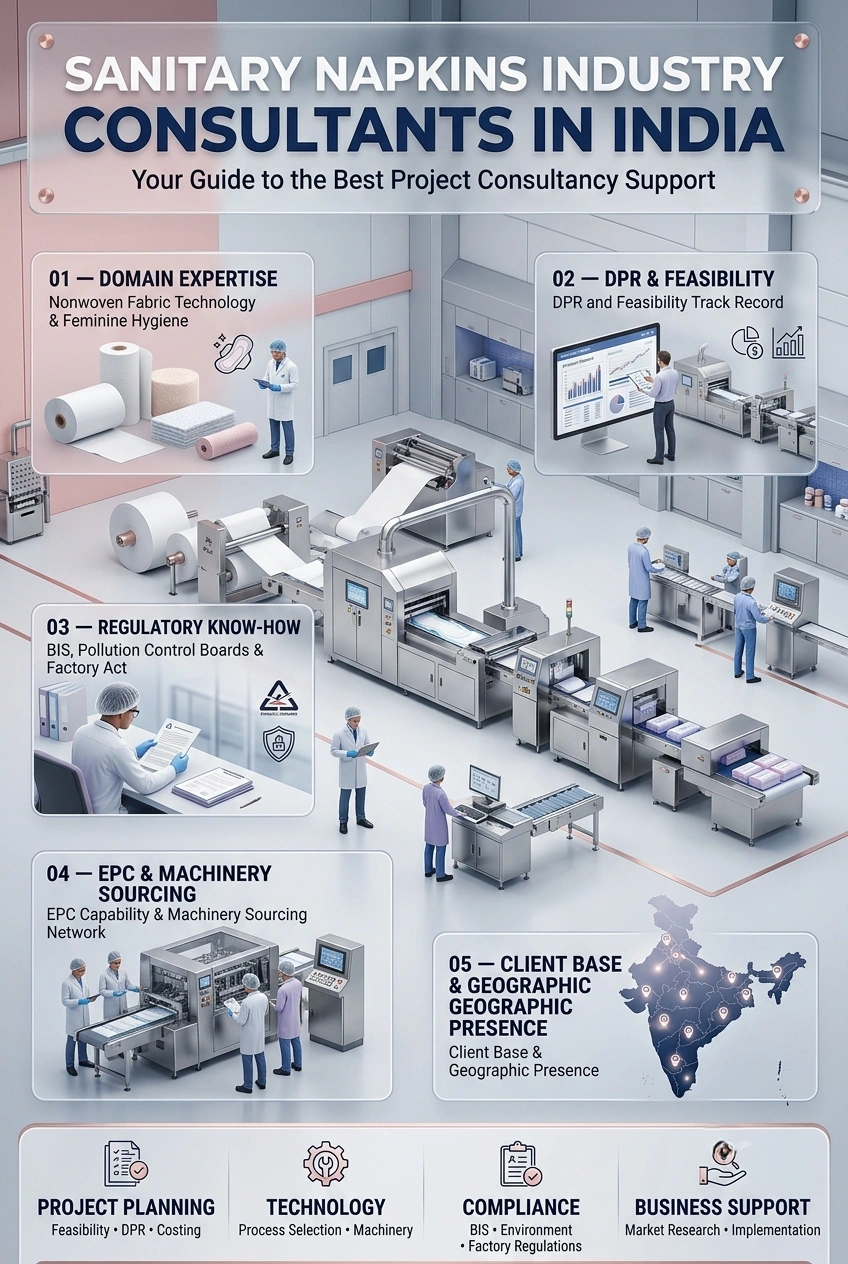
3. Regulatory Know-How — BIS, Pollution Control Boards, and Factory Act
Mandatory BIS Certified Sanitary Napkins in India as per IS 5405:2025 is a must for Sanitary Napkins Manufacturers. The ISI mark is a compulsory requirement for products that cannot enter the Indian market unless they carry the ISI mark. A qualified consultant must understand the BIS certification process, follow the specifications in IS 5405:2025, meet laboratory testing requirements, follow factory inspection norms, and prepare the documentation package for the license application. In addition to BIS, the consultant should help you obtain Pollution Control Board (PCB) consent for your plant size and number of employees, and Factory Act compliance.
4. EPC Capability and Machinery Sourcing Network
If you are a businessman who wishes to have assistance from the start to finish in performing the project, then you need consultant who is an EPC capable consultant. The top sanitary napkins plant consultants in India have established collaborations with both domestic manufacturers of low-speed sanitary napkins converting machines (for MSMEs) and global suppliers of high-speed fully automatic sanitary napkins line. This network directly influences your procurement cost, equipment quality and installation time of the machinery.
5. Client Base and Geographic Presence
The top sanitary napkins industry consultants in Delhi and other metros usually serve clients ranging from startups, NRI investors, the existing FMCG companies venturing into the field of sanitary napkins, and government related procurement firms. A consultant with this experience with their client will have a fuller picture to bring to the table when planning a project. Geographic presence is also a factor: a consultancy that is based in Delhi but has a national presence can understand the state-level factors affecting Pollution Control Board approvals, state MSME schemes and differences in the utility infrastructure.
Related Article: Biodegradable Personal Care Products: Diapers and Sanitary Napkins
Role of NPCS in Sanitary Napkins Project Consultancy
Niir Project Consultancy Services (NPCS) is one of the veteran names in industrial project consultancy services in India which has been supporting the entrepreneurs in sanitary napkins and feminine hygiene industry since more than 30 years. NPCS was founded in 1994 and has been based in Delhi since then → is part mein passive voice hai. Isko active structure mein kar sakte hain:
NPCS serves as a complete project consultancy service for sanitary napkins entrepreneurs. It is a collection of Detailed Project Reports for sanitary napkins manufacturing process which includes the entire manufacturing process from receiving of raw materials (fluff pulp, SAP, nonwoven fabric rolls, polythene film) to the converting line and finally to the packaging. Detailed description of manufacturing process, process flow diagram, plant layout, specifications of the machinery with supplier details, utility consumption, manpower requirement, complete financial modelling including project cost, working capital requirement, profitability analysis, return on investment projection.
The market research aspect of every DPR conducted by NPCS involves demand analysis for sanitary napkins in urban, semi-urban and rural areas, mapping of the competitive landscape, price analysis across tiers, and PMBJP and government health programme analysis of institutional procurement opportunities. This market intelligence layer will make the NPCS DPR truly valuable for not only financial institutions but also for entrepreneurs creating their go-to-market strategy.
Your investment deserves the right opportunity
For entrepreneurs who want to explore the full range of sanitary napkins and feminine hygiene project ideas — including baby diapers, adult diapers, panty liners, and menstrual hygiene products — NPCS maintains a dedicated project profiles catalog for this sector. This catalog allows project planners to compare multiple product formats, capacity levels, and investment scales before committing to a specific project configuration.
NPCS also has a realistic, on-the-ground understanding of the typical problem areas in the Indian consulting business that the company has encountered over its 30 years of operation: over-investment in equipment before securing distribution; underestimating BIS certification times; and lacking working capital for the initial raw material pipeline. Such practical learning is available from a seasoned consultancy that is not a desk research report machine.
Best Sanitary Napkins Industry Consultants in Delhi and the National Landscape
The disparity in the number of industrial consultancy and process plant expertise, government linkages and financial institutions is evident in the region of Delhi and NCR and hence it continues to be the natural centre for the top engineering consultants/or process plant consultants of India. The feminine hygiene products market is also dominated by North India with around 31% share of the national market, reflecting its modernity in the retail market and the higher female workforce participation rate in Delhi-NCR.
But the consulting business among sanitary napkins is a national business. There are also a good number of process engineering (PE) consultants and EPC consultants for FMCG and medical textile projects in Maharashtra, Gujarat, Tamil Nadu and Karnataka. Consultants will need to have experience in dealing with state Pollution Control Board requirements, and be familiar with the machinery available and how to be efficient in sourcing it in Tier 2 cities and state industrial areas.
Reference resources for project planning and investment intelligence include the Indian Brand Equity Foundation (IBEF) Textiles Sector page, the Invest India Consumer Healthcare portal, the Ministry of Textiles PLI scheme portal, the National Health Mission Menstrual Hygiene Scheme page, and the FICCI Women’s Healthcare Committee. Together, these sources provide a comprehensive view of the regulatory environment, government demand drivers, and investment opportunity landscape for any entrepreneur evaluating a sanitary napkins manufacturing project.
Sanitary Napkins Consulting Services: Types, Focus Areas, and Best-Fit Use Cases
| Service Type | Core Focus | Key Deliverables | Best-Fit Client |
| Techno-Economic Feasibility Study | Viability assessment of a proposed sanitary napkins plant | Market analysis, cost-benefit projection, break-even analysis, risk assessment | First-generation entrepreneur or investor evaluating project entry |
| Detailed Project Report (DPR) | Full project blueprint for financing and execution | Plant layout, machinery specs, raw material sourcing, financials, profitability model | MSME founders seeking bank loans, government scheme benefits, or investor funding |
| Process Engineering & Plant Design | Technical design of the sanitary napkins manufacturing line | Process flow diagrams, capacity planning, equipment selection, nonwoven fabric technology integration | Entrepreneurs setting up greenfield manufacturing units |
| EPC (Engineering, Procurement & Construction) Consultancy | End-to-end project execution from design to commissioning | Procurement support, contractor management, construction supervision, trial runs | Investors requiring turnkey project delivery with limited in-house technical team |
| Regulatory & Compliance Advisory | Ensuring BIS IS 5405:2025 certification, Factory Act, and Pollution Control Board compliance | Compliance roadmap, license applications, documentation support | New manufacturers unfamiliar with India’s mandatory BIS certification requirements |
| Market Research & Demand Analysis | Understanding consumer demand, pricing, and competitive landscape | Market sizing, channel analysis, competitor benchmarking, export opportunity assessment | Existing MSME units planning diversification or capacity expansion |
The table above illustrates that consulting needs vary significantly by project stage and client profile. A first-generation entrepreneur exploring project viability needs a feasibility study first. An MSME founder who has already committed to the project and needs bank financing requires a full DPR. An investor with capital but limited technical bandwidth needs EPC consultancy. Understanding where you are in this journey is the first step to finding the right consulting engagement.
Conclusion: Your Next Steps in Sanitary Napkins Project Consultancy
India’s sanitary napkins manufacturing sector offers one of the most structurally sound investment opportunities in the consumer health and FMCG space — large addressable demand, active government procurement support, rising consumer awareness, and a clear regulatory framework through mandatory BIS certification. For entrepreneurs entering this space, the quality of your consulting support will determine whether you enter the market with a well-capitalised, technically sound, compliant plant — or spend the first two years correcting avoidable mistakes.
Start by conducting a clear self-assessment: Where are you in your project journey? If you are in the exploration phase, a feasibility study from a credible sanitary napkins project consultant in India is your immediate next step. You have already identified your product and capacity, a Detailed Project Report is the document you need — both for internal planning and for bank financing. If you are ready to execute, look for an EPC-capable consultant or process engineering consultancy that can also manage your plant setup.
Use the criteria in this article to shortlist and engage the best sanitary napkins industry consultants in India for your specific project stage. Leverage government resources — the National Health Mission’s Menstrual Hygiene Scheme, the Ministry of MSME’s PMEGP portal, and the BIS product certification portal — to understand the compliance and incentive landscape before committing capital. And explore the range of sanitary napkins and feminine hygiene project profiles available through established consultancies to identify the specific product format and scale that matches your investment capacity and market ambition.
The demand is real, the policy support is in place, and the consulting ecosystem in India is mature enough to guide even a first-generation entrepreneur from project idea to commercial production. The right consultancy partner makes that journey significantly faster and considerably less risky.