
The synthetic rubber industry of India is undergoing a turning point in terms of demand. Tyre manufacturers are growing in a fast pace, EVs are gaining traction at a pace faster than expected, and environmental laws are driving the entire chemical value chain towards greener production methods. These forces are driving a structural change in the synthetic rubber production, consumption and trading pattern in India.
The Economic Times Chemicals recent report was a perfect snapshot of this turnaround, pinpointing the demand for synthetic rubber to be receiving a shot in the arm from the tyres, EVs and cleaner production technologies. This is not a cyclical increase. Constructive market change.
In the eyes of an entrepreneur, an MSME owner, an investor and every industrial startup founder, the transformation is one of the best manufacturing opportunities in India today. The window to enter, scale and grab a piece of market share is open, but it won’t last long.
Related Article: Rubber and Rubber Products Industry Consultants in India
What Recent Reporting Means for Business Builders
According to the Economic Times Chemicals report, three tailwinds are driving the synthetic rubber sector: skyrocketing tyre production, quick growth of EV fleet and a decisive shift towards greener, bio-based production.
The forces are independent of each other, but they support each other. Rubber producers are looking to make more rubber for larger, higher-performance tyres for the passenger car, commercial truck, and new EV markets. Higher quality, lower rolling resistance rubber compounds are needed for EVs, where there is continued high import reliance. Regulating environmental requirements also necessitates changes by producers to transition away from petroleum-derived feedstocks and towards partial bio-based and/or recycled rubber materials.
In practice, demand is increasing from various sources at once. The domestic production has not matched the demand. In India, the demand for speciality synthetic rubber grades is high and the country is currently dependent on imports of these grades to cater to the industry needs. The market opportunity is exactly this space between the demand and the local production, where new businesses can be established.
Entrepreneurs – tyre and rubber downstream supply chain looking for reliable domestic suppliers. Ancillary manufacturing of rubber products has received direct government support for MSMEs. For investors: The sector is eligible as per chemicals and petrochemicals PLI framework under consideration. For exporters: Indian rubber intermediates and finished rubber goods have increased in demand in Southeast Asia, Middle East and Africa.
Access Complete Business Plan: Rubber & Rubber Products Manufacturing
Why This Industry Is Growing
Tyre Sector Expansion
India produces the 3rd largest tyre in the world. MRF, Balkrishna Industries, Applao Apollo Tyres and CEAT are all implementing capacity expansion programmes as well. Upstream rubber compounding, rubber chemicals and speciality polymer feedstocks are needed for each new tyre plant. This is a demand that can be directly met by Indian MSMEs in the upstream value chain.
Electric Vehicle Fleet Rollout
India has pledged to make a “major leap” towards electrification of its vehicle fleet by 2030. Speciality rubber is used in the EV for battery seals, cable insulation, vibration dampening and high-performance rubber. The majority of this speciality rubber is imported, mainly from South Korea, Germany and China. The domestic production of EV-grade rubber compounds is yet in its infancy, indicating a huge market opportunity, and the initial players will establish quality standards.
Greener Production Push
With regulatory pressure from the Ministry of Environment, Forest and Climate Change (MoEFCC) and growing ESG considerations with global buyers, manufacturers are on a search for bio-based feedstocks, recycled rubber content, and cleaner manufacturing processes. The companies that invest in these technologies now will reap high prices from export markets and large Indian corporates with sustainability policies.
By 2028, synthetic rubber is expected to see growth in the global market, reaching nearly USD 39.5 billion, according to industry research, which valued the 2023 market at around USD 32 billion. Asia-Pacific is the fastest-growing region, accounting for approximately 50% of the growth in global demand over this period, with India and China being the key markets. These are not business-as-usual numbers; instead, orders, capacity expansion contracts, and documented government infrastructure programs back them.
Government Policies & Incentives
The Indian government has created an extensive support mechanism for the chemicals, rubber and automobile components industry. Some of the key programmes which relate directly to the synthetic rubber entrepreneurs and MSME are:
- The PLI Scheme by Ministry of Heavy Industries provides a production linked incentive of INR 25,938 crore for advanced technologies related to automobiles & auto components. Under this scheme rubber parts, tyre technology and sealing systems for vehicle electrification are eligible.
- The Department of Chemicals and Petrochemicals (DCPC) has indicated serious interest in the PLI benefits for the chemicals sector, which includes synthetic rubber precursors and downstream products.
- Invest India – Make in India Chemicals initiative is a proactive initiative by Invest India to promote the chemicals and rubber industry in India with a dedicated pipeline of chemical parks and industrial zones in various States like Gujarat, Rajasthan, Andhra Pradesh and Odisha.
- MSME Credit and Technology Support: Credit-linked capital subsidies of up to 15% on investments in eligible plant and machinery is available to the rubber compounding and processing units directly from the Ministry of MSME – Technology Upgradation.
- The Ministry of Commerce and Industry provides technology support, R&D assistance and export development programmes to rubber manufacturers through the Rubber Board of India (RBI).
- State level Chemical Parks: Gujarat has created Gujarat Industrial Development Corporation (GIDC) chemical clusters to provide plug and play facilities, common effluent treatment and logistics connectivity to synthetic rubber processing units.
- DPIIT Startup Recognition: Tax benefits of DPIIT Startup India Scheme (3 years), fast-track patent mechanism, access to Fund of Funds for Startups in specialty chemicals and rubber processing.
Get Detailed Insights from This Book: The Complete Book on Rubber Processing and Compounding Technology (4th Revised Edition)
- National Chemical Policy: The Department of Chemicals and Petrochemicals – National Chemical Policy aims to boost the Indian chemicals industry to USD 300 billion by 2025 and to USD 1 trillion by 2040, with special emphasis on synthetic rubber and speciality polymers.
- The ZED Certification Scheme – MSME Ministry: This is a scheme that gives financial support and rating certification for MSMEs which is becoming mandatory from tyre OEMs as well as export buyers for rubber suppliers.
Manufacturing Business Opportunities: Six Entry Points for Entrepreneurs
The below opportunities are directly sourced from the Economic Times Chemicals demand and validated with the existing market structure:
1. Styrene-Butadiene Rubber (SBR) Compounding Unit
SBR is the most widely consumed synthetic rubber in India, with tyre cord manufacturing and general rubber goods as primary end uses. Setting up a downstream SBR compounding unit — blending SBR with carbon black, processing oils, accelerators, and antioxidants — requires an investment of INR 1.5–3 crore for a small MSME-scale plant.
Why this opportunity emerges: as tyre companies expand capacity, they increasingly outsource rubber compounding to specialised vendors. This reduces their capital commitment and creates a stable demand pipeline for compounding MSMEs operating at 500–2,000 MT annual capacity.
2. Nitrile Butadiene Rubber (NBR) Processing Unit
NBR is the workhorse rubber for oil-resistant seals, gaskets, hoses, and O-rings used across automotive, industrial machinery, and hydraulics. Apcotex Industries — India’s only domestic NBR manufacturer — operates at 100% capacity utilisation with 70–75% of domestic NBR requirements still met through imports. This import dependency creates a direct opportunity for processing units that can convert NBR feedstock into finished rubber products for automotive OEMs and industrial buyers.
Investment range: INR 2–5 crore depending on automation level and product complexity. EBITDA margins for NBR finished products typically range from 14–20%.
3. Rubber Chemicals Manufacturing Unit
Accelerators (CBS, MBTS), antioxidants, vulcanising agents, and processing aids are the chemicals that transform raw rubber into usable elastomers. India imports a large share of these inputs from China. The Make in India push and geopolitical de-risking have created a policy-supported window for Indian MSMEs to establish domestic rubber chemicals production.
A unit producing 200–500 MT of rubber accelerators or antioxidants annually can serve 10–20 tyre and rubber goods manufacturers from a single production facility. Capital requirement: INR 3–8 crore. Export potential to Southeast Asia and the Middle East is immediately actionable.
Explore This Book: The Complete Book on Rubber Chemicals
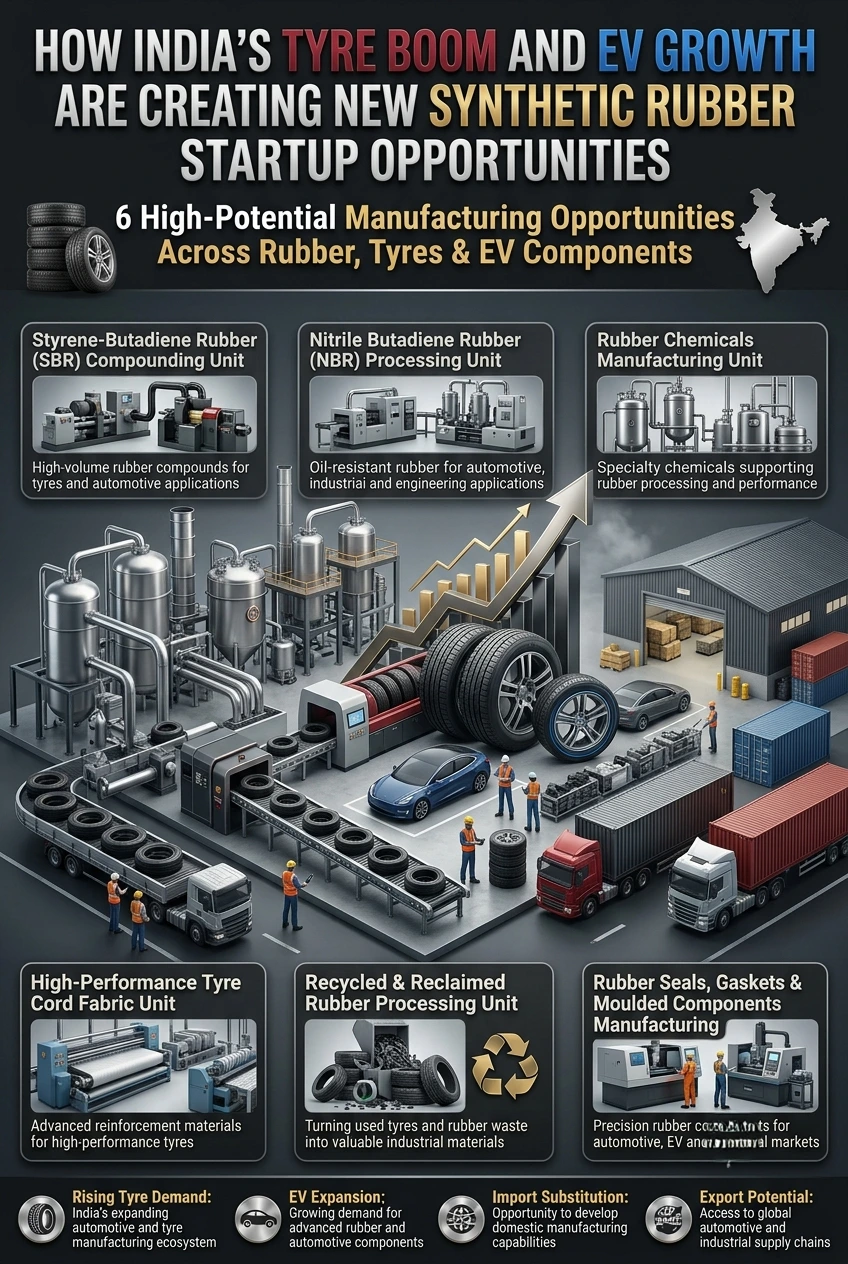
4. High-Performance Tyre Cord Fabric Unit
Tyre cord is a synthetic fabric — predominantly polyester or nylon — embedded in the rubber matrix of tyres to provide strength and dimensional stability. India produces tyre cord fabric, but demand from expanding tyre plants consistently outpaces supply. A tyre cord weaving and dipping unit represents a capital-intensive but high-margin entry into the tyre supply chain.
Investment range: INR 15–40 crore. This segment better suits industrial promoters with existing textile or polymer processing capabilities who want to enter the rubber supply chain.
5. Recycled and Reclaimed Rubber Processing Unit
The shift toward greener production, highlighted in the Economic Times Chemicals report, creates a direct commercial opening for recycled rubber processors. Devulcanised rubber and reclaimed rubber can substitute 15–30% of virgin synthetic rubber in many non-critical applications. India generates over 1.1 million tonnes of end-of-life tyres annually, representing a substantial raw material base.
A reclaimed rubber unit processing 1,000–3,000 MT annually requires INR 1–3 crore in capital and generates stable revenues from rubber goods manufacturers seeking cost reduction and sustainability compliance. This is the entry point most directly aligned with current environmental regulatory trends.
View Full Project Details: Reclaimed Rubber Manufacturing Project Report
6. Rubber Seals, Gaskets, and Moulded Components Manufacturing
The EV sector’s demand for high-quality rubber seals is growing rapidly. These seals protect battery enclosures, cable management systems, motor housings, and thermal management modules. They require precision moulding in clean rooms, with strict dimensional accuracy and documented quality systems. These requirements create barriers that protect margins without requiring enormous capital.
An MSME entering the EV or automotive sector with a well-equipped compression and injection moulding shop can target Tier-1 supplier qualification. An investment of INR 2–6 crore can support this setup. Tier-1 qualification can provide long-term pricing stability and repeat orders.
Import–Export Opportunity Analysis
Import Substitution
India currently imports speciality synthetic rubbers including EPDM (ethylene propylene diene monomer), polychloroprene (neoprene), and high-performance NBR grades. Total rubber imports contribute significantly to the chemicals trade deficit. Government policy actively incentivises domestic production of these grades, and tyre OEMs have signalled willingness to shift to domestic suppliers who can meet quality specifications.
Export Markets
Indian rubber goods manufacturers already export to the US, EU, Southeast Asia, and the Middle East. As domestic rubber chemicals and compound quality improves, the export addressable market expands. ASEAN countries — Thailand, Vietnam, Indonesia — are active importers of rubber chemicals and compounded rubber. The EU’s expanding sustainability procurement requirements favour Indian suppliers who can demonstrate lower-carbon production methods.
International Demand
The global synthetic rubber market is expected to grow at a CAGR of approximately 4.2–5.7% through 2027–2028. This growth translates into consistent annual demand increases in absolute tonnage terms. India’s competitive manufacturing costs and government trade promotion support provide a strong advantage. Existing buyer relationships in rubber goods also position Indian manufacturers to capture a growing share of global demand.
Indian MSME & Startup Success Stories
Apcotex Industries Limited
Apcotex is the clearest Indian success story in domestic synthetic rubber manufacturing. Founded in 1980 as a division of Asian Paints, the company was spun off in 1991. The Mumbai-headquartered company built a dominant position in Nitrile Rubber (NBR), High Styrene Rubber (HSR), and synthetic latex. Today, Apcotex is the only Indian manufacturer of NBR. It operates at 100% capacity utilisation and generates annual revenues exceeding INR 1,000 crore. Its journey from a chemical industry spinoff to a sector leader demonstrates the value of focused specialisation. This strategy has created durable competitive moats, even against global majors.
Rubfila International Limited
Kerala-based Rubfila International is a mid-sized manufacturer of high-quality rubber thread — a specialised synthetic and natural rubber product used in garments, medical bandages, and industrial applications. The company exports to over 30 countries and competes directly with Malaysian and Thai producers. Rubfila exemplifies how focused product specialisation within the broader rubber category can build a globally competitive MSME from an Indian base.
Precision Rubber Industries (Pune)
This Pune-based MSME manufactures precision moulded rubber components for automotive OEMs including Tata Motors, Mahindra, and international Tier-1 suppliers. The company entered with compression moulding for commercial vehicle door seals and expanded into injection-moulded components for passenger vehicles. Today it supplies rubber vibration isolation mounts and battery tray gaskets for EV platforms — a direct example of an MSME riding the EV rubber demand wave reported by Economic Times Chemicals.
Identify high-growth industries before others do
About Niir Project Consultancy Services (NPCS)
Niir Project Consultancy Services (NPCS) is one of India’s most respected industrial consultancy and project advisory firms. With decades of experience serving entrepreneurs, MSMEs, large industrial houses, and government bodies, NPCS provides end-to-end support for new manufacturing ventures in chemicals, rubber, plastics, and allied sectors.
NPCS services relevant to synthetic rubber entrepreneurs include:
- Detailed Project Reports (DPR): Techno-economic feasibility reports covering plant layout, machinery specifications, manpower requirements, capital cost estimates, working capital analysis, and profitability projections.
- Market Research: Primary and secondary research on demand patterns, import-export dynamics, competitive landscape, and pricing trends for synthetic rubber and downstream products.
- Technology Consultancy: Identification of appropriate process technologies, equipment vendors, and quality standards for SBR compounding, NBR processing, rubber chemicals, and recycled rubber units.
- Feasibility Studies: Independent assessment of commercial viability, ROI analysis, and risk evaluation for greenfield and brownfield rubber manufacturing projects.
- Bank Loan Assistance: Preparation of detailed project reports in formats accepted by nationalised banks, SFCs, and SIDBI for MSME loan applications.
For entrepreneurs considering entry into the synthetic rubber value chain, NPCS project reports provide a reliable starting point for investment decisions, bank loan applications, and government subsidy claims.
Industry Data Summary
<tr>MSME OpportunitySBR compounding, NBR processing, rubber chemicals, recycled rubber, moulded parts
| Parameter | Details |
| Industry | Synthetic Rubber Manufacturing & Processing |
| Market Driver | Tyre sector expansion, EV fleet growth, greener production mandates |
| Investment Range (MSME) | INR 1 crore (reclaimed rubber) to INR 40 crore (tyre cord fabric) |
| Export Potential | ASEAN, Middle East, EU, USA – rubber chemicals, latex, rubber goods |
| Government Support | PLI Automotive, PLI Chemicals (proposed), MSME CLCSS, Rubber Board India, ZED Scheme |
| Risk Level | Medium – raw material (petrochemical) price volatility; mitigated by long-term tyre OEM contracts |
| Growth Outlook | Strong – global market CAGR ~4.2–5.7%; India domestic demand growing faster than supply |
Conclusion: Act Now — The Rubber Market Window Is Open
India’s synthetic rubber sector is at a genuine inflection point. Demand is rising from three directions simultaneously: expanding tyre production, EV fleet growth, and sustainability-driven demand for greener rubber inputs. Domestic supply has not kept pace. Import dependence remains high across multiple synthetic rubber grades and downstream products.
As Economic Times Chemicals reported, this demand lift is structural, not cyclical. The tyre sector’s capacity expansion is committed capital. The EV fleet targets are government-mandated. The sustainability requirements are contractually embedded in global supply chains.
For Indian entrepreneurs and MSME founders, this means the market is already moving in your favour. The question is not whether to enter — it is which segment to enter, at what scale, and with what product focus.
Six clear manufacturing opportunities exist today: SBR compounding, NBR processing, rubber chemicals production, tyre cord fabric manufacturing, recycled rubber processing, and EV-grade moulded rubber components. Each suits a different capital base and technical capability profile.
Government policy support — from the Rubber Board to PLI frameworks to MSME credit subsidies — has never been more comprehensive. International demand from ASEAN, the Middle East, and the EU adds export upside to a strong domestic demand story.