
NRI Investment in Indian Manufacturing
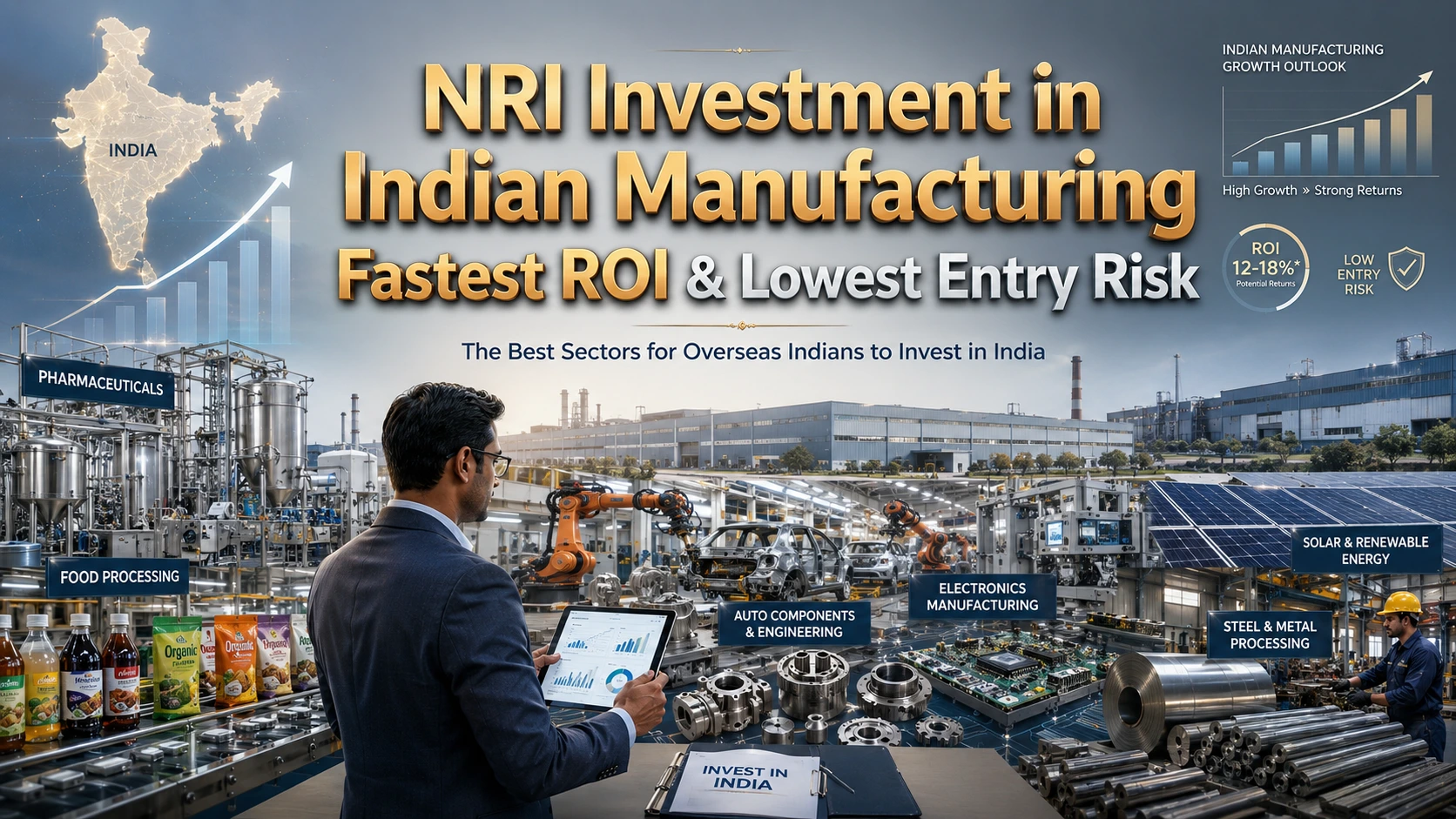
The Indian manufacturing industry is in a turning point. It is one such moment that has caught the attention of seasoned investors, including Non-Resident Indians, with government-backed industrial policy, a young workforce, growing domestic consumption and diversification in the global supply chain away from China. NRIs get certain benefits from investing in Indian manufacturing: Currency appreciation benefits on the returns in INR, personal connection to Indian market which helps overcome information asymmetry and emotional satisfaction of supporting the industrial development of India. The concept of these business ideas is across sectors which have short ROI due to policy support, robust domestic demand and exportability, which are important factors for NRIs to consider while assessing manufacturing avenues in India.
Why Indian Manufacturing Is Attracting NRI Capital
The macro story is interesting. Indian manufacturing is expanding from time to time. The government’s PLI schemes are channelling billions of dollars into particular industries. Global supply chains are shifting towards India due to the China-plus-one principle. Against this backdrop, the rupee has appreciated against the global currencies which makes the investment of NRI in the Indian Rupee denomination immediate cost advantage over the domestic investors. The micro story is even more interesting than the macro. In a few industries, the manufacturing MSMEs in India are very undercapitalised compared to the market opportunity.
NRI capital – patient, strategic and volume-appropriate – can finance just that kind of scale up that transforms a family business with a turnover of ₹ 2 crore to one with a turnover of ₹ 20 crore, with export operations in 3 to 5 years. India’s manufacturing value added is projected to rise substantially in coming decade, says World Bank India Economic Monitor (IEM) due to policy and demographic tailwinds.
Government Policy Incentives for NRI Investors in Manufacturing
The framework of regulation for NRI investment in manufacturing in India is one of the most liberal in the world. Under the Foreign Exchange Management Act (FEMA), NRIs are allowed to invest in manufacturing businesses on a repatriation basis through NRE account. There are no restrictions on the repatriation of profits and/or capital, provided that taxes are paid. The Reserve Bank of India has given clear guidelines regarding investment by NRIs through automatic and approval route. Invest India investment facilitation desk offers investment introductions, regulatory support and sector-specific guidance to NRI investors, as well as introductions to industries across various states.
Priority manufacturing sectors with the best policy support, where NRI capital can generate the highest risk-adjusted returns, have been highlighted in the DPIIT’s Make in India sectoral opportunities guide. IBEF’s investment intelligence reports offer ROI information by sector, project market size and analysis of the competitive landscape for manufacturing industries.
6 Manufacturing Sectors With Fastest ROI for NRI Investors
1. Pharmaceutical and Nutraceutical Manufacturing
India is the world’s pharmacy to the developing countries, which includes generic medicines to more than 150 countries. Pharma industry provides NRIs an opportunity to participate in a business which is globally proven and has high margins, export orientation. The manufacturing of generic drugs, production of active pharmaceutical ingredient (API) and the fast-growing nutraceutical manufacturing industry (vitamins, minerals, protein supplement, herbal extract etc.) all have the potential of achieving rapid return on investment (ROI) as compared to most manufacturing industries because of high price realisation, relatively low dependency on raw materials (as imported), and regular and predictable demand driven by regulatory requirements.
There is a definite policy push in favour of domestic API manufacturing under PLI scheme of pharmaceuticals (creating further margin improvement for API producers). For NRI investors, the nutraceutical segment is especially interesting, as the global trend with health supplements is a reflection of the trend amongst NRI communities – whereby the need for these products creates natural export channels through the NRI community.
Access Complete Business Plan: Pharmaceutical, Drugs & Fine Chemicals Handbook
2. Food Processing and Ethnic Food Manufacturing
Processed food manufacturing is one such sector where the NRI investors have advantage of capital and market intelligence which are lacking for the domestic investors. It is the only competitive advantage that a company can have if it understands what members of the Indian diaspora want to purchase (and won’t find locally in their countries of residence). International markets are systematically under-supplied with Indian ethnic foods, traditional snacks, ready-to-cook food kits and authentic regional condiments. Authenticity, personal knowledge of the demand of the NRI community, and personal distribution network are key areas where an NRI can capitalize on a food processing and export business in India, which domestic investor can easily emulate.
Export support programmes offered by APEDA offer financial support for export packaging, certification and market development in the international market. ROI can be achieved in the export-oriented food processing businesses in a relatively shorter period as compared to food processing businesses which process food for home consumption.
Read the Complete Book Here: Handbook on Fruits, Vegetables & Food Processing with Canning & Preservation
3. Textile and Technical Textile Manufacturing
Related Article: Top 3 Textile Manufacturing Business Opportunities Backed by PLI Scheme
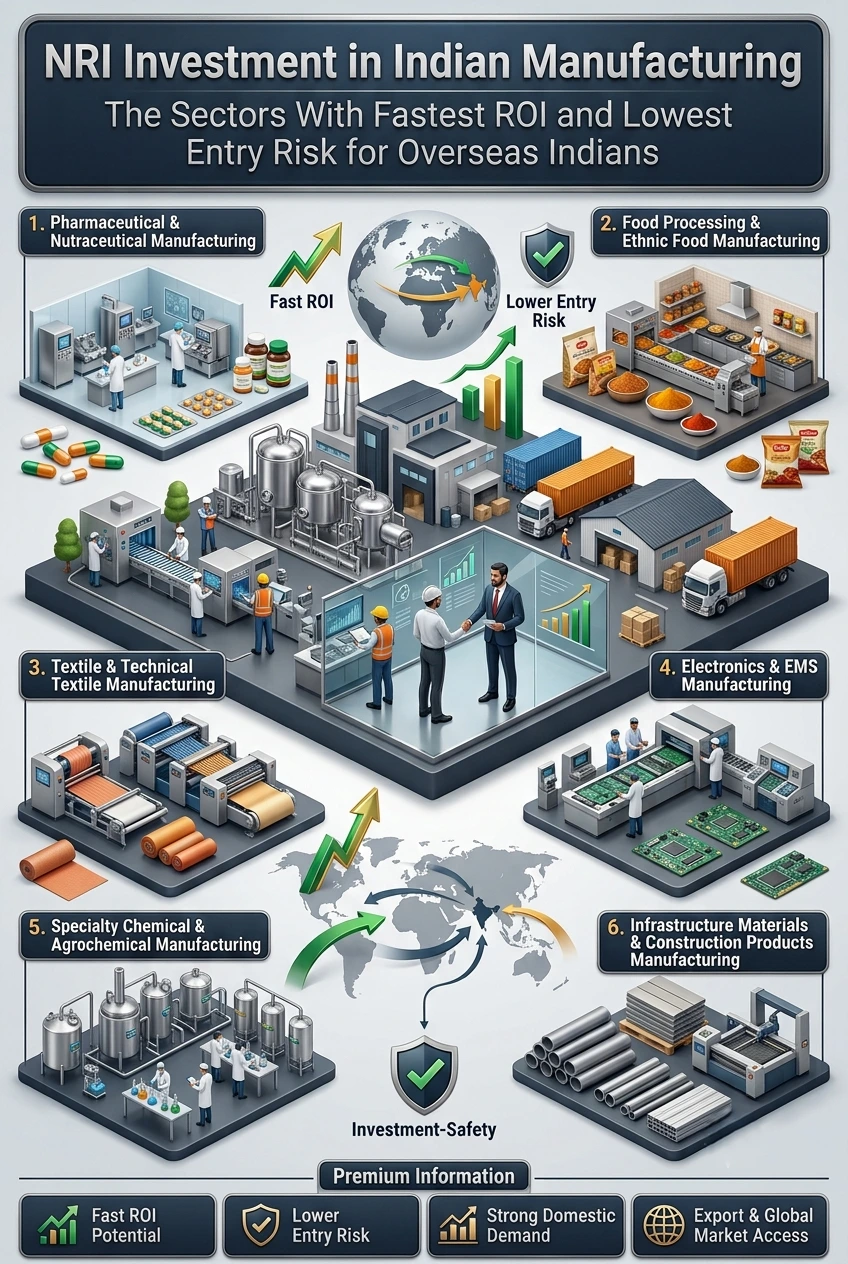
4. Electronics and EMS Manufacturing
The investment in a technically strong and ready-to-service the international customers from India is a high ROI option in India. Its one of the fastest growing sectors in Indian manufacturing due to the advantage of labour cost, PLI incentive, and increase in volumes of assembling of smartphones and IoT. According to electronics sector data from IBEF, the electronics’ sector is expected to grow significantly in India, with more and more electronics manufacturing being done domestically.
View Full Project Details: Electrical, Electronics and Power Project Opportunities
5. Specialty Chemical and Agrochemical Manufacturing
Specialty chemicals command price premiums and margins that commodity manufacturing cannot match. India’s chemical manufacturing base is strong — the country is already a global leader in generic agrochemical active ingredients and pharmaceutical intermediates. NRI investors, particularly those with chemistry backgrounds or experience in chemical trading in international markets, can identify specific chemical products that India imports in large volumes and invest in domestic manufacturing capacity to substitute those imports. The return on investment is accelerated by the import substitution premium — manufactured products that replace imports immediately find buyers among existing importers. Agrochemical manufacturing for export, particularly to Africa, Southeast Asia, and Latin America, also offers NRI investors strong dollar-denominated revenue streams that hedge currency risk naturally.
Explore This Book: Agrochemicals Manufacturing Technology Book
6. Infrastructure Materials and Construction Products Manufacturing
India’s infrastructure spending — roads, railways, metro, housing, and water supply — creates enormous demand for construction materials: TMT bars, cement additives, tiles, sanitary ware, wiring accessories, PVC pipes, and insulation materials. These are not glamorous manufacturing segments, but they are extremely high-volume, domestically driven, and recession-resistant relative to export-dependent manufacturing. NRI investors looking for capital-preservation-first ROI profiles should consider infrastructure materials manufacturing — where demand is virtually guaranteed by government capital expenditure plans. Returns are predictable, market entry is straightforward, and the path to profitability is well-documented in the MSME sector. Invest India’s infrastructure sector data confirms the scale of opportunity in infrastructure-linked manufacturing.
Get Detailed Insights from This Book: The Complete Book on Construction Materials
Import–Export Opportunity for NRI Manufacturing Investors
The most powerful advantage an NRI manufacturing investor has over a domestic investor is export market access. An NRI based in the UAE, USA, or UK has personal knowledge of pricing, buyer behaviour, regulatory requirements, and distribution channels in their country of residence. This knowledge — combined with Indian manufacturing cost advantages — creates a natural arbitrage opportunity. Processed foods, pharmaceuticals, textiles, chemicals, and electronics all have large import markets in countries with significant Indian diaspora populations. NRI investors who build India-based manufacturing with an export-first orientation capture both the low-cost manufacturing advantage and the high-margin export pricing premium — a combination that dramatically accelerates ROI.
Indian MSME Success Stories Backed by NRI Investment
Dr. Reddy’s Laboratories, now a global pharmaceutical giant, received early international capital and technical collaborations that helped it scale from a small API manufacturer to a global generics leader. The NRI and foreign institutional investment model in Indian pharma has consistently outperformed. Mahindra’s Farm Equipment sector received strategic NRI and overseas Indian community investment through diaspora bond instruments to expand its manufacturing capacity — demonstrating how manufacturing growth and NRI capital can be productively combined. Cipla’s founder’s philosophy of affordable generic medicines for the world was partly enabled by international funding relationships and cross-border pharmaceutical partnerships — a model that NRI investors can replicate in smaller form through targeted investments in Indian specialty pharma manufacturing.
Smart entrepreneurs start here—find your perfect venture
How NPCS Supports NRI Investors in Indian Manufacturing
We at Niir Project Consultancy Services (NPCS) provide professional consulting for the preparation of Market Survey cum Detailed Techno-Economic Feasibility Reports (DPRs) for setting up new industries or businesses. Our reports include detailed manufacturing processes, market research and demand analysis, process flow diagrams, product mix and capacity planning, machinery and raw material details, and complete project financials with profitability analysis. Our objective is to help entrepreneurs evaluate feasibility, profitability, and long-term scalability before investing. For NRI investors evaluating manufacturing opportunities from overseas, our DPRs provide the due diligence foundation needed to invest with confidence without requiring physical presence during the evaluation phase.
NRI Manufacturing Investment — Sector ROI Comparison
| Sector | Expected ROI Timeline | Export Potential | PLI Support | Risk Level |
| Pharma & Nutraceuticals | 3–5 years | Very High | Yes | Moderate |
| Food Processing (Export) | 2–4 years | Very High | Yes | Low-Moderate |
| Technical Textiles | 3–5 years | High | Yes | Moderate |
| Electronics/EMS | 3–6 years | Very High | Yes | Moderate-High |
| Specialty Chemicals | 2–4 years | High | Partial | Moderate |
| Infrastructure Materials | 3–5 years | Low-Moderate | No | Low |
Conclusion — India’s Manufacturing Rise Is an NRI Investor’s Opportunity
India is building the manufacturing base of the next three decades right now. The policy environment, the demographic dividend, the export market expansion, and the domestic consumption growth are all pointing in one direction. For NRIs who understand Indian culture, speak the language, have family networks across India’s industrial cities, and hold capital in strong global currencies, this is not merely an investment opportunity — it is a natural advantage. The six manufacturing sectors covered in this article all offer faster-than-average ROI timelines, active government support, and genuine export market relevance. Choose the sector that aligns with your expertise, your network, and your capital capacity. Commission a proper feasibility study. Structure the investment correctly. And build a manufacturing business that contributes to India’s industrial story — and generates real returns for your portfolio.