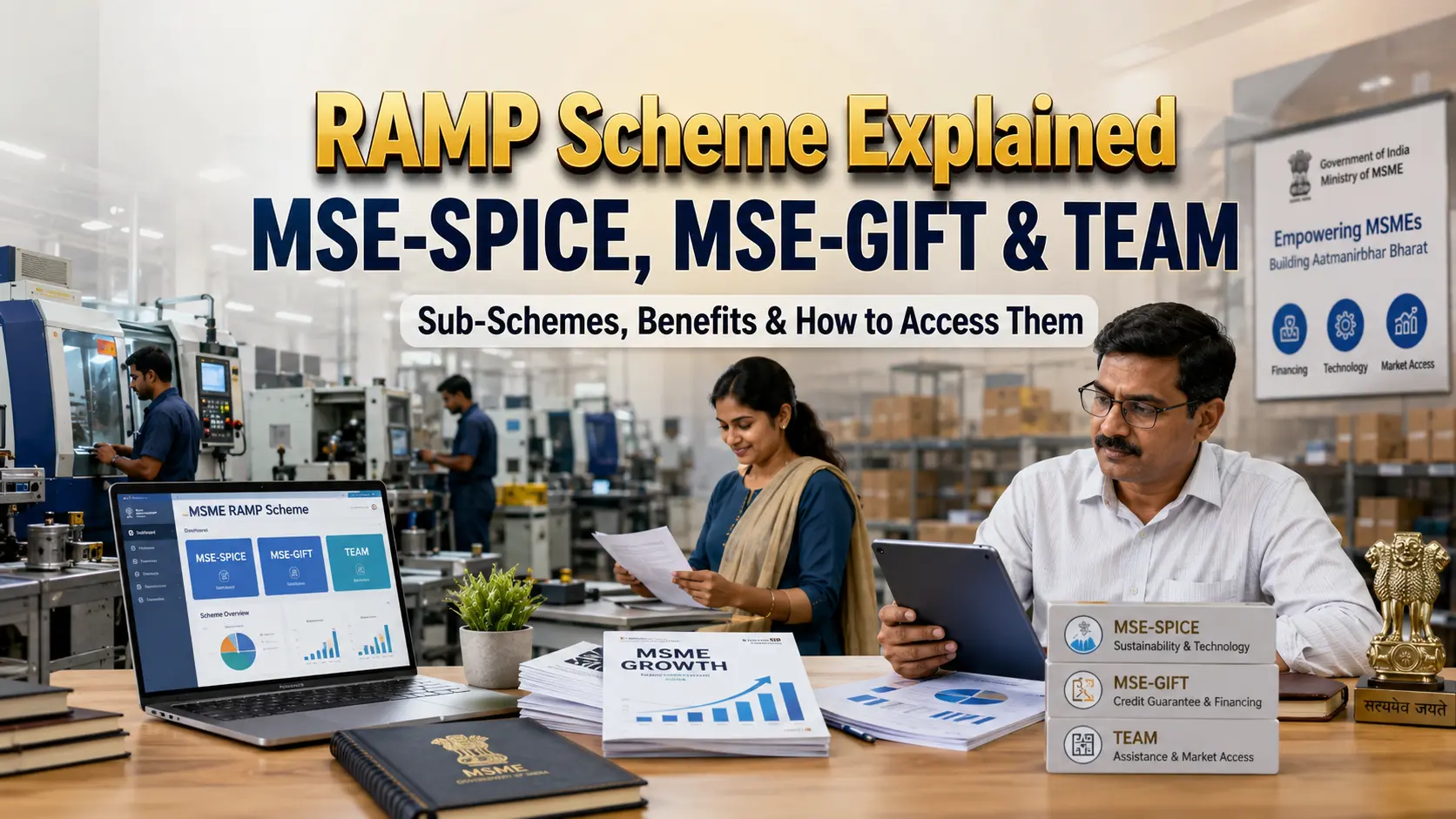

Each year thousands of small manufacturers come through our doors at NPCS with the same question: Where is the government money and how can I access some of it? Most of the business ideas in India fail not because there is no demand for the product but it is due to the lack of a simple thing that is a small loan, a market linkage, a working capital cushion that puts a good product to work. The RAMP scheme, which stands for Raising and Accelerating MSME Performance, was created just for that reason. It now has three sub schemes that are important for a working entrepreneur – MSE-SPICE for projects associated with circular economy, MSE-GIFT for green manufacturing and TEAM for digital market access. Once you develop the concept of how these three fits together, it can shift the way you plan your next unit.
Why the RAMP Scheme Matters for MSME Business Ideas Right Now
The MSME sector is already burdening India’s economy. It accounts for nearly 29% of GDP, approximately 36% of Manufacturing GDP, and approximately 44% of national exports. But the majority of this production continues to be from under-equipped units. A promoter who has an effective process and powerful market is easily paralysed at the point of looking for machinery financing without collateral.
RAMP is a Central Sector Scheme designed by the Ministry of Micro, Small and Medium Enterprises to fix this very problem, which was assisted by the World Bank. It will continue till FY 2026-27, with an outlay of more than ₹6,062 crore, and instead of giving one-time grants, it will work on strengthening the systems involving the MSMEs — credit guarantees, technology adoption, market access, payment resolution, etc. This is what makes RAMP-linked schemes more lasting than regular subsidies announcements.
As a first-generation entrepreneur, this is a good time to be considering new business ideas. Three sub-schemes are running and taking applications, and the digital commerce push, ONDC, is still on early adoption curve and green manufacturing incentives are not this high. Typically, it will be a more competitive and less subsidized market after 2 or 3 years.
Government Policies and Incentives Under the RAMP Umbrella
RAMP is not a single scheme with a single form to complete. It is an umbrella programme and each sub-scheme has its own implementing agency, eligibility rules and application portal. A knock on the right door equals months of confusion.
MSE-GIFT: Green Investment and Financing for Transformation
The MSE GIFT Scheme drives the small units towards clean technology by reducing the cost of green loans. Interest subvention up to 2% per annum on term loans for ₹2 crore is provided for enterprises that switch to solar energy, energy efficient machines or effluent treatment or similar clean processes. The scheme involves the outlay of approximately ₹478 crore, comprising interest subvention, risk sharing fund and awareness activities. It is implemented by SIDBI and applications are usually handled by the banks and NBFCs that are empanelled with SIDBI and not through the government portal.
MSE-SPICE: Scheme for Promotion and Investment in Circular Economy
MSE SPICE is the first dedicated effort by the government for circular economy projects including recycling units, waste-to-resource plants, and remanufacturing lines. Units will be eligible for a credit-linked capital subsidy that will be sourced from an overall expenditure of about ₹472.5 crore over the period 2026-27. This is one of the few schemes in which a scrap-processing or recycling business idea is eligible for direct capital support instead of just a loan. SIDBI is yet the implementing agency and detailed eligibility is available on the MSME RAMP Portal.
MSME-TEAM: Trade Enablement and Marketing Initiative
Whereas TEAM addresses the problem of market access, the other one looks at the problem of price control. It connects micro and small businesses directly to the Open Network for Digital Commerce (ONDC), providing them with an instant online storefront, payment options and logistics integration, without needing to create their own e-commerce from the ground up. The scheme will be implemented during FY 2024-25 to FY 2026-27 and will have an outlay of ₹277.35 crore to benefit 5,00,000 MSEs with 50% of the slots allocated to women entrepreneurs. Onboarding is done via Seller Network Participants and the level of support is limited per catalogue entry; e.g., support for creating digital catalogues is limited to near ₹2,500 per enterprise. The implementing agency is National Small Industries Corporation (NSIC) and the registration is done via the dedicated TEAM portal.
Other Support Layers Worth Knowing
There are two additional components that complete the RAMP ecosystem. First, RAMP (or GIFT + SPICE) boosts the credit guarantee structure of CGTMSE, which is widely recognized as one of the best collateral-free credit guarantee structures in the world. First, RAMP enhances the framework of CGTMSE, which is one of the most widely recognized collateral-free credit guarantee structures in the world. Second, an MSE Online Dispute Resolution (ODR) facility is designed to expedite delayed payment disputes through the use of AI-assisted tools, a critical feature for small suppliers languishing while waiting for big buyers. Both are not funding schemes; they both help to diminish the risk of a small manufacturing unit.
Multiple Business Ideas You Can Build Around RAMP
The actual value of RAMP is not the paperwork; it’s the group of business ideas that it makes possible quietly. Let’s write about the project categories in which the sub-schemes represent a real cost or market benefit.
1. E-Waste and Battery Recycling Unit (MSE-SPICE)
India produces an increasing amount of e-waste and lithium battery waste annually, but recycling facilities cannot match the volume. The unit breaks down, separates, and recovers metals from used electronics and EV batteries. It also fits well into the circular economy agenda that MSE-SPICE was designed to support. The scheme provides a credit-linked capital subsidy instead of just a loan. This significantly reduces the effective project cost for the promoter compared with conventional bank financing. Plus, this business concept has another advantage. Extended Producer Responsibility laws now require electronic and battery manufacturers to send their waste to certified recyclers. Therefore, you are not building a demand base from scratch. Instead, the regulations are already helping create one for you.
Get Detailed Insights from This Book: The Complete Technology Book on E-Waste Recycling
2. Solar-Powered Food Processing or Cold Storage Unit (MSE-GIFT)
Small food processors and cold-chain operators operate on slim margins; and power is the second largest expense after product cost. A unit which has been established based on solar power generation, energy efficient refrigeration or drying using biogas is eligible for the interest subvention under the GIFT component of the term loan for the installation of this equipment. When the 2% subvention on machinery financing is coupled with the reduced recurring power bill, it makes a significant difference in the effective cost of capital over the 5–7-year term of the loan. This combination – lower financing and lower running cost – often makes the difference between success and failure of a cold storage project for the entrepreneur in agri-belts where produce spoilage is an actual problem, in year three or five.
View Full Project Details: Renewable Energy & Green Power Guide
3. Plastic Waste to Granules or Construction Material (MSE-SPICE)
While municipal plastic waste segregation has improved, downstream processing capacity remains limited. This includes converting collected plastic into usable granules, paver blocks, or road construction aggregates in most tier-2 and tier-3 towns. The scheme is a natural fit for MSE-SPICE because it focuses on projects that reduce environmental impact and improve resource efficiency. The subsidised component is incorporated into the financial model during the bank appraisal stage. Promoters can use it to set up a shredding and granulation line. They can also establish a unit that converts multi-layer plastic waste into construction blocks through SIDBI-linked lenders.
Related Article: Start a Plastic Waste Recycling Unit and Build a Sustainable, Eco-Friendly Future
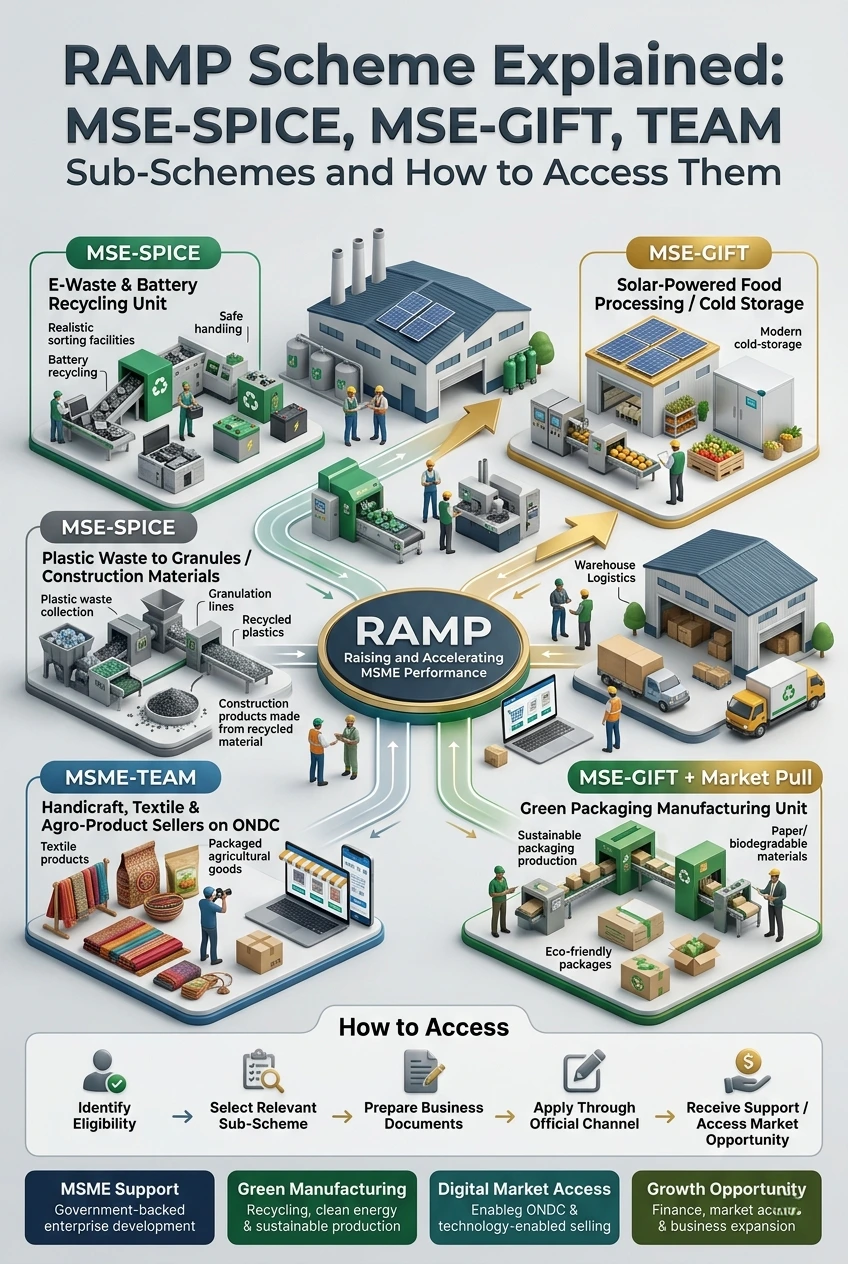
4. Handicraft, Textile, or Agro-Product Seller on ONDC (MSME-TEAM)
Not all RAMP related business concepts require new equipment.
Explore This Book: The Complete Technology Book on Textile Spinning, Weaving, Finishing and Printing
5. Green Packaging Manufacturing Unit (MSE-GIFT + Market Pull)
As the ban on single-use plastics gets stricter across states, compostable and recycled-content packaging is shifting from preference to requirement. If the manufacturing process qualifies as clean technology, companies producing biodegradable packaging, moulded fibre trays, or recycled paper packaging can benefit from GIFT’s interest subvention. At the same time, they can tap into a fast-growing, compliance-driven market. This combination of lower financing costs and regulation-driven demand is rare. Therefore, it deserves serious consideration in any techno-economic feasibility study of the packaging industry.
Get Detailed Project Report (DPR): Bioplastics and Compostable Packaging
Import-Export Opportunity Analysis for RAMP-Linked Business Ideas
It’s in trade potential where these three sub-schemes complement one another and not work in isolation. Metal for recycled units under SPICE schemes is directly utilized by downstream industries that export products and need recycled content. These include automotive component suppliers and consumer electronics manufacturers. Global buyers increasingly pressure them to meet sustainability requirements. Likewise, Indian exporters with green certification under GIFT can gain an advantage in markets adopting carbon border adjustment rules. This is especially relevant to the EU market.
From the import side, a number of circular economy business concepts lessen the toll on virgin raw material imports into India. For example, a domestic battery-recycling unit reduces the need for imported lithium, cobalt and nickel compounds to make new batteries. It’s not just a minor matter for policy makers, though: As more and more EVs appear on the roadway, battery material that’s been recycled is projected to be a strategic input, not a waste-management afterthought, and the heavy adopters in this category will reap the rewards of their early efforts more than others.
Meanwhile, TEAM enabled sellers get indirect exposure in the export market as well. A small manufacturer that has established a regular digital sales history on ONDC can leverage on the data to secure more financing for their businesses, ranging from working capital loans to financing export orders. Basically, what is good for exports today, is good for credibility tomorrow.
Indian MSME Success Stories: Lessons for New Entrepreneurs
Access to scheme is important but execution discipline has created the success stories of India’s small businesses. There are three examples to be studied.
Karsanbhai Patel, Nirma
Starting from selling detergent powder door to door from his bicycle, Patel was a manufacturer and seller that was keen on providing his products cheaper than the market leader. His simple decision logic was to keep the process low cost, keep the price down, and let volume do the rest. Later, Nirma’s expanded into a business that is in competition with multinational giants. The lesson for all who consider a business idea linked to a RAMP is that a subsidy can help make your business costs easier, but the business itself must be viable without the subsidy.
CavinKare founder C. K. Ranganathan, CavinKare
CavinKare was based on the idea of the sachet-pack which sold shampoos in small, affordable quantities to rural consumers who were unable to afford a full bottle. It was that one packaging choice that put in place a market segment that had been left untouched. For TEAM linked sellers: it is a good reminder that the innovation that unlocks a market may not be the product itself, but how you package and distribute it so that it is within your buyer’s actual buying power.
Nitin Gupta, Founder of Attero Recycling
Gupta co-founded Attero to give a formal structure to e-waste and battery recycling in India. At the time, the sector remained informal and almost invisible. The company developed proprietary recovery technology and became one of India’s leading electronics and battery recyclers. This growth came even before circular economy funding emerged in its current form. His journey shows what an entrepreneur with an MSE attachment can achieve. Over the past decade, he built the business with subsidy support that did not exist a decade ago.
Smart entrepreneurs start here—find your perfect venture
About NPCS: Turning Business Ideas Into Bankable Project Reports
At Niir Project Consultancy Services (NPCS), we prepare Market Survey cum Detailed Techno-Economic Feasibility Reports for entrepreneurs setting up new industries or businesses, including projects designed to align with schemes like RAMP, MSE-SPICE, and MSE-GIFT. Our reports cover the manufacturing process in detail, market research and demand analysis, process flow diagrams, product mix and capacity planning, machinery and raw material specifications, and complete project financials with profitability analysis. The objective is straightforward: help a promoter walk into a bank or SIDBI-linked lender with a report that answers the appraisal team’s questions before they even ask them, so the scheme-linked financing conversation moves faster.
RAMP Sub-Schemes at a Glance: Data Table
| Sub-Scheme | Focus Area | Implementing Agency | Key Benefit | Outlay |
| MSE-GIFT | Green technology adoption | SIDBI | 2% p.a. interest subvention on term loans up to ₹2 crore | ₹478 crore |
| MSE-SPICE | Circular economy projects | SIDBI | Credit-linked capital subsidy for recycling / resource-efficient units | ₹472.5 crore |
| MSME-TEAM | Digital market access via ONDC | NSIC | Catalogue, onboarding and logistics support on ONDC | ₹277.35 crore |
| MSE-ODR | Delayed payment resolution | NIC Services Inc. | AI-assisted dispute resolution platform | Part of RAMP outlay |
State-Level Access Points for RAMP-Linked Schemes
RAMP works at the Centre-State intersection, and several states publish their own MSME facilitation portals that help with Udyam registration, DIC referrals, and scheme awareness. Useful starting points include the Maharashtra Directorate of Industries (MAITRI) portal, the Tamil Nadu Department of Industries and Commerce, and the Gujarat Industries Commissionerate. Additionally, industry bodies such as FICCI regularly run awareness workshops on RAMP sub-schemes for their MSME members.
The Bottom Line
RAMP does not hand out easy money, and its designers never intended it to. What it does is lower the effective cost and risk of starting the right kind of business — green, circular, or digitally market-linked. Each direction is becoming a policy priority rather than a passing trend. Therefore, For an entrepreneur still deciding between business ideas, that is a meaningful signal. Moreover, The scheme rewards projects that were already sound, and it does very little for those that were not. Before applying to any RAMP sub-scheme, it is worth getting the underlying project report right first, because that document, more than any application form, decides whether the financing conversation goes anywhere.