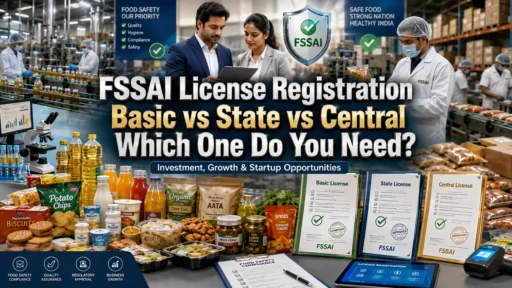


FSSAI License Registration
Setting Up a Food Business Starts with One Decision
For every food business start-up idea taker in India, there is one common hurdle – which FSSAI license does fit into their idea? Miss the classification, and you run the risk of paying for compliance that is not necessary or worse, you are not compliant with the cover you are legally entitled to. Both errors are costly.
It was the Food Safety and Standards Authority of India who recently updated the turnover thresholds determining this option and which really benefit the small operators. The application and category check process has been completely streamlined through the new FoSCoS system as opposed to the previous FLRS system. A street vendor, who previously had to register for a State License, is now able to operate under Basic Registration. A mid-sized manufacturer, which was worried about Central compliance, can now rest easy in the State band.A medium-sized manufacturer, who was concerned about Central compliance, can now relax in the State band. This article explains the three categories, the paperwork involved, the support offered by the government, and where the actual opportunity is available for new entrepreneurs.
View Full Project Details: Complete Guide to Food Processing Projects
Why the Food Processing Sector Deserves Your Attention Now
India’s packaged food and food-processing industry is on trend to grow at a faster pace than most manufacturing categories and the reasons are structural, and not seasonal. Even though they cook most of their meals, urban households are increasingly purchasing processed, ready-to-cook and branded essentials. It is also rural incomes are picking up and now, even small towns that didn’t have organised supplies before are now going for hygienically packed grains, spices and snacks.
There’s another layer of export demand. Indian spices, millet products, marine food and processed fruit pulp already have an established market in the Middle East, Africa and South East Asian region. FSSAI is not just about securing domestic contracts, it’s about winning a seat at the table of serious export projects for which global buyers demand traceable, certified sourcing.
Margins in this sector are in favour of operators who keep quality under control early on. With good storage, labelling and batch records from the start, it doesn’t need to face rework and recall costs down the road that cost profits. The first step in that discipline is selecting the right type of license, and making the compliance a part of the business plan, rather than an afterthought.
This change is closely monitored by industry bodies. According to both the FICCI and CII reports in the sector, food processing is one of the few manufacturing segments which has the entrepreneurs’ favor at the raw material, labour cost and export logistics end.
Government Policies and Incentives Supporting Food Entrepreneurs
Increasingly, new food businesses are not aware of the level of support that exists for them once they enter the formal Food Business Operator Register. New food businesses often are not aware of the extent of financial support that can be provided for them when they enter the formal Food Business Operator Register. The DPIIT also facilitates startup-recognition benefits that food-tech and processing units can be availed along with sector-specific benefits. Combination of these schemes with the appropriate FSSAI category can help you significantly reduce the cost of your project.
PM Formalisation of Micro Food Processing Enterprises (PMFME)
The scheme was launched by Ministry of Food Processing Industries with a credit linked capital subsidy of 35% for a maximum of ₹10 lakh for micro units, SHG, FPOs and cooperatives. It’s a One District One Product model, meaning that applicants do not have to guess which product to support.
Production Linked Incentive Scheme for Food Processing (PLISFPI)
Larger manufacturers can access the PLI scheme, which incentivises additional sales of qualifying categories of processed foods, and also offers funding for branding and marketing international. Scale is not a barrier for micro, small and medium enterprises, which also make up a significant portion of current beneficiaries.
Stop guessing—choose the right business with confidence
MSME and Udyam Benefits
When registered under Udyam, MSME gets access to collateral-free loans, access to Credit Guarantee Fund Trust for MSME, access to MSME Development Act (where loans are paid back in delayed mode) under priority-sector loans. Combine this with your FSSAI license and you create a compliance profile that banks will rely on for project loans.
State-Level Food Processing Policies
There are a number of states with their own capital subsidy, stamp-duty exemption and electricity-duty waiver schemes on food processing units. Maharashtra, Uttar Pradesh, Madhya Pradesh and Punjab have incentive documents for various sectors, accessible on their industry portals so it’s worth checking both state and centre portals before deciding on the state where you plan to set up your project.
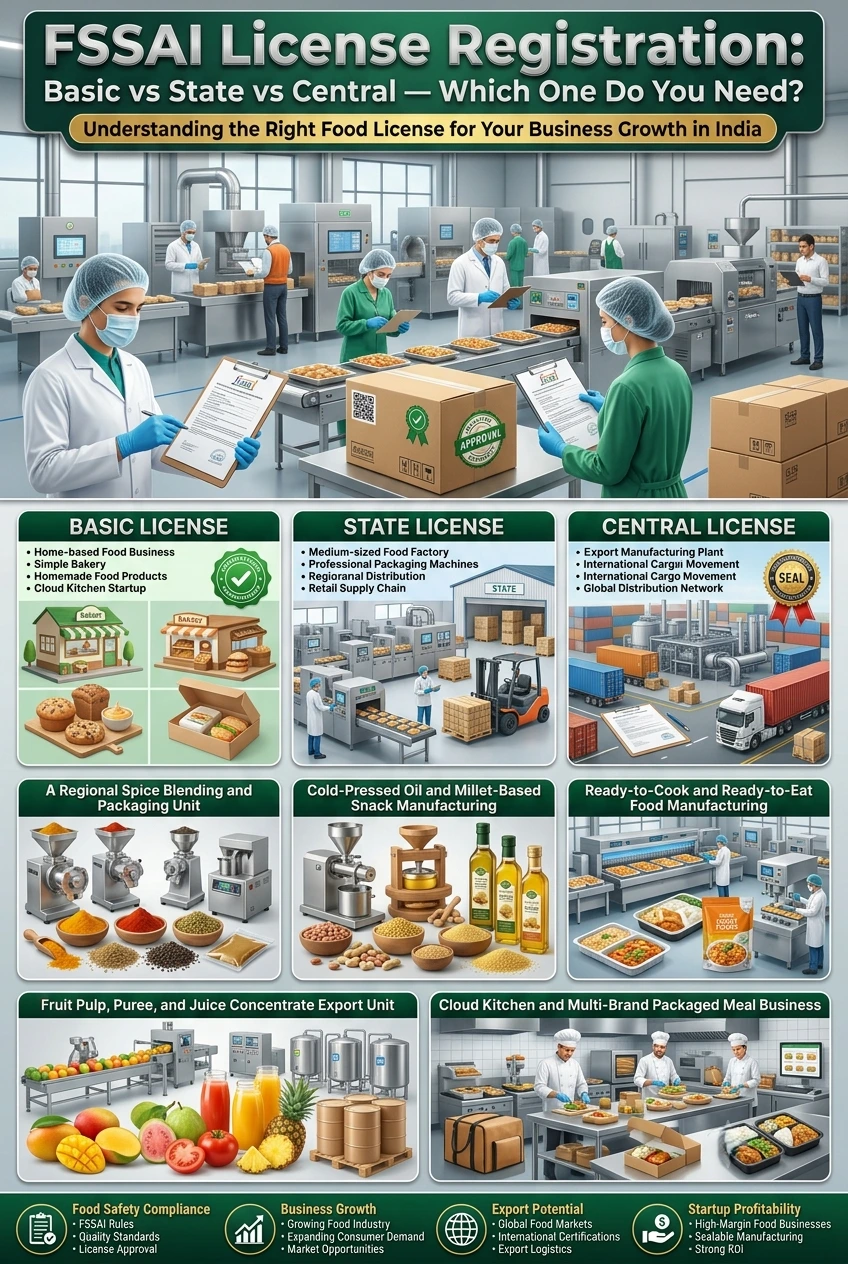
Multiple Business Ideas Built Around FSSAI Compliance
After you’ve determined the license band you’re in, the true challenge actually starts: Selecting a product line that is suited to your capital and compliance appetite. These are some concepts that should be considered.
Regional Spice Blending and Packaging Unit
There is a balance between scale and price of production and licensing, with a spice blending unit falling somewhere in the middle of the Basic and State License category and demand for standardised, hygienically packed masalas on the rise, both metro and tier-2 markets. When it comes to raw spices, the little guys can compete with national suppliers by sourcing their raw spices from the mandis, cleaning and grinding them in-house and marketing them under a recognizable brand with different regional flavour profiles. Subsidy math can work the founder’s way at year 1, as spice units sellable in many district ODOP lists are included.
Get Detailed Insights from This Book: Handbook on Spices
Cold-Pressed Oil and Millet-Based Snack Manufacturing
The government’s International Year of Millets follow-through programmes have led to focus on cold-pressed oils and millet snacks which are becoming popular among health-conscious buyers. This type of business normally requires a State License when turnover exceeds the threshold, and when the machinery investment is not too heavy for a full-scale food park. Once a brand has established repeat online customers, margins start to get much better as cold-pressed and millet products are more expensive than commodity options.
Ready-to-Cook and Ready-to-Eat Food Manufacturing
Dual-income households are looking for convenience but not sacrificing taste, which RTC and RTE brands deliver. This class requires higher level of process control – retort packaging, shelf-life validation, and cold-chain logistics (if frozen) – and most serious entrants fall into the State License band, becoming Central once they grow or begin to export. The initial investment is greater, but so is the capacity to develop a defending product that is branded.
Fruit Pulp, Puree, and Juice Concentrate Export Unit
India’s mango, guava and pomegranate belts create a ripe export market if processes can pass global food-safety muster. Given that export transactions automatically mandate a Central License, regardless of revenue turnover, entrepreneurs must design in that compliance cost from day one, not as something to retrofit later. Consistent Brix numbers and sparkling micro-reports bring a price premium in the Gulf and Europe, favouring discipline over pure scale.
Cloud Kitchen and Multi-Brand Packaged Meal Business
A Cloud kitchen has one of the lowest capital entry barriers into food business for any aspiring food entrepreneur, and 95% operators beginning under Basic registration scale up to obtain a State License, once they build up their order volume and presence across multiple cities. Operating multiple virtual brands out of a single kitchen allow entrepreneurs to experiment with cuisines and price points swiftly, and an existing FSSAI number from the onboarding stage onto a platform, makes their compliance journey inherently aligned with their growth trajectory.
Import–Export Opportunity Analysis for New Food Entrepreneurs
Trade data consistently shows India’s processed food exports growing faster than several traditional agricultural commodity exports, driven by spices, marine products, and value-added grain items. For a new entrepreneur, this creates a layered opportunity: start domestic under a State License to build process discipline, then move to a Central License once export orders justify the additional compliance and documentation.
Exporters must also register for an Importer Exporter Code and, for many product categories, secure clearances through agencies such as APEDA or the Spices Board depending on the product line. Most international Buyers in today’s world expect either HACCP certification or ISO 22000 in addition to the FSSAI Central License. Startups planning to enter export markets must allocate sufficient funds for these certifications before confirming orders, as they cannot arrange them later.
Import-side opportunities exist too. Specialty ingredients — certain food additives, packaging films, and processing machinery — still enter India through import channels, and businesses that can localise these supply chains often find a profitable niche supplying other food manufacturers rather than end consumers directly.
Indian MSME Success Stories Worth Studying
Learning from founders who scaled food businesses from a single unit offers more practical insight than any regulation summary.
Haldiram’s — Agarwal Family
What started as a humble sweets store in Bikaner has expanded to become India’s biggest brands for snack and namkeen, the Agarwal family’s careful approach. “We realised that it was important to standardise ingredients and packaging from the start so that we could take the brand into different states without the product being inconsistent,” he says. New entrants can take away a clear lesson: invest in process documentation before you need it, not after demand outpaces your kitchen.
MTR Foods — Maiya Family
Born to Bangalore restaurant origins, MTR evolved to make spice blends and instant meals that made it appealing to a multinational acquirer. Early focus by the original family on institutionalising quality processes and identifying export potential equipped them with a trustworthiness that home-bred rivals did not possess. For a founder today, the takeaway is that certification and process rigor directly translate into acquisition and export value later.
Priya Foods — Telangana-Based Processor
Success built by a relentless focus on flavour and bold, but disciplined, distribution expansion, Priya Foods transformed from a small regional producer to a pan-Indian name. The owners chose hygiene certificates and quality checks even before it became a mandatory thing-giving them an edge in popping into modern retail chains while peers struggle to catch up.
Related Article: List of 33 profitable food manufacturing business
How NPCS Supports Food Entrepreneurs Through the Compliance Journey
We at Niir Project Consultancy Services (NPCS) provide professional consulting for the preparation of Market Survey cum Detailed Techno-Economic Feasibility Reports (DPRs) for setting up new industries or businesses. Our reports include detailed manufacturing processes, market research and demand analysis, process flow diagrams, product mix and capacity planning, machinery and raw material details, and complete project financials with profitability analysis. For food entrepreneurs navigating FSSAI categories and layered government schemes, a well-structured DPR often becomes the single document that speeds up bank loan approval, subsidy sanction, and license processing together. Our objective is to help entrepreneurs evaluate feasibility, profitability, and long-term scalability before investing.
FSSAI License Comparison Table
| License / Registration Type | Annual Turnover Band | Approximate Annual Fee | Typical Applicants |
| Basic Registration (Form A) | Up to ₹1.5 crore | ₹100 per year | Petty manufacturers, home kitchens, small vendors, tea stalls |
| State License (Form B) | ₹1.5 crore to ₹50 crore | ₹2,000 – ₹5,000 per year | Mid-sized manufacturers, restaurant chains, packaged food brands |
| Central License (Form B) | Above ₹50 crore | ₹7,500 per year | Large manufacturers, importers, exporters, e-commerce food sellers |
| Central License (activity-based) | Any turnover | ₹7,500 per year | 100% export units, importers, government-supply vendors, airport/seaport/rail outlets |
Frequently Asked Questions
1. Do I need an FSSAI license for a home-based food business?
Yes, even a basic home kitchen or a commercial cloud kitchen needs at least a Basic FSSAI Registration to sell food commercially. Food delivery platforms also verify this registration before onboarding you as a seller.
2. Can my license category change as my business grows?
Yes. You have the option to apply for the modification in the FoSCoS portal each time your turnover moves you to the higher band, or when you start doing a new activity e.g. Export which would require the Central License irrespective of the turnover.
3. How long does FSSAI approval typically take?
Basic registration takes as little as 2-3 weeks State or central licences usually take 4-6 weeks, but depending on how long your application and documentation is valid and the time your inspections will book will depend all of these figures
4. Does the FSSAI license expire and need renewal?
Although newly issued licenses and registrations have no expiry date, companies must renew them and submit compliance returns annually to keep them active.
5. Is a separate license needed for each state I operate in?
If your operations stay within one state and your turnover fits the State License band, one license generally covers that state’s units. Multi-state manufacturing or distribution, however, typically pushes a business toward Central License requirements.
6. Can NPCS help with both the FSSAI process and the business plan?
While NPCS handles your loan and subsidy feasibility study, financial modeling, and DPR preparation, you can file the FSSAI application directly through the FoSCoS portal or seek assistance from a registered compliance consultant.
The Bottom Line
The choice between Basic, State and Central FSSAI category for your enterprise is not a trivial filing matter – it translates to your compliance cost, ease in raising institutional debt and swift response for export orders. Businesses which take care to align the category with the actual business volume/operations, and also overlay governmental concessions to that baseline are able to sprint past many of their brethren for whom compliance is an item on the backburner. Begin with an honest assessment of your actual revenue and business area, confirm existing caps in FoSCoS Portal (Official Gov Portal of India) and write your DPR based on the category you will actually conduct business in.
References and Useful Links
Official FoSCoS licensing portal: foscos.fssai.gov.in
Ministry of Food Processing Industries (PMFME and PLI schemes): mofpi.gov.in
Department for Promotion of Industry and Internal Trade (DPIIT): dpiit.gov.in
Udyam MSME Registration: udyamregistration.gov.in
Agricultural and Processed Food Products Export Development Authority (APEDA): apeda.gov.in
Federation of Indian Chambers of Commerce and Industry (FICCI): ficci.in
Confederation of Indian Industry (CII): cii.in
Maharashtra Food and Drug Administration: fda.maharashtra.gov.in