
Stainless Steel Manufacturing Business
India’s stainless-steel industry has just been dealt one of the most impactful signals of this year, 2026. Steel Authority of India (SAIL) and Krakatau Steel, Indonesia, recently announced plans to form a joint venture for a stainless-steel slab plant in Indonesia, which will have an annual capacity of 500,000 metric tonnes, all to be dedicated for SAIL’s Salem plant in Tamil Nadu, Economic Times reported recently. It’s not regular business communication. It’s a paradigm change in the stainless-steel supply chain in India.
The Indian opportunity to get the raw material supply secured for its biggest state-owned steel company (BSSC) at a cost of $350 m is a clear indication to the market that the demand for stainless steel in India is on a rise, the gap in supply is increasing and it is about to receive a massive supply of processed stainless-steel slabs from its BSSC. That is a space that startup founders and MSMEs can carve out successful and scalable businesses in today — that is, downstream!
In the latest development, Economic Times reports that this is directly linked to recent Indian Prime Minister Narendra Modi’s visit to Indonesia, where the agreement was a preliminary one between SAIL and Krakatau. The team of technical feasibility is deployed to Indonesia in August 2026. Equity structures and timelines will follow. This whole process will take 3-4 years to ‘generate’ new volumes of slabs in India, but the window of opportunity for downstream business begins today.
It’s a clear message for Indian entrepreneurs and MSMEs that the time of stainless-steel downstream manufacturing is now entering growth with security of supply as the demand is increasing. At first, the players who arrive in these manufacturing segments will reap the greatest profit.
Get Detailed Insights from This Book: Handbook on Steel Bars, Wires, Tubes, Pipes, S.S. Sheets Production with Ferrous Metal Casting & Processing
What Recent Economic Times Reporting Means
The Economic Times recently broke the news that SAIL and Krakatau Steel are preparing to pour in an investment of up to $350 million in a plant to manufacture stainless steel slabs in Indonesia. Once running, the plant will be able to generate 500,000 metric tonnes per annum and has potential to expand capacity further. SAIL plans to use all the production at its Salem Steel plant in Tamil Nadu, where slabs will be rolled and turned into stainless steel end-use products for its local customers and a few exports to the Middle East and Europe.
Read the full development at Economic Times Manufacturing.
Why This Development is Different
Nickel is a critical material for stainless steel production in India and has posed a major challenge for the industry. More than half of the world’s nickel production is in Indonesia, where this is the primary alloying material for stainless steel. As part of the tie up with Krakatau Steel, at the heart of the nickel supply, SAIL is working its way down to lower input cost structure. It is not a supply contract. This is a pricing policy that will help Indian S-steel products to be competitively priced in the world.
This is an inflection point for MSMEs as it marks a structural cost advantage that will come down the supply chain for stainless steel in India in 4 years. As this supply chain develops, the cost of raw materials, margins and competitiveness in the export market will be reduced, directly benefiting businesses that were created today in the downstream stainless steel manufacturing sector.
This deal is a more than a bilateral corporate deal as reported by Economic Times. It signals the ripening of India’s stainless steel industrial policy — and an opportunity window that entrepreneurs can’t miss for high value manufacturing.
Why the Stainless-Steel Industry Is Growing
The stainless-steel segment is one of the fastest-growing material segments in Asia market in India. It is estimated that the market was worth about USD 8 billion in 2025 with forecast to grow to almost USD 12.9 billion by 2031 at 8.1% CAGR. This is not speculative growth, instead it’s based on real structural demand in six major verticals.
Infrastructure Demand
Trillions of rupees are being invested by India’s National Infrastructure Pipeline in airports, metro rail, bridges, highways and ports. Stainless steel is the material of choice in all large-scale infrastructure projects for handrails, cladding, structural supports and sanitation systems. Consumption of stainless-steel picks up pace in India as it builds.
Pharmaceutical & Chemical Sector Demand
India is the third largest manufacturer of medicines in the world. From pharmaceutical plants to chemical reactors, biotech fermentation units to food processing, all have to depend on stainless steel for the storage tanks, pipelines, reactors, and processing equipment. This is an inelastic demand, which does not vary with the change in the levels of income and production and continues to increase as the manufacturing base expands in India.
Consumer & Hospitality Sector Demand
The consistent demand for stainless steel kitchenware and cookware, as well as catering equipment for hotels and institutions has been fuelled by the increasing income of middle class, urbanization and the growth in the hospitality sector in India. Food processing and exports are also driving export demand for stainless steel products from India to Middle East, Africa and Europe.
Automotive & Railway Modernisation
High-grade stainless steel plays a crucial role in automobile body panels, exhaust systems, structural parts, and interior components. It also supports railway modernization and metro rail construction projects across India. The government is introducing new metro lines, developing hydrogen fuel lines and operating Vande Bharat trains actively. These initiatives are driving a multi-decade structural upcycle in stainless steel demand.
View Full Project Details: Explore This Comprehensive Steel Manufacturing Guide
Government Policies & Incentives
Government of India has created a strong policy framework for the industry of stainless steel and specialty steel. There are three flagship programmes that directly impact MSME entrepreneurs who will soon enter this industry in 2026.
PLI Scheme for Specialty Steel
The Government launched the third Production-Linked Incentive (PLI) scheme for Specialty Steel, which includes stainless steel long and flat products. The rates of incentives are in the range of 4% to 15% on incremental sales for 5 years from FY 2025–26 and disbursal of incentives will begin from FY 2026–27. The number of committed investments and the amount already deployed clearly indicate strong industry confidence, with investments exceeding ₹43,874 crore. Make in India and Startup India provides options for startup founders to explore about eligibility.
MSME Credit & Support Schemes
New MSMEs in stainless steel manufacturing industry can avail Credit Guarantee Fund Trust for Micro and Small Enterprises (CGTMSE), Technology Upgradation Scheme (CLCSS), and raw material assistance from NSIC. The MSME Ministry portal offers the Udyam registration and cluster development assistance for the stainless-steel fabrication MSMEs in Tamil Nadu, Gujarat, Maharashtra, Punjab, and Delhi NCR.
Export Promotion & DGFT Benefits
The export of stainless steel to India increased by 35.8% in FY 2025-26. Duty drawback, Export Promotion Capital Goods (EPCG) and DGFT export promotion schemes are available for entrepreneurs who wish to do business in the Middle East, Africa, and Europe market and can use these opportunities at DGFT portal.
State-Level Investment Incentives
The state of Tamil Nadu, where the Salem plant is located, provides ample State Industrial Incentives to steel and engineering manufacturing units. Salem will be the direct processing center of Indonesian slab imports, therefore, locating or positioning of supply chain enterprises adjacent or near Salem will have logistics, power and subsidy benefits. There is also some similarity to the incentive ecosystems in the GIDC clusters of Gujarat, the MIDC zones of Maharashtra and the Ludhiana SSS cluster of Punjab.(Stainless Steel Manufacturing Business)
5 Manufacturing Business Ideas for Startups & MSMEs
All of the business ideas below directly derive from the SAIL–Krakatau investment signal covered by the Economic Times. With the new stainless-steel slabs worth 500,000 tonnes entering the Indian manufacturing value chain, these downstream manufacturing units will consume the slabs and transform them into value added finished goods.
Business Idea 1: Stainless Steel Kitchenware & Cookware Manufacturing Unit
The SAIL–Krakatau agreement takes a direct shot at enhancing finished product’ supplies to Indian consumers and export markets. India’s biggest volume stainless steel consumer product is stainless steel cookware and kitchenware.
The manufacturing unit will produce products such as pressure cookers, cooking pots, frying pans, hotel-grade food containers, tiffin systems, commercial kitchen equipment, mixing bowls, and modular kitchen accessories.
Investment: ₹50 lakh to ₹3 crore (small to mid-scale unit). Marges for branded kitchenware are between 25-40%. The markets with the highest potential for exports are the GCC countries, the UK, USA and Australia due to the demand from Indian diaspora. The markets have highest export potential are the GCC countries, UK, USA and Australia with consistent volumes of Indian diaspora demand.
Why Now: The lower cost of nickel-based slabs will reduce raw material expenses for stainless steel kitchenware manufacturers in India over the next three to four years, as SAIL is sourcing these slabs from Indonesia at a lower cost. When input costs drop and margins expand, businesses that build brand identity and strengthen distribution channels now will be in the best position to benefit.
Business Idea 2: Stainless Steel Medical Equipment & Surgical Instrument Manufacturing
The medical device manufacturing industry in India is on a high growth path and is poised to benefit from PLI. Hospitals, surgical centers, and diagnostics labs in India and the Global South need stainless steel surgical trays, surgical instrument tables, storage trolleys, OT tables, autoclaves, and sterilization equipment.
Products manufactured: Surgical instruments (scissors, clamps, retractors), OT tables, hospital trolleys, instrument trays, dental equipment stands, sterilisation chambers and IV stands.
Nomination Price: ₹75 lakh to ₹5 crore (as per product mix) Medical grade stainless steel products have an added cost – 35 – 55% is possible when the product is certified and listed in ISO 13485 / BIS. The Knowledge of Sialkot-grade Manufacturing of Surgical Instruments can be nurtured in the Jalandhar and Agra cluster in India.
Why Now: India is witnessing the fast growth of the healthcare infrastructure, with the Ayushman Bharat and PM-ABHIM scheme. Indian manufacturers have structural advantage over their import competitors due to domestic preference for procurement of medical equipment.
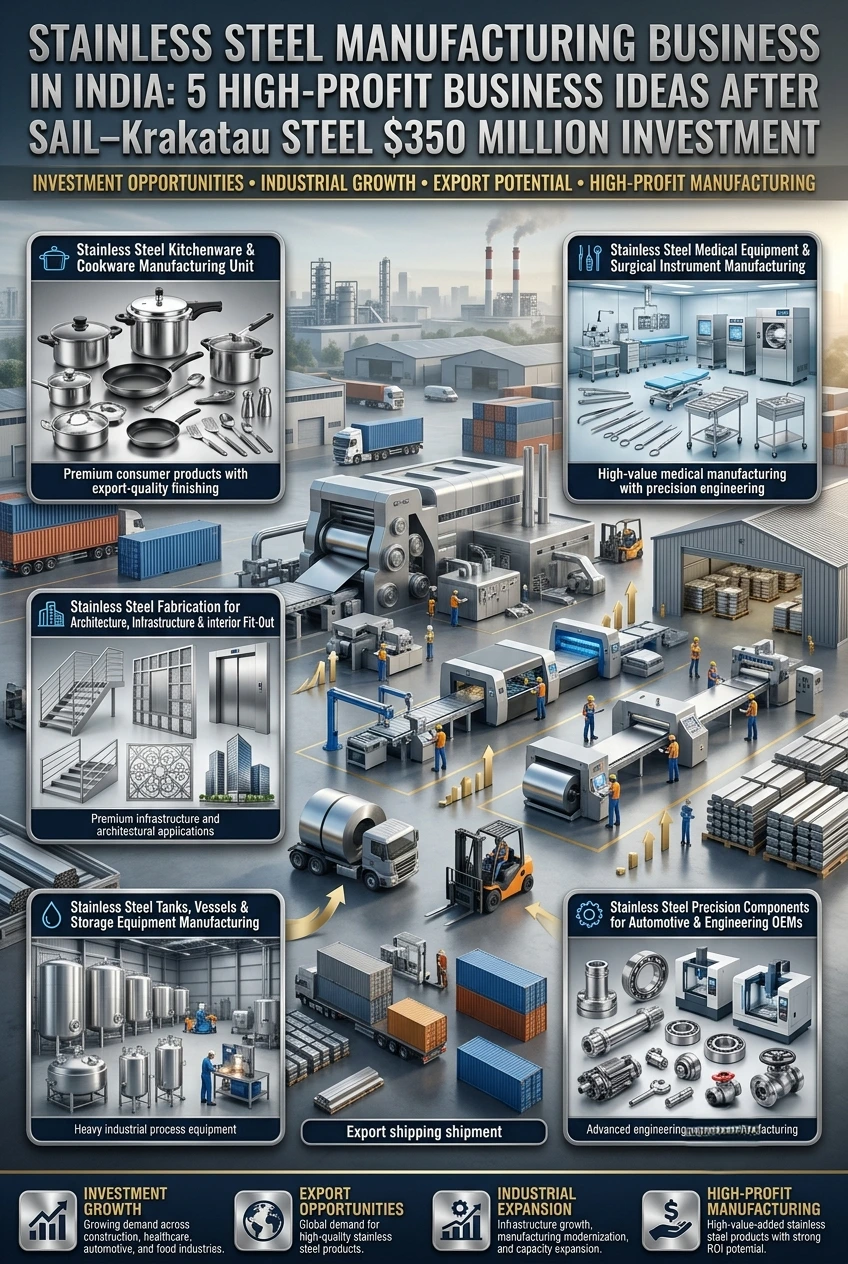
Business Idea 3: Stainless Steel Fabrication for Architecture, Infrastructure & Interior Fit-Out
India is witnessing consistent demand for stainless steel architectural fabrication. This growth is driven by infrastructure spending under PM GatiShakti, the National Infrastructure Pipeline (NIP), and the Smart Cities Mission. Applications include water feature structures, decorative grilles, ceiling systems, fascias, and railings.
Products to Manufacture: Stainless steel handrails and balusters for metro stations, airports, malls, and commercial buildings. Other products include interior wall cladding panels, decorative grilles, screens, structural supports, stairs, water tank frameworks, and garden furniture.
Investment Range: ₹40 lakh to ₹2.5 crore for a fully-equipped fabrication shop that includes CNC bending, welding, polishing machines. In infrastructure fabrication, project-based revenue makes for high-ticket contract revenues and project margins of 30-45%.
Why Now: The Indian airports modernization initiative (UDAN 100+ airports), metro expansion in 27 cities and smart city commercial development pipelines are all active tender markets. Compared to demand, there are few architectural stainless-steel fabricators that have quality certifications.(Stainless Steel Manufacturing Business)
Business Idea 4: Stainless Steel Tanks, Vessels & Storage Equipment Manufacturing
Market Signal: Food processing, dairy, chemical, pharmaceutical and water treatment industries are growing at a rapid pace in India. All of these industries are using stainless steel storage tanks, pressure vessels, mixing tanks, reactors and holding vessels. A low risk and high volume B2B manufacturing business segment.
Industrial uses of the product: Milk collection and chilling tanks, fermentation vessels, water storage tanks, chemical reactor liners, pharmaceutical bulk storage containers, wine and brewery tanks, and industrial process vessels.
Investment Range: ₹1 crore – ₹8 crore for medium-size manufacturing tank. ASME, BIS and food grade stainless steel certification are powerful premium pricing attributes. Recurring revenue is provided by captive customer relationships with dairy cooperatives; pharma manufactures and breweries.
Why Now: India uses only 35% of its milk production in organised dairy plants. The remaining 65% represents a major infrastructure gap. This gap is being addressed rapidly. New dairy plants, food processing units, and pharmaceutical manufacturers are creating strong demand for stainless steel process vessels.
Business Idea 5: Stainless Steel Precision Components for Automotive & Engineering OEMs
Stainless steel is gaining increasing adoption in India’s automotive industry, where manufacturers use it for exhaust systems, fuel lines, structural brackets, fasteners, and emerging hydrogen fuel cell vehicles. OEMs in the precision stainless steel components sector have not yet developed strong Tier-2 and Tier-3 supply chains.
What they manufacture: CNC stainless steel fasteners and bolts, exhaust system flanges and brackets, precision turned fuel delivery parts, automotive sensor housings, hydraulic fittings and railway coach fittings.
A CNC precision machining facility equipped with quality management systems requires an estimated investment of ₹1.5 crores to ₹10 crores. Automotive certification (IATF 16949) allows direct supply from the OEM. PLI Scheme for Specialty Steel can be applicable for eligible Precision Manufacturing Units for investment incentives.
Why now: SAIL is expanding its stainless-steel production line with a guaranteed supply of slabs from Indonesia. By 2030, India is expected to become one of Asia’s most cost-competitive stainless-steel manufacturing ecosystems. Today, precision component manufacturers who build strong relationships with automotive and engineering OEMs can secure contracts before the market becomes saturated.(Stainless Steel Manufacturing Business)
Related Article: Steel and Steel Products Industry Consultants in India
Import–Export Opportunity Analysis
The agreement with SAIL-Krakatau Steel is a double whammy: this is a chance to replace imports of stainless steel and increase exports. The results for FY 2025–26 show that India’s steel exports rose by 35.8% while imports fell by 46.47%, indicating growing competitiveness in steel production.
Export Markets for Indian Stainless-Steel Products
Stainless steel has a high demand in Middle East (GCC) for kitchenware, construction fixtures and industrial equipment etc. India has geographical, cultural and logistics benefits over Chinese and European competitors.
Africa: S.S. Tanks, structural components and construction hardware demanded as infrastructure building phase in sub-Saharan and East Africa begins.
Europe: EU-India FTA negotiations are making good progress. The possible tariff reductions would boost Indian stainless-steel exports by 15–20% in European markets, as per the price elasticity models.
MSMEs can look into schemes available at DGFT (Directorate General of Foreign Trade) for export licence and promotion.
Import Substitution Opportunities
India still imports a significant quantity of high-grade stainless steel flat products, precision tubes, and specialty alloy components from China, Taiwan, and South Korea. Domestic manufacturers can gain input cost advantages through lower-priced nickel-based slabs compared to the SAIL plant in Salem. This will reduce import dependence in high-value stainless steel product categories.
Indian MSME Success Stories in Stainless Steel
Among the many success stories in India’s stainless steel MSME ecosystem, some are highly interesting. They prove the feasibility of large-scale downstream manufacturing.
Ludhiana Kitchenware Cluster, Punjab
Ludhiana is the hub of stainless-steel kitchenware and utensil producers in India. This cluster has more than 50 countries as its export markets and hundreds of MSMEs are catering to these markets together. The cluster spells out that there is a potential of creating sustainable export-oriented enterprises in MSME scale with the support of raw material cluster and shared infrastructure in the manufacturing of stainless steel.
Rajkot Engineering Components, Gujarat
The precision engineering MSMEs of Rajkot have made a successful shift from mild steel fabrication to production of stainless-steel components for the automotive and pharmaceutical OEMs. There are several units in Rajkot that directly supply to Multinational Chemical & Pharmaceutical Companies in India, Europe & Middle East.
Identify high-growth industries before others do
Salem Stainless Steel Downstream Units, Tamil Nadu
About NPCS: Your Manufacturing Business Partner
When a market transformation of this magnitude happens, with a $350 million investment that is re-aligning India’s stainless steel supply chain, it hardly matters if every entrepreneur decides to do something — rather, how they do it.
Niir Project Consultancy Services (NPCS) is one of the most reputed industrial consultancy and feasibility report companies in India providing more than 30 years of experience to the entrepreneurs, MSMEs, and investors to start any manufacturing ventures with confidence. NPCS offers a complete solution for conducting a feasibility study, preparing a project report, planning plant and machinery and sourcing raw material analysis, profitability projections and providing licensing assistance in the field of stainless steel and allied business.
The project reports delivered by NPCS serve as investment blueprints. They offer a structured approach for founders entering stainless steel kitchenware, medical equipment, architectural fabrication, industrial tanks, or precision component manufacturing based on research. NPCS feasibility report is accepted by SIDBI/NABARD/Nationalised Banks/State Industrial Development Corps for loan processing.
The development by SAIL, covered by The Economic Times, is a strong market signal. NPCS analysts monitor such developments to identify high-potential and timely manufacturing investments. Investors can explore opportunities in India’s downstream stainless steel manufacturing sector. Expert feasibility reports can support informed investment decisions. These investors may benefit from the country’s evolving stainless steel supply chain.
Stainless Steel Manufacturing Opportunity Data Table
| Business Idea | Investment (₹) | Gross Margin | Setup Time | Export Potential | PLI Eligible? |
| Kitchenware & Cookware | 50L – 3Cr | 25–40% | 6–12 months | High | Yes |
| Medical Equipment | 75L – 5Cr | 35–55% | 9–18 months | Medium–High | Yes |
| Architecture Fabrication | 40L – 2.5Cr | 30–45% | 4–8 months | Medium | Yes |
| SS Tanks & Vessels | 1Cr – 8Cr | 28–42% | 12–18 months | Medium | Yes |
| Precision Components | 1.5Cr – 10Cr | 32–48% | 12–24 months | High | Yes |
Frequently Asked Questions
Q1: How it will affect the Indian MSME manufacturers for the SAIL – Krakatau Steel $350 million deal?
The agreement ensures a stable and cost competitive supply of slabs with nickel content from Indonesia. This will reduce the raw material input cost for downstream stainless-steel manufacturers in India by more than 3–4 years, which helps in making the products competitive for export. MSMEs which come in the field now will be in a good position if the supply chain becomes operational.
Q2: What is the amount of start-up capital that is required for which stainless steel manufacturing business?
The investment cost for small scale set up in architectural fabrication and kitchenware manufacturing units is as low as ₹40-50 crore. The break-even periods of these segments are also shorter than precision components and tank manufacturing units — between 18–30 months.
Q3: Can MSMEs in the Stainless-Steel industry avail PLI scheme?
Yes. The PLI Scheme for Specialty Steel (Round 3) applies to stainless steel long products, flat products and includes 4-15% on incremental sales of these products. Indian incorporated companies with registered manufacturing units and a minimum investment are eligible to apply. Please refer the updated eligibility at Startup India and Make in India websites.
Q4: What are the best incentives provided by Indian states for stainless steel manufacturing MSMEs?
Tamil Nadu (near Salem), Gujarat (Rajkot and Ahmedabad), Punjab (Ludhiana), Maharashtra (Pune and Nashik), and Delhi NCR have active stainless steel manufacturing ecosystems. These states offer industrial incentives such as power tariff concessions, land allocation in industrial estates, and capital subsidies. Furthermore, the Salem region in Tamil Nadu has a major advantage because it is located near SAIL’s main processing plant.
Q5: A founder can obtain a feasibility study for a stainless-steel manufacturing enterprise by getting the help of an expert in the field.
Niir Project Consultancy Services (NPCS) provides comprehensive project reports and feasibility studies for stainless steel manufacturing projects. These reports include market analysis, project layouts, stainless-steel machinery lists, raw material sourcing, financial projections, and licensing requirements. Banks and financial institutions use these reports to evaluate loan applications. These institutions include SIDBI, NABARD, and state industrial development corporations.
Q6: What are the necessary certifications for a stainless-steel manufacturer for exports?
For kitchenware and consumer: BIS certification and ISO 9001. Medical equipment: According to ISO 13485 and CDSCO registration. In the automotive industry: IATF 16949. For food processing equipment: food grade material compliance according to FSSAI guidelines. Requirements differ from country to country for exports – DGFT export documentation and APEDA registration can help.
Conclusion
Economic Times reporting on the SAIL–Krakatau Steel $350 million investment has revealed something deeper than a bilateral corporate deal. It signals that India is actively architecting a long-term, supply-secure, cost-competitive stainless steel manufacturing ecosystem — from raw material sourcing in Indonesia right through to finished product delivery in India and export markets globally.
The market window for Indian startups and MSMEs entering downstream stainless-steel manufacturing is open right now. The supply infrastructure is being built. Government PLI incentives are live and disbursing. Export demand is rising. And the competitive landscape in high-value stainless steel products — medical equipment, precision components, architectural fabrication, industrial vessels — remains far from saturated.
Five clear manufacturing business opportunities exist today: stainless steel kitchenware, medical equipment, architectural fabrication, industrial tanks, and precision automotive components. Each is viable at MSME scale, each carries strong export potential, and each benefits directly from the supply chain transformation that SAIL is engineering through its Krakatau partnership.
The Economic Times market signal is clear and the policy architecture is supportive. The only remaining variable is entrepreneurial action. Founders who research, plan, and invest in India’s stainless steel downstream manufacturing chain in 2026 can create success stories before this decade ends.(Stainless Steel Manufacturing Business)
For investment-grade feasibility planning, explore Invest India and engage NPCS for a comprehensive stainless steel manufacturing project report tailored to your target segment and state location.