
PCPIR chemical business India
The focus of a discussion on chemical investments in India tends to be on mega refineries, crackers and integrated petrochemical complexes. These projects are what make the headlines but not the most practical entry point for MSMEs, or first-generation chemical entrepreneurs for that matter.
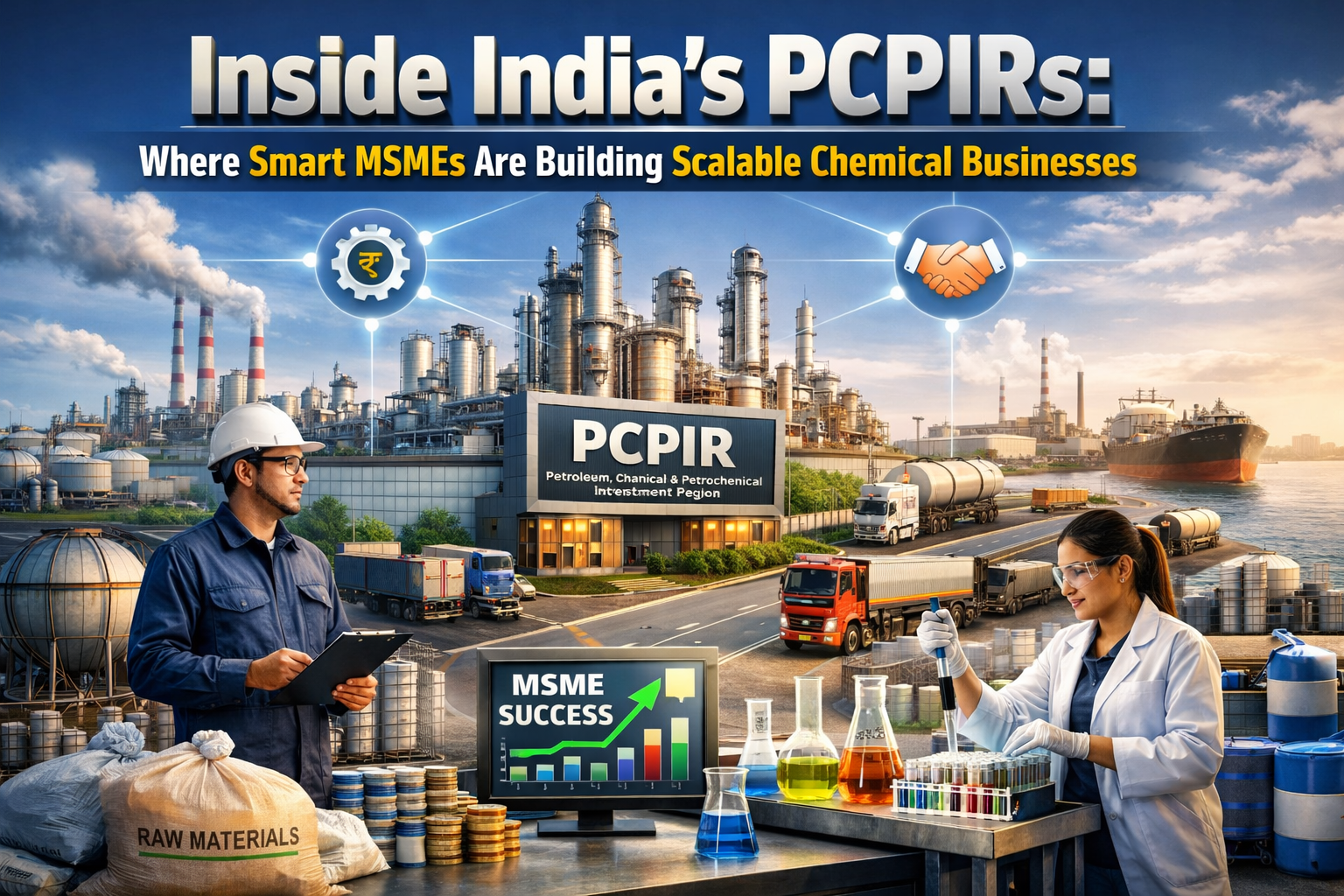
The real opportunity lies downstream – within the value chains that are developed organically around large anchor investments. This is where Petroleum, Chemical and Petrochemical Investment Regions (PCPIRs) have a decisive advantage.
PCPIRs are not only industrial areas. They are risk mitigated industrial ecosystems in which infrastructure, utilities, logistics, environmental systems, and industrial density already exist. For chemical businesses it is a direct ecosystem benefit that enhances bankability and scalability.
Read More: Industrial Chemicals Technology Hand Book
Why PCPIR Infrastructure Changes the Feasibility of Chemical Project
Chemical feasibility is not determined solely by machinery or technology. In fact, the key to project success is two layers.
The first of these is the inside-the-fence – process stability, yields, utilities consumption, manpower, quality control, safety systems. These are mostly under the control of the entrepreneur.
The second layer is outside the fence, and this is where the majority of lone chemical units struggle. This includes:
- Raw material availability and lead time
- Freight & port reliability
- Effluent treatment & Waste handling
- Vendor and maintenance ecosystem
- Buyer Proximity and Regulatory Predictability
PCPIRs are designed to specifically reduce these external uncertainties. Shared infrastructure like ports, pipelines, power links, roads and common effluent treatment plants translate into structure the unpredictability. This structure advantage is why lenders and investors are frequently willing to consider PCPIR-based projects as less risky, even at small capacities.
Demand Environment: Why Downstream Chemicals Make Sense now
As per estimates of the Department of Chemicals and Petrochemicals under the Ministry of Chemicals and Fertilizers, the value of the output of the chemical industry is more than rupee 15 trillion at the current prices, with the rate of growth of double digits in the last few years.
Importantly, this growth is not limited to the basic chemicals. It is driven by downstream consumption from packaging, automotive, infrastructure, textiles, consumer goods and industrial services. This structure of demand highly favours value-added MSME projects that are based close to industrial clusters.(PCPIR chemical business India)
Read More: Handbook On Chemical Industries (Alcohol Based)
What PCPIR Numbers Really Tell Entrepreneurs
When founders consider the PCPIR regions such as Dahej, Visakhapatnam – Kakinada and Paradeep, the data reveals more than mere statistics on the surface.
- High unit density is a sign of a mature vendor and service ecosystem
- High cumulative investment reflects strong demand in the downstream based on anchoring
- Large processing areas signify long-term scalability without moving
For the MSMEs, that means quicker access to their customers, smoother operations and fewer shocks to execution during scale-up.
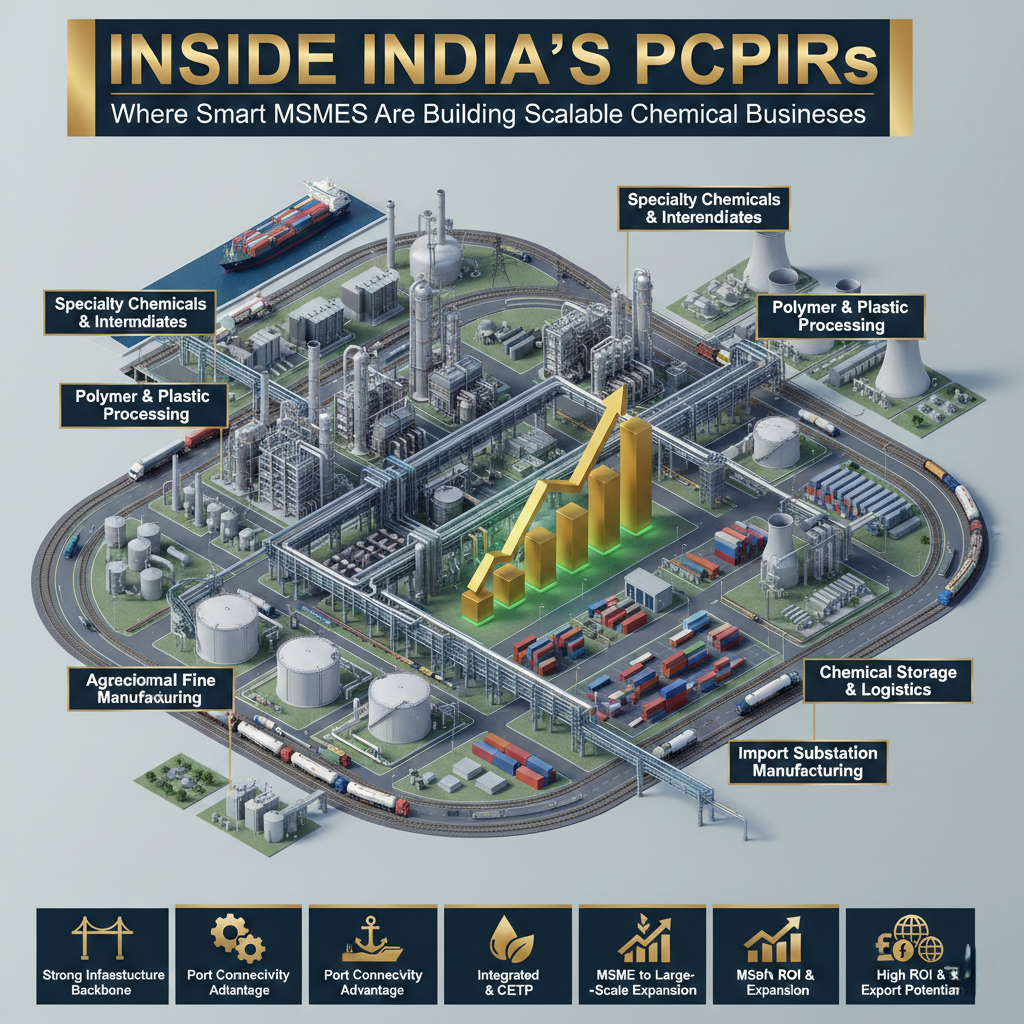
Investment Ready Chemical Businesses That Fit Naturally in PCPIRs
Polymer Compounding and Performance Masterbatch
In PCPIR ecosystems, the availability of raw resin is seldom a limiting factor. The opportunity is in performance conversion – polymer compounds and masterbatches that provide improved processing efficiency or end-use properties.
Typical demand is from grades offering:
- UV and heat stability
- Flame retardancy
- Impact modification
- Antistatic or processing aid performance
Once these grades have been qualified on customer production lines, switching suppliers is operationally risky. This results in high customer stickiness and predictable repeat demand.
Read More: Project Reports & Profiles
Industrial Packaging and Export Support Products
PCPIR-adjacent zones typically have export-oriented manufacturers that rely on the availability of industrial packaging. These include rigid containers, drums, liners and specialty transit packaging products.
This segment is good for the following reasons:
- Packaging demand is not seasonal
- Buyers value consistency over marginal price differences
- Defect control and delivery reliability – commands premiums
Cluster proximity aids the manufacturer in achieving tight dispatch schedules consistently.
Solvents, Blends and Process Chemicals
Every industrial cluster, the use of solvents, cleaners and standardized process chemicals. PCPIR infrastructure enhances the sources via ports and tank terminals, and minimizes the costs to customers via logistics, in the immediate vicinity.
However, success in this segment is dependent on discipline. Profitable players approach blending as a manufacturing, not trading, activity with a focus on incoming QC, batch traceability, SOP-driven blending and compliance documentation.(PCPIR chemical business India)
Surfactant Mixtures and Industrial Detergent Intermediates
Industrial and institutional cleaning demand is noteworthy in the portable cleaners market (PCPIR clusters) industry, such as factories, ports, warehouses, food processors, and infrastructure operators.
This business benefits from:
- Recurring consumption
- Approval based on performance (approvals)
- Repeat orders which are relationship driven
Once a form is used reliably at a customer site, purchase is routine, not transactional.
Read More: Profitable Petrochemical Business Ideas in India for MSMEs: Textile, Agriculture & Auto Applications
Specialty Resins, Coating Intermediates & Additives
Automotive, infrastructure and engineering industries use large amounts of coatings and performance resins. Buyers often prioritize:
- Consistency of viscosity and performance
- Quick support for trials and modifications,
- Dependable delivery for maintenance shutdowns
PCPIR ecosystems concentrate these buyers, making responsiveness a huge competitive advantage.
Rubber and Elastomer Conversion Products
Rather than manufacturing base elastomers, stronger feasibility for MSMEs lies in the conversion, like compounding, sealant, gaskets, and special rubber components. Proximity to automotive and industrial maintenance customers helps improve retention and repeat business.
Industrial Gases and Chemical Services
Clusters also create stable demand for services to keep plants operating. These include industrial gases, utilities support chemicals, testing services and maintenance-related supplies. Such businesses tend to have stable cash flows and are relatively less prone to regulations.
Import-Export Strategy for PCPIR Based MSMEs
Export success in chemicals is fuelled by certainty, not excitement. The startups based on PCPIR work best when they focus on products where:
- Buyers reorder frequently
- Switching suppliers is risky operationally
- (Logistics speed, documentation)
- Quality consistency is critical
Performance materials and standardized industrial supplies usually establish greater performance during the early years than commodity products.
Read More: Top High-Growth Chemical Manufacturing Businesses New Entrepreneurs Can Start
What Indian Industrial Leaders Teach to New Founders
Large industrial groups provide patterns that are worth learning from. Mukesh Ambani Demonstrates the power of downstream value capture Kumar Mangalam Birla reflects platform based diversification. Gautam Adani proves infrastructure-led competitiveness and Karsanbhai Patel proves that consistency is often superior to aggressive expansion.
For MSMEs, the lesson is not scale – it is sequencing and discipline.
Converting PCPIR Opportunities into Bankable Projects
PCPIRs reduce risk, but they do not eliminate a need for structured planning. Projects still go down in failure when product selection is poor, working capital is underestimated or compliance is treated as an afterthought.
This is why detailed feasibility analysis is still very important. At Niir Project Consultancy Services (NPCS), we prepare Market Survey cum Detailed Techno-Economic Feasibility Reports that includes market demand, manufacturing processes, capacity planning, machinery, financials and scale up.
Closing Perspective
PCPIR development converts uncertainty into structure. That structure—shared utilities, logistics access, industrial density, and support services—creates a pipeline of investment-ready chemical businesses that can scale sustainably.
The entrepreneurs who succeed will be those who focus on repeat-demand products, performance differentiation, and disciplined execution—using the PCPIR ecosystem as a competitive advantage, not just a pin on the map.(PCPIR chemical business India)
Frequently Asked Questions (FAQ)
Why do PCPIR-linked projects get funded faster?
Because shared infrastructure and ecosystem maturity reduce execution and logistics risk.
Which chemical segments scale fastest in PCPIRs?
Performance compounds, industrial packaging, standardized blends, and process chemicals.
Is export realistic for PCPIR-based MSMEs?
Yes, if quality systems, documentation, and batch traceability are built early.
What is the biggest mistake new chemical entrepreneurs make?
Treating chemical manufacturing like trading instead of process-driven production.
How should founders choose between Dahej, Vizag–Kakinada, and Paradeep?
By evaluating feedstock routes, buyer geography, freight economics, approvals, and scale plans through a DPR.