Introduction: BESS Business Opportunities in India
The Battery Energy Storage System (BESS) has evolved from its previous role as a supporting technology to become an essential component of India’s developing energy system. BESS systems have evolved from their original purpose of handling renewable energy interruptions to their current functions which include supporting decentralized power generation and electric mobility systems and grid-edge management and future energy trading systems.
As India fast-tracks its renewable energy goals, electric vehicle (EV) adoption targets, and agenda for inclusive electrification, there is a big demand for flexible, reliable and localized energy solutions. This transition is opening up new wave of high growth business opportunities for Micro, Small and Medium Enterprises (MSMEs) and startups – especially those willing to move away from conventional hardware sales and adopt service-oriented energy business models.
This article examines the role of BESS-powered EV charging, solar micro-grids, grid-edge energy storage and virtual power plants (VPPs) and how they are opening scalable and profitable pathways for entrepreneurs in India, as they look into the future.
Read More: Profitable Business Industry of EV Charging Stations.
Why Advanced BESS Business Models Are Increasing in Momentum
India’s power sector is undergoing many structural shifts at the same time. Rapid adoption of EVs, large-scale implementation of renewable energy sources, grid congestion, energy price increases and decentralization of power supply are fundamentally affecting the way in which electricity is produced, stored and consumed.
Key drivers driving the adoption of advanced forms of BES models include:
- Rapid growth in electric vehicles in two-wheelers, three-wheelers, fleets, and buses
- Changes in costs of lithium-ion batteries and solar photovoltaic systems are declining
- Increasing peak-load stress and congestion in the grid in urban centers
- Unreliable Electricity Supply in rural and Semi-Urban Areas
- Increasing focus on energy resiliency, sustainability, and ESG compliance by industries
Together, these factors are driving BESS out of the “backup solution” and into mission-critical energy infrastructure.
EV Growth and The Requirement for BESS Supported Charging Infrastructure
The electric vehicle market in India experiences rapid expansion because of government policies and the decreased costs of vehicle operation and the growing public understanding of environmental problems. The limited availability of EV charging stations remains a major obstacle which particularly affects areas with restricted electrical grid capacity.
Traditional grid-dependent charging stations are faced with the issues of high demand charges, peak hour power and costly grid upgrades. BESS backed EV charging stations are a good solution, which can act as an energy buffer.
In this model, batteries are charged during off-peak hours or through on-site solar generation and use them to provide fast charging during times of high demand.
The major benefits of BESS-supported EV charging are:
- Reduced reliance on expensive grid upgrades
- Lower electricity tariff and demand charges
- Improved Reliability and Uptime
- Faster deployment in highways, cities and remote areas
For MSMEs, EV Charging-as-a-Service (CaaS) is a good recurring-revenue opportunity that is aligned with national EV infrastructure expansion plans.
Solar + BESS Micro-Grids: The Powering of Rural and Remote India
Despite significant improvements in grid connectivity, there are still many areas in India with unreliable electricity or low supply. Diesel generators are still widely used but expensive, polluting and operationally inefficient.
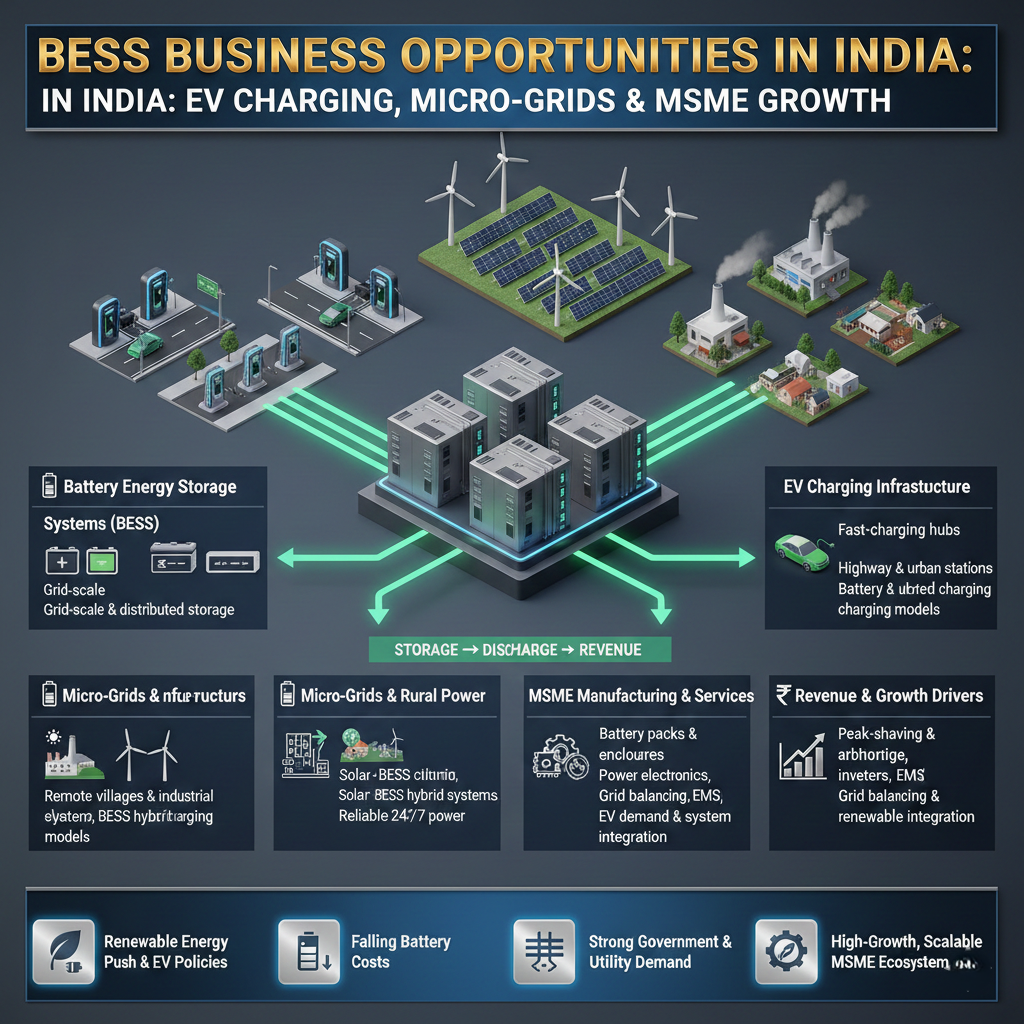
Solar powered micro-grids combined with BESS are becoming an alternative that is clean, reliable and cost-effective. These systems can provide 24X7 power irrespective of the central grid.
Read More: Silicon Metal – Manufacturing Plant, Detailed Project Report, Profile, Business Plan, Industry Trends, Market Research, Survey, Manufacturing Process, Machinery, Raw Materials, Feasibility Study, Investment Opportunities, Cost and Revenue, Plant Economics
Important areas of application are:
- Rural villages, remote hamlets
- Agricultural Irrigation, Cold Storage and Food Processing Units
- schools, healthcare centers, community infrastructure
- Mining operations, construction sites and tourism projects in remote areas
Instead of selling hardware, entrepreneurs can operate these micro-grids using subscription-based or pay-per-use energy models to generate predictable long-term revenue while creating measurable social and environmental impact.
Grid Edge BESS for Commercial and Industrial Energy Management
Commercial buildings and industrial facilities in India have to contend with electricity tariffs, excessive demand charges, fluctuating voltage and routine power outages. These challenges affect directly the productivity, operational costs and profitability.(BESS Business Opportunities in India)
Grid-edge BESS installations help to address these issues by providing for the intelligent management of energy use at the consumer level.
Read More: How to Start an EV Station Franchise: A Complete Guide for Entrepreneurs
Key benefits include:
- Peak demand shaving and decreased demand charges
- Backup power during outages
- Better utilisation of rooftop solar assets
- Enhanced power quality and operation reliability
Entrepreneurs can provide these solutions in the form of turnkey EPC models, or Storage-as-a-Service (SaaS) offerings, in which their customers pay a monthly fee instead of investing in the upfront capital. This approach is especially attractive for SMEs and commercial facilities with small capital budgets.
Market Forecast for BESS in India
India’s BESS market is expected to expand at a compound annual growth rate (CAGR) of over 30 percent during the next 10 years. EV charging infrastructure, renewable energy integration and commercial energy storage are expected to lead the bulk of new installations.(BESS Business Opportunities in India)
EV charging alone should also constitute a large portion of distributed storage demand by 2030. At the same time, solar-plus-storage systems are becoming cost-competitive with diesel generators and grid power in many applications.
This means that the growth of BESS in India will be broad-based and cover mobility, industry, infrastructure and rural development.
Virtual Power Plants: The Future of Distributed Energy
Virtual Power Plants (VPPs) are the ultimate and most strategic application of BESS.When operators bring together distributed storage assets—such as EV charging stations, commercial batteries, micro-grids, and industrial storage systems—they can collectively deliver grid support services.
Read More: Microwave Oven – Manufacturing Plant, Detailed Project Report, Profile, Business Plan, Industry Trends, Market Research, Survey, Manufacturing Process, Machinery, Raw Materials, Feasibility Study, Investment Opportunities, Cost and Revenue, Plant Economic
Potential revenue streams from VPPs are as follows:
- Peak load support for utilities
- Demand response programs
- Frequency control and grid balancing
- Energy trading and market participation (as regulations change)
While the regulatory framework for VPPs is still evolving in India, early movers that invest in aggregation platforms, data analytics and operational expertise will have a good first mover advantage.
Business Opportunity: Low-Capital and Supporting BESS Business Opportunities
Not every entrepreneur has to invest in large-scale infrastructure. There are multiple support services that offer strong business expansion opportunities while requiring only minimal financial investments.
These include:
- Bess consulting system & design services
- Battery health monitoring, diagnostics and O&M
- Leasing & Rental Solutions BESS
- Solar Plus Storage advisory for real estate and industrial projects
- Refurbishment of batteries and second life energy storage applications
These business segments create predictable income streams together with enduring customer ties which require minimal financial commitments to maintain broad market presence.
Read More: Build a Profitable EV Station Franchise: A Strategic Guide for New-Age Entrepreneurs
Significant Issues and Risk Mitigation Plans
Like any emerging sector, BESS-based ventures are challenged by issues of regulation, capital intensity, technology risks and operational complexity.
Successful entrepreneurs reduce such risks by:
- Start-up strategies Starting with pilot projects before scaling
- Selecting modular and upgrade friendly technologies
- Focusing service-based revenue models
- Planning of battery lifecycle management and replacement
- Segmenting customers with specific and immediate energy pain points
Professional feasibility analysis, structured contracts, and solid O&M planning make a huge difference in success rates of projects.
Conclusion: BESS as the Pillar of Energy Transition in India
The energy future of India is decentralized, renewable and increasingly electrified. In this ever-changing landscape, Battery Energy Storage Systems is no longer an option – it’s necessary.
For MSMEs and startups, BESS represents several different opportunities of entry, ranging from EV charging to micro-grids, commercial energy services, and future VPP participation. Entrepreneurs who combine technical expertise with new business approaches and customer-focused products will achieve business growth through their sustainable practices which benefit India’s energy security initiatives.(BESS Business Opportunities in India)
The opportunity is real, the time is ripe and the change is already underway.
Frequently Asked Questions (FAQ)
Is BESS business profitable in India?
Yes. With the growing EV adoption, renewable integration and grid constraints, BESS based service models are becoming more lucrative.
Which model of BESS is most suitable for MSMEs?
EV Charging-as-a-Service, grid-edge storage services for SMEs, and O&M services are a few of the MSME-friendly choices.
Does the Indian government help in BESS projects?
Yes. Policy support is available in renewable energy, EV infrastructure and energy storage initiatives run by MNRE and Ministry of Power.
What is the biggest risk in BESS ventures?
Battery lifecycle management and regulatory uncertainty, which can be managed by modular system design and flexible contracts.
Can start-ups enter the BESS sector without manufacturing batteries?
Absolutely. Integration, consulting, leasing, software platforms, and operations services provide good non-manufacturing opportunities.