Introduction: Why Tamil Nadu Is the New Frontier for Business Ideas
Tamil Nadu has long held a reputation as one of India’s most industrially mature states, but what is changing now — and changing decisively — is the texture of entrepreneurship within it. The conversation has shifted from large-scale factory investment to something more democratic: business ideas that are lean, locally grounded, and scalable on modest capital. From the textile clusters of Tirupur to the auto-component corridors of Chennai, from the agricultural hinterlands of Thanjavur to the logistics hubs emerging along the Chennai-Bengaluru corridor, Tamil Nadu is throwing open opportunities across sectors that were, until recently, accessible only to established players.
What makes this moment particularly compelling for startup founders and MSME planners is the convergence of three forces: a large, educated, and cost-competitive labour pool; aggressive state-level industrial policy designed to attract investment at every tier; and a growing middle class that is reshaping consumption patterns across food, services, manufacturing, and retail. For investors seeking viable business ideas with manageable risk exposure, Tamil Nadu in the current cycle presents a rarely seen alignment of demand, policy, and infrastructure.
Why Tamil Nadu Deserves Strategic Attention Right Now
Tamil Nadu is India’s second-largest state economy by GSDP, and its industrial base spans automotive, electronics, textiles, chemicals, food processing, IT services, and renewable energy — a diversity that few states can claim. The State regularly ranks among the top three in ease of doing business, and the connectivity of the ports of Chennai, Ennore, and Tuticorin to global markets gives export-based companies an enviable logistics advantage. [Source: Tamil Nadu Economic Survey 2025–26]
In like fashion, the consumption economy of the state is also of tremendous importance. Tamil Nadu has one of the highest per capita incomes in peninsular India, a large urban professional class, and a rural sector that is graduating from subsistence to aspirational expenditure. This dual engine — industrial production on one end, domestic consumption on the other — creates demand across the full supply chain. New businesses that enter the right node of this chain can achieve profitability within a manageable timeframe, especially when they prioritize capital efficiency from the very beginning.
The renewable energy sector deserves particular mention. Tamil Nadu is one of India’s most renewable-intensive states, with over 27 GW of installed capacity, and is rapidly scaling solar capacity. This has created downstream opportunities in component manufacturing, installation services, operations and maintenance contracting, and energy storage — all of which are open to new entrants with technical capability and modest capital. [Source: Renewable Watch]
Government Policies and Incentives That Make Entry Viable
Overall, The Tamil Nadu government has built one of the most entrepreneur-friendly policy architectures in India. The TN Industrial Policy offers eligible MSMEs capital subsidy, concessions in power tariff, stamp duty exemption and employment incentives. It is working in tandem with the state’s agencies-TIDCO and SIPCOT-to allot industrial land and offer plug-and-play infrastructure, thus alleviating the land acquisition burden, hurdle small investors often face.
At the central level, it has complementary support provided by the Credit Guarantee Trust for Micro and Small Enterprises (CGTMSE) to provide loans without any collateral for projects of up to Rs 2 crore. There is a margin money subsidy of 15–35% under PMEGP (Prime Minister’s Employment Generation Programmer). It supports the establishment of new units. Subsidy amounts vary based on the entrepreneur category and location. The government also operates a Production Linked Incentive (PLI) scheme across various sectors, including food processing, textiles, electronics, and specialty chemicals. Financial assistance is provided by the PLI scheme to manufacturers based on set production criteria. [Source: Ministry of MSME — PMEGP]
Tamil Nadu-specific schemes include the New Entrepreneur cum Enterprise Development Scheme (NEEDS), which provides preferential finance and mentorship for first-generation entrepreneurs from engineering and polytechnic backgrounds. The state also extends special incentives under the Micro, Small and Medium Enterprises scheme for women entrepreneurs. For those interested in agriculture-linked processing, the central government’s Pradhan Mantri Kisan SAMPADA Yojana and the Agricultural and Processed Food Products Export Development Authority (APEDA) programmes provide critical backward linkage support. More information on MSME financing and eligibility is available at the Ministry of MSME website. Details on the NEEDS scheme are available at the Tamil Nadu MSME Department portal.
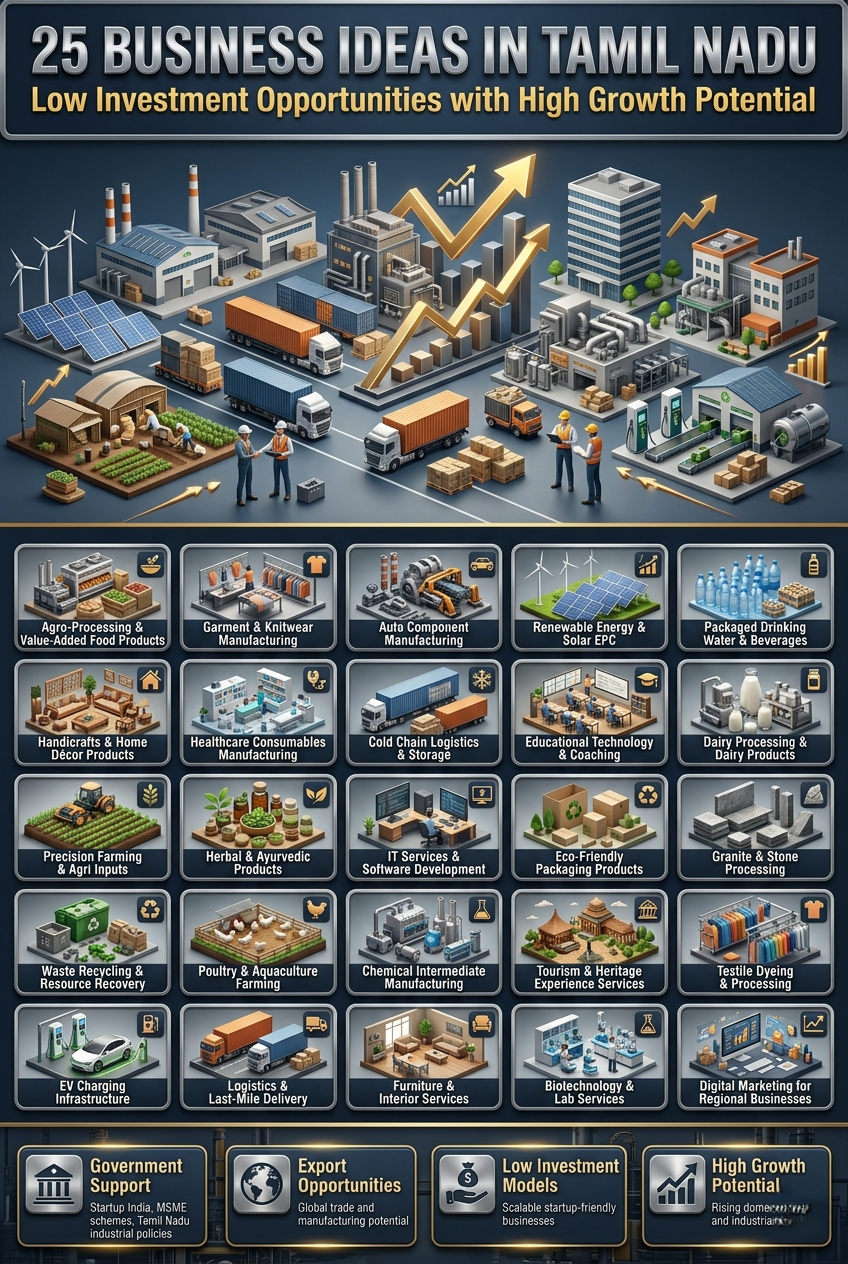
25 Low-Investment Business Ideas in Tamil Nadu: A Sector-by-Sector Analysis
Agro-Processing and Value-Added Food Products
Tamil Nadu’s agricultural output — paddy, groundnut, turmeric, banana, tamarind, and coconut — forms the raw material base for a robust agro-processing industry that remains chronically under-exploited at the MSME scale. Capital outlay required to establish a small-scale unit for rice milling with sortex grading, turmeric polishing and packaging, or tamarind paste extraction ranges from Rs 15–40 lakh. An entrepreneur may recover the investment within 18 months with proper supply chain management. Margins in branded & packaged food product space have increased considerably due to demand from institutional and retail buyers seeking product-traceability & hygiene certifications. Entrepreneurs wishing to make inroads in this domain need to factor in licensing (FSSAI and other relevant ones if needed, like BIS for food products), and direct connect with the FPO.
Explore This Book: Modern Technology of Agro Processing & Agricultural Waste Products
Garment and Knitwear Manufacturing
Tirupur is the garment capital of Asia, accounting for 55% of India’s knitwear exports, and the ripple effects of its supply chain reach deep into surrounding districts. New entrepreneurs can enter the knitwear and garment value chain. They can work as sub-contractors, finishing units, or branded domestic apparel producers. They do not need to match the scale of established exporters. A job-work unit that serves three to five large exporters can be set up for Rs 20–50 lakh. It focuses on specialized embroidery, cut-and-sew, or washing operations. Such a unit can achieve utilization-based profitability within the first year. Alternatively, building a domestic knitwear brand targeting Tier-2 cities — where awareness of quality and brand is rising faster than in metros — represents a medium-term opportunity with strong margin potential. [Source: Business Standard, FY25 Knitwear Exports]
Auto Component and Sub-Assembly Manufacturing
The automotive cluster in Chennai-including Hyundai, the Ford former supply chain, Ashok Leyland, TVS Motors- and the thick matrix of Tier 1 and Tier 2 suppliers makes for a sustained demand for sub-assemblies, precision machined parts, rubber parts, sheet metal fabrications and plastic injection moulded parts. High entry barrier into this segment involves ISO certification and the assurance of quality with a minimum viable production set up somewhere between the range of Rs.30 lakh to 75 lakh, depending upon the type of component. The EV transition in India’s automotive sector is creating a new layer of component demand—battery enclosures, thermal management parts, and EV-specific wiring harnesses—and OEMs are actively developing new suppliers for these components.
Renewable Energy Services and Solar EPC
The growth of solar energy in Tamil Nadu directly opens the doors for EPC contractors, O&M service providers, and component dealers from the state. A solar EPC company with a primary business model of rooftop installation for households, commercial, and industrial clients can start its operations with a team of skilled technicians and business capital line of Rs 15 to 25 lakh. EPC work margins are 12-18%, and AMC margins are recurring revenues. The volumes of enquiries from residential customers are increasing due to the government’s PM Surya Ghar solar home scheme and from commercial customers because of the state Net Metering policy. Tamil Nadu Renewable Energy Policy[Source: Power Line Magazine — Tamil Nadu Renewable Energy Policy]
Packaged Drinking Water and Beverages
The geographical conditions of Tamil Nadu are favourable for packaged drinking water as it is a coastal state, semi-arid in many districts and highly urbanized in the northern part of the state. The cost of installation of a water purification and bottling plant in the range of 5000-10000 litre per day is Rs 20-35 lakh which includes land lease, BIS ISI licensing and equipment. EBITDA margins for the packaged water segment are strongly dependent on the distribution reach: packaged water entrepreneurs can expect to secure margins of 20-28% by investing in direct retail distribution apart from distributors. The segment is becoming more and more premiumised in the alkaline and mineral water segments, with realisation being much higher than in the packaged water segment.
Handicrafts, Home Décor, and Export Artisan Products
The craft traditions of Thanjavur paintings, Chettiar furniture, bronze casting, silk weaving, terracotta and palm leaf art of Tamil Nadu is an untapped product for export in the global home décor and lifestyle market. It is possible to start a craft aggregation and export company with little investment, mostly working capital for stock and photo shoots. Seeing an IEC code, quality grading, packaging investments, and a B2B ecommerce website or an Etsy-type export platform are key requirements. The craft exporters are backed by the government through the One District One Product (ODOP) and GI Tag programmes.
Hospital and Healthcare Consumables Manufacturing
Healthcare industry in Tamilnadan is booming, with a large number of private hospitals, clinics and diagnostic centres in Coimbatore, Madurai, Vellore and Chennai. This drives the need for industrial use of consumables such as examination gloves, disposable syringes, IV sets, surgical drapes, non-wovens and wound care products. The demand of the consumables can be met by setting up a unit for Rs 25 to 60 lakh, depending on the item. It is a prerequisite to have the certification from GMP and MD (Medical Device) registration under the CDSCO. Pharmaceutical or chemical engineering-based entrepreneurs are especially suitable for this sector.
Cold Chain Logistics and Perishable Storage
Tamil Nadu’s horticulture and marine product production is seriously affected due to the lack of proper cold chain facilities at the primary and secondary markets. A Refrigerated transport/cold storage facility for specific commodities— flowers from Dharmapuri belt, prawns from coastal districts, mangoes from Krishnagiri, etc.—with the bankable economics is a reality addressing a real infrastructural gap. A cold storage unit (100 tonne) can be created at Rs 35-60 lakh with subsidy available under the National Horticulture Mission. The market for pre-cooling and controlled atmosphere storage is very small and has only a handful of players in most of the non-metropolitan districts, and is thus in very early stages in these markets.
Educational Technology and Coaching Services
The competitive education environment and English language skills in Tamil Nadu provide favourable market conditions for EdTech services. The education competitive culture and English language skills in Tamil Nadu provide favourable market conditions for EdTech Services. If faculty expenses are minimal and they rent the land, they do not need significant capex to start a coaching institute for NEET, JEE, TNPSC, or competitive bank exams at district headquarters. For small coaching businesses, the hybrid approach (in-person and recorded content, with doubt-clearing apps) is making a huge impact on unit economics and has allowed them to scale their unit capacity without scaling their costs proportionately. The Tamil Nadu competitive exam segment, especially TNPSC Group I–IV, represents a significant untapped market outside Chennai.
Dairy Processing and Value-Added Dairy Products
MSME dairy processors in Tamil Nadu, including the Tamil Nadu Aavin cooperative, produce a large quantity of milk, but they do not add much value to most of it. There are opportunities in the production of paneer, flavored yogurt, ghee and probiotic drinks which have higher realizations than raw milk. Small-scale dairy processing unit having processing capacity is 500-1000 liters/ day may be set up at an initial investment of Rs 20-40 lakh. Institutional supply has become a more consistent distribution avenue to offset the variability of retail distribution to hotel chains, hospitals and company cafeterias. The essential pre-requisite for entering the FSSAI Grade A dairy sector includes dairy licensing and cold chain discipline.
Access Complete Business Plan: Dairy Farming (Cow) Project Report & Business Plan
Precision Farming and Agricultural Input Supply
The use of drip irrigation, precision farming and soil testing is gaining momentum among farmers in Tamilnadu, due partly to the limited availability of water, and partly because of the volatility of output price. A company in the precision agri inputs business (soil sensors, fertigation and drip system, and advisory services) to farmers in the Cauvery delta and northern districts is discovering a technically receptive but untapped market. This business isn’t about product margin, it’s about an advisory relationship that leads to repeat purchase and cross-sell. Structured market entry through tying up with national agri-input companies for market entry and service rights.
Herbal and Ayurvedic Product Manufacturing
Siddha medicine has a rich tradition in Tamil Nadu along with a strong base of cultivation of herbal raw materials such as neem, tulsi, ashwagandha, brahmi and many local herbs. A herbal formulation unit can be set up with investment of Rs 25-50 lakh for making herbal personal care products or digestive supplements or ayurvedic proprietary medicines for domestic and export markets. Ayurvedic formulations come under the regulation of Drugs and Cosmetics Act, and have relatively lower compliance barriers as compared to allopathic drugs. Gulf, USA, UK export orders from the Indian Diaspora have led to continuous pipelines of authentic formulations of herbs without any compromise in their quality or laboratory testing and with modern packaging.
IT Services and Software Development for SMEs
The Chennai IT ecosystem has created a talent pool that is far beyond the city’s limits. The initial start-up costs for a boutique IT services provider that focuses on digital transformation for the large base of Tamil Nadu SMEs such as implementation of accounting software, automation of GST compliance, ecommerce integration or ERP customisation are minimal, 3-5 skilled individuals and almost no capex. The advantage is that domain-specific solutions cater to specific needs, such as those in the textile trading business, granite export business or automotive spare parts distribution business, where generic software is not able to meet the local operational requirements. These SaaS models, built on open-source platforms and requiring a subscription, provide good margins outside of development costs.
Eco-Friendly Packaging and Paper Products
The packaging industry has a significant demand in Tamilnadu owing to its large FMCG, Food Processing and Textile industries. The regulatory ban on single-use plastics has led to a structural change in the packaging industry in favour of paper-based, bagasse and compostable packaging materials. A paper bag making unit/can be started with areca palm leaf manufacturing unit with relatively simple machinery with capital investment of Rs 15-30 lakh. Restaurants, FMCG companies making the change from packaging, and export to European and Middle Eastern buyers that require sustainable sourcing from their suppliers are key markets.
Granite and Stone Processing
Tamilnadu is endowed with rich deposits of granite and the state is home to some of the best granite mines in India, especially the districts of Krishnagiri, Dharmapuri, Salem and Namakkal. The upstream operation of quarrying requires large capital investment and quarry clearance. The downstream stone processing can be done on a relatively small scale. This includes cutting, polishing, surface finishing, and tile fabrication. The granite processing shed with three to four gang saws and a polishing line can be started with Rs 40–80 lakh. It can also get direct access to the export market. Tamil Nadu granite is well recognized in the construction markets of Europe and North America and fetches premium prices there.
The value-added granite products margins are much higher than raw granite blocks. The rock type of this soil is Granite. [Source: TAMIN Granites, Tamil Nadu]
Waste Recycling and Resource Recovery
The urbanisation and industrialisation of Tamil Nadu has generated a huge opportunity in waste management which is largely unmet by organised private waste management. Tamil Nadu has huge opportunity in waste management which is chronically unmet by organised private players, due to the urbanisation and industrialisation of the state. The opportunities for collecting and dismantling e-waste are promising. Making plastic pellets from post-consumer waste is also viable. Recycling textiles into industrial wipers is another option. Organic composting operations are low-capital and financially viable. Waste collection fees are one source of revenue. Selling recovered materials also generates income. Long-term contracts with industries are another source. These industries need certified disposal to meet regulatory requirements. The national EPR framework is shaping up structured demand for registered recyclers from electronics and FMCG companies.
Poultry and Aquaculture Farming
Increase in protein consumption due to the growing income and urbanisation levels has always been higher than the domestic supply in the poultry and seafood proteins category in Tamil Nadu. A broiler poultry farm of 10,000 birds per batch can be established for Rs 25-40 lakh, and breaks even in the third cycle, with an assured offtake. Aquaculture, particularly vannamei shrimp culture in coastal areas, has a better margin of profit but is demanding of technical management of water quality and biosecurity. The economies of commodity farming are far surpassed by integrated models involving production as well as local processing and institutional supply.
Chemical and Industrial Intermediate Manufacturing
Chemical industries in Tamil Nadu, located in Cuddalore, Manali, and Ranipet, provide skilled manpower and infrastructure support for downstream chemical processing at the MSME scale. Specialty chemicals are used in degreasing solutions, textile aids, water treatment, and construction chemicals. They usually have healthy margins. They also have lower entry barriers compared to bulk chemical production. Capital requirement remains low due to the formulation unit, while still capturing chemical sector margins of ₹30–60 lakhs. There are several industrial chemical intermediates with export potential. Tamil Nadu manufacturers have a cost-competitiveness advantage over Chinese manufacturers in certain product categories.
Tourism, Homestay, and Heritage Experience Services
Tamil Nadu is one of the most popular domestic tourist destinations in India, having a circuit of temples, coastal belt, hill stations and heritage towns, that attract large numbers of visitors. The quality accommodation supply of Tier-2 destinations (Kumbakonam, Rameswaram, Mahabalipuram & Yelagiri) is the least in comparison to the tourist demand. A Chettinad mansion, a colonial bungalow, or a property restored in the Chettinad style can be used to create a premium ADR. This works well for a heritage homestay or boutique accommodation business. It also keeps operating expenses relatively low. Swadesh Darshan and PRASHAD are two schemes of the Ministry of Tourism. They provide partial grants for tourism infrastructure in priority circuits.
Find high-return business ideas based on your budget & ROI
Textiles Dyeing, Printing, and Processing
The textile industry in Tamil Nadu includes Erode, Salem, Karur, and Coimbatore. It generates a regular demand for processing services to convert grey fabric into finished fabric. Fabric Dyeing and Printing Facility in Reactive, Digital or Screen-printing technology for furnishing fabrics, ethnic wear and home textiles can be set up at Rs 40-70 lakh. The process water treatment compliance is mandatory for textile clusters under the Tamil Nadu Pollution Control Board regulations. The new ZLD (Zero Liquid Discharge) unit economics have improved considerably. This is due to the use of solar-powered evaporation and membrane filtration. These technologies also help reduce operating costs.
Electric Vehicle Charging Infrastructure
The state’s fast pace of EV adoption, especially of 2-wheelers, 3-wheelers, and commercial vehicles, is generating demand for charging stations that is substantially higher than the number that are available. A company investing in a regional or statewide system of commercial electric vehicle charging stations at logistics parks, along major state roadways or in urban apartment complexes can generate revenue through resale margins, land lease agreements, and ancillary services such as vehicle maintenance and retail at charging stations. The capital cost of an FCS ranges from ₹3–8 lakh per station, depending on charging speed. If stations are placed strategically, a network of 10–15 charging stations can be built for less than ₹75 lakh in total.
Logistics and Last-Mile Delivery Services
The boom in e-commerce has redefined the economics of logistics in Tier-2 and Tier-3 cities of Tamil Nadu. A last-mile delivery franchise or aggregator model covering districts with weak incumbent coverage — Virudhunagar, Tenkasi, Tirunelveli, or Nagapattinam — can achieve rapid volume growth by partnering with national e-commerce platforms as a logistics service provider. The investment requirement is primarily vehicle fleet and warehouse security deposit. Business owners with existing commercial real estate or transport assets can enter this space with a conversion of existing assets rather than fresh capital outlay.
Furniture and Interior Fit-Out Services
Overall, Whether the interest rates go up or down, residential and commercial construction is picking up in Tamil Nadu on account of investments in infrastructure, growth of IT offices and growth of households. Moreover, Institutional- Hospitals, co-working spaces, hotels and government institutions-clients can provide order consistency for modular furniture manufacturing unit/interior fit out contractor whereas a modular furniture provider serving only the residential segment can be plagued by unpredictable orders. Furthermore, With Rs 30-60 lac setup costs for a small factory with CNC routing machinery, one can compete favorably with branded imported modular furniture while offering prompt delivery within the country. Additionally, Utilizing local artisans for upholstery and finishing helps reduce the variable costs but maintains quality of craftsmanship.
Biotechnology and Lab Services
Moreover, There is a major scope for lab testing, QA and research in various sectors such as pharmaceuticals, food processing and agriculture, which has major manufacturing footprint in Tamil Nadu. For example, You can set up a NABL certified testing lab, conducting any of the above-mentioned services (microbiological testing, soil & water analysis, food safety certification, analytical testing for pharma etc.) at a capital cost of Rs.25-50 Lakh depending on accreditation. In addition, NABL accreditations add credibility and would enable participation in government tenders. Thus, entrepreneurs with biology and chemistry backgrounds can build high-value service businesses in this segment. They can focus on food processing clusters and API manufacturers, where outsourced testing is necessary.
Digital Marketing and Content Services for Regional Businesses
In fact, Tamil Nadu’s large MSME sector — traditionally relying on word-of-mouth and local advertising — is undergoing a digital transition accelerated by post-pandemic consumer behaviour changes. Moreover, A digital marketing agency or content production studio specialising in Tamil-language content, regional SEO, and SME digital onboarding can build a high-margin service business with near-zero fixed asset requirements. The differentiation in this space comes from deep sector knowledge. For example, understanding the digital marketing needs of a Tirupur garment exporter is different. It is not the same as those of a Coimbatore engineering firm.This allows well-positioned agencies to command retainer fees well above generic digital marketing rates.
Import–Export Opportunity Analysis for Tamil Nadu Startups
Furthermore, Tamil Nadu’s export competitiveness spans multiple manufacturing and agro-processing categories, and new entrepreneurs can access global markets through several structured entry points. The state’s marine product exports are growing steadily. They are led by shrimp, fish meal, and seaweed, supported by APEDA-registered processors and exporters. In addition, Engineering goods exports from Chennai and Coimbatore cover precision components, pumps, motors, and castings, with growing orders from the Middle East and Southeast Asia.
On the import side, opportunities exist for businesses that localise the sourcing of raw materials. These materials are currently imported from China and Southeast Asia. Moreover, Chemical intermediates, electronic sub-assemblies, specialty textiles, and packaging machinery represent categories where Tamil Nadu businesses can build cost-competitive domestic supply chains with the right technical investment. The DPIIT’s production incentive framework and the state’s export promotion policy together provide support. financial motivation for entrepreneurs willing to develop import-substituting manufacturing.
Moreover, The handicraft and artisan product export opportunity deserves emphasis. Tamil Nadu’s GI-tagged products — Kancheepuram silk, Thanjavur paintings, Aranmula Kannadi — command international premiums that vastly exceed domestic price points. A firm that develops professional export logistics, a proper packaging system, and an online presence focused on one or two GI-tag categories can achieve strong results. Such firms may earn a 40–60% profit margin from exports, which is much higher than domestic market profits.
Indian MSME Success Stories That Offer Strategic Lessons
Saravana Stores — Building a Retail Empire from a Single Shop
To begin with, One of Chennai’s retail institutions, Saravana Stores, founded by P. Saravana Kumar. Saravana Stores began as a small textile shop on Ranganathan Street. It later grew into a well-known retail chain in South India. Moreover, the strategy depended on large-scale bulk purchasing and low overheads. It was based on the idea of serving price-conscious urban consumers. These consumers wanted a “good” product at the “right” price, rather than paying the high prices of branded products. As a result, new entrepreneurs learn the power of compounding by reinvesting margins into expansion instead of taking early profits. Saravana Stores followed this discipline strictly throughout its growth phases.
CavinKare — Building FMCG from a Single Sachet Insight
To begin with, C.K. Ranganathan built CavinKare from a single product insight: that rural consumers wanted quality personal care products but could not afford standard pack sizes. For example, The introduction of the shampoo sachet for Re 1 — later widely copied across FMCG — was not just a packaging innovation but a business model rethinking that opened an entirely new consumer segment. Started in Chennai, CavinKare blossomed into a national FMCG house with brands in shampoo, skin care, dairy, beverage. Key lesson is that business model innovation – on accessibility & distribution-can lead to a broader competitive moat than product innovation. Source: The Print — CavinKare Sachet Story
Related Article: Top 24 Manufacturing Business Ideas in Tamil Nadu Under ₹25 Lakhs (2026)
Butterfly Gandhimathi — Consumer Appliances from Tamil Nadu to National Shelves
Butterfly Gandhimathi Appliances is headquartered in Chennai. It built a strong domestic appliance brand. Its products include mixers, pressure cookers, and gas stoves. The company competed on quality and price. It challenged established national players. Moreover, the company’s success rested on manufacturing discipline, deep distribution in South India, and strong consumer trust. This trust was built over decades of reliable product performance. New entrepreneurs can learn from the company’s patient approach to building markets. Instead of chasing rapid national expansion through heavy marketing spend, Butterfly first strengthened its position in home markets. Only after that did it expand outward. This step-by-step strategy helped build real operational strength.
How NPCS Supports Entrepreneurs Setting Up New Businesses in Tamil Nadu
At Niir Project Consultancy Services (NPCS), we work with entrepreneurs and investors at the point where ambition meets execution risk — the feasibility evaluation stage. We prepare Detailed Market Survey-cum-Techno Economic Feasibility Reports (DPRs). These reports form the basis for investment decisions for each business idea mentioned above.
The DPR includes analysis of the manufacturing process and technology selection. It also covers identification of raw materials and their suppliers. We study market demand and competitor analysis as well. The report evaluates product mix and capacity planning.
In addition, it provides a detailed machine and equipment schedule. It also includes complete financial modelling, covering capital costs, working capital, revenues, and profits. Long-term growth prospects are also assessed.
We add policy incentives at the state level, compliance norms at the sector level, and local market intelligence in state-level reports instead of general reports. This helps advise entrepreneurs in a relevant local context.
Moreover, the idea is that all investment decisions should be supported by a thorough feasibility study. The cost of a good DPR is negligible compared to the loss from a bad project.
Estimated Investment and Return Profile: Selected Business Ideas in Tamil Nadu
| Business Segment | Approx. Investment (Rs Lakh) | Expected Payback Period | Key Revenue Driver |
| Agro-Processing Unit | 15 – 40 | 18 – 24 months | Branded packaged food sales |
| Knitwear / Garment Unit | 20 – 50 | 12 – 18 months | Export job-work / domestic brand |
| Solar EPC Services | 15 – 25 | 10 – 14 months | Project margin + AMC contracts |
| Packaged Water Plant | 20 – 35 | 18 – 24 months | Distribution network reach |
| Auto Component Unit | 30 – 75 | 24 – 36 months | OEM / Tier-1 supply contracts |
| Cold Storage Facility | 35 – 60 | 24 – 30 months | Storage rental + commodity handling |
| Herbal Product Unit | 25 – 50 | 18 – 24 months | Export orders / retail distribution |
| Dairy Processing Unit | 20 – 40 | 18 – 24 months | Institutional supply contracts |
| Granite Processing Unit | 40 – 80 | 24 – 36 months | Export of value-added tiles/slabs |
| EV Charging Network | 50 – 75 | 20 – 30 months | Electricity resale + services |
References and Useful Government / Institutional Links
The following official government and institutional resources are recommended for further reading and for direct application to the schemes discussed in this article.
- Startup India – Official Portal –https://www.startupindia.gov.in/
- Ministry of Micro, Small & Medium Enterprises (MSME) –https://msme.gov.in/
- Udyam Registration Portal –https://udyamregistration.gov.in/
- Department for Promotion of Industry and Internal Trade (DPIIT) –https://dpiit.gov.in/
- Small Industries Development Bank of India (SIDBI) –https://www.sidbi.in/
- MUDRA / PMMY Official Portal – https://www.mudra.org.in/
- CGTMSE Official Portal –https://www.cgtmse.in/
- Ministry of Micro, Small & Medium Enterprises –https://msme.gov.in/
- JanSamarth Portal (Government Loan Schemes) –https://www.jansamarth.in/
- Niir Project Consultancy Services (NPCS) –https://www.niir.org/