How to Start a Packaged Drinking Water Business in India
Contents 10 sections
- Jars, bottles or pouches: which pack should you start with?
- Which licences does a packaged drinking water plant need now that BIS is optional?
- How much does it cost to start a packaged water plant?
- How is packaged drinking water made, and which machines do you need?
- Is a packaged water business profitable?
- Can you start from home or with low investment?
- Where do new packaged water plants go wrong?
- How do you fund it, and what will a lender ask for?
- What should you do in the next 30 days?
- Frequently asked questions
To start a packaged water business in India, choose your pack first: 20-litre jars, 1-litre bottles or pouches. That one decision fixes your machines, your testing load and your buyers. Then arrange, in this order, a water source you have had tested, a treatment and filling line, a licence from the Food Safety and Standards Authority of India (FSSAI) and a contract with an accredited laboratory.
One change trips up first-timers. Since October 2024 the Bureau of Indian Standards (BIS) mark is no longer compulsory for packaged drinking water, so advice to obtain a BIS certificate before anything else is out of date. What decides whether you can sell is now the FSSAI approval and a fixed cycle of lab tests that applies from 1 January 2026. Budget for more than machines too: land, building, testing and working capital sit on top of the equipment bill.
Jars, bottles or pouches: which pack should you start with?
Pick the format by the buyers you can reach in your first three months. The table shows what each format needs and where it loses money.
| Pack | Buyers | Line you need | Pack rule | Where money leaks |
|---|---|---|---|---|
| 20-litre jars | Homes, offices, shops | Jar washer, filler, capper | Reused containers must be plastic of 5 litres or more, or glass | Lost and damaged jars |
| 1-litre and 500 ml PET bottles | Retail, hotels, events | Rinse-fill-cap machine; blow moulder if you make bottles | Bottle and cap migration tested every six months | Bottle and cap cost |
| Pouches | Events, low price points | Form-fill-seal machine | Pouch material and potability tested every six months | Thin price per pack |
If you want an alternative to PET, our guides on paper water bottle manufacturing and PLA bottle manufacturing cover those lines.
Which licences does a packaged drinking water plant need now that BIS is optional?
Start with FSSAI. The rest depend on your water source and state.
| Approval | What to know |
|---|---|
| FSSAI registration or licence | From 1 April 2026, FSSAI's March 2026 turnover order sets registration up to ₹1.5 crore turnover and a state licence from ₹1.5 crore to ₹50 crore. Packaged water is a high-risk category, so FSSAI's November 2024 order, as reported by Lexplosion, requires an inspection before approval and then every year. |
| Lab testing | Monthly microbiology, chemical parameters every three months, pesticide residues and pack migration every six months, all at an FSSAI-notified laboratory accredited by NABL. Test the source before use, and again for any new source. |
| Groundwater NOC | Needed if you use a borewell. The Central Ground Water Authority's consolidated guidelines refuse a no-objection certificate (NOC) to new packaged water units in over-exploited areas, and require a digital flow meter and rainwater recharge from certificate holders. |
| Pollution control consent | Ask your State Pollution Control Board whether consent is needed before you build. |
| GST | Register before your first sale. ClearTax's rate comparison lists 20-litre jars at 5% from 22 September 2025, down from 12%; check other pack sizes on the CBIC rate list. |
How much does it cost to start a packaged water plant?
Capacity and automation move the cost more than anything else. Two NPCS project reports show the spread.
| NPCS project report | Capacity | Plant and machinery | Total capital investment | Return | Break-even |
|---|---|---|---|---|---|
| Packaged drinking water | 10,000 litres a day | ₹60 lakh | ₹180 lakh | 43% | 40% |
| Packaged drinking water, 1-litre PET bottles, automatic plant | 32,000 litres a day | ₹221 lakh | ₹327 lakh | 19% | 60% |
Machinery is a third of the total in the first report and about two thirds in the second, so ask what else sits inside any quote: land, building, working capital, licences and the testing set-up. Buying empty bottles instead of blowing your own, and renting instead of building, also change the figure. These are project-report estimates; a lender needs numbers for your site.
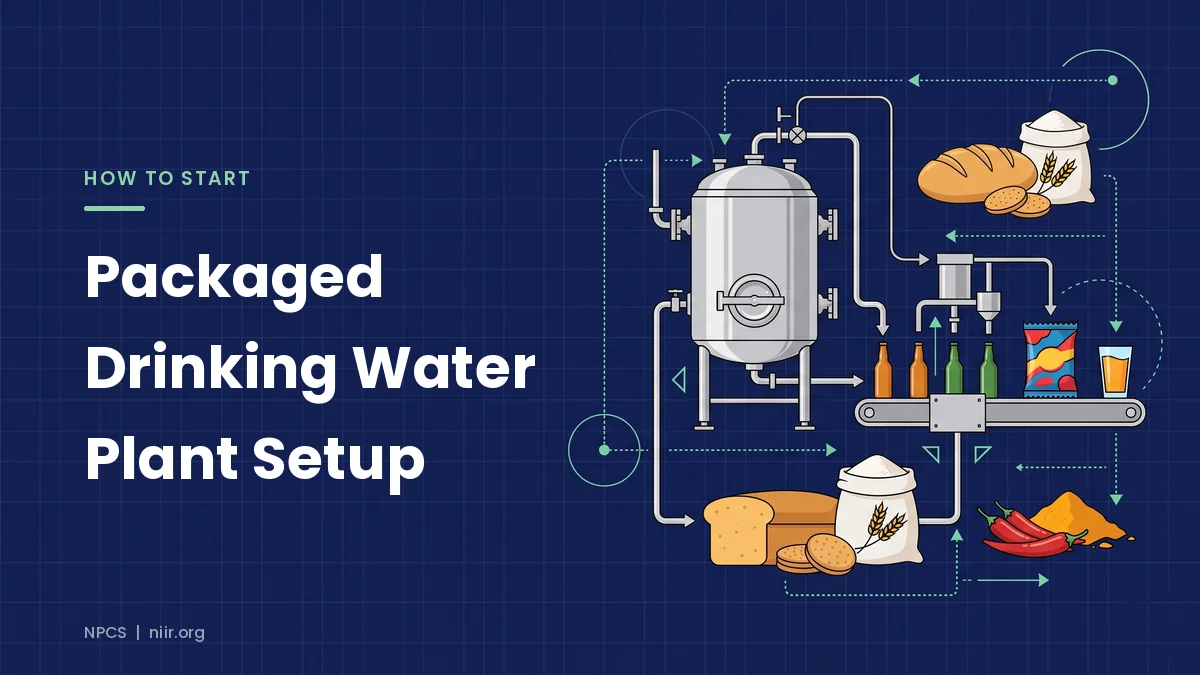
How is packaged drinking water made, and which machines do you need?
The government's 2003 DC-MSME project profile for a 15,000 litres a day bottling unit is still a useful flow sheet, though its cost figures are two decades old.
- Test raw water against the full parameter list before buying equipment.
- Hold it in covered tanks so suspended matter settles.
- Filter through sand, activated carbon and micron cartridges.
- Strip dissolved salts with a reverse osmosis (RO) unit.
- Add minerals back using food-grade or pharma-grade ingredients, then disinfect with ultraviolet light or ozone and declare the method.
- Rinse, fill and cap in a clean filling room, then code, label and pack.
| Machine | Job | Check with the supplier |
|---|---|---|
| Sand and carbon filters | Remove silt, chlorine and odour | Backwash arrangement |
| RO unit | Removes dissolved salts | Membrane life and replacement cost at your water's salt level |
| Mineral dosing unit | Restores minerals after RO | Dosing accuracy and batch records |
| UV and ozone systems | Final disinfection | Lamp life, dose and contact time |
| Rinse-fill-cap machine | Washes, fills and seals containers | Real output per hour for your pack |
| Coder, labeller, shrink wrapper | Batch marking and pack finishing | Space in the packing hall |
A borewell brings the groundwater rules above, while municipal or tanker water brings supply risk, so decide after you hold the test report. Keep raw water, treatment, filling and storage in separate areas and add a diesel generator, because a power cut mid-batch wastes bottles.
Is a packaged water business profitable?
The same two NPCS reports show returns of 43% and 19%, with break-even points of 40% and 60%. The larger automatic plant earns the lower return, so size alone does not make the business pay. Profit follows how close you run to capacity, how far each delivery truck travels and what your bottles and caps cost. Start with a delivery radius you can cover daily, and widen it once the plant runs above its break-even level.
Can you start from home or with low investment?
A plant that needs inspection before approval is hard to run from a home. The lower-cost routes are distributing an established brand, or having a licensed bottler fill under your label, as our contract manufacturing guide explains. In the second case, ask for the plant's licence and its last lab reports before your name goes on a bottle.
Where do new packaged water plants go wrong?
- Buying machines before the source water report, when that report decides the treatment line.
- Chasing a BIS certificate first because older articles say so.
- Sizing for the best month, when the reports above break even at 40% to 60%.
How do you fund it, and what will a lender ask for?
Banks look for the licence plan, a tested water source, supplier quotations and a project report. The Khadi and Village Industries Commission's PMEGP is the usual central subsidy route for small units, but its approved cycle ended on 31 March 2026, and in August 2026 the MSME ministry told the Rajya Sabha that margin money releases depend on approval to continue it, as Kashmir Life reported. Check its status before relying on a subsidy. Our pages on MSME government schemes and startup funding options cover the alternatives. NPCS has prepared project reports since 1994, in the format banks typically ask for.
What should you do in the next 30 days?
- Send water samples to an NABL-accredited lab for the full parameter list.
- Fix your pack and a delivery radius, then list the shops, offices, hotels and caterers you can sign up.
- Get three itemised supplier quotes for the same capacity, each listing filling, packing and lab items.
- Confirm your groundwater category before you pay for land.
- Prepare a detailed project report after a short feasibility study, before you approach a bank.
An NPCS project report for packaged drinking water covers the process flow, machinery, raw water treatment, plant layout, project cost, working capital and a multi-year cash flow with break-even point, which is what lenders usually review. Approval remains the lender's decision. If the numbers do not suit you, compare other food processing business ideas.
Frequently asked questions
How much do 1,000 bottles of water cost?
There is no single price. Build it from supplier quotes: bottle and cap, label or shrink film, treatment consumables, power, labour, lab testing per batch and delivery. Divide the monthly total by your realistic output, not rated capacity.
How much does a 1,000 litre water plant cost?
Ask what the quote includes. Treat a 1,000 litre an hour quote as the treatment block alone until the supplier lists filling, packing, lab and building items in writing. The NPCS report for a 10,000 litres a day plant shows machinery of ₹60 lakh inside ₹180 lakh in total.
Can I reuse 20-litre jars?
Yes, but FSSAI's testing scheme limits reused containers to plastic of 5 litres or more, or glass. Number every jar and track returns, since lost jars are the main leak.
What happens if a batch fails the lab test?
Hold the stock and investigate before shipping more. After a microbiological failure, production restarts only once five consecutive batches pass all applicable microbiological tests. Keep corrective-action records for at least five years. Repeated chemical failures can bring a risk-based inspection.

Planning a new manufacturing unit?
NIIR prepares detailed project reports and feasibility studies for new projects. Share your requirement and the team will get in touch.