How to Start an Additives Manufacturing Business in India
Contents 9 sections
- Which additive family should you make first?
- Should you blend bought-in actives or make the chemical yourself?
- Is an additives manufacturing business profitable?
- How is an additive made, step by step?
- What machinery does an additives plant need?
- Which approvals does an additives unit need, and in what order?
- What decides the cost of an additives plant?
- What should you settle before you buy land or machines?
- Frequently asked questions about starting an additives business
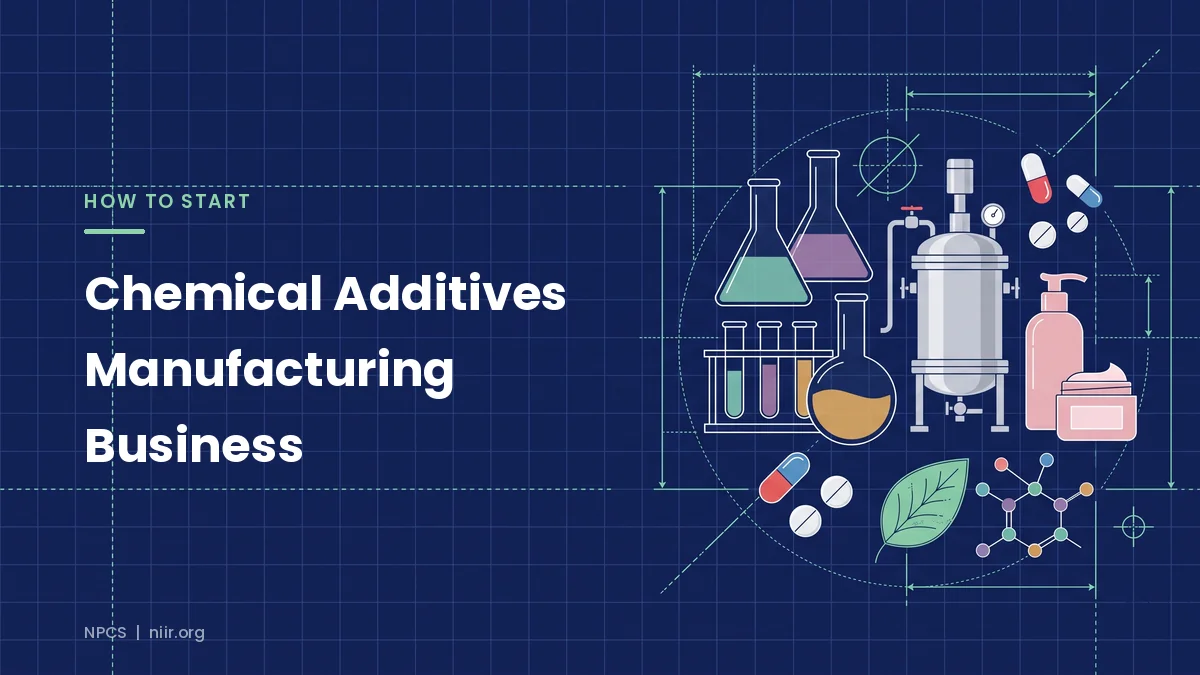
To start an additives manufacturing business, choose one additive family and one way of making it before you look at land or machines. Those choices fix your buyers, approvals and cash needs. A first unit usually blends bought-in active chemicals into a finished product for a buyer who has agreed to test it, such as a plastics compounder, a concrete plant or a paint maker. Making the active chemical by reaction comes later, with more capital and more pollution paperwork. Register on Udyam, ask your State Pollution Control Board for consent before you build, and expect the first order to wait for the buyer's trial, not for your plant. This page covers chemical additives; 3D printing, also called additive manufacturing, is a different business.
Which additive family should you make first?
Additives are chemicals added in small doses to improve another product. Food additives face a legal gate written for the product; for most others, the buyer's trial decides.
| Family | Who buys | What lets you in | Way in |
|---|---|---|---|
| Plastic additives (plasticisers, stabilisers, flame retardants) | Compounders, pipe and film makers | Trial on the buyer's polymer | Blend for one polymer |
| Concrete admixtures | Ready-mix plants, contractors | Test results against IS 9103 | Formulate from bought-in actives |
| Paint additives | Paint and coating makers | Trial in the buyer's formula | Start with one function |
| Lubricant additives | Oil blenders | Slow performance testing | Supply one component, not a full package |
| Food additives | Food and beverage makers | FSSAI licence, permitted list, purity limits | Only with a hygienic plant |
IMARC, a market research firm, puts India's plastic additives market at USD 4.5 billion in 2025 and expects USD 7.0 billion by 2034, listing packaging, automotive, consumer goods and construction as applications. With no named buyer, plastics and paint additives offer the most possible first customers, and concrete admixtures suit you near ready-mix plants. For how these customers work, see paint manufacturing, plastic pipe manufacturing and cement products manufacturing.
Should you blend bought-in actives or make the chemical yourself?
Blending reaches a sample sooner. Reaction gives you control of cost but carries the heaviest paperwork.
| Factor | Blending | Reaction |
|---|---|---|
| Equipment | Mixing vessels, filling, small lab | Reactors, heating, filtration, effluent treatment |
| Pollution paperwork | Set by inputs and wash water | Set by the process itself |
| Margin | You pay the supplier's margin | You keep it but carry input price swings |
| People | Formulation chemist | Process chemist, trained operators |
| First sample | Once actives arrive | After lab work and pilot batches |
Blend first unless a buyer has asked for a product nobody sells locally. Move to reaction when one bought-in active makes up most of your cost and your volumes can carry a plant. If you cannot yet afford vessels, ask an established additives manufacturer to run your formula; the guide to contract manufacturing explains such deals.
Is an additives manufacturing business profitable?
Crisil Ratings' July 2026 outlook for 126 specialty chemical makers, about 40% of industry revenue, shows slower growth and thinner margins.
| Measure | Crisil's finding |
|---|---|
| Revenue growth | About 6% in the fiscal year from April 2026, from about 8% in each of the past two |
| Operating margin | 14-14.5%, down from about 16% last fiscal |
| Crude-linked inputs | Nearly one-third of raw material cost |
Those companies are far bigger than a new unit, so read the figures as direction, not as your profit. Crisil says Chinese competition and dumping constrain pricing. A small unit has less cushion; its protection is a formula the buyer has approved (switching forces the buyer to repeat trials), inputs from more than one supplier, and a price that does not swing with every crude move.
How is an additive made, step by step?
- Agree the target with the buyer: the property to improve, the dose and the test they will run.
- Develop the formula in small lab batches and keep a retained sample of the approved version.
- Charge raw materials into a jacketed vessel and blend them, or react them at a controlled temperature.
- Finish by filtering, neutralising, drying or grinding, or pelletise on an extruder for plastics concentrates.
- Test every batch against the retained sample; IS 9103 asks concrete admixture batches to match the accepted sample on density, pH and chloride content.
- Pack in drums, bags or tanks with batch labels so any complaint can be traced.
What machinery does an additives plant need?
Both routes need a vessel, tanks and a lab; reaction adds filtration, drying and effluent treatment.
| Machine | What it does | Route |
|---|---|---|
| Jacketed vessel with agitator | Mixes and heats the charge | Both |
| High-speed disperser | Breaks powders into liquids | Blending |
| Filter press | Removes solids | Reaction |
| Dryer and pulveriser | Makes powder | Powder products |
| Twin-screw extruder | Makes pellets | Plastics concentrates |
| Tanks, drum and bag filling | Stores and packs | Both |
| Quality lab | Checks every batch | Both |
| Effluent treatment | Treats process water | Reaction |
Which approvals does an additives unit need, and in what order?
- Register on Udyam, the free online MSME registration. As of October 2026, limits revised in Union Budget 2025-26 make a unit micro up to ₹2.5 crore of investment and ₹10 crore of turnover, and small up to ₹25 crore and ₹100 crore. Our MSME guide covers what registration opens up.
- Before paying for land, ask the State Pollution Control Board which category your process falls in. Industries are graded red, orange, green or white, and a worse grade means heavier paperwork.
- Take consent to establish before you build and consent to operate before you produce. As of October 2026, the Environment Ministry's guidelines revised in January 2026 keep a consent to operate valid until cancelled, with inspections continuing, and cut the red category target from 120 to 90 days. Micro and small units in notified industrial estates get consent to establish deemed granted on a self-certified application; ask your board how it applies these.
- Apply for the factory licence from your state's factories department, and ask whether any input counts as a hazardous chemical and what that adds for your site.
- Food additives only: the unit needs an FSSAI licence, as its licensing system has a separate category for substances added to food, and each additive must be permitted and meet FSSAI's purity specifications.
- Check the Department of Chemicals and Petrochemicals' current Quality Control Orders for your inputs and product. It said in December 2025 that it had withdrawn orders on several key chemicals, so an older list of mandatory BIS marks may be outdated.
What decides the cost of an additives plant?
A mixing shed and a reaction plant sit in different cost brackets, so no single figure fits every reader. Three drivers decide where you land.
| Driver | Why it moves cost | How to hold it down |
|---|---|---|
| Route | Reactors, heating and effluent treatment multiply the machinery bill | Start with blending or contract manufacturing |
| Working capital | Industrial buyers usually pay on credit, while actives are bought earlier | Buy small batches, negotiate supplier terms |
| Site and consents | Plot prices and consent fees vary by state | Compare notified industrial estates |
Ask three suppliers for written quotes on the same product form and capacity. Banks usually want a project report; see the detailed project report format and startup funding in India.
What should you settle before you buy land or machines?
- Pick one additive family and write down three buyers you can name.
- Ask each buyer which test it runs on a new additive and how much it would use in a year.
- Get blending quotes, and ask an additives manufacturer whether it will run a trial batch of your formula.
- Show your process flow to the pollution board and factories department before choosing a site.
- Build a cost sheet for the bank. If the numbers disappoint, compare other chemical manufacturing business ideas or browse our manufacturing guides.
Frequently asked questions about starting an additives business
Which additive is in highest demand in India?
Plastic additives have the clearest published numbers: IMARC puts the market at USD 4.5 billion in 2025. Packaging, automotive, construction and consumer goods drive it and also buy paint and concrete additives. Demand helps only if a buyer near you will test your sample, so ask purchase managers first.
Do I need an FSSAI licence to make additives?
Only for additives meant for food. FSSAI's licensing categories include substances added to food, and each food additive must meet its purity specifications. Additives for plastics, paint, concrete or lubricants fall under pollution and factory rules instead.
Can I start an additives unit in a rented shed?
Possibly, but consent is granted for a site and a process, so the board must accept both. A notified industrial estate is simpler: under the January 2026 guidelines, micro and small units there get consent to establish deemed granted on a self-certified application.
Is additive manufacturing the same as 3D printing?
Yes in engineering usage, where additive manufacturing means building an object layer by layer. This page covers chemical additives put into plastics, concrete, paint, oil and food; 3D printing needs different machines, materials and customers.

Planning a new manufacturing unit?
NIIR prepares detailed project reports and feasibility studies for new projects. Share your requirement and the team will get in touch.