
 New

Bestseller
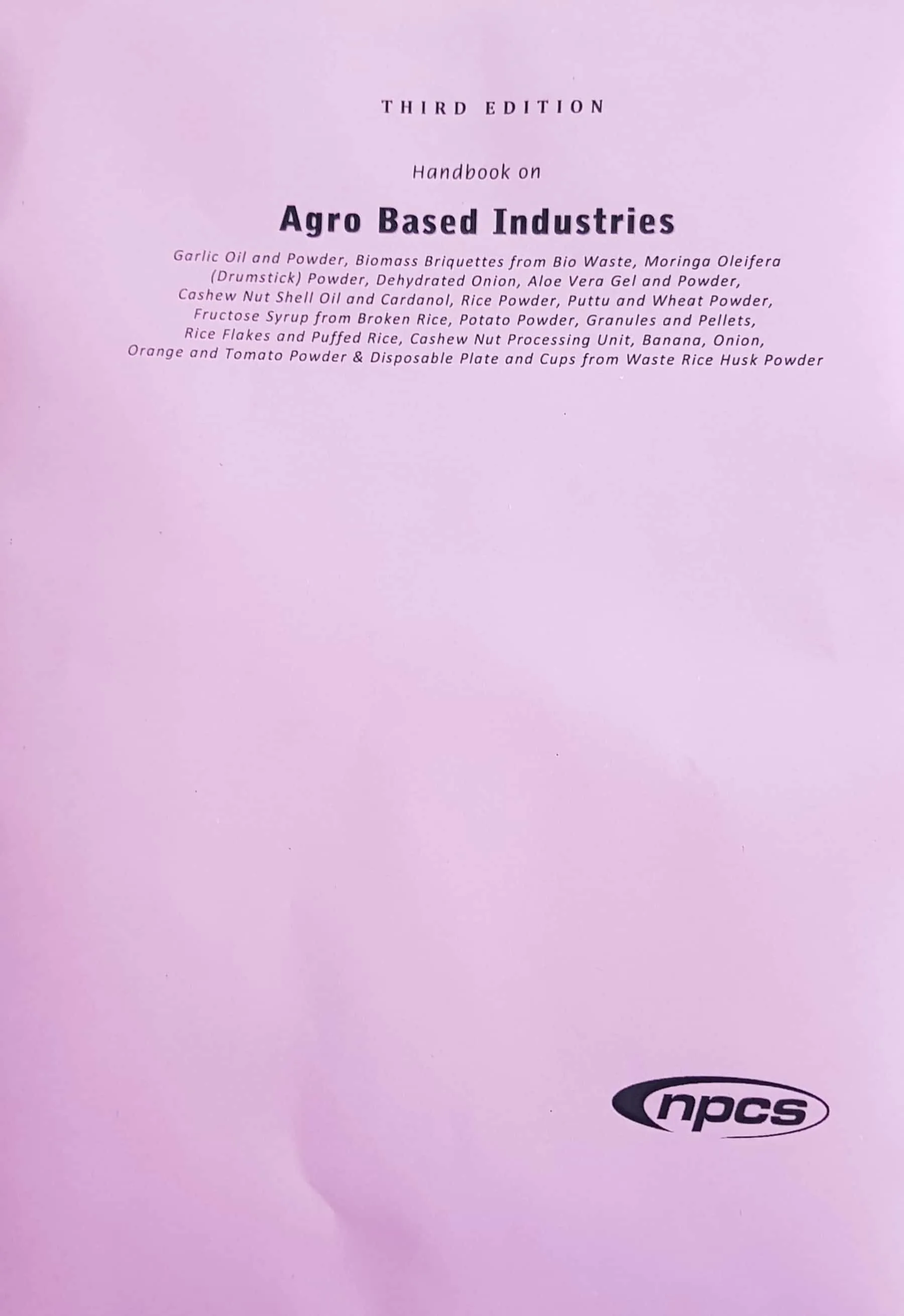
Handbook on Agro Based Industries (3rd Edition)
Handbook on Agro Based Industries · 3rd edition
This book covers agro-based projects such as garlic oil and powder, biomass briquettes, moringa powder, dehydrated onion and aloe vera products. It helps entrepreneurs understand processes, standards and plant economics for agro-based units.
₹1,775 US$45
Plus GST as applicable
- Hardcover
- 221 pages
- In stock, ships in 5 working days
- ISBN
- 9788195676934
- Pages
- 221
- Author
- P.K. Tripathi
- Publisher
- NIIR PROJECT CONSULTANCY SERVICES
- Edition
- 3rd edition
- Language
- English
- Product code
- NI12
Who this book is for
- New entrepreneurs planning an agro-based unit
- Farmer producer organisations
- Food and herbal product makers
- Consultants and investors
What's inside
- Overview of agro-based industries, Indian agribusiness facts and SWOT analysis
- Quality control, BIS standards and legislative framework
- Garlic oil and powder
- Biomass briquettes from bio waste
- Moringa (drumstick) powder
- Dehydrated onion and other agro products
- Manufacturing process, process flow diagrams and plant economics for each project
Table of contents
Show or hide the full contents
1. AGRO BASED INDUSTRIES 1
1.1. INTRODUCTION
1.2. INDIAN AGRI-BUSINESS FACTS AND FIGURES
1.3. SWOT ANALYSIS OF AGRO-PROCESSING INDUSTRY INFRASTRUCTURE IN INDIA
1.3.1. Strengths
1.3.2. Weaknesses
1.3.3. Opportunities
1.3.4. Threats
1.3.5. Agribusiness
1.4. SCOPE FOR AGRIBUSINESS IN INDIA
1.5. QUALITY CONTROL & STANDARDS
1.6. BUREAU OF INDIAN STANDARDS (BIS)
1.6.1. Agricultural Mechanisation
1.6.2. Demonstration of Newly Developed Agricultural/Horticultural Equipments
1.6.3. Outsourcing of Training
1.6.4. Post Harvest Technology and Management
1.6.5. State Agro Industries Corporations
1.6.6. Legislative Framework
2. GARLIC OIL AND POWDER 12
2.1. INTRODUCTION
2.2. PROPERTIES
2.3. USES
2.3.1. Medicinal Use of Garlic as an Antifungal Agent
2.3.2. Storing Garlic in Oil
2.3.3. Uses of Garlic Powder
2.4. B.I.S. SPECIFICATIONS
2.5. DIFFERENT FORMS OF GARLIC
2.5.1. Garlic Flakes
2.5.2. Garlic Powder
2.6. RAW MATERIAL
2.7. MANUFACTURING PROCESS
2.7.1. Garlic Oil
2.7.2. Dehydration Process of Garlic Powder
2.8. SAFETY PRECAUTIONS IN GARLIC DEHYDRATION
2.9. PROCESS FLOW DIAGRAM OF GARLIC OIL & POWDER
2.10. PLANT ECONOMICS
3. BIOMASS BRIQUETTES FROM BIO WASTE 25
3.1. INTRODUCTION
3.2. TYPES OF BRIQUETTES ON THE BASIS OF RAW-MATERIALS
3.2.1. Saw Dust Briquettes
3.2.2. Mustard Husk Briquettes
3.2.3. Cotton Briquettes
3.2.4. Guar Briquettes
3.2.5. Peanut Shell Briquettes
3.2.6. Agro Waste
3.3. USES AND APPLICATIONS
3.4. BENEFITS OF THE BIOMASS BRIQUETTES
3.4.1. Environmental Benefits
3.4.2. Social Benefits
3.4.3. Economic Benefits
3.5. ADVANTAGES
3.6. PROPERTIES
3.7. CHARACTERIZATION OF BRIQUETTES
3.8. BIOMASS CHARACTERISTICS
3.9. FACTORS INFLUENCING BIOMASS UTILIZATION
3.10. ENVIRONMENTAL ASPECTS
3.11. RAW MATERIALS
3.11.1. Biomass Classification on the Basis of Different Sector
3.12. MANUFACTURING PROCESS
3.13. PROCESS FLOW DIAGRAM
3.14. HEALTH AND SAFETY MEASURES IN BRIQUETTE PRODUCTION
3.15. PLANT ECONOMICS
4. MORINGA OLEIFERA (DRUMSTICK) POWDER 47
4.1. INTRODUCTION
4.2. HISTORY OF MORINGA
4.3. VARIETIES OF DRUMSTICKS (MORINGA)
4.4. USES OF MORINGA
4.5. NUTRITIONAL VALUES OF MORINGA
4.6. USES OF DRUMSTICK POWDER
4.7. HEALTH BENEFITS OF DRUMSTICKS
4.8. NUTRITIONAL VALUE OF DRUMSTICK
4.9. MANUFACTURING PROCESS
4.10. PROCESS FLOW DIAGRAM
4.11. QUALITY SPECIFICATIONS
4.12. FOOD SAFETY & STANDARD REQUIREMENTS
4.13. WASTE COLLECTION AND MANAGEMENT PROCEDURES
4.13.1. Major Waste Generating Activities
4.13.2. Waste Management Practices
4.14. POLLUTION PREVENTION AND CONTROL
4.15. PLANT ECONOMICS
5. DEHYDRATED ONION 60
5.1. INTRODUCTION
5.2. TYPES OF DEHYDRATED ONION
5.3. NUTRITIONAL VALUES
5.3.1. Onion
5.3.2. Dehydrated Onion Flakes
5.4. PRODUCTS SPECIFICATIONS
5.4.1. Dehydrated Onion
5.5. USES & APPLICATIONS
5.5.1. Uses
5.5.2. Applications
5.6. B.I.S. SPECIFICATIONS
5.7. HEALTH BENEFITS OF ONION
5.8. HUNDRED PERCENT (100%) EXPORT ORIENTED UNIT
5.9. DEHYDRATION PROCESS OF ONION
5.10. PACKAGING OF DEHYDRATED ONION
5.11. PROCESS FLOW DIAGRAM
5.12. FOOD SAFETY REQUIREMENTS & STANDARD REQUIRED
5.13. WASTE COLLECTION AND MANAGEMENT PROCEDURES
5.13.1. Major Waste Generating Activities
5.13.2. Waste Management Practices
5.14. POLLUTION PREVENTION AND CONTROL
5.15. PLANT ECONOMICS
6. ALOE VERA GEL AND POWDER 76
6.1. INTRODUCTION
6.2. THE CHEMISTRY OF ALOE VERA
6.3. HEALTH BENEFITS
6.4. PROPERTIES OF ALOE VERA
6.4.1. Active Components with its Properties
6.5. USES & APPLICATIONS
6.5.1. Aloe Vera Gel
6.5.2. Aloe Vera Powder
6.6. BENEFITS OF ALOE VERA POWDER
6.6.1. Health Benefits
6.7. BENEFITS OF ALOE VERA GEL
6.8. MANUFACTURING PROCESS
6.9. DETAILS MANUFACTURING PROCESS
6.9.1. Aloe Vera Powder
6.10. PROCESS FLOW DIAGRAM
6.11. THE STAGES OF THE TTS (TIME, TEMPERATURE AND SANITATION) ALOE PROCESS
6.11.1. Timing of Leaf Process
6.12. PLANT ECONOMICS
7. CASHEW NUT SHELL OIL AND CARDANOL 95
7.1. INTRODUCTION
7.1.1. Cashew Nut Shell Oil
7.1.2. Cardanol
7.1.3. Characteristic of Cardanol
7.2. USES & APPLICATION
7.2.1. Cashew Nut Shell Oil
7.2.2. Cardanol
7.3. PROPERTIES
7.4. COMPOSITION OF CASHEW NUT
7.5. PROPERTIES OF CNSL RESIN
7.6. APPLICATION OF CNSL RESIN
7.7. CHEMICAL COMPOSITION OF CNSL
7.7.1. Separation of Cardanol from CNSL Oil
7.7.2. Feasibility of Cardanol for Biofuel
7.8. B.I.S. SPECIFICATIONS
7.9. MANUFACTURING PROCESS
7.9.1. Cashew Nut Shell Oil Processing
7.9.2. Process Flow Diagram of Cashew Nut Shell Oil
7.9.3. Cardanol Processing from CNSL
7.9.4. Process Flow Diagram of Cardanol
7.10. QUALITY CONTROL & STANDARDS
7.10.1. Untreated Cashew Nut Shell Liquid
7.10.2. Treated Cashew Nut Shell Liquid
7.10.3. Cold Pressed Cashew Nut Shell Liquid
7.10.4. Machine Performance Evaluation
7.10.5. Extraction Efficiency
7.11. ENVIRONMENT POLLUTION AND EFFLUENT TREATMENT
7.11.1. Effluent Treatment Plant Equipment
7.12. PLANT ECONOMICS
8. RICE POWDER, PUTTU AND WHEAT POWDER 120
8.1. INTRODUCTION
8.1.1. Wheat Flour
8.1.2. Wheat Varieties
8.1.3. Benefits
8.1.4. Health Benefits
8.2. USES
8.2.1. Health Benefits of Rice Flour
8.2.2. Gluten-Free
8.2.3. Protein
8.2.4. Fiber
8.3. MANUFACTURING PROCESS
8.3.1. Rice Flour
8.3.2. Puttu
8.3.3. Production Process for Puttu
8.4. PLANT ECONOMICS
9. FRUCTOSE SYRUP FROM BROKEN RICE 129
9.1. INTRODUCTION
9.2. PROPERTIES
9.3. USES AND APPLICATIONS
9.4. RAW MATERIAL
9.5. MANUFACTURING PROCESS
9.6. PROCESS FLOW DIAGRAM
9.7. PLANT ECONOMICS
10. POTATO POWDER, GRANULES AND PELLETS 135
10.1. INTRODUCTION
10.1.1. Potato Powder
10.1.2. Potato Granules
10.1.3. Potato Pellets
10.2. PROPERTIES
10.2.1. Potato Powder
10.2.2. Potato Granules
10.2.3. Potato Pellets
10.3. USES
10.3.1. Potato Powder
10.3.2. Potato Granules
10.3.3. Potato Pellets
10.4. BENEFITS
10.4.1. Potato Powder
10.4.2. Potato Granules
10.4.3. Potato Pellets
10.5. VARIETY OF INDIAN POTATO
10.6. RAW MATERIAL DETAILS
10.7. MANUFACTURING PROCESS
10.7.1. Potato Powder
10.7.2. Potato Granules
10.7.3. Potato Pellets
10.7.4. Basic Raw Material Required:
10.8. PROCESS FLOW DIAGRAM
10.8.1. Potato Powder
10.8.2. Potato Granules
10.8.3. Potato Pellets
10.9. FOOD SAFETY REQUIREMENTS & STANDARD REQUIRED
10.10. WASTE COLLECTION AND MANAGEMENT PROCEDURES
10.10.1. Major Waste Generating Activities
10.10.2. Waste Management Practices
10.11. POLLUTION PREVENTION AND CONTROL
10.12. PLANT ECONOMICS
11. RICE FLAKES AND PUFFED RICE 151
11.1. INTRODUCTION
11.2. USES & APPLICATIONS
11.3. HEALTH BENEFITS OF PRODUCT
11.3.1. Rice Flake
11.3.2. Puffed Rice
11.4. PROPERTIES
11.4.1. Rice Flakes
11.4.2. Puffed Rice
11.4.3. B.I.S. SPECIFICATIONS
11.5. RAW MATERIALS DETAILS
11.6. INDIAN PRODUCTION OF RICE
11.7. RICE VARIETIES
11.7.1. Physical Characteristics of Rice Types
11.7.2. Milled or White Rice
11.7.3. Nutrition Value of Rice
11.8. HEALTH BENEFITS OF RICE
11.9. RICE FLAKES MANUFACTURING PROCESS
11.10. PROCESS FLOW DIAGRAM
11.11. PUFFED RICE MANUFACTURING PROCESS
11.12. PROCESS FLOW DIAGRAM
11.13. PLANT ECONOMICS
12. CASHEW NUT PROCESSING UNIT 164
12.1. INTRODUCTION
12.2. NUTRITIVE VALUE/COMPOSITION
12.2.1. Cashew Nut Kernel
12.2.2. Overall Composition
12.2.3. Nutritive Value in Cashew Nut
12.3. CASHEW NUT SHELL OIL
12.4. CASHEW APPLE
12.5. USES OF CASHEW NUT
12.6. HEALTH BENEFITS OF CASHEW NUTS
12.7. PROPERTIES
12.8. ADVANTAGES OF CNSL BASED POLYMERS
12.9. B.I.S. SPECIFICATIONS
12.10. CASHEW NUT PROCESSING
12.11. MEASUREMENT OF THE MOISTURE CONTENT OF CASHEW KERNELS
12.12. EXTRACTION OF CASHEW NUT SHELL LIQUID
12.13. MANUFACTURING PROCESS OF CNSL
12.14. PROCESS FLOW DIAGRAM
12.15. CASHEW KERNEL PROCESSING STEPS
12.16. PROCESS FLOW DIAGRAM OF CNSL
12.17. QUALITY CONTROL (PLANT SANITATION)
12.17.1. Quality Control of Cashew Kernels
12.18. HYGIENE AND SAFETY
12.19. FOOD POISONING AND ITS CAUSES
12.20. ENVIRONMENTAL STANDARDS FOR CASHEW PROCESSING INDUSTRIES
12.20.1. Air Pollution Emission Standards
12.20.2. Wastewater Discharge Standards
12.20.3. Solid Waste Disposal Practices
12.21. PLANT ECONOMICS
13. BANANA, ONION, ORANGE AND TOMATO POWDER 183
13.1. INTRODUCTION
13.2. B.I.S. SPECIFICATIONS
13.3. BANANA POWDER
13.3.1. Introduction
13.3.2. Nutritional Value
13.3.3. Uses and Applications
13.3.4. Raw Material
13.3.5. Manufacturing Process
13.4. Process Flow Diagram
13.5. ONION POWDER
13.5.1. Introduction
13.6. NUTRITION FACTS OF ONION POWDER
13.6.1. Uses and Applications
13.6.2. Raw Material
13.6.3. Manufacturing Process
13.6.4. Process Flow Diagram
13.7. ORANGE POWDER
13.7.1. Introduction
13.7.2. Nutritional Value
13.7.3. Raw Material and its Availability
13.7.4. Manufacturing Process
13.7.5. Process Flow Diagram
13.8. TOMATO POWDER
13.8.1. Introduction
13.8.2. Uses and Applications
13.8.3. Manufacturing Process
13.8.4. Process Flow Diagram
13.9. PLANT ECONOMICS
14. DISPOSABLE PLATE AND CUPS FROM WASTE RICE HUSK POWDER 200
14.1. INTRODUCTION
14.2. PRODUCT DETAIL
14.3. BENEFITS
14.4. RAW MATERIAL DETAILS
14.5. PROPERTIES
14.6. MANUFACTURING PROCESS
14.7. PROCESS FLOW DIAGRAM
14.8. PLANT ECONOMICS
Need a detailed project report?
This book explains the technology. For a bank loan or an investment decision, NPCS also prepares project reports with plant cost, machinery and five-year financials.
About this book
Read the full description
Handbook on Agro Based Industries (Garlic Oil and Powder, Biomass Briquettes from Bio Waste, Moringa Oleifera (Drumstick) Powder, Dehydrated Onion, Aloe Vera Gel and Powder, Cashew Nut Shell Oil and Cardanol, Rice Powder, Puttu and Wheat Powder, Fructose Syrup from Broken Rice, Potato Powder, Granules and Pellets, Rice Flakes and Puffed Rice, Cashew Nut Processing Unit, Banana, Onion, Orange and Tomato Powder & Disposable Plate and Cups from Waste Rice Husk Powder)
The term "agro" refers to agriculture, which is the cultivation of crops and the rearing of animals for various purposes. The agro-based industry, "agro" encompasses all the activities related to farming, including growing crops, raising livestock, and harvesting natural resources. Agro is the foundation of the agro-based industry, as it involves the production of raw materials and agricultural products that are essential for various sectors. This includes crops such as grains, fruits, vegetables, and oilseeds, as well as livestock such as cattle, poultry, and fish.
Agro-based industries use these agricultural products as raw materials for further processing and manufacturing. For example, crops can be processed into food products such as flour, oil, and beverages, while livestock can be processed into meat, dairy products, and leather. In addition to food and beverages, the agro based industry also includes sectors such as biofuels, forestry, and fisheries. Biofuels are derived from agricultural crops and are used as an alternative to traditional fossil fuels. Forestry involves the sustainable management of forests and the production of wood products. Fisheries focus on the breeding and harvesting of fish and other aquatic organisms.
Agro is the backbone of the agro-based industry, providing the necessary raw materials and resources for various sectors. It is an integral part of our economy and plays a vital role in meeting the growing demand for food, fuel, and fiber products.
India is one of the largest producers of food, and is the second largest producer of rice, wheat, fruits, and vegetables in the world. Nearly 70% of the population depends on agriculture and agro-based industries. Since it would cause diversification and commercialization of agriculture, it will thus enhance the incomes of farmers and create food surpluses. It is a well-recognized fact across the world, particularly in the context of industrial development that the importance of agro industries is relative to agriculture increases as economies develop. It should be emphasized that food is not just produce. Food also encompasses a wide variety of processed products. It is in this sense that the agro-industry is an important and vital part of the manufacturing sector in developing countries and the means for building industrial capacities. The development of agro-based industries commenced during pre-independence days. Cotton mills, sugar mills, jute mills were fostered in the corporate sector.
The major contents of the book are production of Garlic Oil and Powder, Biomass Briquettes from Bio Waste, Moringa Oleifera (Drumstick) Powder, Dehydrated Onion, Aloe Vera Gel and Powder, Cashew Nut Shell Oil and Cardanol, Rice Powder, Puttu and Wheat Powder, Fructose Syrup from Broken Rice, Potato Powder, Granules and Pellets, Rice Flakes and Puffed Rice, Cashew Nut Processing Unit, Banana, Onion, Orange and Tomato Powder, Disposable Plate and Cups from Waste Rice Husk Powder with Manufacturing Process, Project Profiles (with cost estimation) and process flow diagrams. This book is also a fantastic resource for people interested in or who have worked in the Agro Based industry.
Profitable and viable business opportunities exist in the Agro sector. As a result, creating your own business is a good way to get into it. To learn more about Agro based industry in depth, read this book. It will assist you in figuring out how to establish your own Agro Business. Because of the increasing demand for Agro based Products in today's market, it's a terrific method to earn money.
Questions about this book
Is this a printed book or a PDF?
This is a hardcover edition, shipped within 5 working days of payment. The free sample PDF on this page shows the contents and introduction.
Which edition is this?
This is the 3rd edition of the Handbook on Agro Based Industries.
Can I order from outside India?
Yes. Buyers outside India pay the US$ price shown. WhatsApp or email us for the delivery time to your country.
Can colleges, libraries or companies order in bulk?
Yes. Write to npcs.india@gmail.com or WhatsApp us with the titles and quantities for a quote.
How do I pay?
Add the book to the cart and pay online, or WhatsApp us to order and pay by bank transfer.