Wire nails are one of the most under-noticed but always rewarding business opportunities in the manufacturing sector in India. On the surface, they seem like a nothing product — just a commodity, sold by the pound, in hardware stores. But for a consultant with an industrial background, who’s walked the factory floors and pored over feasibility models, wire nails have a fascinating history of constant demand, low competition from organised players and a manufacturing model that suited first generation entrepreneurs.
The product is indispensable. Wire nails are essential components in any project, whether it’s a rural carpenter building furniture or an urban contractor erecting formwork, or a packaging company nailing wooden crates together. Furthermore, low entry barriers, the well-developed government support system, and the market fragmentation allow a disciplined small manufacturer to establish a market position.
The story of the construction and infrastructure development in India is directly related to the consumption of wire nails as a part of the various initiatives launched by the government of India such as PM Gati Shakti, AMRUT 2.0 and Pradhan Mantram Awas Yojana. Millions of nails are required for every square foot of new construction, each new housing unit in a tier-2 city and each new warehouse cluster on a national highway. This is not a hypothetical demand forecast for any serious consideration on business ideas for manufacturing. It is a reality in the market that is already coming true in all the districts of the Country.(Wire Nails Manufacturing Business)
Why the Wire Nail Sector Deserves Serious Attention
The Indian wire nail industry is structurally capable to accommodate MSMEs. This space is unattractive to large, organized players. Margins are thin, and serving a geographically dispersed network of hardware distributors is operationally challenging at scale. This establishes a secured and constant market segment for SMEs to fulfill regional distribution systems and offer tailored conditions.
The demand for wood from the building industry, furniture industry, wooden packing units and railway sleepers contractors is consistently high. The real estate sector of India, which contributes to over 7% of the country’s GDP, is on a long upward trajectory, and estimates of housing shortfall are in the millions. Moreover, other industries are also strong users of demand:
- MDF board producers using nails for joining and plywood manufacturers using nails for their production.
- Suppliers of wooden formwork to the high-rise construction industry
- Pallet and wooden crate manufacturers in the logistics and export industries. The wood and paper pallet producers in logistics and exporting industries.
- For pre-engineered building system contractors that need special nails.
A smaller but genuine threat comes from export markets, particularly in Africa, South Asia, and the Middle East. Indian prices remain competitive in these regions, and strong trade links are already in place. Further, the raw material – low carbon mild steel wire – is easily available from the local manufacturing units like Steel Authority of India Limited (SAIL) and various small rolling mills in Punjab, Maharashtra and Gujarat. Process is not too complicated and is mechanised, so availability of skilled labour is not a hurdle in tier-3 areas.
Government Policies and Incentives Supporting Wire Nail Manufacturers
The government supports this segment with a well-developed support ecosystem, which helps new entrants in this segment. There are several ways that schemes directly ease the capital load and risk the first-generation entrepreneur.(Wire Nails Manufacturing Business)
- CGTMSE (Credit Guarantee Fund Trust for Micro and Small Enterprises): Loans up to ₹2 crore with no collateral required, making the money the main concern for the founder not a property concern.
- PMEGP (Prime Minister’s Employment Generation Programme): It is a government scheme that provides maximum capital subsidy of 35% to the rural entrepreneurs under KVIC and State Nodal Agencies. Wire nail production being labour intensive is well place in the eligibility criteria.
- MSE-CDP (Cluster Development Programme): Entrepreneurs in the designated industrial clusters are offered subsidised infrastructure, common facility centres and marketing development. In the past, iron and steel processing units in Ludhiana and Jamnagar, Howrah have promoted allied industries like nail making.
- The benefits under RoDTEP (Remission of Duties and Taxes on Exported Products) to export-oriented units are a significant boost to the profitability of exports.
The Udyam Registration portal allows MSMEs to register in just a few minutes. Registered enterprises are able to avail of facilities of priority sector lending, government preference in procurement of goods/services and payment protection as per MSMED Act at concessional rates. The DGFT portal enables IEC registration and access to export incentives for operations that are import-export orientated.
Access Complete Business Plan: Wire Nail
Five Strong Business Ideas for Startups in Wire Nail Manufacturing
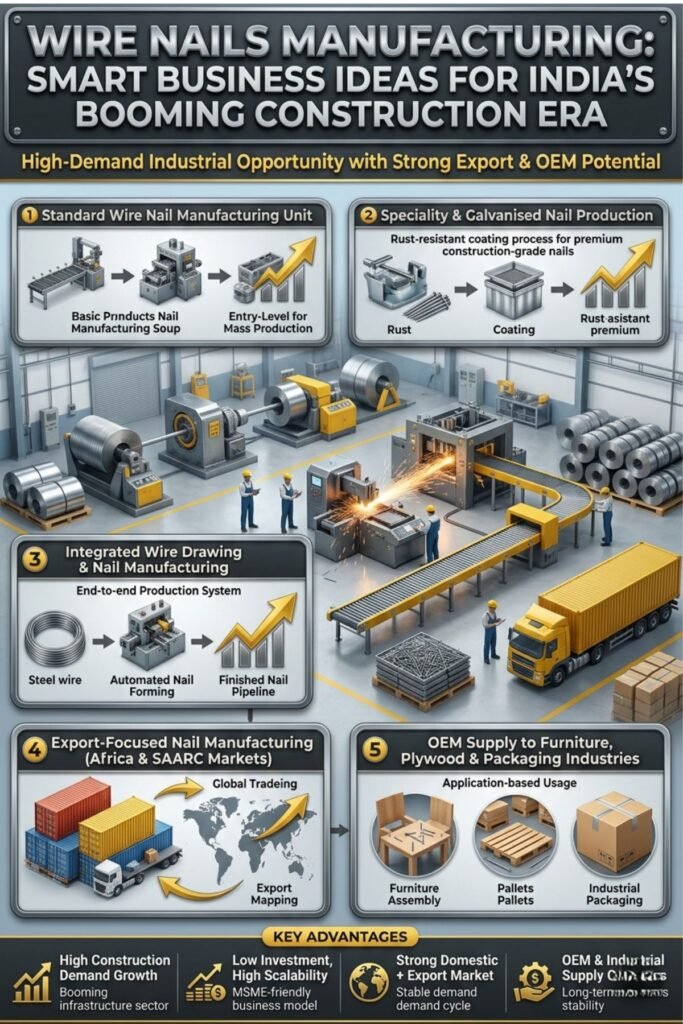
The wire nail value chain has several distinct entry points, all of which are appropriate to varying amounts of capital, risk appetite, and market aspirations. The following are five clearly stated models that you can consider.
1. Standard Wire Nail Manufacturing Unit
The most direct route is to set up the production line of wire nail production stand-alone, which can be made by wire drawing machine, nail making machine and polishing drum. A medium scale unit with a capacity of 3-5 metric tonnes per day can be used to cater to a district network of 4-6 districts in the region. Capital investment is generally ₹20–30 lakh for machinery and ₹8–12 lakh for working capital. Generally, the capital investment is around ₹20–30 lakh for machinery and ₹8–12 lakh for working capital which is accessible to first generation entrepreneurs with CGTMSE backing.(Wire Nails Manufacturing Business)
Production capacity can be adjusted to market demand. The breakeven period of a unit located in a good spot is usually less than 18 months. The secret to profitable operations is the discipline in sourcing raw material: the price of wire rod fluctuates with the steel cycles and procurement contracts with fixed price clauses for 30-60 days offer a level of cost insulation.
2. Speciality and Galvanised Nail Production
In addition to common nails, the market for galvanised nails, roofing nails, hardened masonry nails and ring-shank nails is expanding quickly. This need is created by the roofing industry, pre-engineered building industry as well as modular furniture industry. The price gap between galvanised nails (either hot dip or electro galvanised for corrosion resistance) and plain nails is 25-40% and they are less directly competitive to informal galvanised nail producers.
Upgrading a basic wire nail unit with a galvanizing tank and related equipment requires an incremental investment of ₹8–15 lakh. This upgrade can significantly improve margins and enhance product defensibility. It is important that the aspiring entrepreneur target and focus on the institutional end-users like roofing contractors, pre-engineered building system suppliers and export packers as opposed to retail hardware channels in this sub-segment of the industry.
3. Integrated Wire Drawing and Nail Manufacturing
Another “capital intensive” but hugely higher margin option is to integrate back into wire drawing. To avoid buying finished wire, the entrepreneur buys mild steel wire rods (one step before wire making) and pulls them in the required gauge before the production of nails. The additional investment required is of the order of ₹15-25 lakh in multi die drawing machines with annealing furnace. But the raw material cost per tonne advantage can boost the EBITDA margin by 8-12 percentage points.
This model also improves supply chain resilience. It is not dependent on external wire supplies and can provide surplus drawn wire to other nail manufacturers. The company draws wire in-house and pulls it to the required gauge before nail production. This model has a clear better return profile for site within steel rolling clusters in Punjab or Gujarat.
Read the Complete Book Here: Steel and Iron Handbook
4. Export-Focused Nail Manufacturing for African and SAARC Markets
India has consistently exported a few minor hardware items, which are known as wire nails. Common and galvanised nails are imported from India to African markets, such as Nigeria, Kenya, Ethiopia and Tanzania, because of their competitive pricing and trade connections. Neighbours of SAARC countries like Bangladesh, Nepal and Sri Lanka are also regular importers.
A unit geared toward exports needs a bit more investment in packaging, quality control and third-party certification. However, it is able to tap markets where domestic competitors are not present. The margins in export pricing are typically 15-25% over domestic selling prices in USD. The RoDTEP scheme offers a tax rebate on embedded taxes, which will further improve the competitiveness of exports.
5. OEM Supply to Furniture, Plywood, and Packaging Industries
An OEM-to-OEM direct supply relationship with furniture manufacturers and plywood furniture assemblers and wooden crate/pallet manufacturers is a volume secure business model. These buyers value consistent quality, standard sizing, and reliable delivery. A professionally run small unit can meet these expectations better than an informal roadside supplier.
The long-term contracts with these buyers help in minimizing the volatility of the spot market prices and help in better raw materials planning. Furniture and plywood manufacturers are concentrated in cities such as Morbi, Rajkot, Yamuna Nagar, and Ernakulam. These cities are major institutional buyers of wire nails in large quantities.
Import–Export Opportunity Analysis
India is in a structurally favourable position in the world trade in wire nails. Indian nail manufacturers are cost-competitive with producers in China, Taiwan, and Vietnam. India’s advantage comes from low manufacturing labor costs and established shipping links to African, Middle Eastern, and South Asian ports. China also faces anti-dumping restrictions in several markets.
On the export side, India’s manufacturing capacity restricts exposure by itself, small manufacturers provide thousands of points of supply to the domestic market. But the importation of speciality fasteners (ring-shank, spiral, and stainless-steel nails) from Germany, Taiwan and South Korea is a definite substitution opportunity. Indian manufacturers developing precision nail making facilities can grab this local market, which is being tapped by imports.
Entrepreneurs can refer to the DGFT portal and Engineering Export Promotion Council (EEPC India) for export documentation, rate incentive details and market intelligence. EEPC India organise market access reports and attend various international trade fairs related to hardware industry regularly.
Find high-return business ideas based on your budget & ROI
Indian MSME Success Stories in Wire Nail Manufacturing
Three entrepreneurs show how they have found profitable ways to use strategic thinking to develop wire nail businesses, in their real-world examples of this seemingly straightforward product category.
Everest Industries Limited — Punjab
The small hardware cluster in Ludhiana was the origin of the nail manufacturing wing that became a success for Everest, as they realised that wire quality uniformity and packaging differentiation would help them gain over institutional buyers, who would otherwise end up with the unorganised manufacturers. The promoters spent money on making nail-making machines calibrated from Germany and also set up a separate quality control lab – something that was unusual for a unit of this size. They were working to ensure inventory of their product with the furniture manufacturers in Haryana and Delhi NCR region and this resulted in the significant turnover. The message of the lesson is clear: consistency is the competitive moat for a commodity product.(Wire Nails Manufacturing Business)
Shree Nails and Wires — Gujarat
Shree Nails and Wires of Rajkot has carved out a niche for itself by providing wire drawing services from the beginning of its operations. The promoter realised that the price of wire was by far the most variable cost and invested in a small wire drawing plant, ahead of others. This reverse integration resulted in a reduction of production cost to ₹2,000-2,500 per tonne, aggressive regional market pricing and preservation of margins as well. The company currently caters to packaging manufacturers in Gujarat as well as exports to East African markets via a trading partner based in Mumbai. The takeaway: Structural advantage and not price-cutting can lead to cost leadership that is sustainable.
Aggarwal Iron Works — Uttarakhand
Aggarwal Iron Works is a case study on how location can enhance profit, as they are located in Haridwar’s industrial estate and take advantage of the state MSME incentives. The founder’s timing was planned around the state government’s industrial policy, which provided capital investment subsidies and electricity tariff concessions. The unit has embarked on a mission of becoming self-sustaining in just 14 months with state incentives and PMEGP support and a targeted approach to the construction suppliers of UP and Uttarakhand. The take-home message for new entrepreneurs is that it is as important as manufacturing quality: geography and timing. Accumulating to a conventional business, but entering a government incentive zone, can switch the economic course of a business.
Wire Nail Industry: Key Project Benchmarks
| Parameter | Small Unit (1–2 MT/day) | Medium Unit (4–5 MT/day) |
| Estimated Project Cost | ₹18–25 Lakh | ₹45–65 Lakh |
| Working Capital Requirement | ₹5–8 Lakh/month | ₹15–20 Lakh/month |
| Raw Material (Wire Rod) | 70–75% of production cost | 65–70% of production cost |
| Installed Capacity | 300–500 MT/year | 1,000–1,500 MT/year |
| Estimated Revenue (₹/MT) | ₹52,000–58,000 | ₹50,000–56,000 |
| Gross Margin Range | 10–14% | 12–17% |
| Typical Breakeven Period | 14–18 months | 18–24 months |
| Key Market Segments | Regional hardware, local contractors | OEM, institutional, exports |
| Employment Generated | 8–15 persons | 25–40 persons |
Related Article: Electric Wire and Cable Industry in India: Market Size, Growth Forecast & Investment Opportunity
How NPCS Supports Wire Nail Entrepreneurs
The ability to get reliable, project-specific feasibility information is essential for entrepreneurs doing due diligence prior to investing funding into a wire nail manufacturing business. Niir Project Consultancy Services (NPCS) has a proven track record in preparing detailed techno-economic feasibility reports (DPRs) for new industries and businesses for professional consulting.(Wire Nails Manufacturing Business)
NPCS reports for wire nail manufacturing projects include:
- Detailed manufacturing processes and process flow diagrams
- Market research and demand analysis by segment and geography
- Product mix and capacity planning recommendations
- Machinery and raw material specifications with vendor sources
- Utility requirements, plant layout, and infrastructure needs
- Complete project financials with profitability and sensitivity analysis
The objective is to help entrepreneurs evaluate feasibility, profitability, and long-term scalability before making investment commitments — ensuring that capital is deployed with clarity rather than optimism.
Reference and Data Sources
Ministry of MSME, Government of India – Scheme details and Udyam Registration: https://msme.gov.in
DGFT – Export Incentives and IEC Registration (RoDTEP, FTP): https://dgft.gov.in
SIDBI – MSME Finance and Credit Guarantee Schemes: https://www.sidbi.in
Engineering Export Promotion Council (EEPC India): https://www.eepcindia.org
IBEF – Steel and Infrastructure Sector Reports: https://www.ibef.org
Frequently Asked Questions (FAQs)
Q1. What is the minimum investment required to establish a wire nail manufacturing unit?
An optimum setting for small-scale wire nail manufacturing including nail making machines, polishing drum, simple electric fittings, and raw materials would require an investment between Rs.18-25 lakh (for production capacity 1-2 Metric ton per day) if it does not get funding assistance from PMEGP or CGTMSE and 5-10% of project cost as own investment by promoter, if it seeks funding from PMEGP or CGTMSE.
Q2. What raw materials do you require and how stable are they?
The main raw material needed for manufacturing wire nails is low carbon mild steel wire rod (IS 2062/ SAE 1006-1010 grade). This can be procured locally from primary steel producers like SAIL, RINL and secondary rolling mills located in the States of Punjab, Maharashtra and Gujarat. Supply is relatively consistent for all grades of wire rod, with prices fluctuating directly with HRC (hot rolled coil) market trend. Adequate stock of 15-20 days would provide a sense of security for the short- term supply disruption.
Q3. Which government schemes can be availed by wire nail start-ups?
New wire nail producers could leverage the benefits from schemes such as PMEGP (capital subsidy up to 35%) and CGTMSE (collateral-free credit up to 2 crore) and MSE-CDP for common infrastructure development within clusters. For Udyam registered firms interest subvention under RBI directed schemes, priority sector advances from commercial banks and delayed payment protection under MSMED Act will be available. Furthermore, state level industrial policies of Punjab, Gujarat, Maharashtra and Uttarakhand are available with capital subsidy and power tariff concessions.
Q4. What are the most common distribution channels adopted by wire nail manufacturers?
The primary distribution channels include local distributors who serve retailers in 4-6 districts, direct institutional sales to furniture manufacturers and construction companies and OEM contracts with wood product manufacturers, packaging and plywood producers. Exports will be handled by merchant exporters or directly by the manufacturer to Africa and SAARC countries through the Customs House Agent. Most of the small units will start through regional distributor tie-ups and move to institutional supply once their quality reputation is established.
Q5. Is wire nail manufacturing a viable export business?
Wire nail manufacturing is a very viable export business, especially for common and galvanized wire nails to Nigeria, Kenya, Bangladesh, Nepal, UAE etc. Indian manufacturers have a price advantage over Chinese exporters. The EEPC India provides market intelligence and helps connect with buyers through their international exhibitions. The RoDTEP scheme also ensures refund of embedded domestic taxes so export margins can be increased further. Any firm interested in exports should have IEC registered with DGFT.
Q6. What are the benefits of backward integration to wire drawing?
A wire drawing plant will help reduce the cost per metric ton of nails manufactured by 1,800-2,500. For a unit producing 4-5 metric tons of nails per day the savings per month will be 2-3 lakh. An additional wire drawing investment will be paid back in 12-18 months for larger units. Besides reducing cost and saving of funds, a wire drawing plant would ensure raw material availability at any point of time and enable manufacture of all gauges of wire required.
Conclusion
Wire nail manufacturing is by no means a flashy business. Nevertheless, it is a very real and profitable venture, which can be scaled further by industrialists, if they operate with the seriousness of manufacturing professionals rather than over-enthusiasm of novice entrepreneurs.
The industry rewards firms that focus on consistent quality, optimal raw material costs and strategic marketing partnerships. Be it a standard production unit, the specialty segment, backward integration or export market, there is always a valid reasoning. The Indian construction mega-cycle is not transient; it is a trend for over a decade. Therefore, the demand for wire nails will only keep on expanding with rising urbanization, infrastructure investment and overall manufacturing increase throughout all economic strata.(Wire Nails Manufacturing Business)
Aspiring industrialists looking to launch their wire nail manufacturing venture should conduct a well-documented feasibility study first. Start with an analysis of the number; analyse your market, take appropriate steps to gain government scheme support at the very beginning of your venture and establish a distribution network prior to commissioning your plant. This sequence of activities not the machinery itself will differentiate an under-performing unit from an efficient one.