Urea Business Opportunities in India
India Is Rewriting Its Fertiliser Story — And Founders Should Be Paying Attention
The Economic Times recently made a compelling report on a game-changer policy move that will bring a sea-change in the agriculture and chemical manufacturing area for the next 10 years in India. The Union Cabinet, led by Prime Minister Narendra Modi, has approved the National Investment Policy for Urea-2026, which will help establish 8–9 new gas-based urea manufacturing plants across the country. Combined capacity of these plants is about 1 crore metric tonnes (10 million tonnes) per year, which will help in eliminating the long-standing urea import deficit of India once and for all.
This is not business as usual. India now consumes almost 25% of urea required annually which is worth of thousands of crores of precious foreign exchange every year. Geopolitical issues and fluctuations in international energy prices have regularly disrupted these imports, negatively affecting farmers and increasing subsidy costs. The government’s final decision is NIPU-2026.
However, the more interesting narrative for the founders, MSMEs and industrial investors is the creation and commissioning of 8-9 big urea plants, which will create a cascading demand in several dozen ancillary industries that will range from engineering services, piping, environmental compliance, logistics, agri-input retail, and so on. This article breaks down those opportunities, and provides the most current market signals.
What Recent Economic Times Reporting Means for the Market
According to the Economic Times Manufacturing desk, the Cabinet Committee on Economic Affairs (CCEA) has accepted NIPU-2026 as a direct successor to the New Investment Policy of 2012 (NIP-2012) that had helped six urea plants in a decade. It is a new policy that comes with a significantly enhanced financial framework after 14 years.(Urea Business Opportunities in India)
Some of the essential features that make this market changing information:
- The new plants will have an efficiency of 12.7 lakh metric tonnes per annum on each plant which is equal to proven plant efficiency configurations.
- The policy establishes a definite band for return on equity (RoE) from 12% to 16% which would give financial certainty to private investors & PSU joint ventures.
- Single, rather than combined, fixed and variable cost structures have been separated — a much sought after transparency change that makes subsidy calculation and project financing easier.
- The forex risk is reduced by 4-year break-even conversion of fixed costs into Indian Rupees, at the prevailing exchange rate, directly lowering the financing cost of the project developers.
- The government estimates savings of more than ₹250 crore for each plant from the old policy regime.
It is a right step towards an Atmanirbhar Bharat flagged by Economic Times. However, this is no less a game-changer for the startup and MSME community: every large plant creates a ecosystem of small and high value-added supporting businesses.
Identify high-growth industries before others do
Why India’s Urea & Fertiliser Industry Is Primed for a Decade of Growth
Demand Is Structurally Rising
India’s urea demand is growing around 5% annually, due to the increasing cropped area, growing urea demand in agriculture as government initiatives step up the agricultural productivity, and as urea is diversified for other applications like melamine manufacturing, AdBlue (for emission control in vehicles), and resin manufacturing.
Import Dependence Has Been a Strategic Vulnerability
India has been one of the major importers of urea in the world. In recent years, global supply disruptions, such as those in 2021–22, have caused shortages in the country and driven up subsidy costs. NIPU-2026 directly addresses this structural deficiency and aims to bring production back to India by leveraging the increasingly available gas infrastructure.(Urea Business Opportunities in India)
Six Plants Already Proved the Model Works
In line with NIP-2012, six urea plants were successfully commissioned. This history eliminates investor concerns. For the private sector, the cooperative sector and PSUs, they now have an approved, government supported system to invest with confidence. The Economic Times has closely followed this policy trend, and has reported the NIP-2012 results as well as the need for a replacement policy.
Natural Gas Infrastructure Is Expanding Rapidly
Growing gas grid infrastructure in eastern and north eastern India is making manufacture of urea using gas a viable alternative in the areas which were earlier relying on LPG or coal-based urea. The Jagdishpur-Haldia pipeline and the current pipeline expansion program of GAIL are making the new plant locations possible, which are in tune with the demand clusters of the agricultural activities.
Government Policies & Support Ecosystem for Investors and MSMEs
NIPU-2026 is not a standalone. India has laid a strong foundation of policy and institutional measures in favour of the large plant developers as well as the MSME ancillary ecosystem.
Multiple schemes can be taken advantage of for startups and MSMEs in the fertiliser ancillary space. Credit Guarantee Fund Trust for Micro and Small Enterprises (CGTMSE) is a scheme provided by the Ministry of MSME for providing credit for the financing of equipment to new businesses/start-ups, without requiring collateral upto ₹2 crore.(Urea Business Opportunities in India)
The Startup India platform of DPIIT offers tax exemptions for three years, IPR fast-tracking, and a fund-of-funds corpus dedicated to recognized startups. The following are examples of technologies that are eligible by businesses under these frameworks: fertiliser supply chain, precision agri-input delivery, plant engineering services.
Chemicals and fertilisers are the priority manufacturing sectors of the Make in India initiative, which provides industrial zone benefits, allocation of land, and single-window clearances in many states at the state level.
The Department for Promotion of Industry and Internal Trade (DPIIT) also facilitates FDI in the fertiliser sector, with 100% FDI allowed under the automatic route, thus allowing joint venture opportunities to pursue with foreign engineering and gas companies without bureaucratic hassles.
8 Manufacturing Business Ideas Emerging from NIPU-2026
1. High-Pressure Piping & Pressure Vessel Fabrication
Every urea plant operates at very high pressure and requires thousands of metres of high-pressure IBR/ASME-certified piping, heat exchangers, and pressure vessels for ammonia and urea services. Combined procurement in this segment alone will touch Rs 3000 crore across 8-9 plants. The ideal Tier-2 supplier to the major EPC contractors such as L&T, Toyo Engineering India, Technip Energies and so many others could be an MSME scale precision metal fabrication unit having proper IBR certification and ASME U-stamp.
2. Neem Oil Extraction & Urea Coating Unit
As of 2015, 100% subsidized urea sold in India must be neem coated. With an addition of about 1 crore metric tonnes of urea production capacity, the demand for Neem oil will increase in line with the increase in urea production in NIPU-2026. Crushing of neem seeds, oil extraction and refining are low cap-ex high demand manufacturing opportunities. MSMEs can set up units in Tier-2 agricultural regions, including those in Rajasthan, Madhya Pradesh and Andhra Pradesh, to directly feed into urea blending plants or the plant operators.(Urea Business Opportunities in India)
Get Detailed Insights from This Book: Hand Book on Neem & Allied Products
3. AdBlue / Diesel Exhaust Fluid (DEF) Manufacturing
The main starting material for AdBlue (aqueous urea solution) for commercial trucks and BS-VI compliant diesel cars to reduce NOx emissions is urea. As NIPU-2026 is keeping the domestic urea supply and price stable; it is now highly possible to establish AdBlue blending, purification, and packaging plant. Demand in the automotive OEM, fleet management and mining equipment industries is increasing. The manufacturing process remains fairly simple, and BS-VI vehicle compliance regulations help manufacturers maintain consistent margins.
4. Urea-Formaldehyde (UF) Resin Manufacturing
Urea-formaldehyde (UF) resin is the main binder used in plywood, MDF boards, particle boards and laminates. The product is witnessing strong growth due to India’s expanding construction and furniture markets. A Entrepreneurs can establish a large-scale UF resin plant with a capacity of 5,000–20,000 TPA with moderate capital investment. Plywood mills, furniture clusters and panel board manufacturers can purchase the resin directly. Moreover, NIPU-2026 could improve the product’s input cost economics by increasing the availability of affordable and reliable domestic urea supplies.
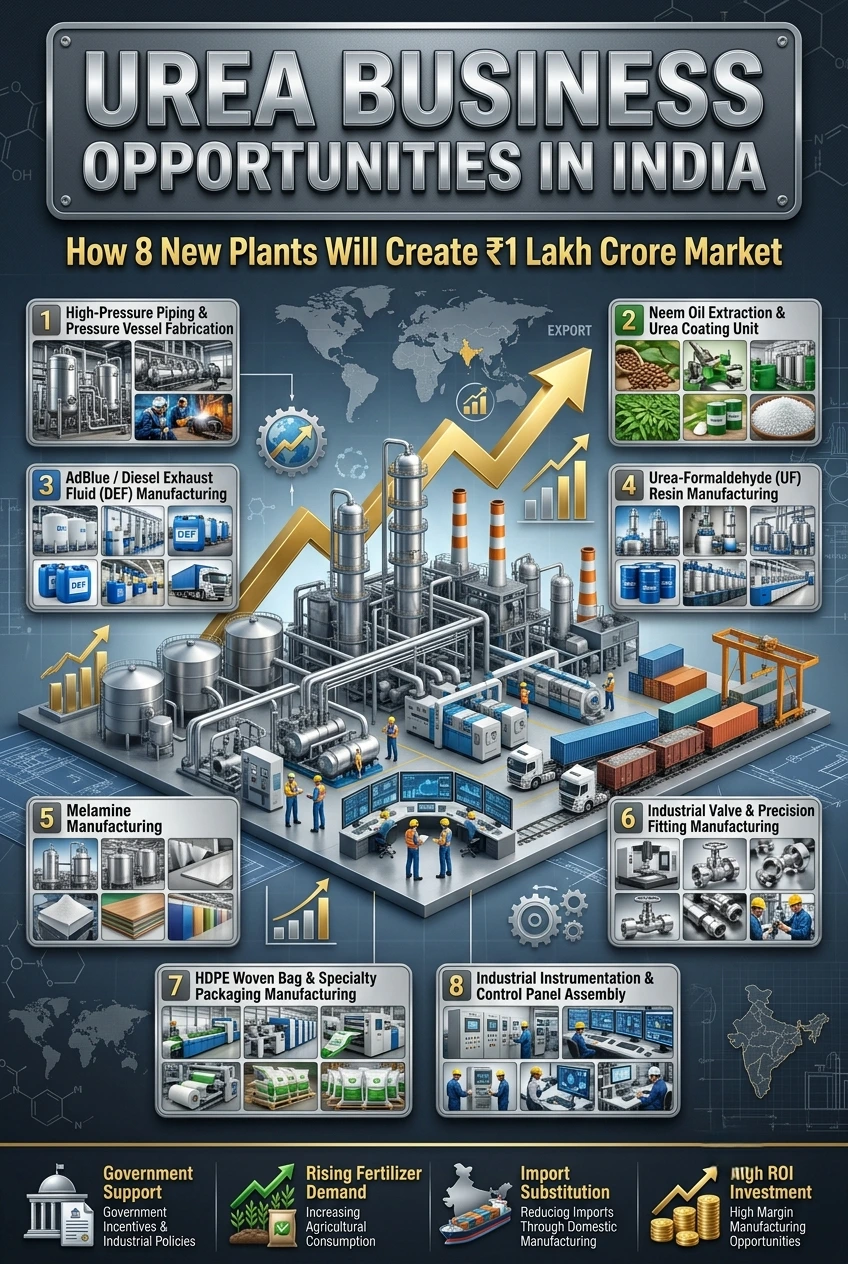
5. Melamine Manufacturing
Manufacturers prepare melamine from urea through a catalytic process and use it in laminates, kitchenware, surface coatings, and flame-retardant materials. India is now importing a large amount of melamine. There is a strong case for integration of a melamine manufacturing plant located close to a new facility for the production of urea, with captive feedstock. The product targets domestic laminate manufacturers, chemical distributors, and export markets in South and Southeast Asia.(Urea Business Opportunities in India)
View Full Project Details: Melamine Manufacturing Business Project Report
6. Industrial Valve & Precision Fitting Manufacturing
Urea and ammonia plants utilize numerous highly specialised valves, including globe, ball, diaphragm and safety relief valves, for corrosive and high-pressure applications. They are now being imported from Europe and China in big numbers. The precision valve casting, machining and testing plant for MSME scale level is filling the clear import substitution gap in the Fertiliser, Petrochemical and Power Plant segments. Organised manufacturers can get BIS and API certification, which can provide them with better procurement preferences from the operators of PSU plants.
7. HDPE Woven Bag & Speciality Packaging Manufacturing
Compliant and strong packaging is needed for every tonne of urea produced. The consumption of 50 kg urea rated HDPE woven bags is huge in volume. With the addition of 8-9 new plants with a combined generation of 1 crore MT per annum, hundreds of millions of bags per annum will be needed. In Gujarat, Uttar Pradesh or Odisha, a dedicated HDPE woven sack manufacturing unit that is close to the plant clusters, wins long-term high-volume supply contracts. Additional revenue diversification comes from the bulk intermediate container (FIBC or jumbo bag) manufacturing for export-oriented shipments.
Get Detailed Project Report (DPR): HDPE/PP Bags Manufacturing Plant Report
8. Industrial Instrumentation & Control Panel Assembly
Continuous process instrumentation is essential for urea plants. This includes pressure transmitters, flow meters, level sensors, temperature controllers and DCS panels. An MSME can manufacture, fine-tune and test plant-specific instrumentation packages. These packages can support both construction projects and long-term operations and maintenance. Around 8 to 9 plants are expected to be commissioned over the next 5 to 7 years. This will create a steady demand for instrumentation assemblies. As a result, this opportunity is well suited to MSME-scale manufacturing investment.(Urea Business Opportunities in India)
Import–Export Opportunity Analysis
The Economic Times market signals show that India has moved from being a urea importer to becoming a self-sufficient producer, creating multi-layered export implications that require careful analysis.
Reduced Import Dependency — Immediate Forex Savings
The current value of imports of urea into India is about $2–2.5 billion per year. As NIPU-2026 plants come online, usually within 48–60 months of commissioning, they will significantly reduce the import bill. The “arbitrage model” will change for companies engaged in trading urea. The value of domestic procurement and distribution contracts will grow with respect to import facilitation contracts.
Export Potential in the Medium Term
With the full self-sufficiency, surplus production may put India in a position to be a regional urea exporter to the markets of South Asian and South East Asian countries. For those entrepreneurs who are establishing export oriented agri-commodity trading companies, it is advisable to establish relations with the DGFT (Direction General of Foreign Trade) and investigate the possibility of export promotion benefits early. In countries like Bangladesh, Nepal and Sri Lanka, the logistical cost of Indian supply is a possible advantage for them.
Urea Derivatives for Industrial Export
Urea can be used as a raw material for the production of melamine, formaldehyde resin and AdBlue (Diesel Exhaust Fluid). The price of domestic urea is becoming more stable, which provides an opportunity to manufacture urea derivatives for export that have high margins. Global automotive emission norms such as BS-VI regulations are creating a great opportunity for chemical MSMEs to become an attractive derivative market for AdBlue.(Urea Business Opportunities in India)
Indian MSME Success Stories in the Fertiliser Ancillary Space
Gujarat-Based Piping MSME Scales to National Contractor
A mid-size pipeline fabrication company in Vadodara started as a supplier to the fertiliser plant at GSFC and built up the scale of its operations by always fulfilling the IBR certification standards. Over a decade, the contractor expanded the workshop from a 50-person operation to a company employing 400 personnel and serving various PSU fertiliser and petrochemical plants across India. The NIPU-2026 pipeline is the same-level rollout that today’s MSME fabricators are on.
Neem Oil Processor in Rajasthan Capitalises on Mandatory Coating Norms
One family-owned oilseed processing unit in Barmer, Rajasthan, shifted to neem oil extraction after the 2015 neem-coating regulation. The business later secured long-term supply contracts with two urea blending units. Within three years, its revenue tripled. The unit now exports surplus neem oil extract to Europe for organic pesticide production. This is a textbook example of domestic policy creating multi-market revenue opportunities.
Precision Agritech Startup Integrates with State FPOs
A Pune-based agritech startup developed a soil health monitoring platform using the low cost IoT sensors for farmers got 12 Farmer Producer Organisations (FPOs) of farmers from Maharashtra and Karnataka successfully onboarded. The platform connects the data of the use of fertiliser with the outcome of crop yield, which enables FPOs to have a better negotiation of fertiliser procurement. With domestic urea becoming more price-stable in the wake of NIPU-2026, the demand for such optimisation tool will further grow.(Urea Business Opportunities in India)
About NPCS – Niir Project Consultancy Services
For entrepreneurs and MSMEs looking to enter the urea ancillary sector, fertiliser chemical processing, or agri-input distribution, NPCS – Niir Project Consultancy Services offers India’s most comprehensive feasibility reports, project profiles, and industrial investment guides.
With over three decades of expertise across 5,000+ industrial sectors, NPCS provides:
- Detailed Project Reports (DPRs) with financial modelling, plant layouts, and ROI analysis
- Manufacturing process documentation for fertiliser-related chemical products
- Licensing and compliance roadmaps for chemical processing units
- Market research and competitor benchmarking for agri-input businesses
- Export strategy consulting aligned with DGFT and export promotion council frameworks
Whether you are a first-generation entrepreneur evaluating a neem oil extraction unit or an industrial investor assessing a urea derivative chemical plant, NPCS provides the ground-level business intelligence that converts policy opportunity into actionable investment decisions. NIPU-2026 has opened a window — NPCS helps you walk through it confidently.
Related Article: Manufacturing Business Ideas in India with Government Support for MSMEs
NIPU-2026 vs NIP-2012: Key Parameters at a Glance
| Parameter | NIP-2012 | NIPU-2026 | Impact |
| Plants Targeted | 6 Plants | 8–9 Plants | Larger Scale |
| Annual Capacity (per plant) | 12.7 LMT | 12.7 LMT | Consistent |
| Total New Capacity | ~76 LMT | ~1 Cr MT | Higher Output |
| Return on Equity (RoE) | Not Defined | 12–16% | Investor Clarity |
| Forex Risk Mitigation | Absent | Yes (4-yr INR fix) | Lower Risk |
| Cost Savings per Plant | Baseline | Rs 250+ Cr | Better ROI |
| MSME Ancillary Opportunity | Limited | Significant | New Clusters |
| Import Dependency (Current) | ~25% | Target: 0% | Atmanirbhar |
Source: Department of Fertilizers, Government of India; Economic Times; NPCS Research
Frequently Asked Questions (FAQs) for Founders & MSMEs
Q1. What is NIPU-2026 and why does it matter for startups?
NIPU-2026 — the National Investment Policy for Urea-2026 — is a Cabinet-approved framework. It incentivises the development of 8–9 new gas-based urea manufacturing plants in India. The policy also creates opportunities for startups and MSMEs. Large industrial projects can increase demand for engineering services, environmental compliance, logistics, agri-tech, and chemical processing. Startups and agile companies can use these opportunities to secure supply contracts or develop ancillary products.
Q2. How much investment is expected under NIPU-2026?
Each urea plant under NIPU-2026 is estimated to cost ₹10,000–12,000 crore. This estimate is based on comparable recent projects, such as Namrup-IV, which costs ₹10,601 crore. Across 8–9 plants, total direct investment could exceed ₹85,000–1,00,000 crore. This would make NIPU-2026 one of the largest industrial investment programmes announced in recent years.
Q3. Can private sector and cooperatives also set up plants under NIPU-2026?
Yes. NIPU-2026 for the first time formally bring the private sector players on board. Previously, fertiliser policies, except those related to the allocation of imported fertilisers, predominantly focused on PSUs. NIPU-2026 will enable involvement of Indian private industrial groups, even private foreign equity and joint ventures.
Q4. What government schemes support MSMEs in the fertiliser ancillary space?
Various schemes are available, including the Credit Guarantee Fund Trust for Micro and Small Enterprises (CGTMSE) scheme, which offers collateral-free loans of up to Rs 2 crore. The Technology Upgradation Fund Scheme (TUFS) to boost the manufacturing modernization.
Additionally, businesses in specific ancillary manufacturing sectors can utilize the PM Vishwakarma and PLI Schemes. Registering on the Udyam portal will open avenues of benefits through schemes under the MSME ministry as well as priority sector lending.
Q5. Is the urea export market viable for Indian businesses?
Currently, India is a net importer of urea. However, NIPU-2026’s trajectory points toward full self-sufficiency within 5–7 years. Beyond that, India can target South and Southeast Asian markets and benefit from lower logistics costs. Entrepreneurs should begin developing export infrastructure and relationships with DGFT and the Fertiliser Association of India now — before the export window opens competitively.
Q6. How can an entrepreneur identify a viable ancillary business under NIPU-2026?
Let’s start with the upstream: gas infrastructure, construction materials, process chemicals, water treatment, instrumentation, environmental monitoring, logistics. We’ve got the established incumbents in each space, but growing scale there will likely lead to the emergence of new competitive threats – likely those with some tech angle or cost advantage. A detailed project report from NPCS for any of these subsectors will give you financial viability data, licensing requirements, and market sizing.
Conclusion: The Policy Window Is Open — Act Before the Competition Does
Economic Times‘s coverage of NIPU-2026 captures a rare moment in Indian industrial policy — when government intent, infrastructure readiness, financial architecture, and market demand align simultaneously. Eight to nine large urea plants, each worth over ₹10,000 crore, do not get built in isolation. They build ecosystems.
The timing matters enormously. Plant commissioning windows typically run 48–60 months from approval. The procurement and contracting cycles begin 12–18 months before commissioning. That means the window to position your MSME, startup, or ancillary business as a preferred vendor or solution partner is open right now — and will begin to close within 18 months as major contractors lock in supply chain relationships.(Urea Business Opportunities in India)
Whether you build pressure vessels, develop environmental compliance software, process neem oil, or create soil health analytics for better fertiliser utilisation — NIPU-2026 has created your market. The question is not whether the opportunity is real. The question is whether you will act before it is captured by someone faster.
Monitor Economic Times for plant location announcements, tender notifications, and JV partner disclosures as NIPU-2026 moves from policy to project pipeline. The first movers in India’s fertiliser ancillary economy will not be the largest — they will be the most informed.