
Unique Selling Proposition (USP) in Business
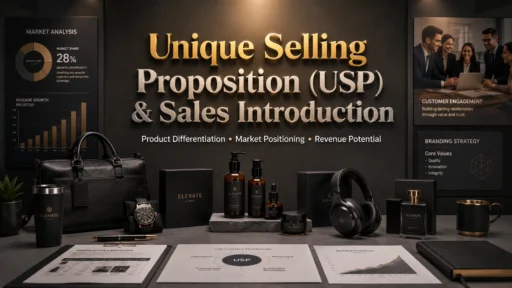
Most start-up founders invest months in developing their product, and then they have a hard time getting customers to understand why they should purchase it. As there are so many options available in the market, the only thing that differentiates two successful business from a failed one is the Unique Selling Proposition. The USP is not a marketing term but a unique selling proposition. It’s a device that can influence the way that you position your product, present to investors, customers, and the world. Whether you’re thinking about new business ventures in manufacturing, food processing, chemicals or services, it’s essential to have your USP in place from the start.
In this article, we will delve into the definition, working principle, and application of the USP in the Indian business landscape, while also offering practical insights for MSME owners, first-generation entrepreneurs, and startup investors with a long-term investment strategy.
What Does USP Full Form Mean — And Why It Matters for Indian Businesses
USP full form is Unique Selling Proposition. To some, it’s also known as Unique Selling Point — it’s the same thing. Your USP is the unique selling proposition – that is, the unique advantage that your product or service has that makes it different from all other products and services offered by everyone else in the market.
Imagine that you can’t share in two simple sentences why your product is different and better — your customer can’t either. And in that uncertainty, they will most probably opt for one they are familiar with.
Having a great USP resolves three questions at once:
- What are your unique skills or talents?
- Who is the end user of your product and/or service?
- Why should they believe your claim?
When it comes to selling, pitching the trade, or pitching to investors, it’s the USP that is the basis of every conversation for Indian MSMEs in the domestic market or trying to go to the export market.
Stop guessing—choose the right business with confidence
Why This Is the Right Time to Build a USP-Led Business in India
The Indian business landscape is changing at a fast pace. The number of MSMEs in the country is more than 63 million, as per the Ministry of MSME, and the competition to grab attention is intense. Meanwhile, consumers’ sophistication is increasing. Consumers are better informed, more demanding and willing to pay a premium for increasingly apparent value differentiation.
That’s a great opportunity, but only if a founder chooses to differentiate their brand from the get-go. The old business model, based on just price, is becoming obsolete. This approach of cost-based positioning is no longer viable for most MSMEs due to pressure on margins, the volatility of raw materials and competition from the global market.
A good USP can put a startup in a category all its own. It changes the way customers think about the product and makes them ask the question as to ‘why should they buy this brand’. Positioning such a change might mean the difference between a profitable business and one that struggles to find success for new businesses that enter into saturated markets, like agro-processor and packager, chemicals, and parts for automobiles and other industries.
Government Policies That Support USP-Led Business Growth
The Government of India has launched various initiatives that directly aid MSMEs with their branding and quality certification, thereby enhancing the brand value of a startup. Startup India recognition by DPIIT – Department for Promotion of Industry and Internal Trade provides tax benefits, ease of compliance and national brand recognition for startups.
There are a number of key government support mechanisms relevant to USP-building which include:
- ZED Certification (Zero Defect Zero Effect): A Quality & Sustainability Standard which directly improves the USP of a Manufacturing MSME in Domestic & Export Market.
- MSME Champions Scheme: Provides support for cluster-based branding, technology upgradation, and market access, which all aid in the enhancement of competitive differentiation.
- Start Up India Seed Fund Scheme: It is a scheme launched by the government to fund startups at their initial stages for their innovative product with differentiation story.
- GeM (Government e-Marketplace): This platform allows MSME’s to directly approach government buyers and a well-documented USP can have a positive impact on the procurement process.
- National SC-ST Hub: Supports underrepresented entrepreneurs to build a market-ready business with differentiated business positioning.
Make in India and NSIC (National Small Industries Corporation) provide marketing assistance, participation in trade fairs and export facilitation where a well-defined USP is the key that can bring tangible benefits.
Multiple Business Ideas Built on Strong USPs: What Startups Can Learn
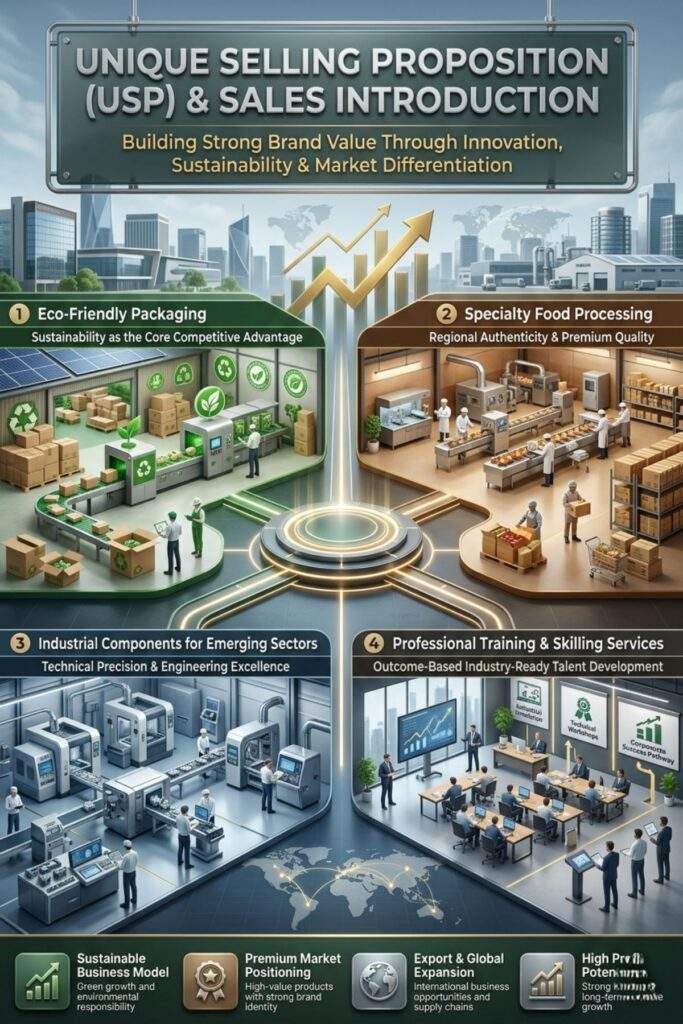
1. Eco-Friendly Packaging: Sustainability as the Core USP
The packaging industry is a fascinating example of a USP-based growth strategy. A single-use plastics ban and a growing appetite for sustainable packaging by FMCG exporters is providing a differentiation story for a startup claiming to be a certified eco-friendly packaging manufacturer. The USP is not the product itself, but the certificate of compliance, the recyclability certificate, and the supply-chain partnerships with brands that care about the environment. Founders who are clear about these benefits attract customers for premium prices, decreasing the competition based on a price. The meaning is that you need to create the USP prior to product launch and not afterwards.
Get Detailed Insights from This Book: Handbook on Biodegradable Plastics (Eco Friendly Plastics)
2. Specialty Food Processing: Regional Authenticity as Differentiation
India’s food processing industry is big and diversified but most of the players are competing on the generic category. The actual chance is niche positioning – regional produce, traditional recipes, clean label ingredients or GI tagged products. If a startup develops a unique selling proposition around a regional identity, like the mustard oil that must be cold pressed from a specific district or the organic mango pulp from a certified farm group, it will be very hard to copy. A differentiation like this is particularly effective in export markets where buyers actively seek authenticity that is backed by provenance. To really maximise this positioning, founders need to participate in storytelling, certification, and supply-chain transparency.
View Full Project Details: Food Processing and Agriculture Based Projects
3. Industrial Components for Emerging Sectors: Technical Precision as the USP
As the Indian corporations expand their footprint globally in the fields of EV manufacturing, defense equipment manufacturing, and precision engineering, there has been a spike in demand for the parts that adhere to even finer tolerances than are commonly accepted in the market. A quality-focused startup is instantly valued by OEM purchasers and tier-1 manufacturers, as evidenced by certifications, documented process controls and traced raw material procurement. This isn’t the lowest price guy. It’s about being the most consistent one. Reliability and accuracy always give better margins than price in high stakes industrial procurement.
4. Professional Training and Skilling Services: Outcome-Based Positioning
The skilling and vocational training industry is booming in India, but there are no distinct differences between the providers. When company A is a training startup that can tell exactly what you can expect to be hired into and has clear statistics about placement rates, salary comparisons, and employer relationships, it has a differentiation story that’s irresistible. Students, parents and corporate clients are all looking for results, and not promises of curriculum. This outcome-centric USP is fantastic for tier-2 and tier-3 markets where there are greater trust gaps and word-of-mouth is more likely to lead to growth than traditional advertising.
Import–Export Opportunity: Where a Strong USP Unlocks Global Markets
Differentiation is a major asset in the Indian export market. The lower-cost economy manufacturers have structural advantages in the generic competition which is really just based on price. But the differentiated products, for which there is a clear USP, whether quality, certification, region or technical specification, goes into a completely different circle of global buyers. FIEO – Federation of Indian Export Organisations reported that unit realisations of exporters who spend on quality certification and positioning are always better than the price-masters.
As a new exporter, the USP is your initial pitch to buyers during the initial contacts at international trade fairs, B2B portals and procurement events. With a clear and distinct unique value, through GI certification, a particular technical capability or sustainable manufacturing credentials, a startup will create a differentiating feature in a saturated sourcing environment.
Businesses that import substitutes do well with a good USP as well. When a domestic manufacturer can justifiably claim to be of equal quality to imported manufacturers but with the added benefits of very quick delivery, local service, and price, he/she has a multi-layered USP that will appeal to procurement heads as well as the finance heads.
Indian MSME Success Stories: USP-Driven Growth in Practice
Haldiram’s: Regional Authenticity Scaled Nationally
One of the best studied cases of USP led growth of FMCG in Indian context is of Haldiram’s. The brand’s main USP was authenticity in its regional recipes, quality and hygienic packaging, as the snacking sector was unorganized in those days, with the establishment itself starting off as a small namkeen shop in Bikaner founded by Ganga Bhishen Agarwal. Investing in food safety and standardization with no compromise on the authenticity of the recipes, gave a story of differentiation that scaled easily from local markets to national retail and international export. What the MSME entrepreneurs learn, is that Authenticity + Process Discipline is an incredibly long lasting USP.
Related Article: Haldiram’s Success Story: How a Small Sweet Shop Became India’s Largest Snack Brand
Amul: Cooperative Ownership as Brand Differentiation
At its very essence Amul’s story is a USP story. At a time when the dairy market was highly fragmented and private traders were exploiting farmers with unfair pricing and inconsistent quality, the Gujarat Cooperative Milk Marketing Federation created a brand identity that is based on farmer ownership, fair pricing, and ensuring consistency of quality. The positioning ‘Taste of India’ was a tag line, and not just for advertising. It was a true statement of cooperative thinking which enabled Amul’s supply chain to be different from its rivals. Amul’s model continues to be one of the most compelling ones for entrepreneurs developing business concepts in a cooperative or community-based format.
Naturals Ice Cream: Local Flavour as Premium USP
Raghunandan Kamath’s Naturals Ice Cream chain followed the motto of “real fruits, no artificial flavours”. With the market being dominated by large dairy brands with standardised flavour profiles, Naturals stood out by maintaining a premium positioning, by following its commitment to an ingredient, and by communicating it with a surprisingly consistent approach. The business grew from its initial Mumbai store to a pan India network of outlets, largely based on customer recommendations. What the lesson is, is that a narrow, well-defined USP, done consistently is more powerful than a broad and generic value proposition.
How NPCS Helps Entrepreneurs Build Business-Ready Ventures
At Niir Project Consultancy Services (NPCS), we not only help startup founders and investors, but also MSME promoters, create the analytical groundwork that forms the basis of any serious business decision. Our Market Survey cum Detailed Techno-Economic Feasibility Reports (DPRs) are more than just a superficial market study. These include manufacturing processes and process flow diagrams, capacity planning and product mix, raw material sourcing, machinery specifications and complete project financials including profitability projections, payback analysis, etc.
The business model is as good as the USP that rests upon it. Entrepreneurs seeking to take an idea for positioning their venture to a project that is investment ready and fundable — NPCS offers the necessary technical and financial validation to complete the transition. Our reports assist with feasibility studies, challenge assumptions and create a realistic and fact-based argument for lenders, investors and joint venture partners.
USP Framework: Key Business Applications and Impact Areas
| USP Type | Best Suited For | Target Market Segment | Expected Pricing Power |
| Quality/Precision | Industrial components, pharma, food | OEM buyers, export markets | 15–30% premium over generic |
| Regional Authenticity | Food processing, handicrafts, agro | D2C, export, premium retail | 20–40% premium over standard |
| Sustainability/Green | Packaging, textiles, agri-inputs | Institutional, ESG-focused buyers | 10–25% premium |
| Outcome-Guarantee | Training, consulting, SaaS services | Corporate, B2C learners | High margin, low churn |
| Speed & Reliability | Logistics, manufacturing, components | Supply chain managers, OEMs | Retained contracts, less price pressure |
| Cost + Quality Combo | Import-substitution businesses | Domestic institutional buyers | Volume-driven margin expansion |
Conclusion: The USP Is Not a Tagline — It Is a Business Strategy
USP full form: unique selling proposition is perhaps the most practical strategic weapon at any founder, MSME operator or an industrialist’s disposal. When competition increasingly dictates survival, having the clarity to explain as to how and why you are different and to structure the operation, communications and sales on this distinction can be your entry barrier.
For any Indian entrepreneurs embarking on a new business concept in the manufacturing space, services space, food processing, and exports: USP cannot be a post product concept. Instead, USP is the filter, which selects the correct product, correct market and correct business concept itself.
Have your USP formed well in advance. Test USP on actual customers. Operational prove your USP and for further feasibility and market analysis the best bet is to go to NPCS – Niir Project Consultancy Services, CII – Confederation of Indian Industry, and SIDBI – Small Industries Development Bank of India for finance, mentoring and market intelligence.
Frequently Asked Questions (FAQ)
Q1. What is the USP full form in business?
USP stands for Unique Selling Proposition (sometimes called Unique Selling Point). A USP is the clear, defined reason why a customer should select your product or service over all others available on the market.
Q2. What are the advantages of USP for a startup in India?
In today’s densely populated MSME sector where most products and services appear very similar externally, a clearly defined USP would provide your business with a distinct identity, remove the reliance of your product on a price-war, and provide a potent story for customers, investors and trade partners.
Q3. How to determine a USP for your business?
Begin with your customer’s problem-and his need is your first concern. Then match it with your product’s strengths against their weaknesses in that domain. Your USP is the sweet spot between where you are best, your customer values, and what the competitor is failing to deliver reliably.
Q4. Can an SME manufacturer create a unique selling point without investing a fortune on advertising?
Of course, yes! In the Indian business scene, you can see very few USPs as strong as that of Amul, Naturals Ice Cream, Haldiram’s. All of these were built based on product truth and effective delivery, not costly marketing campaigns. Sometimes a USP, which is communicated well in your product and customer experience is better than an expensive advertisement campaign.
Q5. What is the perfect way to present USP during a sales talk?
Lead the conversation with the problem your customer faces; not your product’s features. Present the USP as a unique answer to his specific problem in 1 or 2 crisps, easily understood lines without jargon. Support it with proof: be it a certification, a testimonial, technical specifications, or even a direct comparison that makes the distinction evident.
Q6. Is a USP a permanent feature?
No, it’s not and it shouldn’t be. Market dynamics, competitor offerings and customer expectations are subject to change, and so is your USP; it should be assessed and refined continually. The finest MSMEs view their USP as an integral part of the business, constantly monitored against market feedbacks, and adapted according to business strengths or market opportunity.