

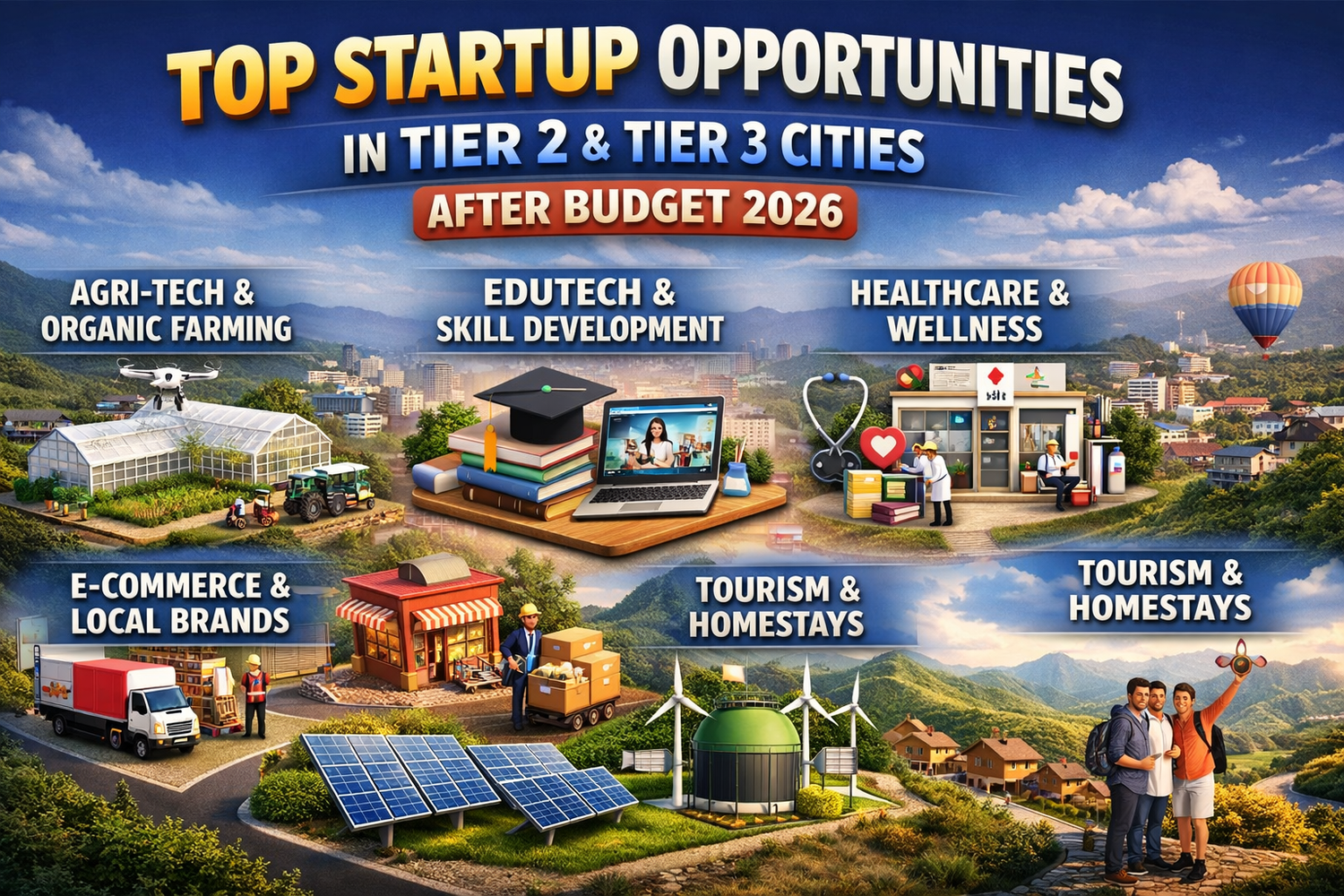

Introduction:Tier 2 Startup 2026
The startup ecosystem in India has maintained its main presence throughout the past 40 years in three major metropolitan areas which include Bengaluru Mumbai and the Delhi National Capital Region. Venture capital and skilled professionals and international business opportunities all came to these cities. The Union Budget 2026-27 represents a significant advancement towards achieving economic development in various regions of India. The infrastructure development together with logistics and regional industrial growth and educational institution development leads Tier-II and Tier-III cities to become vital centers for entrepreneurial activity.
This transformation is not just a policy story – it is changing the economy of building and scaling businesses across India. Lower operational costs, growing local demand, better connectivity and also supporting regional policies are creating a new generation of opportunities for startups outside traditional metros. Entrepreneurs who can match their business models to emerging infrastructure and regional markets are likely to have a sustainable long-term advantage.
Read More: Business Ideas for Startup in Drugs & Pharmaceutical Industry with Project Profiles (3rd Edition)
Budget 2026: A Strategic Drive for Regional Growth
The Union Budget 2026-27 aims to achieve economic growth through its investment in smaller urban areas and regional development. The government supports industrial development through its efforts to create industrial hubs and establish local economic markets outside major cities.(Tier 2 Startup 2026)
The government will establish integrated industrial and logistics corridors which will support freight transport network expansion and execute capital projects for road and power system development while constructing university townships in industrial areas. The concept of “city economic regions” further broadens the scope of development beyond the limits of the municipalities, which promotes regional planning.
These initiatives involve a multiplier effect. Improved infrastructure cuts down the cost of logistics and attracts manufacturing units and creates steady demand for local services. For startups, this means better access to markets, clean supply chains and, in turn, quicker scalability without the high costs for metropolitan operations.
The Shifting Beyond Metro-Centric Startups
Metropolitan cities are still key innovation hubs, but it is not the only possible environment for building successful startups. Rising commercial rents, stiff competition, talent loss and complexity of operations have driven many founders to consider smaller cities as strategic alternatives.
Tier-II and Tier-III cities have a number of advantages:
- Cheap land and operational costs
- Stable workforce with lesser attrition rates
- Undiscovered niche markets and less competition
- Faster local administrative processes
- Growing middle-class consumer bases
Startups around manufacturing, logistics, and regional services, and those with a community focus are particularly benefiting from these benefits. Instead of competing in overcrowded metro markets, founders can develop regionally integrated businesses with good local demand.(Tier 2 Startup 2026)
Read More: Modern Technology of Agro Processing & Agricultural Waste Products
Industrial Corridors and Manufacturing Ecosystems
One of the most important forces that have led to regional entrepreneurship is the growth of industrial corridors. By linking smaller cities to national freight networks, ports and production centres, these corridors minimize transportation time and supply chain inefficiencies.
Rather than creating massive factories on a large scale, many startups can flourish by supporting established industries within these corridors. Opportunities exist in:
- Engineering and fabrication services
- Packaging and supply chain solutions
- Rental of equipment and industrial maintenance
- Raw material distribution
- Utility and facility management services
Such ancillary businesses often need less capital investment and offer recurring revenue streams, which makes them attractive for MSMEs and first generation entrepreneurs.
University Townships and Talent Localization
Budget 2026 also stresses on the development of university townships around industrial clusters. These integrated ecosystems bring together education, research and employment opportunities in one regional context.
For startups, this has several benefits. Companies find it easier to access skilled graduates who become available at lower cost. Local talent helps to decrease workforce instability and relocation expenses. The organization develops through its partnerships with academic institutions and research partnerships and innovation projects and product development activities.(Tier 2 Startup 2026)
The industries that benefit most from these ecosystems are things like IT services, product design, technical consulting, vocational training and applied research startups. As more and more students stay back in their hometown regions instead of migrating to metros, smaller cities get a sustainable and skilled workforce.
Read More: Manufacture of Food & Beverages with Project Profiles (3rd Edn.)
City Economic Regions: A New Model of Growth
The introduction of city economic regions promotes the development of the region beyond the traditional city limits. Instead of establishing companies in the heart of expensive cities, startups can strategically spread offices in nearby industrial areas, residential pockets and logistics hubs.
For instance, manufacturing units may be operating in low-cost regions near large cities and the sales or customer service activities are located nearer urban populations. This hybrid model enables founders to maximize the cost without sacrificing accessibility.
Sectors anticipated to benefit from this regional planning approach are agro-processing, warehousing and logistics, healthcare services, educational institutions and construction-related businesses. The flexibility provided by city economic regions facilitates operational efficiency as well as long-term scalability.

Infrastructure-Led Demand: Opportunity for Local Startups
Large-scale infrastructural investments generate high and stable demand of goods and services at the local level. Roads, housing projects, railways and industrial parks need an extensive network of suppliers and service providers.
Startup opportunities include:
- Building materials, including pre-cast concrete and building components
- Electrical, plumbing and hardware supply services
- Skilled manpower and maintenance solutions
- Equipment leasing, transportation services
- Waste management solutions and sustainability solutions
Local startups tend to outperform national corporations in these areas because they are closer, have a better response time, and understand regional needs better.
Read More: Startup Opportunities in Processing Fruits, Pulses, Spices, and Dairy
Export Potential from Emerging Cities
Historically, it was difficult to export from small cities, because of the logistics of doing so. However, better freight corridors, inland waterways and digital trade platforms are facilitating entrepreneurs from Tier-II and III cities to tap international markets with ease.
Export-friendly sectors are food processing, textiles, handicrafts, parts manufacturing, electronics sub-assembly and specialty manufacturing. Startups can take focus on domestic demand created by infrastructure development, and later on international markets as production stabilizes.
This dual-market strategy allows for stability via local contracts and scalability via exports.
High Potentials Startup Models in Smaller Cities
Some business models work especially well in emerging urban regions:
- Ancillary manufacturing units that serve the industrial clusters
- Regional logistics, cold chain services
- Vocational training and skills development institutes
- Healthcare diagnostics & community clinics
- Facilities management services, including: – Infrastructure maintenance – Facilities management
These startups are more focus on local integration and consistent revenue as opposed to rapid and high burn expansion models usually found in metro-based startups.
Read More: How India’s New Budget Is Creating a Billion-Dollar Container Manufacturing Opportunity for MSMEs
The Significance of Feasibility Planning
Despite the growing opportunities, founders need to plan when going into regional entrepreneurship realistically. Over predicting demand, investing in too much capacity or failing to account for the local market can cause failures at the early stages.
Professional feasibility planning to build a demand analysis of the market, the design of efficient production processes, the choice of the right technology and machinery, and the design of sustainable financial models. A phased approach to growth (start small, grow slowly) helps keep the risk down whilst ensuring stability of operation.
Conclusion: The Emergence of a New Startup Geography
India’s Union Budget 2026 – 27 establishes a new economic model which distributes economic benefits throughout the country. The development of industrial corridors and university townships together with improved logistics and infrastructure development has turned Tier-II and Tier-III cities into active business development centers.
The business opportunity for founders exists through their ability to match their operations with local market requirements and upcoming infrastructure developments. The company starts its path to sustainable growth through three fundamental elements which include its capacity to operate at reduced costs and its access to skilled workers and its expanding customer base. Rather than following the metro-centric growth path, India’s next generation of successful enterprise may be defined by startups with well-connected smaller cities.
The future of Indian entrepreneurship is not restricted to glass skyscrapers in the metros anymore. It is growing to become fast growing regional centers where innovation meets affordability, and where integration within a community is driving long-term resilience.
FAQs
- Are Tier-II and Tier-III cities good for Startups in 2026?
Yes. Improved infrastructure, reduced costs and policy support mean that they are becoming a more competitive place for both manufacturing and service startups.
- Which industries grow the most in smaller cities?
Infrastructure services, agro-processing, logistics, healthcare and ancillary manufacturing are usually quick to scale.
- Is there funding available for start-ups outside metros?
Yes. With strong feasibility reports and clear market demand, startups can get access to government schemes, banks and private investors.
- Do startups require export orientation since day one?
Not necessarily. Many businesses begin in the domestic market and move into export at a later stage.
- What is the largest risk for local startups?
Overestimating demand and scaling too fast. Phased growth and realistic planning is important.


