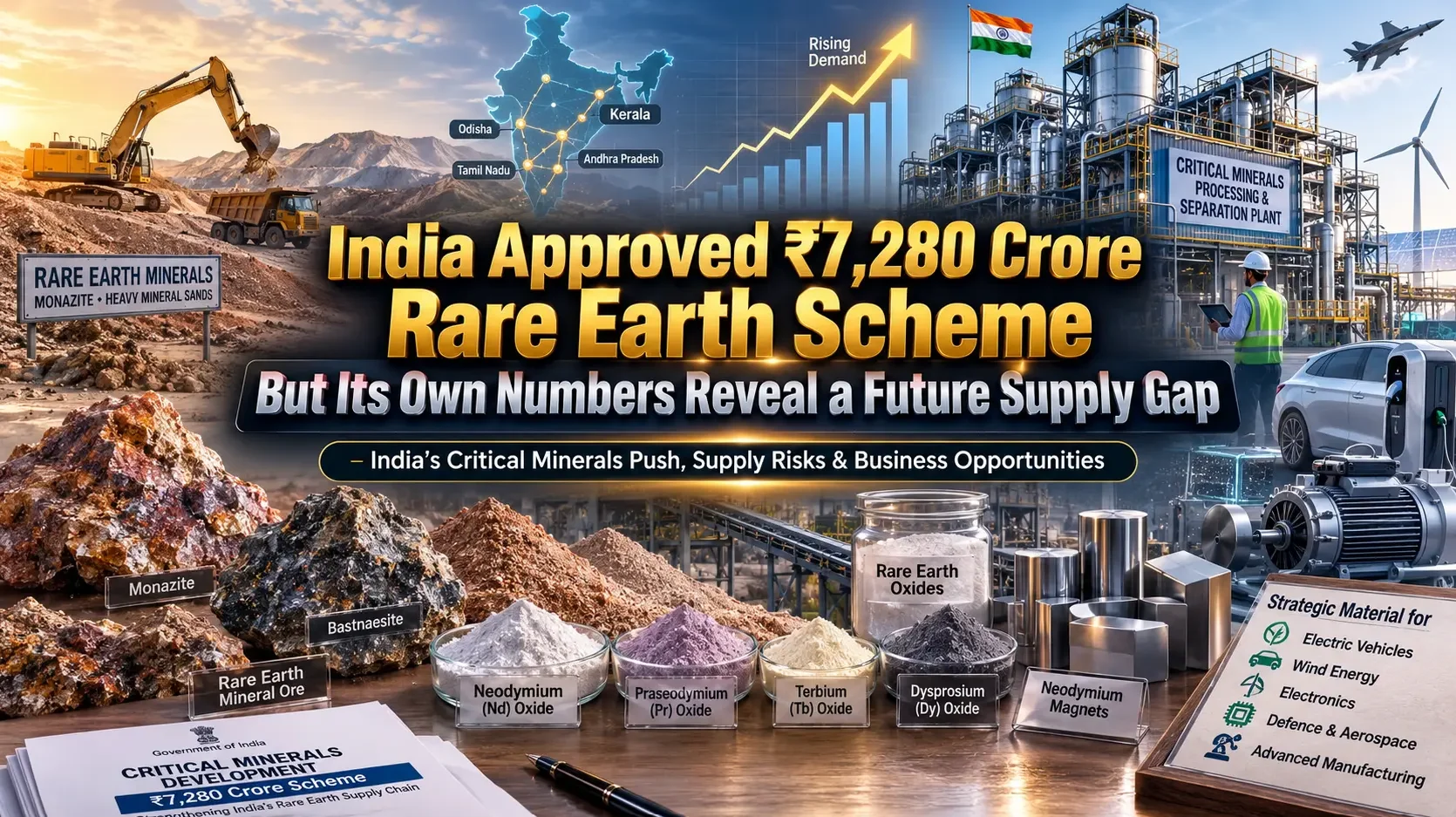

India has granted approval for an ambitious ₹7,280 crore project to manufacture 6,000 metric tonnes per annum (MTPA) of Rare Earth Permanent Magnets (REPMs), but there is a major twist in this story: the 6,000-tonne capacity is likely to meet only half the nation’s future demand by 2030, says a sharp-eyed analysis by Moneycontrol.com.
The government has officially estimated India will consume 8,220 tonnes of rare earth magnets a year by 2030, which includes things like electric vehicles, wind turbines, defence systems and consumer electronics. Despite the government’s plans being carried out to the letter, it is impossible that there will be more than 2,000 tonnes of gap. Those forecasts are regarded as low end by a few independent analysts.
That’s the space for nothing to be a problem. It’s a business opportunity. For entrepreneurs, MSME manufacturers and the startup founders who are willing to take a leap early on the structural deficit is the big opportunity they are looking for that is being poised and lined up by the Indian government, the world’s leading tech giants and automotive majors. The clock is ticking; it’s now or never.
What Recent Reporting Means for India’s Industrial Ecosystem
India’s rare earth magnet production plans are ambitious, but the mismatch between policy plans and the actual demand by 2030 is amplified, reported Moneycontrol.com.
So, what did happen? The Union Cabinet of India in November 2025 approved the Scheme to Promote Manufacturing of Sintered Rare Earth Permanent Magnets (REPM Scheme) with an outlay of ₹7,280 crore. The scheme would focus on 6,000 MTPA of integrated magnet production, and would provide ₹6,450 crore worth of sales linked incentives and ₹750 crore in capital subsidies on five selected facilities.
The scheme is being managed by the Ministry of Heavy Industries which has launched a global competitive tender for both domestic and foreign manufacturers for establishment of integrated rare earth magnet plant. A selection of five beneficiaries will be made, each aiming for an output of up to 1,200 MTPA.
The scheme appears to be a broad-based one. However, India’s own official requirement is 6,000 tonnes and by 2030 it will be 2,220 tonnes short of that requirement, before a single factory comes online. If India’s EV fleet, wind turbine installations and defence electronics programmes grow at a faster rate than expected, demand may go up significantly, according to independent estimates.
What does this have to do with entrepreneurs? Presently India is importing 85-90 per cent of the rare earth magnets, which is almost all from China. In 2025, Beijing tightened export controls and Indian automakers announced a stock of mere two-to-three weeks, revealing the precarious situation of the dependency. Part of that problem is solved by the government’s REPM scheme. What is left is up to you to fill!
View Full Project Details: Rare Earth Permanent Magnet Manufacturing: A Strategic Business Opportunity
If anchor plants come on-line, MSMEs and start-ups that stake a claim to the market today as component suppliers, processing units, alloy manufacturers and/or precision machining partners will be first in line. Smart founders win their supplier credentials and long-term offtake agreements during that window of opportunity, which is usually 18 to 36 months from policy announcement to plant commissioning.
Why This Industry Is Growing Faster Than Most Forecasts
Sintered neodymium-iron-boron (NdFeB) rare earth permanent magnets are at the nexus of all key trends driving growth in the Indian economy over the next decade and beyond.
Electric Mobility
India’s EV market is expanding at 20%+ compounded annual growth rate. The traction motor of a mid-size electric car has a range of 2 to 4 kilograms of NdFeB magnets. Nearly 40 per cent of the total projected demand of REPM by 2030 is allocated to EVs by the official model, which is 3,250 tonnes per year.
Wind Energy
The wind turbine addition targets are picking up pace in India, especially for the offshore and high-yield direct-drive wind turbines, which use REPMs for generators. An estimated 1800 tonnes is expected to be demand for magnets for wind power by 2030.
Defence and Aerospace
Rare earth magnets power modern guided munitions, radar systems, drones and satellite components. The rising domestic defence production initiative is creating fresh demand in India, which is difficult to measure accurately but definitely cannot be ignored. The Ministry of Mines has put up for auction 46 critical mineral blocks to boost the supply of feedstock for the entire value chain, including seven blocks with rare earth resources.
Consumer Electronics and Industrial Automation
Smartphones, hard disk drives and medical imaging systems, as well as industrial robots, all need REPMs. India’s expanding electronics manufacturing ecosystem, which is supported by Production-Linked Incentive schemes, is providing a steady baseline demand, besides the surge in energy demand.
The rare earth magnet market is projected to grow at 6.7 per cent CAGR, reaching USD 30 billion by 2030, from the USD 19.1 billion value recorded in 2023. India’s neodymium market alone is expected to grow at 15 per cent CAGR to USD 99.5 million by 2030. These figures are not a drop in the bucket, that is a core industrial sector.
Government Policies and Incentives
India has a robust policy framework for rare earth magnets and continues to grow. Founders must be aware of, and monitor all of the schemes below, before bid windows close.
In the Union Budget 2026–27, the government announced the establishment of four Dedicated Rare Earth Corridors (DREC) in Odisha, Kerala, Andhra Pradesh and Tamil Nadu to encourage mining, processing, research and development and manufacturing of rare earth elements on the mineral-rich coast of India. These corridors offer infrastructure and regulatory support for setting up new processing/making units at the state level.
The Department for Promotion of Industry and Internal Trade (DPIIT) launched a 60-day guaranteed clearance window for FDI projects in manufacturing of rare earth magnets and PCB for investment proposals in 2026 to replace the indefinite timelines that had kept international investors in limbo. The single window approach has garnered interest from 14–15 applications in the Ministry of Heavy Industries’ global tender so far.
Small scale entrepreneurs can avail of the margin money subsidy starting from 15 to 35 per cent of project cost under Prime Minister’s Employment Generation Programme (PMEGP) provided by KVIC for manufacturing units. Ancillary magnet value chain businesses like bonded magnet units, testing labs, component machining shops etc. fall under manufacturing category under PMEGP.
Read the Complete Book Here: Handbook on Rare Earth Metals and Alloys
Manufacturing Business Ideas Emerging from India’s Rare Earth Demand Gap
1. NdFeB Alloy Strip Casting and Powder Manufacturing Unit
The strip casting unit at IREL is filling a critical gap between raw materials and the final magnet. It can reduce NdPr oxide to metal through molten salt electrolysis or a metallothermic process. It can then produce cast strips for use in the jet milling process. Investment can vary across different scales. For example, a 50-tonne-per-year pilot project can be built with targeted capital investment. It can also use technology licensing from Japanese or European partners. The government’s REPM scheme provides explicit support for ancillary supply investments. Early movers will also benefit from built-in demand from the five anchor facilities once they commence operations.
2. Rare Earth Oxide Beneficiation and Separation Plant
There are coastal sand deposits of monazite in India with an estimated reserve of 13.15 million of tonnes in Andhra Pradesh, Odisha, Tamil Nadu, Kerala, West Bengal and Gujarat. The Indian Bureau of Mines (IBM) estimates that IREL is currently manufacturing 400-500 tonnes per year of rare earth compounds, which is just 10 per cent of the scheme’s target of 6,000 tonnes. There is a need for private investment in beneficiation and solvent extraction separation facilities.
A downstream beneficiation unit could operate close to the new Dedicated Rare Earth Corridors in either Tamil Nadu or Odisha, where the coast has the richest mineral deposits, to manufacture separated lanthanide oxides like lanthanum oxide, cerium oxide and NdPr oxide for domestic magnet manufacturers and international buyers. A strategically important manufacturing play that requires capital but has long offtakes security.
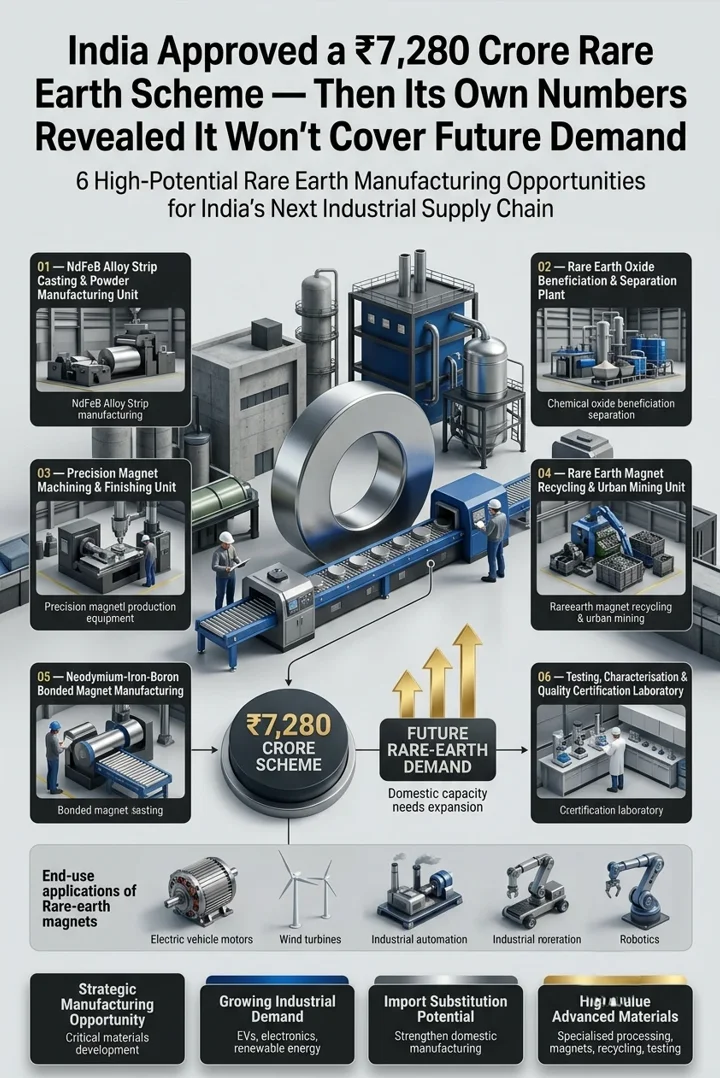
3. Precision Magnet Machining and Finishing Unit
Although the anchor magnet plants will be coming on line, large sintered blocks will be created. The application-specific magnet geometries required for transforming the blocks into thin arcs for EV motors, ring magnets for wind turbine generators, rectangular tiles for industrial robots, etc. demands precision cutting, grinding, coating, and magnetisation. This final process is dominated by China suppliers and the Indian OEMs do not have any reliable domestic supplier.
These diamond wire saws, CNC cylindrical grinders, electroplating lines (zinc, nickel or epoxy coating for corrosion resistance), and pulse magnetisers can integrate into a single-space MSME-size facility to serve EV motor manufacturers, defence contractors, and industrial automation companies. The value-adds per kg are high and the requirement of capital is minimum as compared to upstream processing. MSME founders should take note of this entry point now.
4. Rare Earth Magnet Recycling and Urban Mining Unit
Between 10 and 15 per cent of the value of rare earth magnets can be recovered from the end-of-life electric motors, hard disk drives, wind power generators and MRI machines by means of a hydrometallurgical or a hydrogen decrepitation process. With the increasing number of electric vehicles and older industrial equipment reaching the end of their lives, this feedstock will increase rapidly in India.
Recycling of magnets through closed loop hydromet processing of scrap magnet is not only commercially viable but it is also strategically important for India’s supply security by creating a circular economy business model which recovers NdPr and Dysprosium. This is done through the Credit Guarantee Fund Trust for MSMEs (CGTMSE) in order to provide collateral-free loan guarantees to MSME manufacturers from this category, thus easing the financing hurdle for MSME first-time manufacturers in the recycling segment.
5. Neodymium-Iron-Boron Bonded Magnet Manufacturing
In addition to the highest-performance grade, sintered NdFeB magnets, the government’s REPM scheme is also looking at bonded NdFeB magnets. These magnets are formed by compressing or injection-moulding magnetic powder into a polymer binder. They have their own market, although it is smaller. Smaller motors, sensors, actuators and consumer electronics use bonded magnets. They can also be used to make complex shapes that sintering cannot produce.
A bonded magnet facility will need far less capital than a sintered plant. It may use NdFeB powder from the anchor plant offtakes or imports for domestic electronics makers, medical device OEMs and automotive sensor manufacturers. The product line also includes flexible magnetic sheets for advertisements and packages. This lower-value segment allows small-scale manufacturers to generate revenue and gain technical expertise before entering higher-value markets.
6. Testing, Characterisation and Quality Certification Laboratory for Rare Earth Materials
Third party testing and characterisation services are required for every rare earth magnet plant. They are also needed for every alloy manufacturing plant and recycling unit in India’s growing rare earth ecosystem. This important task involves measuring B-H curves, coercivity, remanence, temperature coefficients and corrosion resistance for each batch of magnets. Anchor plants cannot perform these tests as part of their regular in-house operations at scale.
A third-party quality gate is available to the industry through an independent testing laboratory that equips the facility with a permeameter, vibrating sample magnetometer, salt spray chamber and dimensional metrology tools. Such a lab has a good chance of being a credible partner of domestic and foreign magnet manufacturers due to its NABL accreditation and its linkages with IIT materials engineering departments. The Startup India (DPIIT) offers tax exemption under Section 80-IAC and quick IPR assistance, which are directly applicable to the business of a technology intensive testing lab, for founders.
Related Article: Rare Earth Magnet Manufacturing Business in India: Cost, Profit, Project Report & Government Scheme
Import–Export Opportunity Analysis
Import Substitution
India currently imports 85 to 90 per cent of its rare earth magnet requirements by volume. Virtually all these imports come from China. Such imports cost the country many hundred crore rupees every year. However, every tonne of domestic production can save an equivalent amount of foreign exchange. This is where the government’s REPM scheme comes in. It aims to bridge the gap by offering incentives based on value addition within the country.
Import substitution is the guaranteed demand from Indian OEMs who are legally and financially interested in moving towards domestic suppliers once quality and prices are comparable.
Export Markets
Once India builds credible sintered NdFeB manufacturing capacity, the export opportunity is substantial. The global rare earth magnet market is growing at 6.7 per cent CAGR, and buyers across Europe, Japan, South Korea, and the United States are actively seeking non-China sources following repeated export control disruptions. Invest India is actively facilitating international partnerships for rare earth magnet manufacturers through its single-window platform, connecting global buyers with Indian producers under the 60-day FDI clearance framework.
International Demand
The IEA projects global annual magnet demand to reach 150,000 tonnes by 2030, driven almost entirely by the energy transition. Even capturing a 2 to 3 per cent share of that market — roughly 3,000 to 4,500 tonnes — would represent a massive industrial achievement for India and an extraordinary commercial opportunity for the companies that get there first.
Indian MSME and Startup Success Stories
Ashvini Rare Earth, Pune
Ashvini Rare Earth has established India’s first facility to produce Neodymium–Praseodymium (NdPr) metal from oxide in Pune. At full capacity, the 15-tonne-per-annum plant could supply roughly a quarter of India’s NdPr metal requirements. Managing Director Vikram Dhoot is now focusing on building domestic magnet manufacturing capability. He is also exploring partnerships with major industry players. The goal is to set up a 600-tonne-per-annum NdPr metal facility under government incentive schemes. Ashvini’s trajectory shows how a small technical capability built early can become the foundation for a much larger industrial play.
Midwest Advanced Materials
Midwest Advanced Materials has presented ambitious plans to the Ministry of Heavy Industries. It aims to produce 500 tonnes of custom-made NdFeB magnets annually by the end of 2026. The company plans to scale production to 5,000 tonnes by 2030. Its early engagement with the government’s REPM scheme gives it preferred access to IREL oxide feedstock. This also positions Midwest as a potential anchor beneficiary. For MSME founders, Midwest’s trajectory offers an important lesson. Targeted investment in a specific magnet grade or application segment can create a viable commercial path. This approach may be more practical than attempting full integration immediately.
Entellus Industries
Entellus Industries is among the domestic companies that have presented magnet manufacturing plans to the Ministry of Heavy Industries. The company focuses on building technical capabilities in NdFeB alloy and sintered magnet production. India’s automotive and defence sectors require these capabilities. It represents an emerging class of Indian deep-tech manufacturers. These companies are willing to invest in technically demanding process chemistry in exchange for long-term supply agreements with major OEMs. MSME founders in ancillary segments can also mirror this model.
Discover business ideas that actually make money
About NPCS — Niir Project Consultancy Services
Niir Project Consultancy Services (NPCS) is India’s leading industrial research and project consultancy firm with over 40 years of experience serving entrepreneurs, MSMEs, and investors across manufacturing sectors.
NPCS provides Detailed Project Reports (DPRs) for rare earth processing, magnet manufacturing, alloy production, and critical mineral value-chain businesses. Our services include:
- Market Research and Feasibility Studies for new manufacturing ventures in rare earth and advanced materials
- Technology Consultancy and process selection support for NdFeB alloy, sintered magnet, and bonded magnet units
- Project Reports for bank financing, investor presentations, and government scheme applications under REPM, PMEGP, and CGTMSE
- Industry and regulatory advisory for statutory clearances, BIS certification, and NABL accreditation
Explore rare earth manufacturing project reports on Entrepreneur India and detailed feasibility studies on Niir.org.
Industry Data Table: Rare Earth Permanent Magnet Manufacturing in India
| Parameter | Details |
| Industry | Rare Earth Permanent Magnet (REPM) Manufacturing — Sintered & Bonded NdFeB |
| Market Driver | EV traction motors, wind turbine generators, defence electronics, industrial automation, consumer electronics |
| India 2030 Demand Projection | 8,220 tonnes/year (EVs: 3,250T | Wind: 1,800T | Others: 3,170T) |
| Govt Scheme Target Capacity | 6,000 MTPA across five integrated facilities (REPM Scheme, ₹7,280 crore) |
| Demand–Supply Gap | ~2,220+ tonnes/year by 2030 — the structural manufacturing opportunity |
| MSME Opportunity | Alloy powder supply, precision machining, coatings, testing labs, recycling, bonded magnet units |
| Export Potential | High — Europe/US/Japan seeking non-China supply; IEA projects 150,000 tonne global demand by 2030 |
| Government Support | ₹7,280 crore REPM Scheme + ₹34,300 crore NCMM + 4 Dedicated Rare Earth Corridors (Budget 2026–27) |
| India Rare Earth Reserves | 6.9 million tonnes REO (USGS) — world’s 3rd largest; 13.15 million tonnes monazite in coastal sands |
| Risk Level | Medium — technology licensing and feedstock sourcing are key execution risks; policy support is strong |
| Growth Outlook | Strong — NdFeB magnet CAGR 15%+ in India; global market USD 30 billion by 2030 |
Conclusion: The Gap Is the Opportunity — Act Before It Closes
India’s rare earth magnet story is still being written. The government’s ₹7,280 crore REPM Scheme, as reported by Moneycontrol.com, is the most decisive step India has ever taken toward critical material self-reliance. But the scheme’s own numbers reveal the size of the unmet opportunity: a structural demand gap of more than 2,000 tonnes per year that private entrepreneurs — not the government — must fill.
That gap spans the entire value chain. It begins in beneficiation and separation, runs through alloy production and powder making, extends to precision machining and finishing, and reaches all the way to recycling and testing services. Every node in that chain is a viable MSME business. None of them require a founder to replicate China’s 40-year head start. All of them can be built today, with the full weight of India’s critical minerals policy, international technology partnerships, and domestic OEM demand behind them.
The founders who move now — before the five anchor magnet plants commission, before the four rare earth corridors attract large anchor investors, before the competitive landscape consolidates — will enjoy first-mover advantages in supply agreements, OEM vendor qualifications, and investor attention that latecomers will simply not be able to replicate.(Rare Earth Magnet Manufacturing)
Niir Project Consultancy Services can help you assess the right entry point, prepare your Detailed Project Report, navigate scheme applications, and identify technology partners. The opportunity is real, the policy support is in place, and the demand is guaranteed.