Rare Earth Business Opportunities in India
There was a major turnaround in the industrial sector in India this week. Three of India’s most powerful conglomerates, Reliance Industries, Vedanta and Adani Enterprises, have formally said they are interested in establishing rare earth processing plants in Andhra Pradesh, said the Economic Times. It is not a speculation and it is not a prophetic statement. It is not a prediction or a prophecy. This is a market signal on a grand scale.
Rare earth elements (REE) are a group of 17 metals, including neodymium, lanthanum and dysprosium, which are essential to the world’s most important technologies. These minerals are vital for electric vehicles, wind turbines, defence radar systems, consumer electronics and advanced robotics. More than 90% of the rare earth elements needed in India are imported from China. The Indian government has now officially declared that dependence a national priority problem, and it is mobilising together with its largest private-sector players to solve it.
This is a once-in-a-decade opportunity signal for startups, MSMEs and early-stage entrepreneurs following the Economic Times. A new supply chain will be created within India. Each link of that chain, from mineral processing, through logistics, magnet production, and even compliance consulting, is a business opportunity. This article will explain how you can find those opportunities.
What Recent Economic Times Reporting Means
The report in The Economic Times reveals that around 10 companies have expressed interest in setting up rare earth processing plants in Andhra Pradesh alone. The State has 211 million metric tons of beach sand mineral resources in 16 identified coastal deposits. Geological Survey of India (GSI) has reported that India has 482.6 million tons of total resources of rare earth ores.(Rare Earth Business Opportunities in India)
There’s a different kind of industrial edge from each of the conglomerates that participate. The key to the strength of Reliance is its large-scale chemical processing, which is directly applicable to hydrometallurgical separation of rare-earth elements. Vedanta’s metallurgical experience in base metal processing is applicable to this sector. The Adani port and logistics infrastructure addresses the critical challenge of efficient transportation of ore and processed output along the supply chain.
So, this translates to the market: India is no longer talking about rare earths. Resources are being dedicated by India’s wealthiest private sector companies. The government of India is reportedly mulling an incentive package of Rs 2,000 crore for private companies making rare earth magnets and products in the country. The policy window is open, the capital mobilizing and the supply chain – from mine to magnet – needs to be created. It is at that stage of construction that MSMEs win.
Get Detailed Insights from This Book: Handbook on Rare Earth Metals and Alloys (Properties, Extraction, Preparation and Applications)
Why This Industry Is Growing Right Now
This time differs from earlier rare-earth discussions in India, and three factors account for this difference.
1. Geopolitical Urgency
China’s restriction on rare earth exports to Japan in 2010 severely affected Japanese electronics and auto parts manufacturers. India has learned from that history. India’s increasing concerns at its borders with China and the global trade war that has hit mineral prices have made diminishing dependency on imports a policy objective and a government priority. The Economic Times report underscores that sense of urgency — it’s not only government committees that are talking about this; it’s Reliance and Adani.(Rare Earth Business Opportunities in India)
2. EV and Defence Manufacturing Push
India wants to make EV’s, and needs NdFeB magnets to power the motors. India is in dire need of rare earths for defence indigenisation to develop radar, sonar and guidance systems. Both industries are growing at a rapid pace. Domestic rare earth supply is needed in both sectors. The demand pull is a reality and it’s not going away.
Related Article: EV Battery Materials & Critical Minerals: Startup Opportunities in India
3. Policy and Capital Alignment
Critical minerals have now been included in the Make in India initiative. While a massive upswing in rare earth magnet production is going to happen with the government’s proposed $290 million incentive based on the PLI scheme, the ancillary and support businesses will remain the purview of MSMEs.
Government Policies and Incentives You Should Know
The policy architecture is the first step an entrepreneur or MSME should take to enter this field. The existing structure is:
- India has initiated a dedicated mission on Critical Minerals Mission covering Rare Earths, Battery Materials and Strategic Metals.
- Proposed $290 Million Incentive Scheme – New Delhi is considering direct subsidies for private sector companies producing rare earth magnets and processed products with an annual capacity bid of 500 to 1,500 tonnes.
- MSME Ministry Support: MSME.gov.in offers credit guarantee schemes and funds for technology upgradations for ancillary businesses in this sector.
- Startup India Funding Access: Startup India considers critical mineral technology startups as eligible for DPIIT recognition, tax exemption and government procurement preference.
- DPIIT Recognition: DPIIT is managing the policy framework to develop the rare earth value-chain for domestic industry and facilitating investments.
Such schemes should be actively monitored by the entrepreneurs. The delay from policy announcement to competition crowding is around 12–24 months. It’s the moment right now.(Rare Earth Business Opportunities in India)
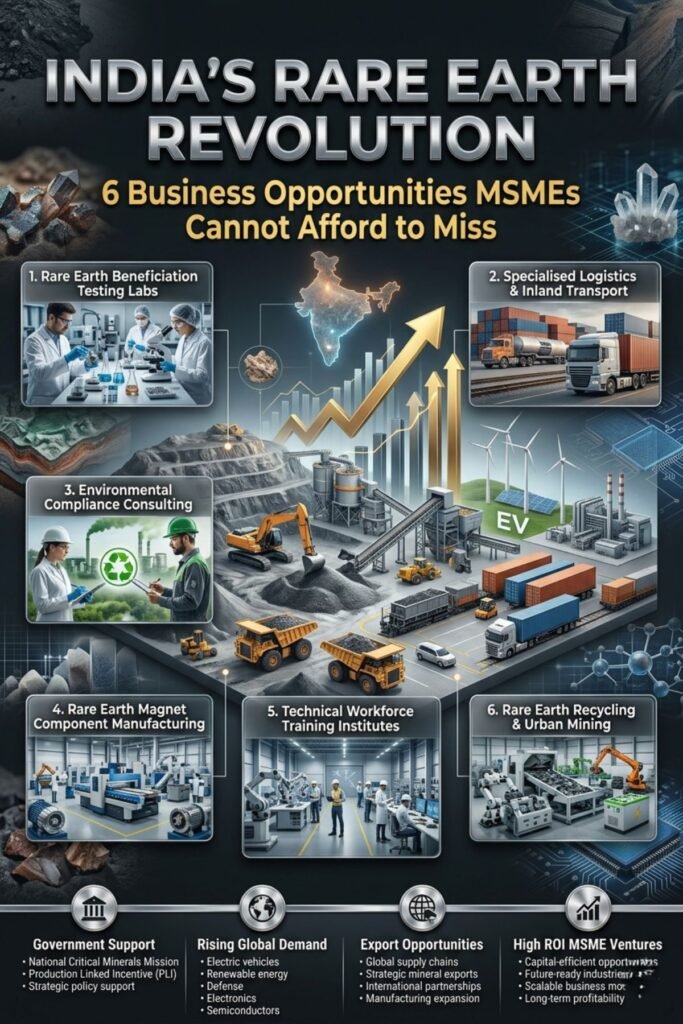
Six Business Opportunities Emerging Directly from This Development
The Economic Times story is not only a story, but also a business blueprint. This unique opportunity brings about six specific business ventures for Indian startups and MSMEs:
1. Rare Earth Beneficiation Testing Labs
Processing plants will be constructed by big companies such as Reliance and Vedanta. Before scaling up, we must chemically characterize each type of ore and test its beneficiation and separation efficiency. Small analytical laboratories that possess both ICP-MS spectrometry and X-ray fluorescence capabilities can serve this market. Startup capital needed: Rs 80 lakh to Rs 1.5 crore. Business model: per-sample testing and annual contracts with mining companies.
2. Specialised Logistics and Inland Transport
Rare earth ores and processed rare earth concentrates are controlled materials, which require special transport, containment, and documentation. MSMEs with logistics in Andhra Pradesh or Odisha can develop a logistics warehouse and transport system that is compliant with the mineral cargo segment. Adani’s port projects provide an anchor client opportunity. In this niche, the first-mover logistics companies will secure early contracts.(Rare Earth Business Opportunities in India)
3. Environmental Compliance Consulting
By-products of rare earth extraction, especially from monazite sands, include radioactive thorium. Specialised regulatory bodies such as the Atomic Energy Regulatory Board, coastal zone authorities, and environmental impact assessment agencies strictly handle regulatory navigation, and these approvals are not negotiable. A consulting firm that brings the skill and understanding of the environmental scientist together with that of the mining regulator can establish a highly defensible practice for both large and small mining licence holders.
4. Rare Earth Magnet Component Manufacturing
Government giveaway scheme is for the production of magnets in bulk quantities. Manufacturers must use precision components such as sintering trays, vacuum furnace linings, and handling fixtures made from non-reactive materials when producing NdFeB magnets. These are the niches in B2B manufacturing that are non-competitive and have high specifications for which MSME with high-level CNC technology can develop dedicated product lines for magnet plant operators.
Get Detailed Project Report (DPR): Rare Earth Permanent Magnet: A High-Growth Strategic Manufacturing Opportunity for Startups
5. Technical Workforce Training Institutes
The trained manpower in the country is very few in the field of hydrometallurgy, rare earth separation chemistry and magnet manufacturing. Severe skills shortages will be experienced by plants as they start to come online in three to five years. A vocational training institute designed to train chemical processing technicians and metallurgical plant operators—co-designed with industry partners and Skill India—will have strong demand and may qualify for government co-funding.
6. Rare Earth Recycling and Urban Mining
Rare earth elements can be recovered from every EV motor, wind turbine blade bearing and hard disk drive discarded. The growth of these devices in India’s installed base makes recycling this device on a scale feasible. An urban mining operation collects end-of-life electronics, extracts rare earth elements, and feeds the processed materials back into processing plants, making it an ESG-attractive business model for institutional and government buyers.(Rare Earth Business Opportunities in India)
Import-Export Opportunity Analysis
The India’s rare earth narrative has two aspects that are commercial—the two aspects being reducing the number of imports that we make, and increasing the exports that we make.
On the import side, the immediate opportunity is being able to substitute processed rare earth oxides and alloys. Currently India imports cerium oxide, lanthanum carbonate and neodymium-praseodymium alloys from China. MSME suppliers of raw material handling equipment’s, chemical reagents, process consumables for domestic RE plants will replace Chinese suppliers in this segment as domestic processing capacity increases.
India is a strategic nation on the export side. The Economic Times report reveals that global buyers, especially those from Europe, Japan and the United States, are actively looking to get alternative sources of rare earth materials, apart from China. A processed rare earth product company created in India today, for whose product quality is properly certified and who is able to produce the required export documentations would be a serious object of commercial interest for buyers from all over the world who look for diversification in their supply chain. Invest India platform facilitates investment attraction in this very sector.
Identify high-growth industries before others do
Indian MSME Success Stories in Critical Materials
The rare earth industry is new, but Indian MSMEs have proven that a first-mover advantage in strategic material industries is sustainable.
Inductotherm India — Specialty Alloy Equipment
This Ahmedabad-based MSME got into Specialty alloy processing equipment business before big conglomerates saw the light of the day. Now it is providing melting and casting machinery to steel and non-ferrous metal manufacturers throughout India. The analogy is easy to make given rare earth equipment manufacturing.
Nile Limited — Recycling Entrepreneurship
Nile Limited developed a profitable business to recover lead from used batteries, which many regarded as unfeasible without conglomerate size. They use a system that systematically collects materials, standardises processing, and produces certified outputs for recycling rare earth elements from electronic waste.
The examples show that once a new strategic material sector emerges in India, well placed MSMEs into the market and establish themselves as technically credible vendors are the preferred suppliers to the large MSMEs which dominate the upstream in the end.
About NPCS: Feasibility Intelligence for Founders
NPCS (Niir Project Consultancy Services) is India’s top industrial consultancy and feasibility report service provider company having more than 25 years of experience in helping entrepreneurs, MSMEs and investors in manufacturing, chemicals and strategic materials industry.
NPCS provides detailed feasibility studies for the rare earth opportunity including plant layout, regulatory pathway analysis, capital expenditure modelling, raw material sourcing and financial projections. Entrepreneurs need these reports when they apply for bank loans, government schemes, or seek investor support for their pitch.(Rare Earth Business Opportunities in India)
If you are a founder wanting to enter the rare earth ancillary market, whether testing, logistics, components, or recycling, the structured Feasibility Analysis can help you invest wisely before investing capital. NPCS reports eliminate uncertainties and speed up decision making.
Rare Earth Business Opportunity at a Glance
| Business Idea | Capital Required | Target Customer | Readiness Timeline |
| RE Testing Lab | Rs 80L – Rs 1.5 Cr | Mining & Processing Firms | 6–12 Months |
| Specialised Logistics | Rs 50L – Rs 2 Cr | Large Conglomerates | 3–9 Months |
| Compliance Consulting | Rs 20L – Rs 60L | Mining Licence Holders | Immediate |
| Magnet Components Mfg | Rs 1.5 Cr – Rs 5 Cr | Magnet Plant Operators | 12–18 Months |
| Workforce Training | Rs 30L – Rs 1 Cr | Industry + Govt Schemes | 6–12 Months |
| RE Recycling / Urban Mining | Rs 1 Cr – Rs 3 Cr | Processing Plants + OEMs | 9–18 Months |
Source: Author analysis based on Economic Times reporting and market intelligence (June 2026)
Frequently Asked Questions for Founders
Q1. Do I need a mining licence to set up a rare earth business?
Not necessarily. Most of the six business ideas discussed in the article-testing labs, logistics, compliance consultants, component manufacturers, workforce trainers, and recyclers-lie downstream of the mining licence. These businesses serve licensed miners and processors, supplying services or components, unlike the capital-intensive, government-approved mining licences.
Q2. Is the government offering any financial support for rare earth ancillary businesses?
Yes. Credit Guarantee Fund Trust for MSMEs (CGTMSE) under the MSME Ministry provides working capital and term loans to ancillary manufacturers & service providers. Benefits of recognition of Start-up India include tax exemptions under section 80-IAC. Although the $290 million incentive plan focuses on magnet manufacturing, ancillary suppliers gain from bulk offtake arrangements from the large plants.
Q3. How long will it take before Indian rare earth processing plants are operational?
The first commercial plants should be ready between 2028 and 2030, based on timelines from similar greenfield mineral processing facilities in India. However, the relevant commercial activities (land acquisition, feasibility studies, environmental clearances, equipment procurement) start now. Those with the right vendor credentials and capability, established in the intervening 18–36-month period prior to operationalization, will be the best placed for long-term supply agreements.
Q4. Is rare earth recycling technically feasible in India at MSME scale?
Yes. Hydrometallurgy can recover neodymium from spent NdFeB magnets. This method uses less capital than primary extraction, and researchers have already piloted it at several other locations. There is huge amount of feedstock availability with growing installed base of EV motors and other electronic gadgets. Over 90% recovery can be achieved by proven techniques of acid dissolution followed by solvent extraction. Proper network of collection is a prerequisite, which can be formed by an MSME and has a logistics component.
Q5. Which geography in India should I prioritise for entering this sector?
Andhra Pradesh is the first priority, being home to the largest identified coastal rare earth deposits and actively wooing investors through its government. Odisha, Tamil Nadu and Kerala too have considerable beach sand resources. Recycling businesses would need to be located near major electronic consumer cities (Mumbai, Delhi, Bengaluru, Hyderabad) instead of the coast.
Q6. How do I validate demand before committing capital to one of these businesses?
Start small with a trial service. Regulatory compliance consultants can offer a basic preliminary regulatory gap analysis for a small retainer fee. Testing labs could offer contract analysis for third parties prior to purchasing instrumentation. Logistics operators can begin with general mineral transport prior to purchasing specialised equipment. Validating demand with one paying customer in the target segment is always the optimal approach for early-stage market development.
Conclusion: The Window Is Open — But Not Forever
The Economic Times article on Reliance, Vedanta and Adani moving into the rare earth space in India is not background news. It is a starting pistol. But specialty denim: if India’s three largest conglomerates enter a new market at the same time, they will build a supply chain—and every supply chain creates demand for thousands of ancillary businesses.
The rare earth opportunity for India is real, backed by the government and durable geographically. It’s not going to be reversed by a budget or policy decision. This is structural. The country is going to have to become less dependent on China for crucial minerals and this trend will become ever starker as global supply chains realign.
For MSMEs & founders, first-mover advantage is genuine and time-limited. Compliance consultants, testing labs and specialized logistics players, who build capabilities & client-ships in the coming 12 to 18 months, will have first mover contracts when the plants come on-stream. Those who wait till commissioning announcements, will enter into a crowded market.
Read the complete Economic Times report. Analyse the government policy frameworks of Startup India and Make in India. Determine how your existing competencies, that is chemical knowledge, logistics, precision manufacturing and environmental science, fit into this supply chain. Then move fast. Rare earth possibilities do not occur in India once in a decade; one is emerging in the country.