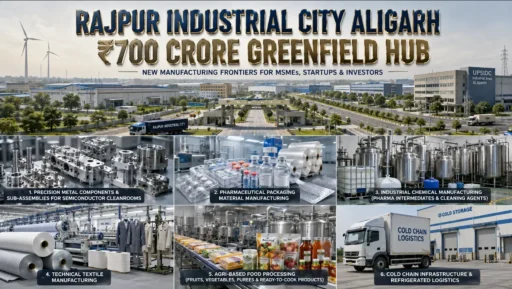
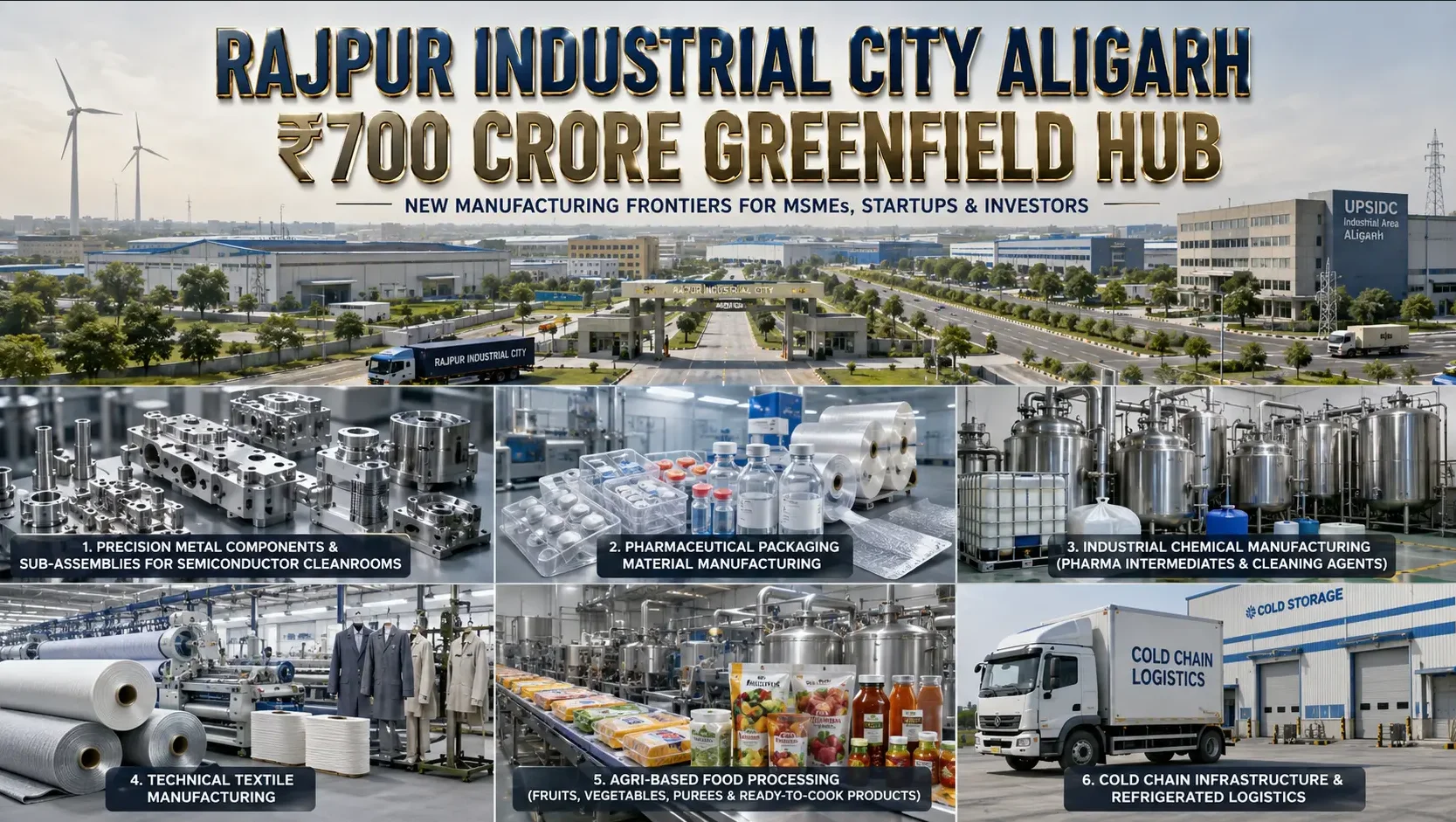

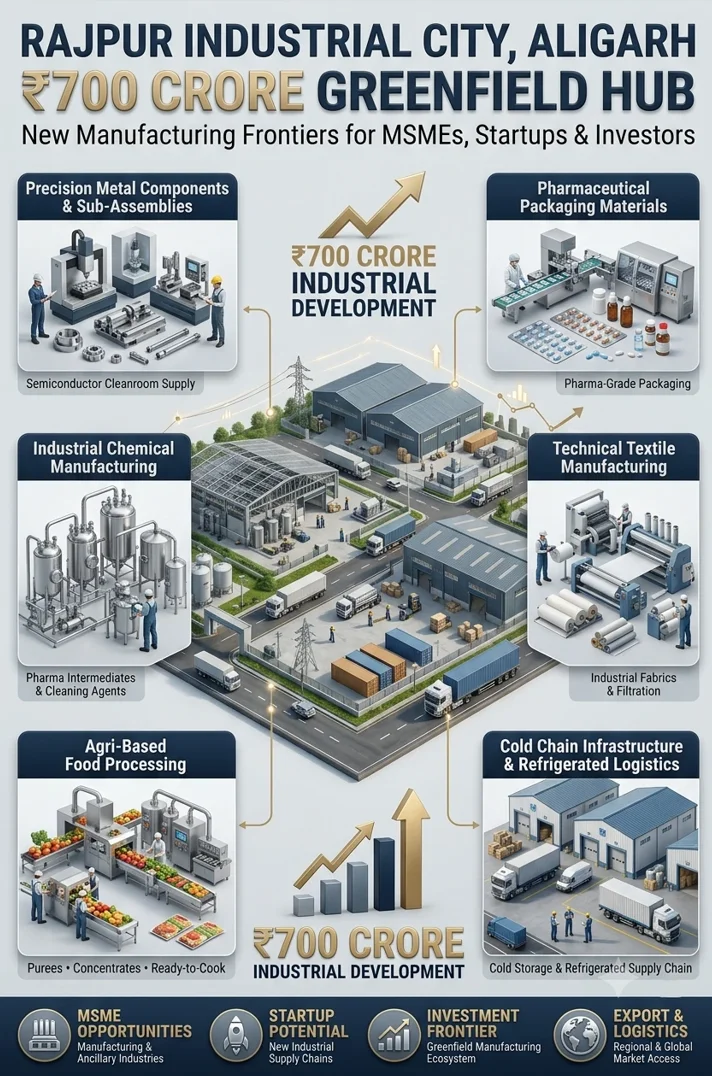
A pivotal event is changing the industrial face of the western region of Uttar Pradesh. Aligarh Development Authority (ADA) has approved Phase 1 of the government’s Rajpur Industrial City project in Aligarh. The government plans to construct the industrial township across 1,358 hectares of land in villages along the Aligarh-Palwal Highway. The total amount of investment in Phase 1 of the project is ₹700 crore, with ₹400 crore coming from the UP-state government under the Mukhyamantri Shahri Vistar Yojana and the remaining ₹300 crore from a HUDCO agreement, making this one of the most ambitious industrial cluster projects in the region in recent years.
According to Amar Ujala on August 17, 2026 the acquisition of land in the ADA was approved on August 13 and ADA Vice Chairman Kuldeep Meena said that development work will start once funds are allocated.
What Amar Ujala’s Reporting Means for Business Builders
The Amar Ujala report further confirms that Rajpur Industrial City is no longer a proposal – it is a funded and board-approved project with government allocation, and the government is pursuing it. The ADA has already reached an agreement in principle with 1,358 hectares from farmers and the industrial giants who have signed up under the Invest UP umbrella have given an official response.
What does this look like day to day? In 12-24 months, the foundations for roads, drainage, power lines, water supply, etc. will appear. Will be followed by large anchor industries (semiconductors, pharma companies, textile mills, food processing units). But there has to be a whole chain of smaller suppliers of components, services, and logistics, and smaller vendors around every big anchor plant.
The opportunity for the MSME of the day is the ancillary universe that ecosystem. The time for entrepreneurs is now to learn about the supply chains of incoming industries and stay ahead of the competition.
Why Every Category of Business Builder Should Pay Attention
Entrepreneurs: Firstly, the owners who will establish ancillary manufacturing or service units around Rajpur will be in a position to have very little competition during the initial years.
MSME Manufacturers: This comes with the need for a vast local vendor network in the pharmaceutical, textile and food processing industries. Rajpur is on the verge of generating tremendous demands for components, packaging, raw materials and sub-assemblies.
Investors: Industrial real estate near greenfield areas really appreciates a lot in advance of anchor units even starting production. The early purchase or booking of sheds is a sure bet.
Exporters: Aligarh is already exporting hardware to other countries. The new semiconductor and pharmaceutical industrial city increase the export infrastructure provided to manufacturers in the region.
Plant Scaling-Up: As large plants are scaling up, startup Founders who can provide automation, quality testing, logistics management and workforce training will have a market waiting.
Why These Industries Are Growing — and Why Aligarh Is the Right Bet
In a bid to establish itself as India’s manufacturing hub, Uttar Pradesh is making a strong push. Invest Up has already engaged more than ₹10 lakh crore of investments across sectors. The Aligarh–Palwal Highway corridor is ideally located along the Delhi–NCR markets as well as the Dedicated Freight Corridor, and the hardware, locks and engineering goods industries provide a legacy of industry.
Under India’s semiconductor mission, semiconductor manufacturing is a national priority. The Department of Pharmaceuticals continues to be one of the key export contributors in India with pharmaceuticals. Production Linked Incentive (PLI) scheme of Ministry of Textiles is applicable to textiles. The agricultural surplus of UP is being utilised for food processing, with help from the schemes of the Ministry of Food Processing Industries, which was the largest producer of sugarcane and wheat in India.
Rajpur Industrial City is poised on the cusp of all these national megatrends. It’s not just a random spot. It’s a wagering by all the government and private investors on the next industrial route of North India.
Government Policies & Incentives Supporting Rajpur Industrial City
For entrepreneurs entering the ecosystem, a number of layers of government support are available. The following is a summary of the various government agencies and their respective schemes:
| Ministry / Authority | Portal / Purpose | Link ID |
| HUDCO | Infrastructure financing – ₹300 Cr HUDCO loan for Rajpur | L04 |
| Invest UP | State investment facilitation, single-window clearance | L05 |
| UP MSME Department | State MSME subsidies, capital assistance schemes | L06 |
| Ministry of MSME (Central) | CGTMSE, PM Vishwakarma, PMEGP, cluster schemes | L07 |
| DPIIT | Industrial licensing, FDI policy, PLI schemes | L08 |
| Startup India (DPIIT) | Startup recognition, Fund of Funds, tax exemptions | L09 |
| MoFPI | PMFME, PLI for food processing, cluster development | L10 |
| APEDA | Agri-food export licensing, market development | L11 |
| Ministry of Textiles | PLI for textiles, technical textile scheme (NTM) | L12 |
| Dept of Pharmaceuticals | PLI for pharma/APIs, Bulk Drug Parks scheme | L13 |
| Invest India | National FDI facilitation, sector deep dives | L14 |
Manufacturing Business Opportunities Emerging from Rajpur Industrial City
1. Precision Metal Components & Sub-Assemblies for Semiconductor Cleanrooms
These semiconductor fabrication plants need ultra-precision metal parts like housings, clamps, brackets and vacuum fittings, and local supply is a must to avoid supply chain delays. The metal machining industry is already established in Aligarh. MSME units that have CNC machining capabilities can switch to meet the demand of new semiconductor customers. The PLI scheme for electronics and semiconductor component manufacturers was run by the DPIIT. Investment range: ₹80 lakh to ₹3 crore.
2. Pharmaceutical Packaging Material Manufacturing
Blister packs, HDPE bottles, aluminium foil packs and labelling materials are essential on a large scale for every pharma unit. Location of a pharma packaging manufacturing unit near Rajpur puts you at the fore front of the supply chain even before any production is underway, for multiple anchor clients. The Department of Pharmaceuticals Bulk Drug Parks scheme also offers an encouragement to the investment in the upstream part of the pharmaceutical supply chain. Investment Range: ₹50 lakh to ₹2 crore.
3. Industrial Chemical Manufacturing — Pharma Intermediates & Cleaning Agents
Solvents, reagents and cleaning chemicals are used in huge amounts in pharmaceutical plants. Setting up a pharma grade intermediates or industrial cleaning compound manufacturing plant in or near Rajpur puts you in a position to become a key vendor for many anchor clients. The CGTMSE scheme by the Ministry of MSME facilitates such type lending without taking the collateral as security. Investment amount: ₹1 cr to ₹5 cr.
Get Detailed Insights from This Book: Biotech & Pharmaceutical Handbook
4. Technical Textile Manufacturing — Industrial Fabrics, Protective Gear & Filtration Cloth
Related Article: Technical Textiles Industry Consultants in India: Your Complete Guide to Expert Project Advisory
5. Agri-Based Food Processing — Purees, Concentrates, Ready-to-Cook Products
UP’s agricultural surplus collides with the infrastructure for industrial processing at Rajpur. Establishment of a food processing unit either tomato puree, mango puree, spice powders, wheat based ready to cook products, or dairy processing, provides direct link between farm supply and FMCG or export demand. MoFPI PMFME scheme offers up to ₹10 lakh credit-linked subsidy for micro food-processing units and APEDA helps in market access. Investment range: ₹40 lakh to ₹2.5 crore.
Access Complete Business Plan: Food Processing & Agriculture-Based Projects
6. Cold Chain Infrastructure & Refrigerated Logistics
Temperature-controlled storage and transportation is necessary in food processing, pharmaceuticals production, and textile dyeing industries. Temperature controlled storage and transportation is a must for food processing, pharmaceuticals production, and textile dyeing industries. Operating cold chain system – either cold storage plants or the logistics services having refrigerated transport fleets or temperature monitoring system – close to Rajpur Industrial City means your business becomes a vital service provider to all three major industries. Under the Integrated Cold Chain scheme, the Ministry of Food Processing Industries offers capital subsidy for Cold Chain projects. Investment range is between ₹60 lakh and ₹4 crore.
Import–Export Opportunity Analysis
The focus of the sector in Rajpur Industrial City provides real export and import substitution possibilities. Owners of export businesses can check for advice on export market through APEDA’s and Invest India’s export guides for various sectors.
Semiconductors: Import Substitution Play
India’s current imports of semiconductor components are more than $50 billion per year. A portion of domestic production from clusters such as Rajpur Industrial City can replace significant imports. The import substitution story closely links to manufacturers of components, providers of testing equipment, and packaging companies that serve domestic fabricators..
Pharmaceuticals: Generic Export Powerhouse
Indian pharma accounts for more than 20% of the total generic drug volume in the world. With the support of the PLI scheme for pharmaceuticals and the Bulk Drug Parks initiative by the Department of Pharmaceuticals, units in Rajpur can export API and finished dosage forms to regulated markets like the US, EU, UK and the African countries.
Processed Foods: GCC and Southeast Asia Demand
There is growing demand for processed food products from India in the markets of the Gulf Cooperation Council (GCC) countries and in Southeast Asian countries. This is a ready market for ready-to-eat foods, spice mixes, flour mixes, and dairy products that UP processes. APEDA provides market development assistance and export packaging grants.
Technical Textiles: EU and US Industrial Demand
From the viewpoint of quality certification, Asian manufacturers are increasingly providing technical textiles – such as geotextiles, filtration fabrics, medical nonwovens – so that the materials are increasingly coming from them. NTTM (National Textiles Trading Modernisation Scheme) scheme by Ministry of Textiles supports the development of the export market for the technical textile industry in India.
Explore This Book: The Complete Technology Book on Textile Spinning, Weaving, Finishing and Printing
Indian MSME Success Stories in Related Sectors
Ami Organics Ltd. — Pharmaceutical Intermediates, Ankleshwar, Gujarat
Ami Organics started its operations in Gujarat’s chemical hub as a small pharmaceutical intermediate producer. The company became a public company by providing an expanding pharma industry “ecosystem” that emulated the planned Rajpur model. Their journey brings to light how a small and medium-sized enterprise (SME) can transform into a substantial business within a generation by becoming a vendor to anchor pharmaceutical companies.
Vinayak Foods Group — Food Processing, Uttar Pradesh
The Vinayak Foods of UP developed their business on the main lines of spice processing and packaging for both domestic retail and export markets. Proximity to agricultural surplus areas—just what Rajpur Industrial City will offer—led the company to establish regular B2B and B2C income generating sources. It is a blueprint for an agri-food entrepreneur who is aspiring for the opportunity of Rajpur.
Pearl Global Industries — Technical Textiles & Apparel, Delhi-NCR
Pearl Global Industries have evolved from a regional garment manufacturer to become a technical textile and apparel export powerhouse. Its trajectory depicts how the industries located at the Delhi-NCR industrial belt with Aligarh corridor can utilize the government funded industrial clusters for the upgradation from commodity apparel to value added technical textiles.
About NPCS — Niir Project Consultancy Services
Entrepreneurs and investors considering involvement in industries driven by the Rajpur Industrial City announcement will need professional feasibility advice. NPCS provides:
- Detailed Project Reports (DPRs): Bankable project report for Pharma, Food Processing, Textile, Chemical Manufacturing Units, Applicable for Bank Finance, Government Scheme Application, Investor Presentation.
- Market Research: Demand Analysis, Mapping of Competitive Landscape and Pricing Intelligence of specific product categories.
- Technical, financial and regulatory Feasibility Studies: for greenfield and brownfield manufacturing projects.
- Technology Consultancy: Identification of process, selection of equipment and plant layout in all the areas of interest pertaining to Rajpur Industrial City.
- Land Selection to commercial production — full support to MSME founders.
Choose the right startup backed by real market demand
Industry Data Overview
| Parameter | Details |
| Industry | Industrial City Development – Semiconductor, Pharma, Textile, Food Processing |
| Market Driver | Rajpur Industrial City, Aligarh – ₹700 Crore Phase 1 (govt-backed, ADA-approved) |
| Investment Range | ₹50 Lakh – ₹20 Crore+ (MSME) | ₹50 Crore+ (Large Scale) |
| MSME Opportunity | Ancillary units, component mfg, pharma packaging, cold chain, logistics, food processing |
| Export Potential | High – pharma APIs & generics (US/EU/Africa), processed foods (GCC), technical textiles (EU) |
| Government Support | Mukhyamantri Shahri Vistar Yojana (₹400 Cr) | HUDCO (₹300 Cr) | Invest UP incentives | PLI | CGTMSE |
| Risk Level | Low–Medium (government-funded, board-approved, FDI-committed anchor industries) |
| Growth Outlook | Strong – 10–15-year industrial cluster across 1,358 hectares with phased expansion |
Conclusion: The First-Mover Window Is Open — Act Before It Closes
The Rajpur Industrial City development (August 17, 2026 Amar Ujala) is not just a local infrastructure project but a transformative initiative that will shape the future of the region. The announcement of the Rajpur Industrial City is not just a regional infrastructure development; it’s a game-changer that will influence the region’s future. It’s a highest-level market signal.
If the state government is willing to spend ₹400 crore, arrange ₹300 crore in project financing through HUDCO and acquire 1,358 hectares of land. Large companies are also coming forward to invest under Invest UP for an industrial township. This signals growing demand for semiconductors, pharmaceuticals, textiles, and food processing, supported by predictable government backing.
It is time for MSME founders to assess which segment of that supply chain you can be a part of and start applying for government schemes under the Ministry of MSME and Startup India, project reports with NPCS and avail loans before the competition is already in place.
Infrastructure is being developed. The money is invested. The industries are inward looking. The question here is: will your business be able to serve them?