
Introduction: Railway electrification business opportunities
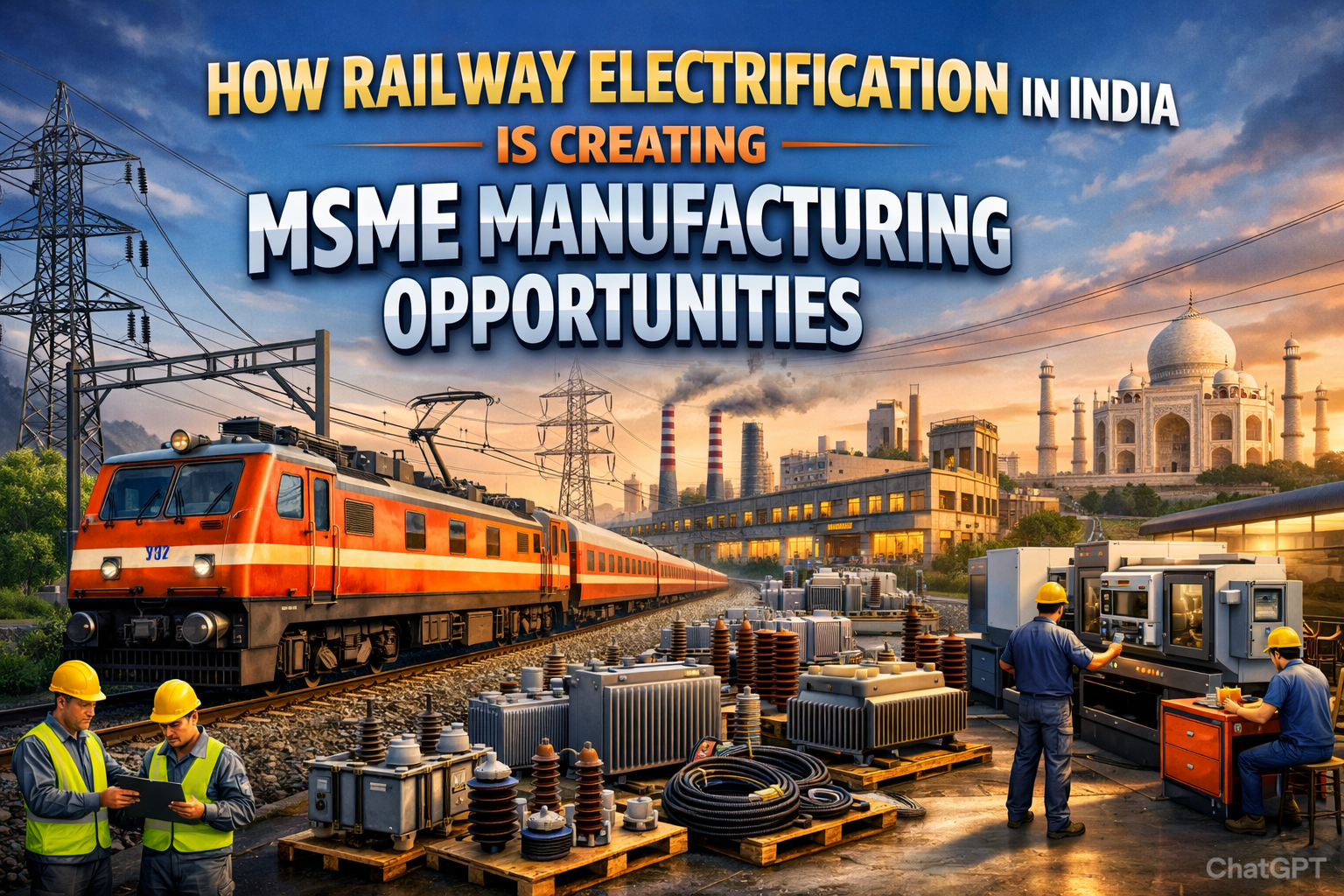
India’s railway electrification program has become one of the most important infrastructure transformations of the country’s modern economic history. While public attention tends to gravitate towards high speed trains and passenger enhancements, the true industrial opportunity is in the electrification of railway routes at the national scale (specifically, to electrify the entire country rapidly).
According to the Annual Report 2023-24 of Indian Railways, over 4,600 kilometres of railway track was electrified in one financial year. This pace puts India into the ranks of the fastest railway electrification programs in the world. More importantly, it generates the sustained manufacturing need for tens of thousands of components needed to build and maintain electrified routes.
For Micro, Small and Medium Enterprises (MSMEs), this is not a short term opportunity at all-such a growth possibility is a long term one, from policy driven industrial growth cycle supported by government capital expenditure.
Read More: Investment Opportunities In Infrastructure Projects
Why is Railway Electrification Strategic?
Railway electrification is closely linked with India’s overall economic and environmental objectives. The shift from diesel to electric traction provides several structural benefits:
- Reduced diesel imports, foreign exchange savings
- Lower operating costs, including freight and passenger services
- Higher hauling capacity and higher train speeds
- Reduced carbon emissions
- Increased energy efficiency and network reliability
In 2023-24 Indian Railways moved about 1,588 million tonnes of freight. With more than 8000 electric locomotives already in use and capital investments of more than 74700 Crore, electrification is closely allied with freight expansion and industrial logistics.
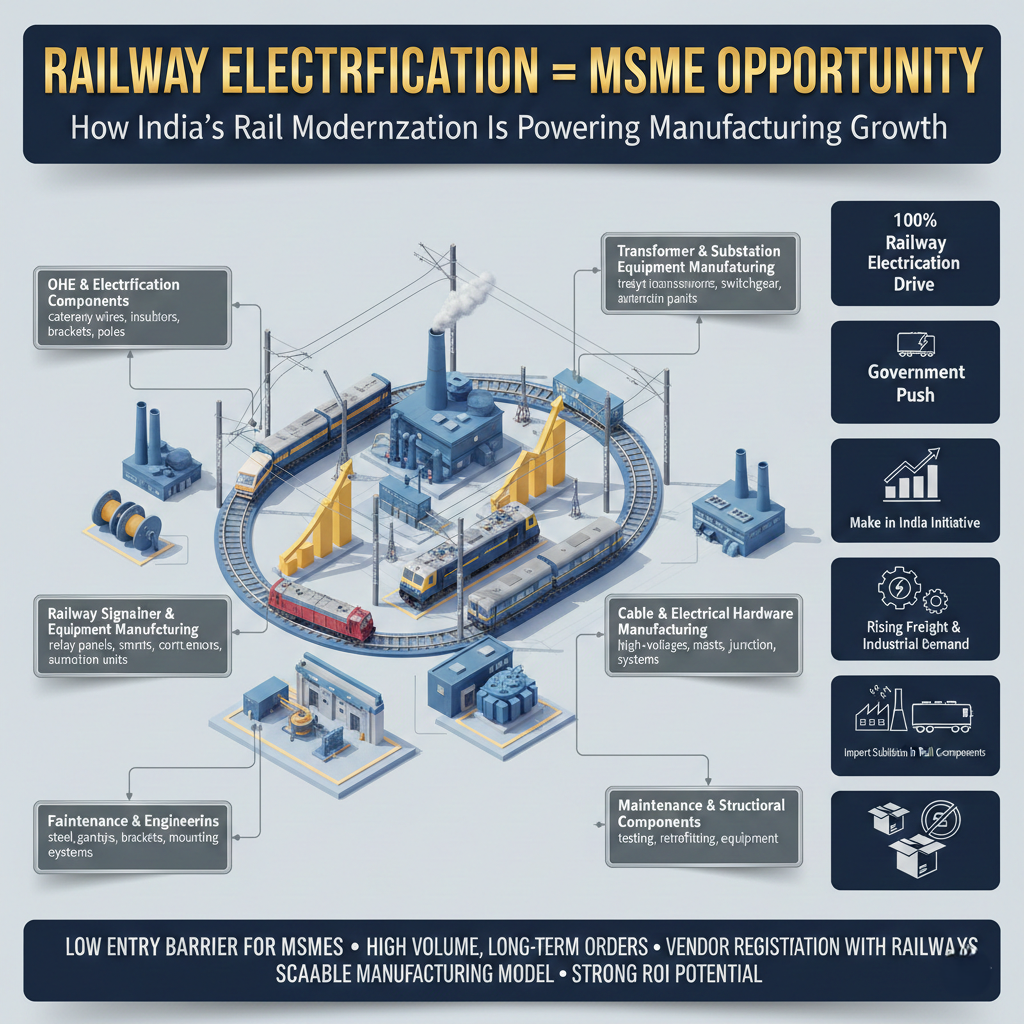
The importance for the manufacturers is evident as each kilometer that is electrified creates demand for steel structures, electrical hardware, insulators, cables, substations, grounding systems and safety equipment. This demand is mostly met by domestic supply chains, leading to the formation of a powerful ecosystem for MSMEs.
High Potential MSME Manufacturing Segments
1. Overhead Equipment (OHE) Structures & Steel Fabrication
Overhead Equipment (OHE) is the backbone of electrified railway system. These structures are used to support the overhead wires that provide power to the electric locomotives.
Major manufacturing components for keys are:
- OHE masts and portals
- Cantilever assemblies
- Cross arms and boom structures
- Base plates and anchor bolts
- Bracing and structural supports
Every single electrified kilometer requires several fabricated steel structures, which guarantees a constant annual demand. For MSMEs that are already in the business of structural fabrication or heavy engineering, this segment presents the opportunity for scalable growth with moderate capital investment.
Companies like Skipper Ltd have proven alignment with infrastructure expansion is the path to long-term growth in structural manufacturing.
Read More: India Glass Fibres and Glass Woven Fabrics Market
2. Electrical Insulators and Composite Materials
Insulators are safety critical parts in railway electrification. They prevent electrical leakage and the safe transmission of current through overhead systems.
Common products include:
- Porcelain insulators
- Polymer composite insulators
- Post insulators
- Section insulators
Unlike heavy steel structures, insulators are seen to create repeating demand due to their periodic replacement needs due to weather exposure, mechanical stresses and environmental degradation.
Indian manufacturers are competitive in this segment with export potential widening to Africa, South Asia and Middle East. With the growth of electrification both at home and worldwide, the demand for certified insulators is likely to stay strong.
3. Earthing, Bonding and Electrical Safety Hardware
As traction systems expand, safety infrastructure is becoming critical. Proper earthing and bonding systems are responsible for safe operation of high-voltage traction networks.
Key products include:
- Earthing rods
- Bonding jumpers
- Copper and aluminum connectors
- Lightning arrestors
- Grounding clamps and accessories
This segment has relatively less entry barriers than cable manufacturing or heavy fabrication. It is especially suitable for first-time MSME entrepreneurs in order to enter the railway supply chain.
With the increasing safety requirements and periodic inspection requirements, this category also gains from the periodic maintenance demand.(Railway electrification business opportunities)
4. Traction Power Panels and Substations
Railway electrification relies on substations and control systems for the distribution of power around the network.
Manufacturing opportunities include the following:
- Control panels
- Relay panels
- Junction boxes
- Power distribution units
- Systems of monitoring and protection
Electrical panel manufacturing is already a well-established MSME manufacturing sector in India. By getting the certifications and approvals necessary for the railway system, manufacturers can shift to supplying equipment to the traction-related areas.
Companies such as Crompton Greaves have established strong foundations in the field of electrical equipment manufacturing by targeting long-term growth in infrastructure.
Read More: Ethanol as Biofuel – Manufacturing Plant, Detailed Project Report, Profile, Business Plan, Industry Trends, Market Research, Survey, Manufacturing Process, Machinery, Raw Materials, Feasibility Study, Investment Opportunities, Cost and Revenue
5. Railway Cables and Conductors
Railway electrification requires large amounts of specialist railway cables and conductors for the traction power and signaling systems.
Demand drivers include:
- Large installation volumes per kilometer
- Ongoing network expansion
- Maintenance and periodic replacement
- Export opportunities via EPC railway projects
Indian manufacturers such as KEI Industries and Apar Industries have grown at a huge rate by catering to infrastructure-driven demand cycles.
While cable manufacturing is relatively higher in terms of capital investment, technical compliance, it offers high scalability and export potential.
Investment Outlook of MSMEs
Investment requirements are varied according to product specialization and scale.
Typical investment ranges:
- Small electrical components: 1.5-4 crores
- Steel fabrication units: 3-8 crores
- Electrical panel manufacturing: 4 to 10 crores
- Cable manufacturing: Above 6 crores
Profit margins typically fall between 12% and 25%, depending upon certification standards, supply contracts and operational efficiency.
Getting approvals like vendor registration with Indian Railways and conforming with railways design standards greatly positively contribute for long term stability of orders.
Vendor Registration and Compliance Issues
To supply to railway electrification projects, one must adhere to certain technical standards and procurement procedures. Manufacturers usually require:
- To register as an approved vendor for
- Quality certifications (ISO standards)
- Product testing approvals
- Compliance to railway design specifications
- Tender processes participation in
Understanding procurement mechanisms and strict quality control are important for continued participation in railway projects.
Read More: Railway Infrastructure Boom: Manufacturing Business Opportunities for New Entrepreneurs
Why This Opportunity Is Long Term and Stable
Unlike consumer driven sectors, railway electrification is policy driven and supported by long-term government capital expenditure. India’s target of complete electrification of broad-gauge lines will ensure the allocation of funds continues.
The opportunity works on multiple demand layers:
- Installation demand (new route electrification)
- Replacement Demand (aging components)
- Upgrade demand (capacity expansion)
- Export demand (international railway projects)
This multi-layered cycle of demand helps to bring down the amount of volatility and bring about predictable growth in the industrial world.(Railway electrification business opportunities)
Strategies for MSMEs to gain advantages
Railway electrification manufacturing has a number of structural benefits:
- Government-backed demand
- Reduced dependence on consumer sentiment
- Large-scale domestic sourcing
- Export linkage opportunities
- Recurring maintenance market
For MSMEs who are aiming for a stable growth in the industrial sector rather than short term speculative gains, this sector provides resilience and scalability.
Read More: Top Most Profitable Business Ideas for the Next 10 Years
Conclusion: Harnessing India’s Manufacturing Future
Railway Electrification in India is much more than transportation upgrade. It is strategic industrial growth that is conducive to freight growth, energy efficiency and infrastructure modernization.
For MSMEs, such transformation offers a rare chance to be fitted into a long-term national development agenda. Whether it is through the making of steel fabrication, electrical components, panel manufacture or cable production, entrepreneurs are able to establish sustainable businesses that can grow with the expanding railway network.
The trick to success is being able to phase in investments, quality compliance, vendor approvals, and operational discipline. Those who move early in this supply chain are able to get a good position with solid recurring revenue streams that have a policy-driven demand in their Favor.
Railway electrification is not just about powering trains – it is about powering the next generation of the growth of Indian manufacturing.(Railway electrification business opportunities)
Frequently Asked Questions (FAQ)
Is railway electrification a long-term opportunity?
Yes. India is continuously shifting towards electrifying all broad gauge routes and the demand is expected to continue.
Can the small MSMEs supply Indian Railways?
Yes. Many components are procured through approved vendor systems and MSMEs constitute a substantial portion of the supply chain.
Is the investment very high?
Not necessarily. There are several products that can be initiated with a moderate capital and expanded over time.
Is it possible to export in this sector?
Yes. Indian railway electrification components are exported along with International railway projects.
Is demand seasonal?
No. Demand is Infrastructure driven, and long term.