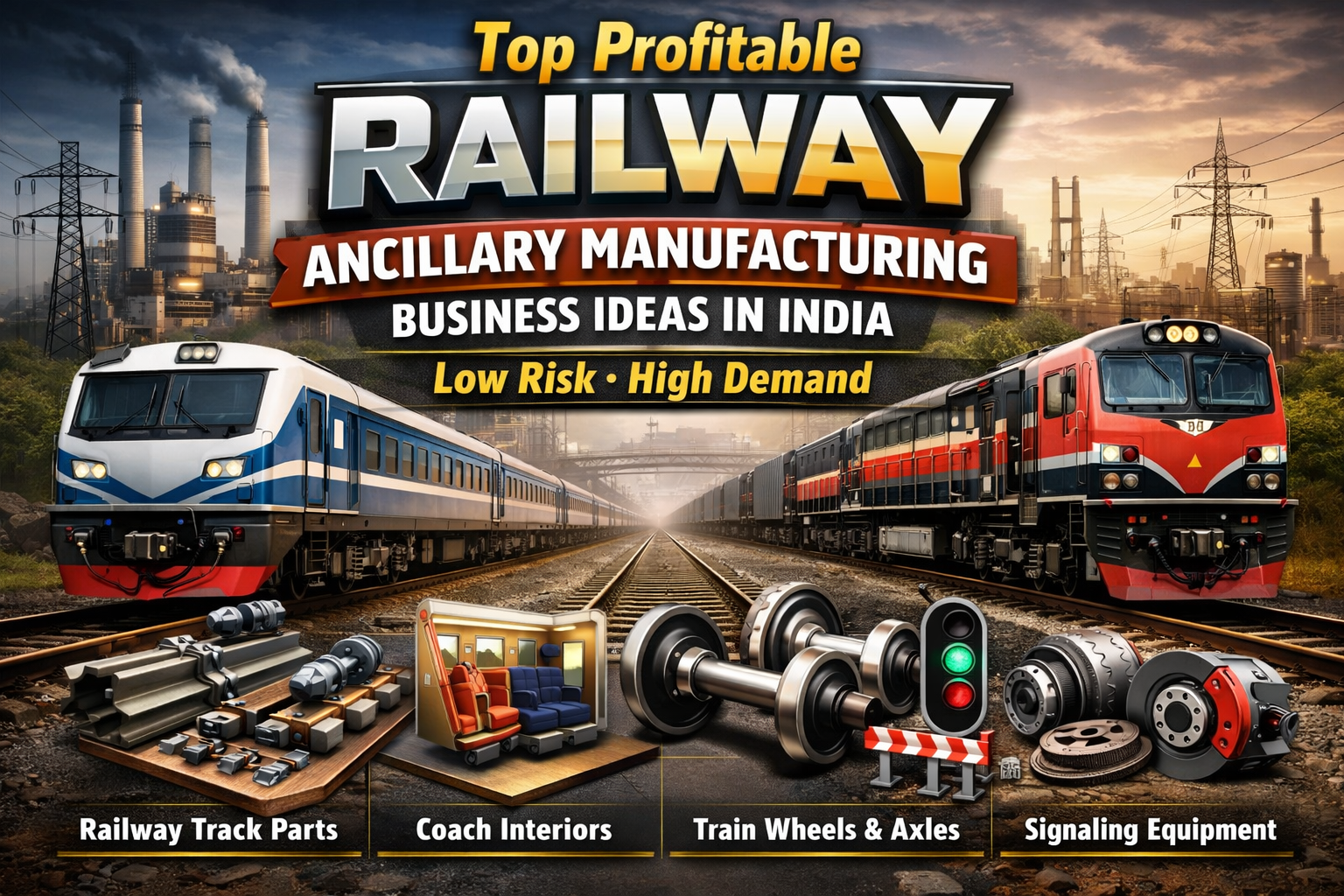

Introduction: Why Railway Ancillary Manufacturing Is a Good Business to Be In
Starting a manufacturing business in India is often fraught with uncertainty regarding demand, pricing pressure and delayed returns. Railway ancillary manufacturing minimizes these risks as demand is institutional and structured and continues to repeat.
Indian Railways is one of the largest railway networks in the world and is one of the largest buyers by the government in India. Its scale of operations includes freight transportation, passenger services as well as electrification, production of rolling stock, revamping of stations, and maintenance infrastructure. Each of these areas is dependent on thousands of ancillary manufacturers.
In contrast with the consumer driven industries, railway procurement is need based and is based on predefined technical standards. Once a supplier is approved and found to comply with specifications, repeat orders are more predictable. This makes railway-linked manufacturing one of the most stable industrial opportunities for the new and first generation entrepreneurs.
Read More: Investment Opportunities In Infrastructure Projects
Indian Railways Growth: Strong Demand Fundamentals
According to the Indian Railways Annual Report 2023-24, the network is continually expanding in terms of scale and capital intensity. Freight movement crossed 1588 million tonnes and electrification added 4644 km in one year. Nearly 5,950 km of track renewal was done while operations continued over two lakh wagons and over seventy thousand passenger coaches.
These figures are directly translated into industrial consumption. Every kilometer of track needs fastening parts and structural arrangements. Electrification projects need cable trays, junction boxes and control panels. Rolling stock maintenance is a continuous source of demand for rubber, polymer and mechanical components. Even in the absence of new projects, replacement cycles sustain consumption.
This institutional nature of demand is what makes railway ancillary businesses comparatively low risk.
Why Railway Ancillary Businesses are Low Risk
Railway-linked manufacturing has a number of structural advantages:
- Purchase and supply of goods and services – Institutional buyer, with predictable procurement systems
- Continuous maintenance – driven by demand
- Standardized product specifications
- Government support to MSMEs and domestic sourcing
- Strong bankability as a result of infrastructure linkage
Because these products are operational necessities, the demand is much less volatile than the demand in manufacturing for consumer goods.
Read More: India Glass Fibres and Glass Woven Fabrics Market
High Potential Railway Ancillary Manufacturing Segments
1. Steel Fabrication & Structural Components
Steel fabrication is one of the most accessible segments for MSMEs. Products like foot over bridge structures, platform sheds, guard rails and cable support frames are needed in railway projects across the board.
Why this segment works well:
- Repetitive and standardized designs
- High volume requirements
- Moderate technology complexity
- Steady cash flow from infrastructure projects
Although margins may be moderate, there consistent demand ensures the stability of business.
2. Fasteners and Clips & Track Accessories
Track systems are greatly reliant on fastening assemblies such as elastic rail clips, bolts, washers and fish plates. Every kilometre of track uses up thousands of such components.
Benefits to business in this segment:
- Continuous replacement demand
- Production (Forging or machining based)
- Scalable manufacturing capacity
- Export potential to the developing railway markets
Since track maintenance is never ending, this part of the business gets to enjoy reoccurring consumption.
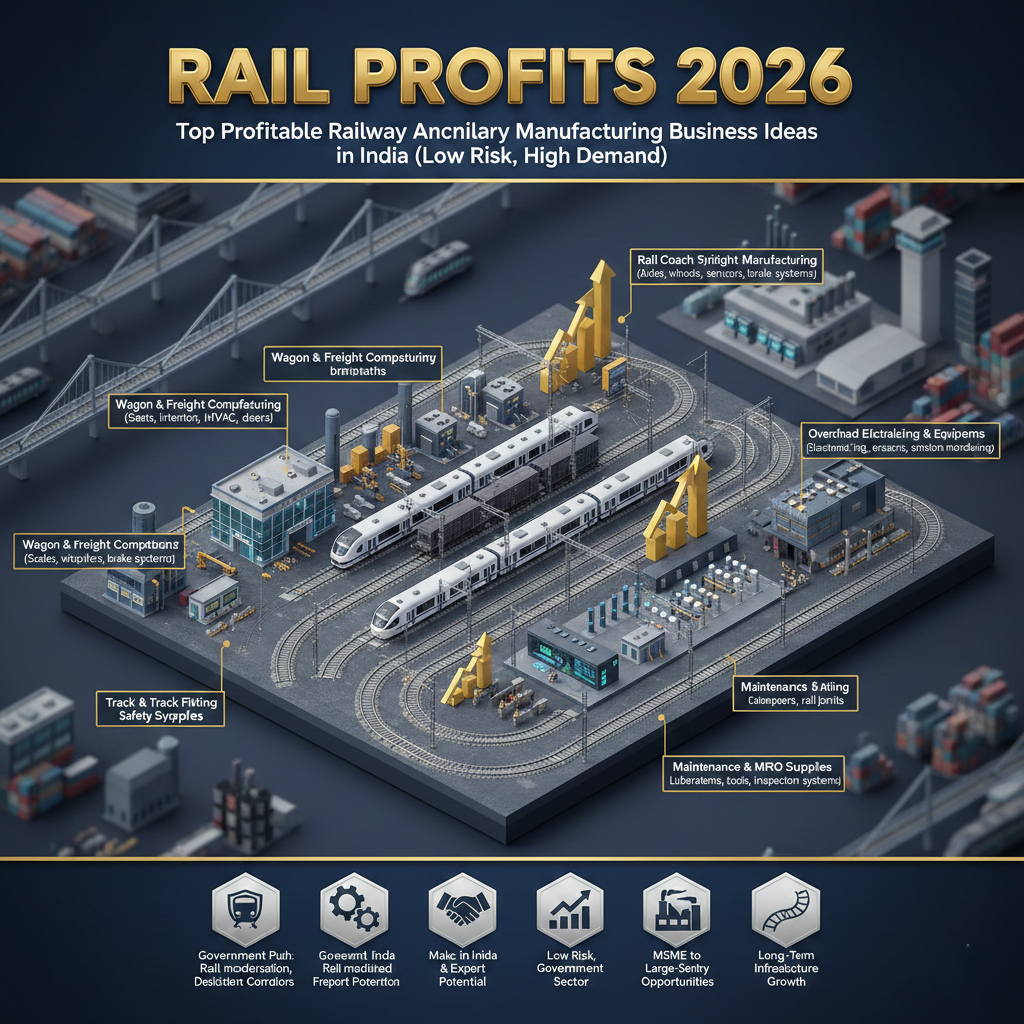
3. Electrical Panels & Signalling Equipment
With rapid electrification and modernization of the signalling systems, the growth of electrical ancillary products is increasing steadily. Control panels, relay cabinets and junction boxes are all key to railway operations.
Growth drivers include:
- electricity is present on the route constantly
- Signalling system upgrades
- Import substitution opportunities
- Expand the infrastructure for traction
This segment needs more technical compliance but has better margins.
4. Rubber, Polymer & Composite Components
Rubber pads, anti-vibration mounts and polymer insulation components are small but important components of railway systems. These parts wear out and must be replaced periodically.
Why entrepreneurs are interested in this segment:
- Moderate capital investment
- High value-to-weight ratio
- Replacing demand demand is recurring
- Attractive operating margins
Due to their shorter lifecycle, repeat orders are common.
Read More: Ethanol as Biofuel – Manufacturing Plant, Detailed Project Report, Profile, Business Plan, Industry Trends, Market Research, Survey, Manufacturing Process, Machinery, Raw Materials, Feasibility Study, Investment Opportunities, Cost and Revenue
5. Station Infrastructure & Passenger Amenities
Station redevelopment programs have identified over a thousand stations for modernization. This gives rise to the demand for seating systems, stainless steel railings, kiosks, water booths and modular sanitation units.
Demand in this segment is supported by:
- Redevelopment programs led by the Government
- enhance passenger safety and comfort upgrades
- Long term plans for modernization
This category is especially good for fabrication-oriented MSMEs.
Export Opportunity for Rail Ancillary Units
Indian manufacturers supplying components for railways tend to get a good quality credibility. As India has a share in Global Infrastructure and EPC projects, ancillary suppliers can grow in export markets.
Products having a high export potential include:
- Fasteners and clips
- Fabricated steel structures
- Electrical enclosures
- Polymer and rubber components
Global railway development in emerging economies is long-term growth possible.
Read More: Railway Infrastructure Boom: Manufacturing Business Opportunities for New Entrepreneurs
Lessons to be Learned from Indian Infrastructure-Aligned Companies
Several Indian companies have scaled successfully by matching their manufacturing capabilities to the growth in infrastructure.
Skipper Ltd grew through the expansion of structural fabrication in line with power and rail demand.
KEI Industries capitalised on growth due to electrification.
Apar Industries focused on the conductors and electrical accessories for infrastructure projects.
Their success indicates a uniform strategy, namely to focus on standardized industrial goods that support long-term national infrastructure programs.
Why 2026 is the Right Time to Enter this Sector
The current conditions create optimal conditions for railway supplementary production activities:
- Increasing freight and passenger traffic
- Continued electrification and signalling improvements
- Strong government capital expenditure
- Import substitution policies
- Active encouragement of MSME participation
The current economic situation creates demand for railway ancillary manufacturing which has stable demand and government backing and capacity to grow.
Read More: Top Most Profitable Business Ideas for the Next 10 Years
Conclusion: Stability vs. speculations
Railway ancillary manufacturing presents entrepreneurs with steady growth because it delivers ongoing institutional requirements and extends beyond normal business operating hours. The manufacturing sector in India offers entrepreneurs with a strong need for stability this particular manufacturing option as their best choice.
This industry will achieve sustainable revenue growth and operational expansion by following proper feasibility assessment methods and railway standard compliance procedures and establishing strict financial control systems.
Frequently Asked Questions (FAQ)
Q1. Is railway ancillary manufacturing suitable for beginners?
Yes. Many products are MSME-friendly and based on standardized specifications, which reduces technical risk.
Q2. Is the demand seasonal?
No. Demand remains continuous due to maintenance cycles and infrastructure projects.
Q3. What is the typical investment required?
Most units can be established with an investment ranging from ₹1.5 crore to ₹8 crore depending on product type.
Q4. Are export opportunities available?
Yes. Indian railway components are increasingly exported through global EPC and infrastructure projects.
Q5. Do banks finance railway-linked manufacturing units?
Yes. Institutional demand improves creditworthiness and enhances loan approval prospects.