Profitable MSME Manufacturing Business
India’s manufacturing is reaching a high growth phase through supply chain diversification, increasing domestic consumption and expansion in infrastructure due to policy support under Make in India. MSMEs already account for nearly 30% of India’s GDP and its more than 40% of total exports and are becoming increasingly important as buyers in the global market are choosing China+1 as their sourcing strategy.
For entrepreneurs interested in investing in a business anywhere from Rs.25 lakh to Rs.3.35 crores, manufacturing presents them with the opportunities for scalability, asset creation, recurring demand and stronger long-term valuation as compared with trading business. The trick is to select those sectors in which demand is growing but where organized supply is still tight.
Below are the most promising scalable MSME manufacturing opportunities in India in the upcoming years.
Read More: Modern Technology of Agro Processing & Agricultural Waste Productsc
1. Precision Agro – Processing & Branded Food Products
India is one of the world’s largest producers of spices and agricultural commodities but value added processing is underdeveloped. Consumers are increasingly shifting towards branded spice blends, ready-mix and packaged health snacks.
Major brands such as Everest Spices and MDH are dominating the national markets while conglomerates such as ITC Limited are expanding aggressively in premium segments. However, regional tastes and export markets still have scope for quality-focused MSMEs.
With an investment of Rs. 50 Lacs to Rs. 1.5 crores, an entrepreneur can establish a semi-automated spice grinding, blending and packaging unit.
Why this sector works:
- High repeat consumption
- Strong export potential
- Good profit margins in branded products
- Integration with e-commerce – Easy integration
Certifications such as FSSAI and ISO go a long way in increasing the credibility and distribution reach.
2. Eco-Friendly Packaging & Compostable Products
India’s efforts to ban single-use plastic waste have created a strong need for packaging materials that can break down into compostable and biodegradable forms. Food delivery services, retail businesses, and corporate consumers are rapidly appreciating the deployment of sustainable packaging solutions.
Companies like Envi green and Ecowars have demonstrated how rapid scaling can be achieved for sustainability-driven companies. Still, the availability of supplies is limited in regional markets.
A unit with a capacity of around 60 lakhs to 2 crores can produce paper bags, moulded Fiber plates and compostable packaging materials with the help of automated cutting and forming machines.
Growth drivers include:
- Government regulations for banning plastics
- ESG compliance demand from Corporates
- Export opportunities in eco-products
- Bulk contract for institutions
The industry benefits from effective government regulations while more people become aware of environmental issues.(Profitable MSME Manufacturing Business)
Read More: Paper Water Bottles – The Future of Sustainable Packaging Business
3. Non-Woven Products & Technical Disposable Supplies
The healthcare industry and hospitality businesses and industrial sectors maintain a steady requirement for non-woven fabrics and medical items that can be thrown away. Hospitals and other institutional facilities commonly use surgical gowns masks and technical drapes and aprons as their essential products.
Large players such as Grasim Industries and Welspun India are working at scale but there is scope for niche units of MSMEs that are working on quality-certified supplies.
An investment of between Rs 75 Lacs and Rs 2.5 Crore helps in installing non-woven fabric machinery, ultrasonic welding machines and automated packing systems.
Advantages of this business:
- Stable B2B demand
- Repeating institutional orders
- Moderate marketing costs
- Export possibilities using ISO certification
Once the approvals are secured from hospitals or institutions, order-flow tends to be predictable.
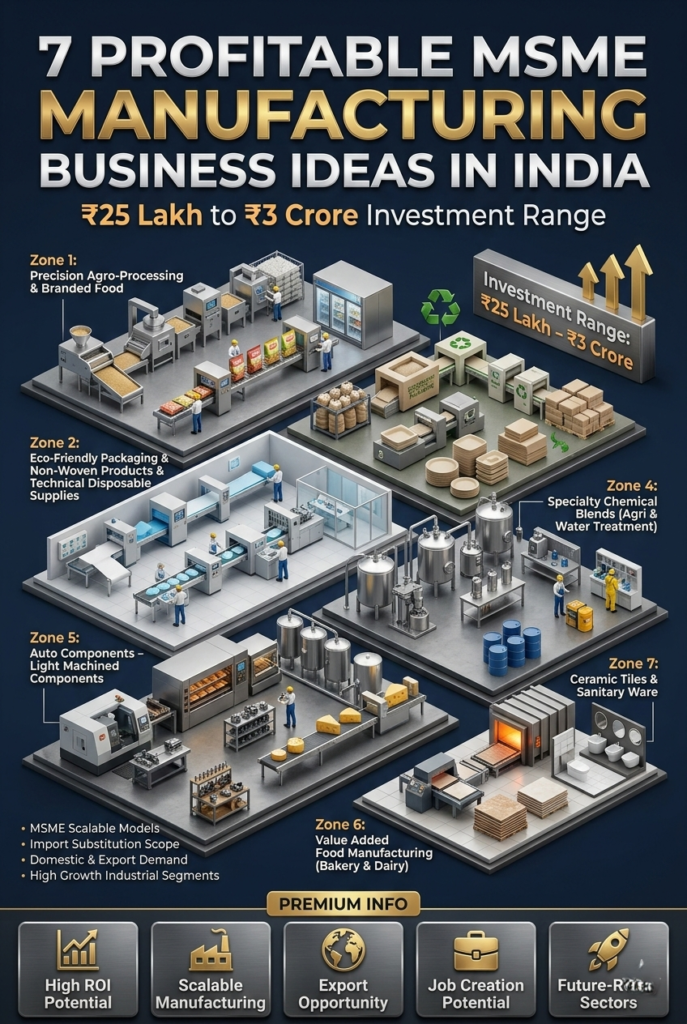
4. Specialty Chemical Blends in the Agriculture & Water Treatment Industries
Industrial growth and environmental compliance are creating a high demand for water treatment chemicals, coagulants, flocculants and specialty blends for agriculture. Municipal corporations and industrial plants are repeat bulk purchasers.
Industry leaders like Thermax and Ion Exchange India dominate the large-scale markets though many specialized formulations are still imported.
Investing anywhere between ₹1 crore to Rs. 1.5 crores, an MSME can install blending reactors, testing laboratories and packaging units.
Why it is attractive:
- Encloses in quotation marks “Institutional supply contracts
- Lower retail market dependence
- Strong margins on specialty blends
- Long-term industrial demand
Compliance with ISO and BIS standards enhances trust and eligibility for tenders by buyers.(Profitable MSME Manufacturing Business)
Read More: Automobile Industry and Auto Components, Automotive components, Spare parts, Auto Parts, Car Parts, Replacement Parts, Tractor Parts, Motorcycle Parts, Auto Body Parts, Two Wheeler, Three Wheeler and Four Wheeler Parts, Accessories & Spares Projects
5. Auto Components – Light Machined Components
India’s auto component industry is competitive on a global stage and is expanding as there is a demand for exports and domestic production of cars. Engine and chassis components of precision machined parts continue to be in high demand.
Companies such as Sundram Fasteners and Matherson Group demonstrate the scope of this industry. However, Tier-2 supplier opportunities are still significant.
With around 1.5 crores, a CNC based machining unit can be set up.
Key strengths of this sector:
- Strong OEM sourcing demand
- Export-oriented growth
- Recurring vendor contracts
- Scalable automation model
Once vendor approval is obtained, this is one of the most structured and predictable of the MSME manufacturing businesses.
6. Value Added Food Manufacturing (Bakery & Dairy)
Urban consumers are more and more inclined to the convenience-based, premium food products such as ready mixes, specialty baked goods and flavoured dairy foods.
Established brands such as Britannia Industries, Amul, etc. dominate the national distribution with the mid-tier premium and niche segments fragmented.
An investment of between Rs 1 crore and Rs 3 crore enables the setting up of ovens, mixers, cold storage and automated packaging lines.
Promising classes of products:
- Gluten-free baking mixes
- Artisanal breads and cakes
- Premium paneer and dairy desserts
- Regional ready-to-cook mixes
Brand positioning and distribution over the web are highly beneficial to margins.
Read More: Biodegradable Products Business: Profitable Eco-Friendly Opportunities in 2025
7. Ceramic Tiles & Sanitary Ware Items
The housing growth and infrastructure development in India is keeping the demand for ceramic tiles and sanitary ware going. While there are major brands such as Kajaria Ceramics and Somany Ceramics dominating metros, the regional production units are efficient in serving the local construction markets.
With an investment of Rs 2 crores to Rs 3.35 crores, a tile manufacturing unit with kiln facilities, glazing systems and polishing equipment can be installed.
Closeness to canters of construction lowers logistics costs and enhances competitiveness.
Why MSME Manufacturing Is Extremely Viable in 2026
Several macroeconomic factors make this an ideal time to get into manufacturing:
- High government incentives and MSME schemes
- Increasing domestic consumption
- Export diversification outside of China
- Improved credit access and cluster infrastructure
- Growing institutional procurement
Entrepreneurs who concentrate on quality certification, operational efficiency and linkage to markets can realistically aim for payback in three to five years.
Read More: Paper Bottle Manufacturing Business – An Infrastructure-Led Opportunity in Beverage
Final Thoughts
India presents manufacturing as a highly expandable business approach which depends on physical assets. Manufacturing operations create physical infrastructure and generate ongoing supply agreements which together establish permanent business value, in contrast to service and trading operations.
MSME units can achieve high profitability through strategic planning combined with market-oriented execution and compliance management according to entrepreneurs who enter the India market with this approach.
The opportunity window which has opened will bring success through disciplined execution.(Profitable MSME Manufacturing Business)
Frequently Asked Questions (FAQ)
Q1. Which MSME manufacturing business is safest for ₹25 lakh–₹3.35 crore investment?
The five industries of agro-processing, eco-friendly packaging, non-woven products, specialty chemicals and auto components maintain stable operations because institutional customers repeatedly purchase their products.
Q2. How important are certifications?
Certifications such as FSSAI, ISO, and BIS are crucial for credibility, institutional contracts, and exports. They significantly reduce market entry barriers.
Q3. Is export feasible at this investment level?
Yes. Spice blends, technical textiles, eco-friendly packaging, and machined auto components have strong export potential if quality standards are maintained.
Q4. What is the typical payback period?
Through their disciplined operations, MSME manufacturing units reach financial payback after three to five years through their effective use of operational capacity.
Q5. Is 2026 a good time to start a manufacturing business in India?
The combination of policy support and export growth together with infrastructure expansion and supply-chain shifts creates the strongest growth cycle for MSME manufacturing in this period.