
How Uttar Pradesh’s PMFME district-crop mapping is unlocking manufacturing, MSME, export, and startup opportunities in India’s largest agricultural state
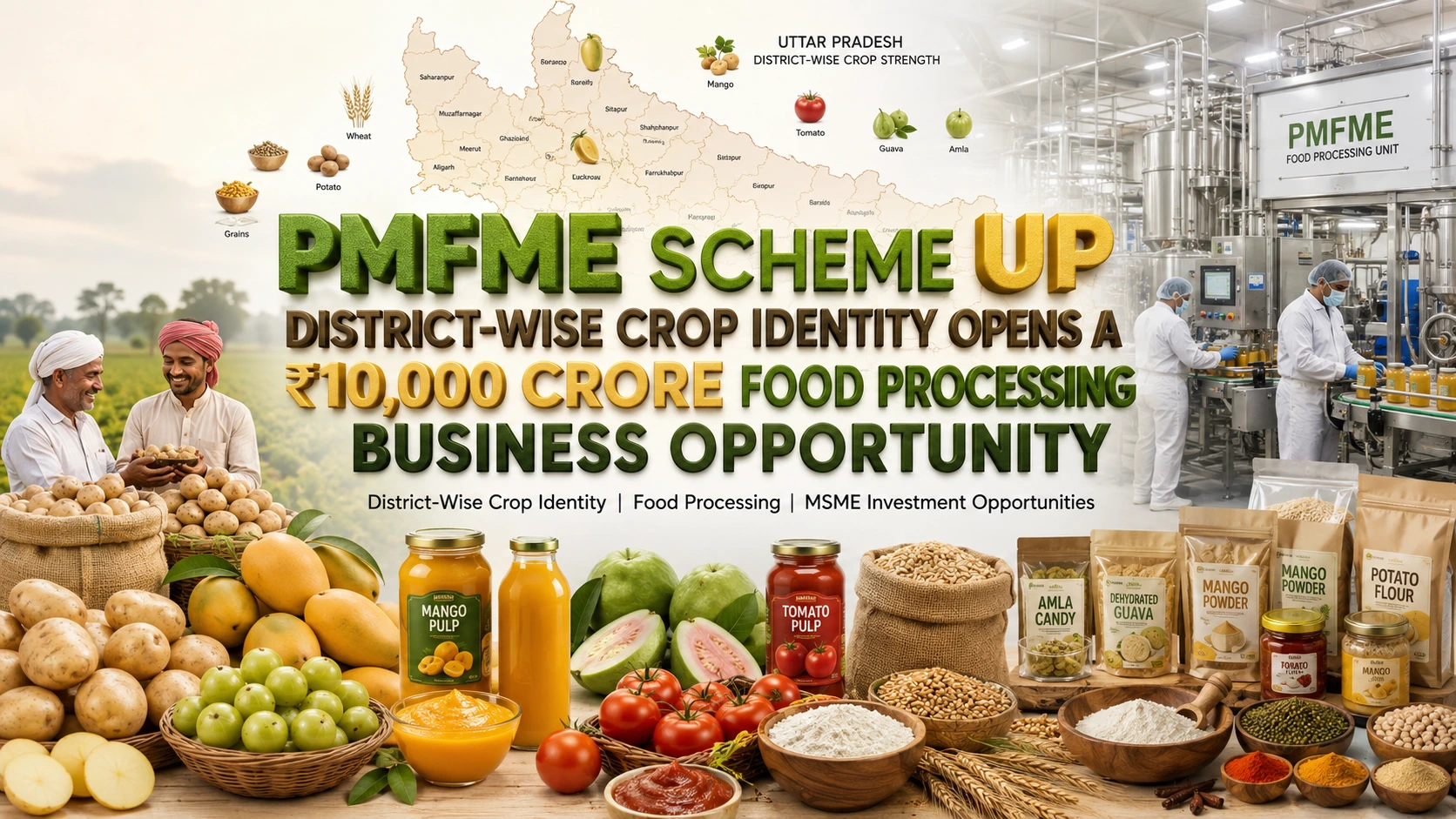
A recent report by Aaj Tak has brought a big development in Uttar Pradesh to light. The central government has tied each of the 75 districts of UP to a specific food crop under Pradhan Mantri Formalisation of Micro food processing Enterprises (PMFME) scheme. The transition follows the popular One District One Product (ODOP) initiative of the government of Rashtrapati, but this time it’s all about food processing, farm-to-market supply chains and micro enterprise development.
This is not a standard government circular. It is a programme of ₹10,000 crore for the nation which tells every food entrepreneur, investor, MSME founder which food product will be given priority support in each of the 75 districts of UP – from mint fields in Barabanki to Kala Namak paddy field of Gorakhpur. The message to the founders is clear: The government has conducted market research. Infrastructure pipeline is beginning to open. Credit windows are open. What’s left are entrepreneurs who must take action.
This article is based on the information provided in the report of Aaj Tak on 18 August 2026, to understand the impact of the development on those manufacturers, MSME owners, exporters and investors considering the most productive agricultural corridor of India.
Related Article: Food Processing Business in Uttar Pradesh: Setup Cost, Project Ideas & Profit Guide
What Recent Reporting Means
According to the Aaj Tak story, the Ministry of Food Processing Industries (MoFPI) had issued a list of crop identities per district, comprising 713 districts in 35 states and Union Territories (UTs) in February, 2024. UP’s 75 districts are highlighted. The Barabanki, Rampur, Sambhal and Sultanpur are assigned to Mint. Amla visits Amethi, Fatehpur, Pratapgarh and Raebareli. The Mango is covering Lucknow, Mau, Sitapur, and Unnao. Kala Namak rice, a heritage variety is been identified for Gorakhpur, Maharajganj, Siddharthnagar and Sant Kabir Nagar which is GI tagged. Jaggery is available all over Ayodhya, Bagpat, Bijnor, Meerut, Muzaffarnagar and Pilibhit.
This mapping process serves three purposes for entrepreneurs. For one, it ensures the concentration of raw materials – crops are already being cultivated on a large scale in those districts. Second, it directs government funds towards technology upgradation and credit facility for all those who construct a processing unit in those specified areas. Thirdly, it links small processors to the big branding-marketing mechanisms, as in the case of multiflora honey of Saharanpur which is being developed as a national brand “Madhumantara” with the support of NAFED and TRIFEDs.
What importance does this have to manufacturers and investors? The PMFME scheme is set up in a credit-linked capital subsidy model. If you are considering investing ₹1 crore in an amla processing unit in Raebaleili, then you can avail a maximum grant of up to ₹35 lakh from PMEGP, MUDRA, or MSME loan, before that. For the first time in its history, the risk equation of a first-generation entrepreneur has shifted.
Why This Industry Is Growing
Food processing industry is one of the largest sectors in India and is one of the least developed as compared to agriculture output of the country. The country is producing more than 300 million tonnes of food grain, fruits and vegetables every year, but not all the agri-products are processed before they reach the consumers. That’s a significant commercial opportunity!
Uttar Pradesh is the central point of this tale. The state is the leading producer of sugarcane, wheat, potato, mango and mint in India. It also has a large production of amla, guava, and aromatic rice for the country. However, a majority of this produce is sold out as raw produce where the value is eroded from the producers to traders, transporters and middle men before reaching the processor or retailer. The district mapping of the PMFME scheme is specifically targeted at cutting this cycle and promoting value addition at the point of production.
The structural change is also borne out by consumer trends. The packaged clean label, ready to use food ingredient market is growing very quickly in urban India. The distilled product of Barabanki crop is known as mint essential oil which is used in the pharmaceutical, confectionary and personal care industry. The Amla extract is a high-quality ingredient that is used in the booming market of nutraceutical and Ayurvedic supplements. The organic and health food stores offer a high price for rice tagged with the ‘GI’ mark as ‘Kala Namak rice’. All of these trends are driving investment into district processing, and the PMFME scheme is now offering the policy and financial framework to enable the investment to be banked.
Government Policies and Incentives
This is largely propelled by the PMFME Scheme. This was launched as part of the Aatmanirbhar Bharat initiative comes with a national budget of ₹10,000 crore from 2020-2025 (now expanded). The scheme offers 35 per cent credit-linked capital subsidy to individual micro enterprises, common infrastructure support to the Farmer Producer Organisations (FPOs), Self-Help Groups (SHGs) and cooperatives, and branding and marketing assistance on a district specific basis for district specific products.
The Ministry of Food Processing Industries also has a Production Linked Incentive (PLI) scheme for food processing which incentivizes the scaling up of food processing exports. The Agricultural and Processed Food Products Export Development Authority (APEDA) offers export promotion support, assistance for GI certification and market development funds to the exporting firms in respect of their UP-specific products such as Kala Namak rice and organic mint oil.
The Department of Agriculture of the UP coordinates the implementation of ODOP and connects the farmers with the FPOs for sourcing of the pooled raw material at the state level. Complementing PMFME, the project-based subsidy granted through the Ministry of MSME’s PMEGP scheme can go up to 35 percent (25 percent for urban area) for eligible micro and small enterprises.
Startup India (DPIIT) and make in India continue to give support to identified Food Processing startups via tax exemption, reduction in patent fees, and access to GeM for government procurement.
Manufacturing Business Ideas Emerging from PMFME Mapping
1. Mint Oil Distillation Unit (Barabanki, Rampur, Sambhal, Sultanpur)
This is one of the densest mint growing areas in Asia, with hundreds of thousands of acres of mint being cultivated in Barabanki and Rampur districts. It’s during the distillation process that all the value is extracted from the plant: Fresh mint leaves are turned into peppermint oil or menthol crystals, and the remaining residue is used as livestock feed. The small-scale steam distillation unit at Barabanki can obtain the raw material from FPO groups and sell it to pharmaceutical, confectionery, and oral care industries. The cost of a 500 kg per day batch distillation unit varies from ₹25 lakh to ₹60 lakh and the PMFME subsidy is offered on the investment cost.
The export prices of Menthol crystals are in the range of USD 12 – 18 per kg in the global market, with the main buyers being from the United States, EU, Japan and the Southeast Asian region. The product is GMP clean and needs to be registered by FSSAI as a food grade product, which can be done by any serious micro entrepreneur.
2. Amla Processing and Value-Addition Unit (Amethi, Fatehpur, Pratapgarh, Raebareli)
The gooseberry Amla is enjoying high demand due to its use as a nutraceutical, in Ayurvedic supplements, and by health-food retailers. The districts of Pratapgarh and Raebareli have been found to throw up a substantial harvest but have limited processing facilities with a large proportion of the harvest being sold as raw product with low margins. The juice processing unit produces amla juice concentrate, amla powder, amla murabba (preserve), and amla candy that caters to various consumer segments, such as retail grocery, and B2B ingredient supply to supplement manufacturers.
The cold-press amla juice is making its presence in modern trade on its own shelf with the brand functional beverages. The washing, crushing and pressing lines along with pasteurising and packaging lines will require an investment of ₹40–80 lakh for an entrepreneur to enter this market. This is one of the most viable food processing projects in the state due to the subsidy provided by PMFME along with APEDA’s export development fund on tropical processed fruits.
Get Detailed Project Report (DPR): Amla Plantation Business Plan & Project Report
3. Kala Namak Rice Milling and Branded Rice Export Unit (Gorakhpur, Maharajganj, Siddharthnagar, Sant Kabir Nagar)
Kala Namak has a Geographical Indication (GI) registration, and its aroma and nutritional value give Kala Namak rice a natural competitive edge in domestic and international markets. Until now, districts that grow Kala Namak rice have lacked branded and certified processing capacity. A founder can establish a dedicated milling, grading, and packaging facility for Kala Namak rice and export the product to diaspora markets in the UK, US, and Gulf countries, where buyers pay higher rates for Indian heritage grains. Organic certification greatly contributes to the export realisable value.
There is no need for advanced machinery. Rice hullers, de-stoners, graders, and colour-sorters are readily available and cost-effective. Together with APEDA GI product export support and PMFME branding support, this export-first approach can help the startup become profitable within 18–24 months of operation.
Access Complete Business Plan: Rice Milling Unit Project Report

4. Jaggery and Sugarcane By-Product Manufacturing (Meerut, Muzaffarnagar, Bijnor, Pilibhit, Ayodhya)
Whereas small and medium jaggery (gur) processing units could be established in sugarcane-growing areas of western UP. Meerut, Muzaffarnagar, and Bijnor are natural locations. These districts already have khandsari and gur production. However, most production is in the form of loose grain and remains unbranded. The business opportunity lies in upgrading to block or powder jaggery and organic jaggery. Specialty products can also include jaggery powder mixed with ginger or jaggery granules for diabetic-friendly sweetener blends.
There is strong diaspora and health-conscious consumer demand in the US, Canada, UK and Australia for natural sugar alternatives. The price of certified organic jaggery manufacturing unit is three to four times that of loose gur in export channels as the manufacturing unit will have tamper proof packaging and FSSAI and APEDA approved product documentation. The investment for 1 tonne/ day unit ranges from ₹20-50 lakh. These units are subject of PMFME credit linked subsidy directly.
Check Out This Recommended Book: The Complete Book on Sugarcane Processing and By-Products of Molasses (with Analysis of Sugar, Syrup and Molasses)
5. Mango Pulp, Puree, and Value-Added Processing (Lucknow, Mau, Sitapur, Unnao)
Although Uttar Pradesh is a major mango producer, mango pulp processing remains limited to a few organised players in the PMFME-listed districts. The real market opportunity for new entrants lies in value-added mango products. These include Alphonso and Dussehri pulp in aseptic packs, bulk mango pickle, mango slices, mango powder, and mango-based beverage premixes.
The products target institutional buyers, including food service, ice cream factories, and confectionery companies. They also target export markets such as the Middle East and Southeast Asia. Indian mango products have a strong brand reputation in these regions. The cost of a small aseptic pulp and IQF line ranges from ₹75 lakh to ₹1.5 crore. This investment can help businesses avail subsidies under PMFME and the MoFPI PLI scheme for food processing.
View Full Project Details: Mango Pulp with Cold Storage
6. Herbal Extract and Ayurvedic Ingredient Manufacturing (Multi-District)
The PMFME scheme is designed around the crop identity of the districts and this does not just apply to the food commodities. Some districts have been allotted herbs and aromatic plants as raw materials to the manufacturers of Ayurvedic/Herbal products. Amla (multiple districts), tulsi, and aromatic plants like mint can produce standardised herbal extracts such as concentrated liquid extracts, dry powders, and tinctures. These products can supply AYUSH product manufacturers, cosmetic formulators, nutraceutical companies, and other buyers. This opportunity suits someone with a chemical or pharmaceutical background who can receive training to work within AYUSH GMP.
The investment required for a solvent extraction and spray-drying unit ranges from ₹60 lakh to ₹2–3 crore. The final cost depends on the scale and compliance requirements. The local market for herbs is expanding at a double-digit rate. In addition, European supplement companies are increasing their imports. This is creating new B2B demand for standardized extracts made from Indian herbs.
Explore This Book: Herbal Cosmetics & Ayurvedic Medicines (EOU)
Import-Export Opportunity Analysis
The district-level crop identity framework under PMFME creates a direct pipeline to export markets. India is already the world’s leading producer and exporter of menthol and peppermint oil, and UP’s mint belt is at the centre of global supply. However, domestic distillation capacity remains fragmented. New distillation units set up under PMFME can directly displace import orders from European and American buyers. These buyers currently source processed mint products from secondary exporters. Amla products also offer import substitution potential. India’s nutraceutical industry imports concentrated berry extracts from China and the US. Domestic amla extract can replace these imports with comparable quality certification.
For Kala Namak rice, the APEDA has identified GI-tagged rice as a priority export category. Indian diaspora communities in the UK, US, Canada, and Australia represent a ready buyer base for authentic, certified Kala Namak rice — currently underserved by existing exporters. Jaggery exports to the US, EU, and Gulf have been growing steadily as health-conscious consumers seek alternatives to refined sugar. The Meerut-Muzaffarnagar belt’s organic jaggery can command premium pricing in certified export channels if producers invest in organic certification and food safety audits.
Indian MSME Success Stories
Shri Ganesh Jaggery, Muzaffarnagar
A cooperative-backed jaggery manufacturer from the sugarcane-rich Muzaffarnagar belt shifted from loose gur production to branded block and powder jaggery. This transition took place under UP’s ODOP push.
The unit invested in SS-grade pans, graders, and food-grade packaging. It also secured FSSAI certification. The manufacturer then began supplying modern trade chains, including D-Mart and organic retail stores.
Within two production seasons, the unit tripled its net realisable margin per quintal. The PMFME scheme’s common facility support also helped the unit access shared cold storage and a packaging line. As a result, it reduced capital expenditure and supported further scaling.
Amogh Kala Namak Rice Exports, Gorakhpur
A first-generation entrepreneur from Gorakhpur established a dedicated milling and branding operation for GI-tagged Kala Namak rice. The business targeted diaspora markets in the UK and Gulf countries through an APEDA-supported export pilot.
The venture started with a milling capacity of 500 kg per day. It invested in tamper-evident packaging with GI certification markings. The company also listed its products on the APEDA e-commerce marketplace for agricultural exports.
Within 12 months, the unit secured consistent repeat orders from three UK importers. It is now expanding to a 2-tonne-per-day milling line. The expansion will receive support through the PMFME credit-linked subsidy.
Arogya Amla Naturals, Pratapgarh
An SHG-backed amla processing unit in Pratapgarh started with amla candy and murabba production. Pratapgarh is one of four districts designated for amla under PMFME. The unit initially targeted local and regional markets.
With branding assistance from the UP ODOP cell and NAFED’s market development programme, the unit expanded its product range. It later began producing amla juice concentrate for institutional B2B buyers. These buyers operate in the food and nutraceutical sectors.
PMFME subsidy funded the upgrade to a cold-press juice line. Meanwhile, PMEGP working capital support helped the unit procure raw materials. This support was especially useful during the peak amla harvest season. The unit now employs 22 women from the local SHG network and has achieved FSSAI-certified production status.
Smart entrepreneurs start here—find your perfect venture
About NPCS – Niir Project Consultancy Services
Niir Project Consultancy Services (NPCS) is India’s leading industrial consultancy and project report preparation company, with over two decades of experience supporting entrepreneurs, MSMEs, and investors across the food processing, chemicals, agro-industry, and manufacturing sectors. NPCS helps founders check government scheme eligibility, prepare bankable Detailed Project Reports (DPRs), conduct market feasibility studies, and access technology partnerships for new manufacturing ventures.
Whether you are setting up a mint oil distillation unit in Barabanki, an amla processing facility in Raebareli, or a branded Kala Namak rice export unit in Gorakhpur, NPCS provides:
- Detailed Project Reports (DPRs) eligible for bank financing and government subsidy applications
- Market research and feasibility studies tailored to district-level PMFME product categories
- Technology consultancy for selecting appropriate processing equipment and plant layouts
- Guidance on PMFME, PMEGP, PLI, and APEDA scheme applications
Explore NPCS’s food processing project reports and services at www.niir.org and www.entrepreneurindia.co.
Business Opportunity at a Glance
| Parameter | Details |
| Industry | Agri-food processing, MSME food manufacturing, value-added agriculture |
| Market Driver | PMFME Scheme — district-wise crop identity for UP’s 75 districts; ₹10,000 crore national budget |
| Investment Range | ₹10 lakh – ₹5 crore depending on product category and processing scale |
| MSME Opportunity | Mint oil distillation, amla processing, black rice milling, jaggery units, mango processing |
| Export Potential | Peppermint oil (global pharma demand), organic amla, GI-tagged Kala Namak rice, jaggery |
| Government Support | PMFME (35% credit-linked subsidy), PMEGP, ODOP UP, MoFPI PLI, APEDA export support |
| Risk Level | Low-to-Medium — government-backed scheme with FPO and SHG credit linkage |
| Growth Outlook | High — India food processing sector targeting USD 535 billion by 2025-26 |
Conclusion: The Farm-to-Market Gateway Is Open — Act Now
The Aaj Tak report on PMFME’s district-wise crop identity for UP is more than a government update. It is a business blueprint. For the first time, India’s largest agricultural state has a formally published, policy-backed map. It tells investors, manufacturers, and startup founders which food products each district can process at scale. It also shows the financial support available to make it happen.
The opportunities are open across major categories. These include mint oil distillation in the Barabanki belt and amla processing in Raebareli and Pratapgarh. They also include GI-tagged rice milling in the Purvanchal corridor. Jaggery upgrading offers potential in western UP’s sugarcane districts. Mango value-addition is another opportunity across Lucknow and Sitapur. Each opportunity represents a credible and capital-efficient manufacturing business. Government subsidies can support these businesses. First-generation entrepreneurs and existing MSMEs can enter these sectors today.
The PMFME framework has substantially reduced the risk profile: concentrated raw material supply supports procurement, the government provides a structured and disbursable subsidy, APEDA has established export channels, and NAFED and TRIFED provide national branding support for category winners. What remains is execution — and the window of advantage belongs to founders who move before the market consolidates.
To explore Detailed Project Reports for mint oil distillation, amla processing, jaggery manufacturing, Kala Namak rice milling, and herbal extract units in UP, visit www.niir.org or contact NPCS – Niir Project Consultancy Services today.