


The booming demand for eco-friendly personal care along with the global shift towards green economy and domestically sourced clean label and skin compatible personal care products makes it imperative for India to increase the manufacture of bio-sourced cosmetics raw materials.
India may have the largest bio-resource repository in the world with strong formulation industry and the growing start-up ecosystem. It makes it well poised to address the demand for clean label cosmetics.
According to Chemical Weekly (June 3, 2025), India is witnessing a surge in domestic production for green cosmetics raw materials including glycerol esters, bio surfactants, and plant antioxidants.
Additionally, defying the pandemic slump, the clean cosmetics market is estimated to cross 22 billion USD by 2027, with plant-derived, biodegradable, and nontoxic ingredients becoming pivotal-Personal Care and Cosmetics.
Thus, cashing on this opportunity, Indian MSMEs and start-up companies can serve as a value added supplier for sustainable raw materials which can cater to Indian brands and global supply chains.
Read More: Entrepreneur’s Guide: Building a Flourishing Herbal Cosmetics Manufacturing Business
What Is the Justification for the Local Production of Cosmetic Ingredients?
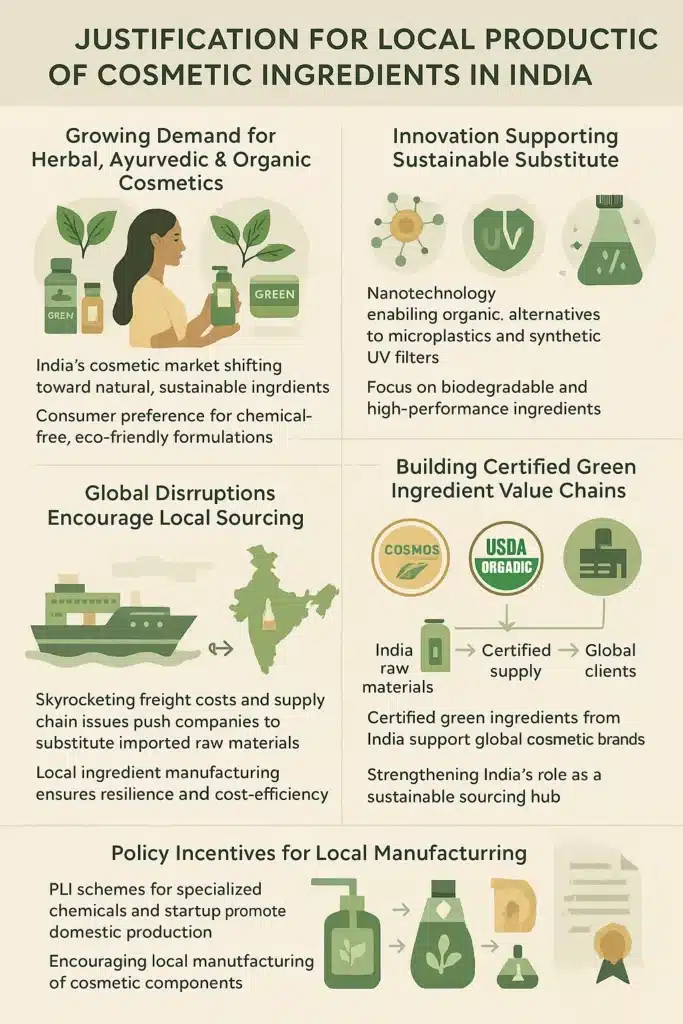
The Indian market is witnessing an increase in demand for herbal, ayurvedic, and organic cosmetics. Advances in nanotechnology that allow for organic substitutes for microplastics and synthetic UV filters.
Efforts to substitute imported raw materials in response to skyrocketing freight charges and global supply chain disruptions. Green ingredient value chains needing COSMOS, ECOCERT, or USDA certification for their global clients needing raw materials from India.
Strong state sponsorship like the PLI in specialized chemicals and the PLI for startups schemes increasingly favor local manufacturing of accessories and components.
Potential Green Ingredients for Startups-Personal Care and Cosmetics
Glycerol Esters and Derivatives of Fatty Acids
They also commonly appear in hair serums, hand and body creams, and skin moisturizers in the form of glycerol monooleate, glyceryl stearate, and mono and diglycerides, have superb profit margins and multiple uses in food and cosmetics. They can be easily manufactured in India due to local raw materials from vegetable oils.
Natural Emollients and Conditioners
Natural emollients and conditioners include capric/caprylic triglycerides and isoamyl laurate, derived from coconut, castor, jojoba, and sunflower oils, and come in behenyl alcohol, and coco-caprylate forms. As noted in Chemical Weekly, India is trying to replace imports with green substitutes, which benefits many startups.
Bio-Based Surfactants
Such as sodium cocoyl isethionate, coco-glucoside, decyl glucoside, and lauryl glucoside, are in shampoos, facewashes, and handwash cleansers.
Their mild, sulfate-free, and biodegradable nature makes them highly suitable for all skin types, including premium and baby care. By producing these in India, many startups would be able to fulfuill the growing domestic and international demand.
Plant-Derived Preservatives and Antioxidants-Personal Care and Cosmetics
Tocopherol, rosemary extract, green tea polyphenols, and natural sodium benzoate replace the controversial parabens and BHA/BHT preservatives. These ingredients can be produced through clean extraction and processing to serve the growing market for cosmetic brands that prioritize safety.
Read More: Herbal Cosmetics – Successful Industry in the Modern Era
Humectants and Moisturizing Agents
Betaines, sodium PCA, and bio-based propanediol are important for skin hydration. Propanediol can be produced from sugarcane or corn through fermentation, resulting in an economical sustainable option to replace propanediol.
Natural Waxes and Film Formers
Portraying the beauty of femininity and cosmetics captured the attention of the masses through lipsticks, balms, and eyeliners. Natural waxes which are valuable to the cosmetics industry include carnauba wax, beeswax, rice bran wax, and candellila wax. Many of these wax products are still imported, which makes local supply a valuable opportunity.
Essential Oils and Natural Fragrances
Popular essential oils which can be derived from different plants include lavender, lemongrass, tea tree, and peppermint oils. Most of these can be removed through the processes of cold pressing or steam distillation at the agricultural level. Hence, many new businesses can supply these oils to both international and local markets, thereby assisting farmers and minimizing the supply chain.
Biodegradable Exfoliants
Plastic microbeads used in cosmetics have been banned. However, other natural and suitable substitutes still exist, such as apricot kernel powder, walnut shell powder, and bamboo powder. Many of these ingredients can easily be sourced from the waste of agicultural processes. Hence, new businesses can produce sustainable and ecologically friendly exfoliators at a cheap price.
Read Our Book: Click Here
Manufacturing Setup and Technology Requirements-Personal Care and Cosmetics
If new businesses are to produce these ingredients, they will require the above mentioned apparatus and GMP-driven compliance for the beneficiaries. Alongside the essential equipment, the new businesses will require other units such as filtration and spray drying, in addition to distillation.
Other ingredients such as romicrobial-based ingredients like hyaluronic acid and lactic acid, fermenters will be a necessity. Other essential equipment such as emulsification and microencapsulation may be required for other high-end products.
Each of these new businesses require dedicated internal quality control units that have high precision equipment like HPLC, GC-MS, and UV-VIS spectrophotometry in order to check for ingredient stability and overall functionality.
Regulatory and Certification Landscape
All emerging businesses need to comply with BIS standards and FSSAI (for dual-use ingredients). For exports, there is still a need to comply with REACH, USDA Organic, COSMOS, and ECOCERT.
Additionally, suppliers need to comply with the Drug and Cosmetic Act. Compliance attainment, and even more, the regulatory certifications obtained, enhances business credibility, thus fostering the sale of ingredients to B2B and D2C customers.
Read Our Project Report: Click Here
Opportunities for Startups and Entrepreneurs
They can create ingredients with multifunctional properties, such as providing hydration, UV protection, and skin anti-aging. They can also implement green processing technologies, for example, low-energy or solvent-free technologies.
Startups can also provide private label ingredients or contract extraction services to brands that do not have a production facility. In addition, developing local sourcing platforms to connect farmers and manufacturers can help strengthen the supply chain and lower the cost.
Market Trends Favoring Green Ingredients-Personal Care and Cosmetics
Industry estimates indicate that the Ayurvedic and herbal cosmetic sector in India will continue to see 15% CAGR growth until 2030. Building supply chain transparency is the focus of several women-led startups including Juicy Chemistry and Earth Rhythm.
Sustainable ingredient sourcing from India is on the rise among foreign enterprises like The Body Shop and L’Oréal, generating opportunities for local and international business.
Challenges
The need for R&D and standardization to sustain and improve quality across the board for startups is a constant challenge. Numerous raw materials need refrigeration immediately, and many others need to be stabilized during transit.
This is also the case for teaching formulators regarding performance parity as it relates to synthetic alternatives. Last but not least, the production and pricing challenges of small-scale operations, coupled with complex processing, creates the constant challenge of not being able to scale profitably-Personal Care and Cosmetics.
Read More: Personal Care and Cosmetics: Eco-Friendly Ingredients for Local Production
Conclusion
The local production of the green cosmetic active ingredients is a lucrative opportunity for Indian entrepreneurs worth a few billion rupees. It is also a step towards fulfilling international supply chain goals for sustainability, supporting the local cosmetics industry, and integrating with farmer-centric supply chains.
Indian startups that focus on R&D, certification, and innovative process design will be able to exploit profitable niches across other personal care products as well.
Find the Best Idea for Yourself With our Startup Selector Tool
How NPCS Can Help You
To help entrepreneurs initiate successful manufacturing ventures, NPCS offers Detailed Project Reports (DPRs), Market Research Studies, and Techno-Economic Feasibility Reconnaissances.
Over the last 40 years, NPCS has assisted numerous startups in project selection, production planning, cost estimation, license acquisition, technology sourcing, and investor relations. This has facilitated seamless project execution and sustainable growth.
Frequently Asked Questions
1) What are the components of green cosmetics?
A. Green cosmetics are of biodegradable, non-toxic, eco-friendly, and plant-derived elements. They found their way into skin, hair, and other personal care products.
2) Why should I manufacture green ingredients in India?
A. Manufacturing green ingredients locally fulfills the increasing international and domestic demand while it diminishes the reliance on imports, the shipping expense, and the supply chain vulnerability.
3) Which ingredients are popular as green and have potential for new ventures?
A. The market is promising for glycerol esters, bio-based surfactants, plant-derived antioxidants, esters of glycerol, natural emollients, humectants, natural waxes, essential oils, and biodegradable exfoliants.
4) What are the requirements for green ingredients?
A. The certifications must include, but are not limited to, COSMOS, ECOCERT, USDA Organic, BIS standards, FSSAI, REACH for Export.
5) What is the minimum capital to establish a business producing green ingredients?
A. The amount of investment largely depends on the scale of operation and type of green ingredients. While we can set up small ventures for a few lakhs, medium scale operations can cost several crores.