

The majority of the Indian businessmen are still going after the good old 9 to 5 window. However, an undeniably influential trend is taking place, and it’s happening at night. In fact, these are some of the hottest business categories for night-owl founders, according to a recent report by Inc., one of the world’s leading business publications.
According to the Inc. article, published Aug. 27, 2026, some of the best business opportunities for late-night entrepreneurs are in e-commerce, extended-hours customer support, after-hours repair services and emergency locksmith services. All of these represent an attractive worldwide market size – and more significantly, an opportunity in the Indian service economy.
The population of India is growing faster in the urban areas. Metro cities operate on a 24/7 basis. Hospitals, data centres, retail complexes, logistics centre and BPO parks do not close. But the organised services system that runs these facilities is still primarily geared towards the day. The opportunity is real in a business sense and it’s one that entrepreneurs who can work the late and night shift hours could use to their advantage.
This article extrapolates the global reporting to real manufacturing, service, export and investment opportunities for Indian MSME, startups and entrepreneurs who are poised to build in the night economy.
What Inc.’s Recent Reporting Means for Indian Entrepreneurs
Working outside of typical work hours is not a negative – it’s a moat, says the Inc. piece. Firms willing to offer customers services later in the day can command high prices, exploit markets where there is less competition, and enjoy less competition.
What Happened
Inc. identified five business models specifically geared to those who prefer to operate their businesses late into the night or at night. The report confirms what the urban service operators know – there is regular and rising demand for services post 6 PM, and most of this demand is not met.
Why It Matters
There are more than 63 million MSMEs in India. The majority of them sell in the crowded market during the day. Pivoting to night time economy services, or developing manufacturing supply chains that enable them, is an untapped market segment.
According to the Inc. report, the global cleaning services market will grow to a whopping $859 billion by 2034, according to Fortune Business Insights. The value of emergency locksmith services is projected to increase from $3.5 billion in 2025 to $5.5 billion in 2035. And e-commerce—a core night-owl business—jumped from $15 billion in 2005 to over $1 trillion in 2023, per McKinsey research referenced by Inc.
Why businesses should not ignore now.
The gig and platform economy in India are growing. Micro-entrepreneurs are already catered by the PM SVANidhi scheme and MSME Udyam Registration Portal. The next logical step is to create structured service operations around the time of peak demand and low supply – the evening and overnight hours.
- Entrepreneurs: Reduce Competition, Increase Pricing Power, and Accelerate Customer Adoption.
- MSMEs: Asset Light models with high recurring revenues and low capital needs.
- Manufacturers: There are lots of important B2B supply opportunities in cleaning chemicals, tools, security hardware, and packaging.
- Investors: Diffused markets and obvious market consolidation opportunities.
- Exporters: Indian made cleaning products and security hardware are catering to the rising global demand.
- Start-ups founders: In India, most of the night-economy platforms/aggregators are yet to be captured.
Get Detailed Insights from This Book: Our Books
Why India’s Night Economy Is Growing Faster Than Expected
India has three structural forces that are fuelling the growth of the night economy, and all of them are accelerating.
Urbanisation and 24/7 Commercial Activity
Now there are 59 cities with a population of one million or more. Tier-1 cities host business and industrial processes 24/7. Bengaluru, Hyderabad and Pune have IT parks that operate on a night shift. On weekends, metro city retail malls operate even after midnight. On their off hours these facilities require cleaning, maintenance, security and support services.
Rising Consumer Expectations
The Inc. report referenced a 2024 Gartner Survey where over 64% of customers would think about switching to a competitor if they saw their company employing AI for customer service. With the advent of premium and e-commerce segment customers, the demand for real human support is escalating at any time of the day in India. This provides a ‘need addressable market’ for after-hours customer service for India.
Government Push for MSME Formalisation
The MSME policy framework of the Government of India actively supports the formalisation of micro and small enterprises by the introduction of Udyam Registration Portal and the PM SVANidhi scheme. Founders who are to be involved in night economy services can avail institutional credit, government tenders and tax benefits for MSMEs as registered entities.
Government Policies and Incentives Supporting Night-Economy MSMEs
Indian founders entering night-economy business verticals have access to a robust government support framework:
- MSME Udyam Registration – Formal MSME registration unlocks access to priority sector lending, government procurement preferences, and subsidy schemes.
- PM SVANidhi – Street Vendor Scheme – Micro-credit access for small service entrepreneurs, including working capital loans up to ₹50,000.
- SIDBI – Small Industries Development Bank of India – Dedicated financing for MSME startups in the service sector, including soft loans for equipment procurement.
- Make in India – MSME Sector – Government of India initiative to support domestic manufacturing of products used in service industries, including cleaning equipment and security hardware.
- NSIC – National Small Industries Corporation – Facilitates technology transfer, raw material procurement, and marketing support for MSMEs entering new sectors.
- Startup India – DPIIT – Founders building tech-enabled night-economy platforms can register as recognised startups and access tax exemptions, compliance relaxation, and investor facilitation.
- Ministry of Commerce – Export Promotion – Supports Indian exporters of cleaning chemicals, safety hardware, and after-market products through export incentive schemes.
- CGTMSE – Credit Guarantee Fund Trust for Micro and Small Enterprises – Collateral-free loan guarantee for MSMEs up to ₹5 crore, highly relevant for asset-light service businesses.
- Ministry of MSME – Government of India – Central hub for all MSME schemes, technology upgradation programmes, and cluster development initiatives.
Manufacturing Business Opportunities Emerging from the Night Economy Trend
It is not only service sector opportunities that the five verticals of business service highlighted in the Inc. report are creating, but significant upstream demand for Indian manufacturers is also being created. Let’s take a look at six manufacturing concepts that are directly associated with this trend.
1. Commercial-Grade Cleaning Chemical Manufacturing
According to the Inc. report, commercial cleaning is a high-profit business to be in during the night economy, as according to Fortune Business Insights, the global cleaning services market will expand from $482 billion in 2026 to $859 billion by 2034. This is an explosive growth which directly creates demands for cleaning chemical manufacturers in India.
Manufacturing units that can make multi surface disinfectants, industrial degreasers, floor care compounds and eco certified cleaning concentrates for institutional supply can also have access to the domestic HORECA and commercial property markets as well as export to the markets of the Southeast Asian and Middle Eastern regions. Pivoting to institutional grade cleaning chemicals is an extension of the existing chemicals manufacturing capability in India.
The investment required is ₹30 to ₹80 lakh in small scale formulation unit. Eligibility for MSME loan through SIDBI and CGTMSE will apply.
Related Article: How to Set Up a Manufacturing Plant for Hemodialysis Dialysate Concentrates and Dialysis Cleaning Chemicals in India
2. Microfibre and Professional Cleaning Equipment Manufacturing
Night-shift cleaning crews need special equipment such as microfibre mops, industrial scrubbers, squeegees, backpack vacuums and floor buffers. A considerable amount of professional class cleaning equipment is imported but there is limited manufacturing capacity.
With this model of the night economy also on the rise in Indian cities, as pointed out by Inc., a manufacturing unit for micro-fibre textiles and plastic-moulded cleaning tools for institutional customers could cater to the continually expanding organised cleaning services sector.
The investment range is between ₹50 lakh to ₹1.5 crore. Eligible for PM Vishwakarma Yojana subsidy for tool manufacturing and MSME technology upgradation subsidy.
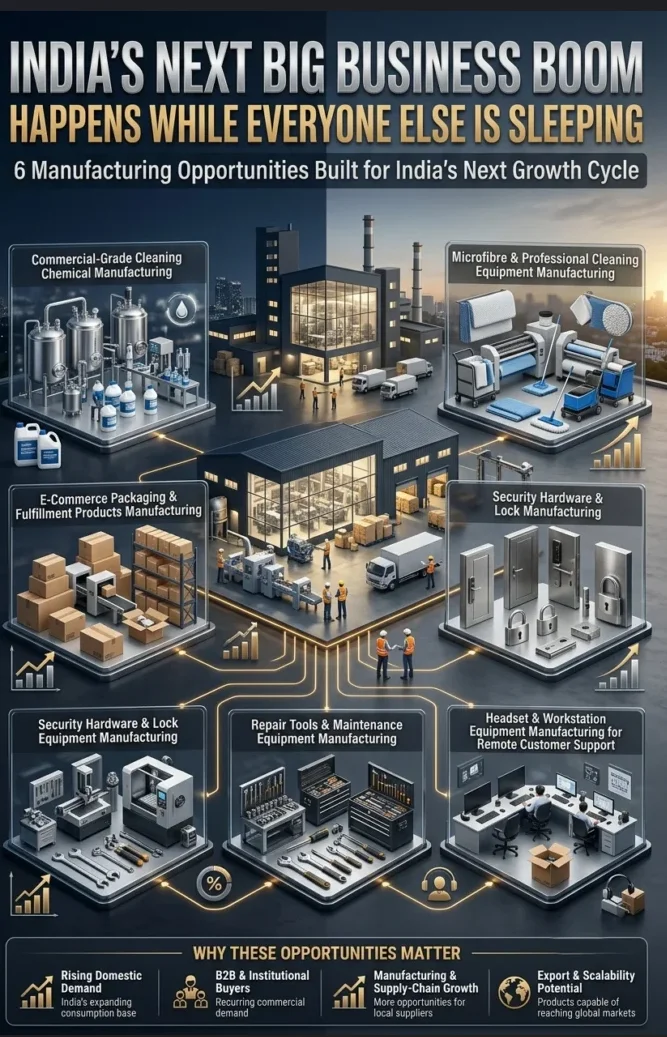
3. E-Commerce Packaging and Fulfillment Products Manufacturing
As per the Inc. article, e-commerce is the most scalable business to be a night owl because it allows the founders to build, list and run online stores in the evenings without having to be physically present when the packages are shipped. India’s e-commerce industry is among the fastest growing in the world.
The downstream manufacturing opportunity is e-commerce packaging, including corrugated boxes, air pillows, bubble wrap and biodegradable mailers, kraft paper bags, and tamper evident packaging. For the night economy e-commerce entrepreneurs, packaging demand is growing in proportion to the growth of their businesses. The small-scale corrugated box manufacturing and eco-packaging units in Tier-2 cities are a viable and less costly investment.
Investment amount: ₹25 Lakhs to ₹60 Lakhs for the packaging unit. Compliant with the PLI scheme incentives for textiles and packaging.
View Full Project Details: Trade, Commodities, International trade, Wholesaling, Retailer, Fair Trade, e-commerce, Merchant, Export, Import Business
4. Security Hardware and Lock Manufacturing
In the Inc. article, the world of night economy is singled out as one in which emergency locksmith services will be a big player, with the global market projected to more than double between 2025 and 2035, rising from $3.5 billion to $5.5 billion. High-quality locks, cylinders, key blanks and access control hardware are necessary for emergency locksmiths.
Indian manufacturers have an opportunity to cater to this market by manufacturing precision engineered lock cylinder, deadbolt, padlocks and electronic lock components. The aspect of import substitution is strong, especially when it comes to institutional security hardware where India is currently importing a significant amount of it. A domestic manufacturing unit may be used for locksmith services market and the expansive residential and business security market segment.
Investment range: Precision metals manufacturing unit – ₹80 lakh to ₹2 crore. Eligible under the MSME technology development schemes.
5. Repair Tools and Maintenance Equipment Manufacturing
The commercial handyman after hours repair services are valued as $16.19 billion in 2025 and are expected to reach $30.39 billion by 2035, as noted in the Inc. report, and are reliant on a continuous stream of professional quality tools. Rise in demand for electrical testing instruments, plumbing tools, power tool accessories, and diagnostic equipment are great domestic manufacturing opportunities.
The Indian tool manufacturing industry is highly concentrated in Ludhiana, Jalandhar, and Rajkot. Businesses can expand these clusters to serve institutional maintenance and after-hours repair markets, creating domestic and export opportunities while meeting BIS quality certification requirements.
Investment required: From ₹1 crore to ₹3 crore in a mid-size tool manufacturing unit. Support in the transfer of NSIC technology.
6. Headset and Workstation Equipment Manufacturing for Remote Customer Support
Global enterprises that provide services to customers in different time zones have an opportunity for customer support staff to work late hours, according to The Inc. report. India is already a leader in the global BPO industry and the night economy customer support model provides the domestic demand for the support equipment that drives it.
The manufacturing of noise-canceling headsets, ergonomic accessories for workstations, and compact systems that can be used at the customer’s desk for home-based customer support staff is a fast-growing B2B niche. India’s work culture is on-the-go and with the COVID-19 pandemic, the demand for small-scale professional quality of equipment for remote working is growing.
The investment amount required is ₹40-₹90 lakh for assembly and light manufacturing. Qualifies for PLI to buy electronics and IT hardware.
Import–Export Opportunity Analysis
Export Markets
A clear export corridor exists for Indian manufacturers with a demand from the night economy service sectors:
- Cleaning chemicals and microfibre products: Middle East, Southeast Asia, East Africa.
- Security hardware: Residential and commercial building construction is booming in the GCC markets.
- Tools and equipment for repairs and maintenance: markets in Africa, the ASEAN and South Asian regions where domestic production is low.
- Ecommerce Packaging: Bangladesh, Sri Lanka, Nepal- Ecommerce is expanding in these markets, but packaging manufacturing is sparse.
Import Substitution
Today, India imports numerous professional and institutional cleaning systems, locks with precision and electronic access control systems. In each of these categories, the domestic production opportunity ranges between ₹2,000–₹5,000 crore that matches perfectly the Atmanirbhar Bharat manufacturing thrust and make in India initiative.
International Demand Drivers
The recovery from the pandemic has boosted the demand for commercial hygiene services, contactless security systems and customer support remotely, worldwide. Once the manufacturers get ISO and BIS certification for their products, they can get international tenders in the institutional cleaning, hospitality, healthcare, and commercial real estate sectors.
Indian MSME Success Stories in Night-Economy Adjacent Sectors
1. SastaSundar – Hyperlocal Night Delivery, West Bengal
SastaSundar Healthbuddy, a health-tech startup based in Kolkata, designed its model around pharmacy services outside regular working hours. It operated during the late evening and completed more than 50 lakh orders for medicines and health products in eastern India. This success shows that extending service hours can provide a competitive advantage for Indian entrepreneurs in the consumer services sector.
2. Duroflex – Manufacturing for 24/7 Hospitality Clients, Bengaluru
Bengaluru-based mattress manufacturer Duroflex had a strong institutional supply business. The company aimed to serve 24×7 operational hotels, hospitals, and corporate accommodations. These sectors require reliable maintenance and supply chains. Duroflex’s revenue growth shows that B2B manufacturing for round-the-clock service clients can support sustainable MSME growth.
3. Nimbus Facility Services – Commercial Cleaning, Gurugram
Nimbus Facility Services is an Indian Facility Management firm, which has its base business model on after-hour cleaning of commercial office parks in NCR. As an organized MSME, the company obtained contracts with major IT parks by proving the reliability in its operations, which the cleaning model during the night economy demands. Now one of the emerging groups in the facility management industry in India.
Find the most profitable startup for your investment range
About NiirProject Consultancy Services (NPCS)
Niir Project Consultancy Services (NPCS) is a reputed firm in the field of industrial and business feasibility studies in India. If you are an entrepreneur or MSME interested in the night-economy service and manufacturing sectors mentioned in this article, NPCS can offer you consultancy support from providing you with a vision and mapping it to a plan, to helping you implement it.
NPCS services include:
- Detailed Project Reports (DPRs): Detailed feasibility reports for bank financing and investor presentations for manufacturing projects such as cleaning chemicals, security hardware, and packaging.
- Demanding Analysis of industry demand in domestic and export market.
- Technological Consultancy: Selection of Plant Process, Plant Layout, and Sourcing of Different types of Machinery for Setting up New Manufacturing units.
- Feasibility Studies: Financial modelling, Break Even and ROI calculations for MSME investments.
- Bank-ready project reports for MSME loan applications at financial institutions like Bank of India, CGTMSE and State-level financial institutions.
Industry Data Snapshot
| Parameter | Details |
| Industry | Night Economy Services & Supporting Manufacturing (Cleaning, Security, E-Commerce, Customer Support, Repair) |
| Market Driver | Urbanisation, 24/7 commercial operations, rising consumer expectations for after-hours service availability |
| Global Market Size (Cleaning) | $482 billion (2026) → $859 billion (2034) | Source: Fortune Business Insights via Inc. |
| Global Market Size (Locksmith) | $3.5 billion (2025) → $5.5 billion (2035) | Source: Wiseguy Reports via Inc. |
| Global Market Size (Repairs) | $16.19 billion (2025) → $30.39 billion (2035) | Source: Market Research Intellect via Inc. |
| MSME Opportunity (India) | Commercial cleaning supply, security hardware manufacturing, packaging, repair tools, customer support infra |
| Export Potential | Cleaning chemicals & equipment: Middle East, ASEAN; Security hardware: GCC; Packaging: South Asia |
| Government Support | Udyam Registration, SIDBI, CGTMSE, PM SVANidhi, Make in India, Startup India, NSIC |
| Investment Range (Mfg) | ₹25 lakh – ₹3 crore depending on sector and scale |
| Risk Level | Low to Medium – Asset-light service models; Medium for manufacturing units |
| Growth Outlook | High – Structural demand from 24/7 urban economy; Under-organised market with first-mover advantage |
Conclusion: The Clock Strikes Opportunity
The Inc. report on night-owl business ideas is more than a lifestyle guide for entrepreneurs who prefer working after dark. It is a validated market intelligence signal pointing to a genuine structural gap in the Indian service economy—and a compelling upstream opportunity for Indian manufacturers and MSMEs.
India’s cities are running 24 hours a day. Commercial complexes, hospitals, IT parks, logistics hubs, and retail facilities need cleaning, maintenance, security, and support services around the clock. The demand is real, growing, and poorly served. Founders who build businesses to meet this demand—and manufacturers who supply the products these businesses need—are entering markets where competition is thin and pricing power is strong.
The six manufacturing opportunities identified in this article—cleaning chemicals, professional cleaning equipment, e-commerce packaging, security hardware, maintenance tools, and remote work equipment—are all directly traceable to the business verticals that Inc. has reported as high-growth evening-economy models. Each carries realistic investment requirements, strong government support, and genuine export potential.
Government frameworks including Udyam Registration, CGTMSE credit guarantees, SIDBI financing, and the Make in India initiative provide a supportive policy environment for founders who act now. The night economy is open. The question is whether India’s next generation of entrepreneurs will be there when the doors are.