Introduction: MSME Subsidy in India Is Real but Underutilized
India possesses one of the biggest MSME ecosystems globally, and government subsidy initiatives, loan facilities, no collaterals, and credit guarantee schemes have been in place. Nevertheless, thousands of crores are given out each year, and still, many entrepreneurs do not receive the benefits of the schemes.
This is not caused by a lack of funding but by lack of awareness and its effective implementation. Most first-time entrepreneurs do not know what scheme to apply or fail because of poor documentation and wrong structure of application.
Subsidy of MSME loans is not hard to obtain- but it demands the correct process, scheme and good project report.
Related Article: MSME Schemes in India: Complete Guide to Subsidies, Loans & Government Benefits
What is MSME Loan Subsidy?
MSME loan subsidy is the government subsidy that aims at lowering the cost of initiating or growing a small enterprise. The government eases the financial burden not by providing direct cash but by providing organized benefits based on bank loans.
These advantages can be:
- The project capital subsidy on cost.
- Subsidy on interest on loans.
- Collateral-free credit guarantee
- Machinery upgrade support
This is aimed at ensuring that entrepreneurship is more affordable and less reliant on high-interest loans by individuals.
Major MSME Loan Subsidy Schemes in India
India has several programs which are applicable to various kinds of businesses and entrepreneurs.
The key programs are PMEGP to start new businesses, MUDRA to fund micro-level, CGTMSE to get loans without collaterals, CLCSS to upgrade their machinery, and Stand-Up India to support women and SC/ST entrepreneurs.
Quick overview of key schemes:
- PMEGP -35-15% subsidy on new business.
- MUDRA Loan – 10 lakh and below without any security.
- CGTMSE- Collateral-free loan up to 5 crores.
- CLCSS -15% subsidy on technology upgradation.
- Stand-Up India 10 lakh-1 crore to SC/ST and women.
The purposes of each of the schemes are different, and therefore it is important to select the appropriate scheme.
Get Detailed Insights from This Book: Our Books
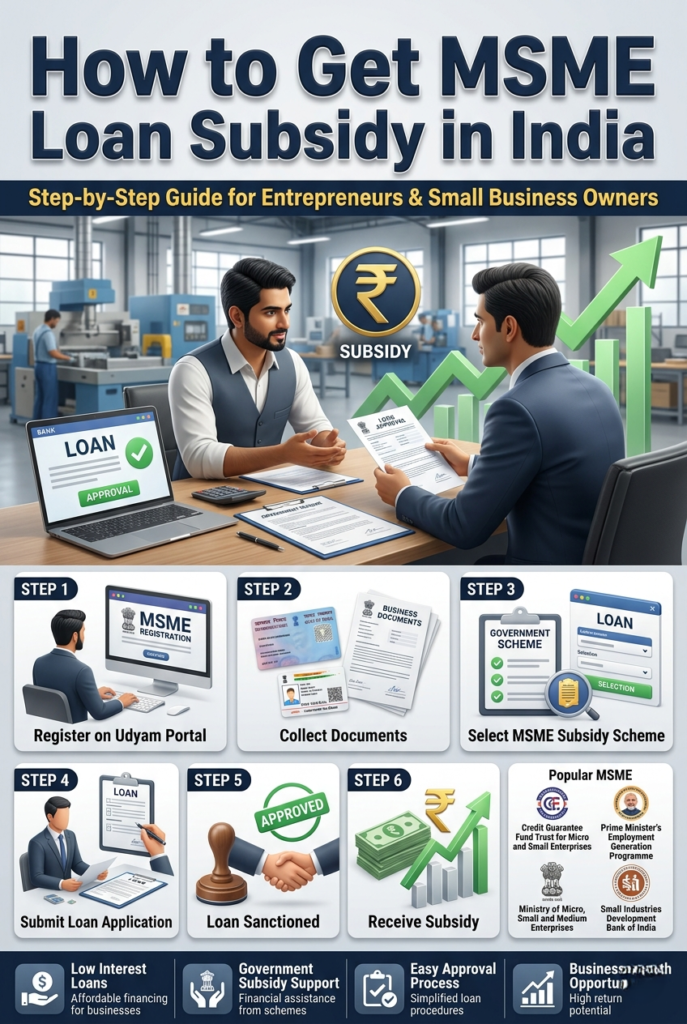
Step-by-Step Process to Get MSME Loan Subsidy
The process of subsidizing MSMEs is organized and should be observed to the letter otherwise, it will be rejected.
Udyam registration is the initial one and it is obligatory in all schemes related to MSME. In the system, your application will not be valid without this.
The second step is the making of a Detailed Project Report (DPR) which is the heart of your loan application. It details your complete business plan, investment strategy and anticipated profitability. This document is critical in approval decisions by banks.
Effective DPR should contain:
- Business idea and model.
- Machinery and set up cost.
- Market demand analysis
- Revenue and profit forecast.
- Break-even and repayment plan.
Scheme selection follows DPR preparation. It is at this point that most applicants falter. The right scheme varies depending on your business type new or old, the nature of your industry and your financial demand.
Upon selecting the scheme, the application is made through respective portal or bank channel.
Once you submit it, the bank carries out an in-depth analysis of your proposal. This involves verifying your credit report, business viability, and ability to repay.
In the case of PMEGP, EDP (Entrepreneurship Development Programme) training is also required to receive subsidies.
Common Reasons MSME Loan Applications Get Rejected
The majority of rejections occur because of some simple and preventable errors and not because of eligibility concerns.
Some significant causes are:
- Weak or unrealistic DPR
- Missing Udyam registration
- Wrong scheme selection
- Incomplete documentation
- Ineffective financial planning or credit score.
A good business idea may be turned down even when documentation is not good.
Get Detailed Project Report (DPR): Project Reports & Profiles
How to Improve Your Chances of Approval
Lucky people are not successful in the application of the MSME subsidies, but rather prepared.
The most important is having a realistic project report. Banks are more attracted to realistic financial forecasts rather than overambitious figures. Indicatively, purported day one full capacity utilization is usually a red flag.
It is also necessary to select the right scheme depending on your business. The most frequent cause of delays is the application under the wrong category.
Other significant practices are:
- Maintaining financial records in cleanliness.
- Having a good credit rating.
- Turning in full documentation in a timely manner.
Such little measures can go a long way in enhancing a chance of approval.
Role of NPCS (Niir Project Consultancy Services)
A professional and bank-ready Detailed Project Report is one of the most significant challenges that face entrepreneurs. It is at this point that the services of expert consultancy will be of great help.
Niir Project Consultancy Services (NPCS) is an established consultancy company in India that focuses on project reports, feasibility studies, and business planning of MSME.
NPCS assists business people by assisting them to create bank compliant and structured project reports that enhance the likelihood of loan acceptance. Their reports are structured in such a way that it complies with the requirements of the bank and government subsidies.
Key services provided by NPCS:
- Detailed Project Reports (DPRs).
- Market and feasibility studies.
- Project analysis of technical and financial aspects.
- Industry-specific business planning
NPCS has worked on thousands of industrial projects in the food processing, manufacturing, agro based industries, chemicals, packaging and engineering industries.
Industry-specific data is their greatest strength as it will make financial projections more realistic and acceptable to banks.
In the case of first-generation entrepreneurs, professional consultancy services, such as NPCS, tend to minimize the risk of rejection as well as accelerate the process of securing a loan.
Turn your budget into a successful business plan
Conclusion: MSME Subsidy Success Depends on Execution
MSME loan subsidies in India are one of the most powerful tools for new entrepreneurs. However, success depends on proper execution rather than just eligibility.(MSME loan subsidy in India)
The government has established a complete financial assistance program which requires applicants to follow correct procedures for their application to succeed. The approval process becomes easier for entrepreneurs who submit proper documentation and select appropriate schemes and present authentic project reports.
The business startup process needs Udyam registration to begin which must then be followed by developing a solid DPR and selecting the appropriate scheme.
MSME subsidies provide your startup with essential cost reductions while they also help create sustainable business operations for your venture.
FAQs
Q1. Is a new business eligible to receive MSME subsidy?
Yes, programs such as PMEGP and MUDRA are tailor-made to new business people.
Q2. Are MSME loans secured?
Not always. Loans below ₹5 crore are not collateralized under CGTMSE.
Q3. Which is the percentage of subsidy in MSME schemes?
It usually varies between 15 and 35 percentage based on the scheme and category.
Q4. Is DPR required in the loaning of MSMEs?
Yes, most loans related to the subsidies will require a Detailed Project Report.
Q5. What is the time frame of MSME loans?
Typically, documentation and scheme type require 30-90 days.