MSME budget 2026 schemes
It’s not just a case of eye-rolling when the union MSME minister publicly applauds Budget 2026-27 for the ‘big importance’ it has accorded to the sector. The data shared by the Ministry of MSME reveals that today, India has registered more than 7.5 crore MSMEs which involve over 33 crore people in their work. Since 2014, more than 34 Crore jobs have been created in the Udyam and Udyam Assist portals. The sector accounts for approximately 30% of GDP, 36% of manufacturing value added and approximately 45% of exports. Entrepreneurs who are looking for serious business ideas in manufacturing, food processing or technology, can find one of the best support schemes in India’s post-reform history in Union Budget 2026-27.
The latest Budget on top of this is more comprehensive with increases in credit guarantees, support for upgrading technologies, and a more aggressive focus on global markets. So knowing which scheme will work for your project is the key to a successful start or a failed start.
The Real Problem: Schemes Exist, But Awareness Does Not
The government of India’s small-enterprise support infrastructure is perhaps the world’s largest. However, surveys have consistently demonstrated that most first time business owners can only identify 1 or 2 schemes. The Minister of MSME himself stated in Parliament that there is no shortage of funds, and the government is also helping cobblers and salon owners under the PM Vishwakarma scheme.(MSME budget 2026 schemes)
The true problem is navigating and figuring out which scheme to follow for your project stage, sector and size — and how to put a bankable proposal forward. Timely and structured credit continues to be one of the biggest challenges for small businesses in India, as reported by SIDBI in its MSME Pulse report. This guide fills in the rest by corresponding the different schemes to realistic business ideas and project types.
Related Article: Budget 2026–27: New Manufacturing Business Ideas Backed by Government Incentives
The Core Scheme Stack for 2026: A Complete Overview
As a whole, these schemes outline the government’s approach toward supporting MSMEs in 2026. Each scheme targets a specific requirement such as seed capital, no collateral, digitalization, or export readiness.
| Scheme | What It Offers | Best Suited For |
| PMEGP | Margin money subsidy of 15–35% on projects up to Rs. 50 lakh (manufacturing) | First-generation entrepreneurs, rural units |
| CGTMSE | Collateral-free credit guarantee on loans up to Rs. 5 crore | Any MSE lacking collateral |
| MUDRA (Tarun Plus) | Loans up to Rs. 20 lakh for proven borrowers | Micro units scaling up |
| PM Vishwakarma | Credit, toolkits and training for 18 traditional trades | Artisans, craftsmen, service trades |
| CLCSS / Tech Upgradation | Capital subsidy on approved machinery | Units modernising equipment |
| SFURTI | Cluster development for traditional industries | Khadi, coir, agro-processing clusters |
| PLI Schemes (14 sectors) | Incentives on incremental production & sales | Electronics, pharma, food, textiles, white goods |
| BHAVYA / PMKSY | Agro-processing infrastructure & food park support | Agro industrial parks, food processing units |
| Stand-Up India | Rs. 10 lakh – 1 crore loans for SC/ST & women | Greenfield units by target groups |
| MSME TEAM | Onboarding 5 lakh MSEs onto ONDC | Units going digital-first |
There is also the Government e-Marketplace (GeM) where MSMEs also have direct access to government procurement — now worth Rs. Annual channel of 4 lakh crore+ The combination of registration together with the schemes above can be of great help to stabilize early revenue for new units.
Find high-return business ideas based on your budget & ROI
What Budget 2026-27 Specifically Changes for Entrepreneurs
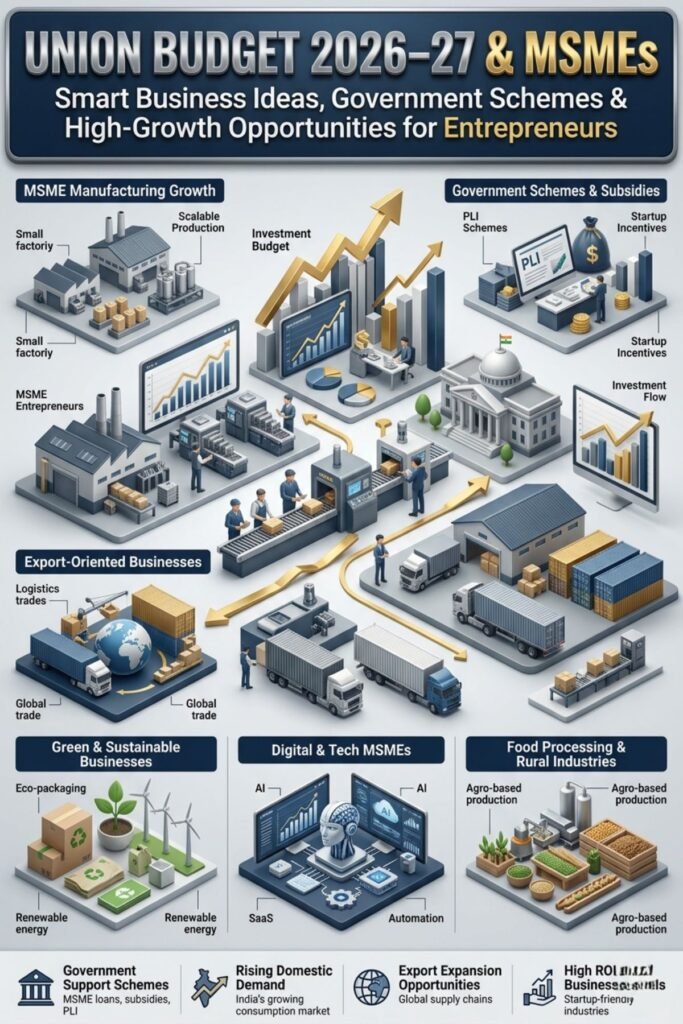
Budget 2026-27 is not a continuation of the current policy. There are a few changes directly impacting the economics of MSME investment. This is what’s most important:
- Increased CGTMSE coverage: Collateral is no longer the norm for successful applications – it is the exception. This is indeed a paradigm shift in the evaluation of MSME risk by banks.
- Growing units will benefit from the revised investment and turnover ceilings, as they can continue to be classified as MSME until they grow, thereby enjoying the advantages of the scheme.
- Procurement demand: With record capital expenditure and an all-time-high defence allocation, government procurement remains a guaranteed demand channel. The Public Procurement Policy for MSEs mandates reserved quotas for micro and small enterprises, including sub-targets for women and SC/ST entrepreneurs.
- Digital & AI push: Budget focus on AI readiness and digital trade channels new funding towards digitalisation of MSMEs. Specific allocations for MSME technology adoption are part of the India AI Mission’s financing pillar for start-ups emphasised during the AI Impact Summit 2026.
- Export thrust: Export facilitation for MSMEs has been rather enhanced keeping in view the Government’s vision of tying up Indian MSMEs with the global value chain. The Federation of Indian Export Organisations (FIEO) has identified priority sectors for which MSME exporters can gain the most.
Three Real-World Business Ideas Matched to Schemes
Abstract policy is only relevant if it has a practical application within the business. Three worked examples are provided below that demonstrate how to construct multiple schemes to achieve the greatest benefit:
Example A: Food Processing Unit in Rural India
A graduate who wants to pursue a career in Rs. There is a possibility of the structure of financing in 45 lakh packaged spices unit in rural Rajasthan as follows: PMEGP provides margin money subsidy of up to 35% to rural and special category borrowers. This balance bank loan uses a guarantee from CGTMSE, so the borrower does not need to provide any collateral. PMKSY/BHAVYA support from the Ministry of Food Processing Industries is applicable for Infrastructure and access to cold-chain for the unit located in the food park. The outcome: final result is: 5 lakh equity was required to be raised by the promoter to start a Rs. 45 lakh plant.(MSME budget 2026 schemes)
Access Complete Business Plan: Food Processing & Agro-Based Projects
Example B: Engineering Workshop Modernisation
An existing job shop owner who is upgrading to CNC machining with Rs. CGTMSE can guarantee a term loan of Rs 1.8 crore to purchase the new machinery. In the technology upgradation capital subsidy, the costs of the machines is reduced. This registration to GeM then opens a stream of government engineering orders without any need of investment in marketing. The trick is this tri-fold formula: credit + subsidy + demand channel and that’s something most entrepreneurs fail to grasp.
Example C: Women-Owned Garment Manufacturing Unit
A woman entrepreneur who starts a micro enterprise with Rs. The Stand-Up India structured greenfield loan (Rs. 80 lakh) is available to 80 lakh garment unit near tier-2 city. 10 lakh to Rs. Four targets under public procurement for women MSMEs, 1 crore and onboarding under ONDC to open digital retail under MSME TEAM. Data available with the Office of the Development Commissioner (MSME) has revealed that the women entrepreneurs who apply for various layers of the scheme have been able to achieve faster break-even period as compared to those who apply for a single scheme.
Download the Full Guide: Opportunities for Women Entrepreneurship (with Project Profiles) 2nd Edition
Financial Snapshot: Typical PMEGP-Backed Manufacturing Project
For this purpose, we present a typical financial configuration of a manufacturing project supported under PMEGP in rupees. 48 lakh range:
| Parameter | Indicative Value |
| Project cost (plant, machinery, working capital) | Rs. 48 lakh |
| PMEGP margin money subsidy (rural, general) | Rs. 12 lakh (25%) |
| Promoter contribution | Rs. 4.8 lakh (10%) |
| Bank term loan (CGTMSE guaranteed) | Rs. 31.2 lakh |
| Effective promoter equity at start | Under Rs. 5 lakh |
| Typical payback period | 4–5 years |
| Employment generated | 12–18 persons |
Note: Subsidy percentages are based on the category of applicant (special or general), and urban or rural location. These are approximate figures. Exactly what is eligible is determined by a project-specific Detailed Project Report (DPR). The current subsidy rate and ceilings for various sectors are available on KVIC’s official portal of PMEGP, which can be referred by the entrepreneurs.
Common Mistakes That Get Applications Rejected
Every year, banks and authorities delay or reject thousands of MSME applications for senseless reasons. Some of the common pitfalls, and why they are important:
- The biggest mistake you can make, and the most common cause of rejection, is to submit a project report that is generic and not a bankable report with realistic financials. Project-specific data is needed by banks and implementing agencies.
- Verification failures are caused by mismatches of Udyam details, GST records and loan application documents which halt loan processing in some cases, irretrievably.
- Underestimated working capital: When a project appears to have sound fixed asset financing, lenders may question its viability because of insufficient working capital. The working capital should correspond with the practical operating cycles.
- Single-scheme thinking: Applying to one scheme instead of a stacked one (subsidy, guarantee, procurement preference) would cut in half the burden on the promoter. This is the highest cost-lost MSME financing opportunity.
How NPCS Helps Entrepreneurs Navigate This Landscape
With a well-established track of more than 4 decades in preparing bankable Detailed Project Reports in over 50+ industries, NIIR Project Consultancy Services (NPCS) has a database of more than 8,000+ DPRs and clients in more than 50 countries. NPCS reports meet the requirements of PMEGP, CGTMSE, MUDRA, and bank appraisal. They include market analysis and finance components under MSME Budget 2026 schemes.
Before choosing a project, the entrepreneur can browse through the projects of each sector from www.niir.org or read the editorial articles from www.entrepreneurindia.co. The well-prepared DPR is not an administrative formality, but the document that makes a good business idea a good fundable project.
Frequently Asked Questions
Q1. Can I combine PMEGP with CGTMSE?
Yes. If the PMEGP project includes a bank loan, CGTMSE can guarantee the loan component, so eligible projects do not require collateral. This combination is specifically designed into the scheme architecture — and most bankers are familiar with it.
Q2. Is Udyam registration mandatory for scheme access?
Effectively yes. The way into the benefits of the schemes, priority-sector lending classification and public procurement preference is Udyam registration or Udyam Assist for informal micro units. An organization can’t legally claim most of these rights without it.
Q3. What loan size does MUDRA now cover?
The loans under MUDRA’s Tarun Plus category is extended up to Rs. 20 lakh for the borrowers who have successfully paid back the Tarun loans. These are the basic levels — Shishu (up to Rs. 50,000), Shishu Plus (Rs. 50,000), Kishore (up to Rs. This is just 5 lakh (up to Rs. Tarun). 10 lakh) — continue as before.
Q4. Are services businesses eligible, or only manufacturing?
Both are eligible. PMEGP, CGTMSE and MUDRA offer support for both service and manufacturing enterprises. But the cost ceiling of the project is higher for manufacturing units and benefit per rupee is larger for capital-intensive industries.
Q5. How long does PMEGP approval typically take?
A DPR is typically submitted to the margin-money sanction in 45-90 days. The processing time is state and bank dependent. This can be considerably longer if the applications are incomplete or the DPRs are poor — so preparation quality is important.
Q6. Can PLI and MSME schemes run simultaneously?
Yes, in many cases. PLI schemes do not conflict with PMEGP or CGTMSE at the project financing stage because they function as production-linked incentive schemes. But the terms of PLI differ significantly across sectors – always check the eligibility criteria prior to designing a staged application.
Conclusion: The Opportunity Is Structured — Your Proposal Should Be Too
Entrepreneurs are not required to make the choice between ambition and safety in Budget 2026-27. It provides multi-layered support—subsidies, guarantees, procurement access, and technology assistance—which directly lowers entry barriers and increases the number of concepts that turn into funded business ventures.
However, government support doesn’t activate itself. It rewards preparation. A well-structured DPR, along with the proper application of layers in the scheme and clean documentation, consistently differentiate funded entrepreneurs from those who are rejected. The funds are on hand. The purpose of the policy is unambiguous. It’s all about how well the applicant executes.(MSME budget 2026 schemes
The infrastructure now supports entrepreneurs more strongly than ever in turning concepts into bankable projects across food processing, engineering, textiles, and 50+ manufacturing sectors.(MSME budget 2026 schemes