


Introduction: Manufacturing Industry Growth Opportunities
The global manufacturing world is experiencing a fast-paced change driven by increasing population, consumption patterns, technological progress, and processed food, agriculture input and specialty chemicals demands. In the process, entrepreneurs and investors are on the lookout for manufacturing businesses that have stable demand, scalability, and long-term growth potential.
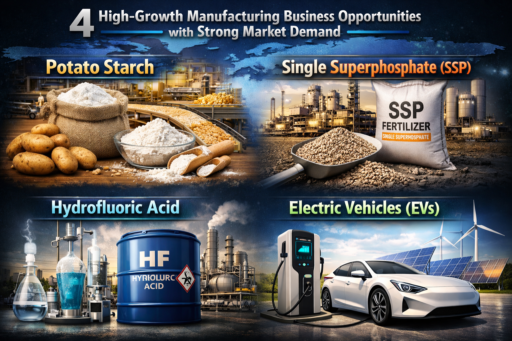
Among the long list of options available, dehulled sesame seeds, potato starch, single superphosphate (SSP) and hydrofluoric acid are remarkable growth manufacturing opportunities. These products serve key industries such as food processing, agriculture, electronics and energy and are therefore relatively resilient to economic fluctuations.
This blog gives a professional view of these four manufacturing sectors, including market trends, application, growth drivers, and the business potential of these industries.
Read More: Manufacture of Paint, Varnish & Allied Products (3rd Revised Edition)
Global Market Overview and Market Growth Trends
The global market outlook for these four products depicts steady and sustainable growth. Demand is being fueled by urbanization, industrialization in developing economies and technological advancement of advanced industries.
- Dehulled sesame The seeds market will grow from approximately USD 7.7 billion in 2024 to USD 9.6 billion in 2034 because more people are eating healthy and plant-based diets.
- Potato starch The market will achieve USD 5.68 billion by 2030 because consumers prefer clean-label and gluten-free products that use natural ingredients.
- Single superphosphate (SSP) The fertilizer market will exceed USD 25 billion by 2035 because global food requirements increase and governments implement agricultural development initiatives.
- Hydrofluoric acid The market will generate more than USD 5.1 billion in revenue by 2030 because semiconductor manufacturing and refrigeration and petrochemical industries will expand.
The manufacturing industries of this sector attract permanent production investments because their demand patterns show stable behavior.
Dehulled Sesame Seeds: Value Added Food Processing Opportunity
Dehulled sesame seeds are known as hulled sesame seeds because they have had their outer husk taken away. This value addition process enhances taste, appearance, digestibility, and shelf life of the product making it suitable for large scale food processing and export markets.(Manufacturing Industry Growth Opportunities)
Read More: Canning of Fruits (Pine Apples slices, Litchee, Cherries, Straw berries in syrup)-Manufacturing Plant, Detailed Project Report, Profile, Business Plan, Industry Trends, Market Research, Survey, Manufacturing Process, Machinery, Raw Materials
Market Drivers
- Growing consumer preference for healthy foods, plant-based foods and natural foods
- Increased demand from bakery, confectionary and ethnic food industries
- Stronger exports demand from Japan, Europe, the United States, and the Middle East
Applications
Dehulled sesame seeds are used in a big way in:
Bakery products (bread, buns, crackers, cookies)
Tahini, halvah, and sesame spreads
Snacks, Breakfast cereals, Ready-to-eat foods
Manufacturing Potential
Sesame dehulling is a moderate investment export-oriented business. The process includes cleaning, soaking, dehulling, drying and sorting. With the right quality control, food safety compliance and packaging standards, manufacturers can be set up to have stable margins and recurring export orders. This is a good sector for new entrepreneurs to get into food processing.
Read More: Single Super Phosphate (Granular) & N.P.K. Fertilizer -Manufacturing Plant, Detailed Project Report, Profile, Business Plan, Industry Trends, Market Research, Survey, Manufacturing Process, Machinery, Raw Materials, Feasibility Study, Cost of Project
Potato Starch: Increased Demand for Clean-Label Ingredients
Potato starch is a natural carbohydrate product that is obtained from potatoes and is widely used as a thickening, binding and stabilising agent. Its neutral taste, high viscosity and gluten-free characteristics make it quite desirable in modern food formulations.
Market Drivers
- Rapid growth of clean label and allergen free foods
- Increasing demand for gluten-free and plant-based products
- Expanding non-food applications in pharmaceuticals, paper and textiles
Applications
Potato starch is commonly used for:
- Soups, sauces, gravies and processed foods
- Gluten-free bakery products – noodles
- Processed meat, dairy products and convenience foods
- Pharmaceutical tablets, Paper coating, Textile sizing, Cosmetics
Manufacturing Potential
Potato starch manufacturing includes washing, crushing, starch separation, drying and packaging. Many manufacturers use surplus or processing-grade potatoes, which helps them improve on cost efficiency. With robust demand in Europe, and very fast growing markets in Asia-Pacific, potato starch gives manufacturers stability and growth potential.(Manufacturing Industry Growth Opportunities)
Read More: Entering the Potato Starch Market: Key Considerations for Startups and SMEs

Single Superphosphate (SSP): Steady and Volumetric Fertilizer Business
Single superphosphate (SSP) is a phosphate fertilizer obtained by treatment of rock phosphate with sulfuric acid. It supplies vital minerals which include phosphorus and sulfur that support both plant development and soil health.
Market Drivers
- Increasing world food demand and agricultural productivity needs
- Government subsidies and fertilizer support programs
- High effectiveness in sulfur deficient and acidic soils
Applications
SSP is widely used in:
- Cereal crops eg wheat, rice, maize
- Oilseeds and pulses
- Fruits, Vegetable, and Horticultural Crops
Manufacturing Potential
Although SSP has moderate margins as compared to complex fertilizers, it benefits from steady demand and high consumption volumes. SSP manufacturing offers a fairly stable business model, especially in developing ag regions of Asia, Africa and Latin America.
Read More: Top Most Profitable Business Ideas for the Next 10 Years
Hydrofluoric Acid: High-Value but Highly-Regulated Chemical Industry
Hydrofluoric acid (HF) is an important industrial chemical that has applications where no good alternatives exist. Despite being so dangerous, HF is an important component of advanced manufacturing industries.
Market Drivers
- Rapid growth in semiconductor and electronics manufacturing
- Growth in refrigeration & air conditioning systems
- Increasing demand from petroleum refining and petrochemicals
Applications
- Hydrofluoric acid is used in:
- Silicon wafer etching and cleaning, semiconductor manufacturing
- Production of refrigerating agents and fluoropolymers
- Alkylation processes in oil refining plants
Manufacturing Potential
Hydrofluoric acid manufacturing must be done with high capital investment but with advanced safety systems and strict environmental compliance. Due to the regulatory and safety issues involved, this is a field that is best suited to experienced chemical manufacturers with good technical expertise.
Importance of Feasibility Studies Before Investing
Before investing in any manufacturing project, it is important to undertake a detailed technical and financial evaluation. Feasibility studies help in assessing market demand, availability of raw materials, capacity of the plant, capital investment, cost of working and regulations and profitability.
Professional feasibility and project reports are clear and minimize the risk of investment, particularly in capital-heavy industries such as fertilizers and specialty chemicals.
Conclusion
Dehulled sesame seeds, potato starch, single superphosphate, and hydrofluoric acid are four high-growth manufacturing opportunities that have good long-term demand fundamentals. Each sector serves critical industries and has unique advantages based on investment capacity, technical expertise and regulatory ready.
Food processing businesses like dehulled sesame seeds and potato starch are generally better suited for new entrepreneurs because of the lesser level of regulation. SSP fertilizer production needs fixed volume requirements to generate continuous demand, while hydrofluoric acid distribution creates profitable business opportunities for established chemical manufacturers.(Manufacturing Industry Growth Opportunities)
The manufacturing sectors require proper planning and feasibility study execution and compliance assessment to achieve sustainable development and enduring financial success.
Frequently Asked Questions (FAQs)
What purpose do dehulled sesame seeds serve?
They are used in bakery products, snacks, tahini, confectionery, and health foods. Removing the hull improves taste, color, and digestibility.
Why is potato starch in high demand?
Potato starch serves as a gluten-free ingredient which maintains a clean-label status and provides various applications for food and pharmaceutical and paper and textile uses.
Who uses single superphosphate fertilizer?
Small sources of sulfur-containing sulfur are used by farmers growing cereals, oilseeds, pulses, fruits, and vegetables; this is especially applicable to sulfur-deficient soils.
Is hydrofluoric acid manufacturing dangerous?
Yes, hydrofluoric acid poses severe hazards which need strict safety measures and environmental protection controls yet the substance remains vital for semiconductor production and refrigerant use and refining operations.