Heavy Machinery Manufacturing in India
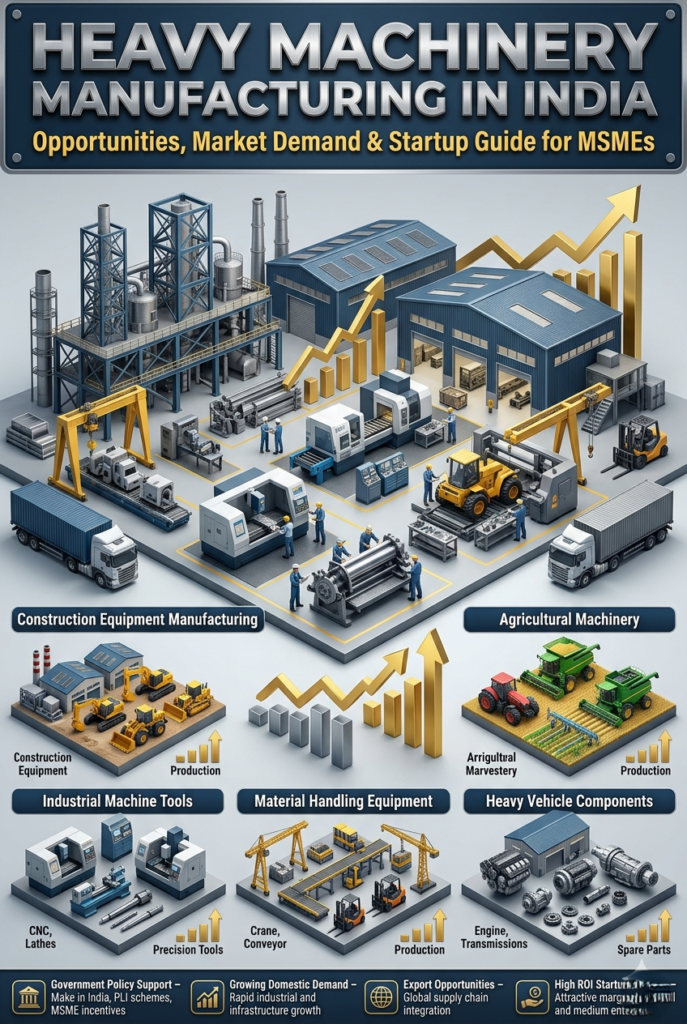
The heavy machinery sector in India is fast emerging as one of the fastest growing streams for first generation entrepreneurs and MSMEs investors. With India’s ambitious industrialization and infrastructure growth the demand for construction, mining and agricultural equipment is not just cyclical – it is structurally secure. Despite these challenges, the market is still underpenetrated, particularly in the mid-range machinery, which can provide a unique opportunity for start-ups to capture value where it is less agile for the larger players in the market.
The charm with the heavy machinery manufacturing business is that it offers a combination of real barriers to entry, manageable competition and big rewards. In contrast to consumer goods or commoditised products, this sector appreciates careful preparation, technical competences and strategic planning. Government-backed initiatives and steady industrial demand make it an ideal opportunity for investment in between Rs 50 lakh and Rs 5 crore scale in MSME.
Explore This Book: Our Books
Why Heavy Machinery Manufacturing Makes Sense in India
India’s infrastructure development is unrivalled outside China. National highway projects, urban metro systems, industrial corridors and port modernisation programmers are ever expanding. Each of these projects creates a need for earth-moving equipment, concrete batching plants, tower cranes and material handling systems. Contractors conducting these projects often find it difficult to obtain the machinery in a short period of time from existing domestic suppliers or imported alternatives. This gap leaves a market for well prepared startups to provide faster, more efficient and better after sales service.
Key market drivers include:
- The construction sector requires compactors and graders and batching plants and tower cranes as essential equipment for its operations.
- The mining sector requires drilling equipment and loaders and crushers and ore processing machinery.
- The government-supported SMAM schemes provide agricultural heavy machinery to farmers who need combine harvesters and paddy threshers and sugarcane harvesters
High Potential Startup Entry Points
MSME manufacturers can access multiple sub-segments which offer profitable business opportunities because they operate without competing directly against major OEMs:
- Concrete Batching Plants: Middle range capacities (30 – 60 m3/hour) are in high demand. Aftermarket spare parts are a source of recurring sales.
- Stone Crushing and Aggregate Equipment: Jaw crusher, cone crusher and VSI screening machines are required throughout India. Reliable Spare Parts and Quality Control Competitive Advantages
- Industrial Lifting & Material Handling: EOT cranes, gantry cranes, and hoists are omnipresent in factories, warehouses, ports and power plants. Maintenance contracts are a source of recurring income.
- Mining Equipment: Specialized machinery for Indian geological conditions is better in terms of performance, compared to imported, standardized machinery.
- Road Construction Equipment: Mid-sized compactors and asphalt pavers are working on rural roads and urban lane projects which are often overlooked by large OEMs.
Get Detailed Project Report (DPR): Project Reports & Profiles
Export Potential: Going Beyond India
Indian heavy machinery is becoming more and more export-competitive because of cost-effectiveness, design improvements and adherence to ISO/IS standards.(Heavy Machinery Manufacturing in India)
- Primary markets – Sub-Saharan Africa, Southeast Asia, and the Middle East
- Competitive advantages: Speedy delivery, customized specifications, and excellent after-sales service.
- The CE marking and Gulf Standardisation Organisation GSO certification process establishes export credibility through its certification requirements.
Startups are recommended to test their product at home before looking to export to other countries. Reference projects and satisfied domestic clients are often the pre-requisites for international buyers.
Choose the right startup backed by real market demand
Government Schemes for Supporting MSME Startups
The Indian government has a number of programmes to lower the entry barriers and capital intensity for the manufacturers of heavy machinery:
- Production Linked Incentive (PLI): Supports incremental production scaling.
- Technology Acquisition and Development Fund (TADF): Funding for R&D and acquiring patented technology.
- SIDBI & CGTMSE: Collateral-free loans, working capital support, and interest subvention schemes for MSME manufacturers.
Leveraging these programmes well can have a significant impact on reducing project risk and enhancing financial viability.
Lessons from India’s Industrial Leaders
India’s heavy machinery market offers a number of examples of smart, market-informed growth strategies:
- ACE (Action Construction Equipment): Focused on underserved mid-market contractors and tier-2 cities, building credibility before scaling.
- Subros Limited: Invested in technical precision and early certification to secure a durable market position.
- BEML Limited: Demonstrated how technical complexity can act as a competitive moat, preventing displacement by imports or new entrants.
Startups should first build technical expertise and valuable credentials before they attempt to grow their business operations.(Heavy Machinery Manufacturing in India)
Related Article: Top 6 High Profit Manufacturing Business Ideas in India (2026)
Final Thoughts
Heavy machinery manufacturing in India is not a business for impatient men, but it gives long-term structural rewards to well-prepared businessmen. Capital investment is real, technical requirements are important, and sales cycles are longer than consumer markets.(Heavy Machinery Manufacturing in India)
MSME founders can achieve business success through demand mapping government program usage and quality investment and their selection of particular market segments. The domestic manufacturers in India must grow their production capacities to fulfil the requirements of the extensive infrastructure development projects which the country currently has planned.
FAQs on Heavy Machinery Startup Guide
How much capital is required?
Small EOT cranes or stone crushers can be launched with a fund of Rs 50 lakh-1 crore whereas concrete batching plant and mining equipment, typically around Rs 2-5 crore. Additional working capital is generally 25-40% of projected annual revenue.
What kind of technical skill is required?
A diploma or degree in mechanical engineering, combined with practical experience in fabrication, is usually enough. Advanced machinery may need some licences or tie-ups.
How do I obtain customers in the first place?
Engage anchor contractors or operators in your region, attend EEPC India, CII or FICCI trade fairs and use state procurement portals and GeM.
But what certifications are required?
MSME/Udyam registration, factory licence, standards of BIS and IS, PESO approval and for exports CE/GSO certification.
Is export-first viable?
No. domestic validation is important before exporting.
How long to achieve profitability?
Companies typically achieve break-even point between 16 and 28 months after their launch. The company maintains low profitability periods because of its pre-order system and solid connections with vendors.