
Maize and Corn Processing has undergone a dramatic change in the last decade in India. Once a grain business based on commodity prices, it has become a multi-product manufacturing plant producing starch, liquid glucose, dextrose, sorbitol, gluten, corn oil and high fructose corn syrup (HFCS) for some of the fastest growing end-use markets in the country. The first crucial decision for any entrepreneur who wants to venture into this space is about getting the right maize, corn and by-products industry consultants in India, even before the acquisition of land, sourcing of machinery and bank finance. That consultancy engagement will influence every subsequent decision we make, including product mix, plant capacity, process selection, financial viability, and regulatory compliance. This article aims at discussing what exactly these consultants do, how to choose the best among them and where India falls short in the manufacturing and investment arena for this trade.
India’s Maize Processing Industry: A Sector on the Rise
Maize is India’s third most important cereal crop after rice and wheat. Production has increased steadily and now exceeds an estimated 43 million tonnes in 2024–25. The government plans to double production by 2047. But raw maize production is a half story. The industrialization of maize into value added products is where the real business opportunity lies.
This growth is being supported by the Production-Linked Incentive (PLI) Scheme of the Ministry of Food Processing Industries (MoFPI) with an outlay of ₹10,900 crore. The scheme has created more than 3.39 lakh jobs (direct and indirect) and distributed incentives worth of about ₹2000 crore. The incentives significantly enhance the economic viability of projects in the maize processing sector, but this can only be achieved if the feasibility study and the project report are set up properly from the start. This is where specialised maize, corn industry consultants and by-products in India are proven to be essential.
Get Detailed Insights from This Book: Handbook on Maize (Corn) Processing and Manufacture of Maize Products
What Maize, Corn and By-Products Plant Consultants Actually Do
Many first-time investors are not aware of the complexity involved in establishing maize processing plants, whether they are wet-milling or dry-milling. The process engineering alone, from steeping to separation of the germs, extraction of starch, centrifugation, evaporation and derivatisation of starch for glucose or sorbitol requires a deep knowledge of the domain. That’s why the work of a good consultancy company extends beyond the simple production of a project report.
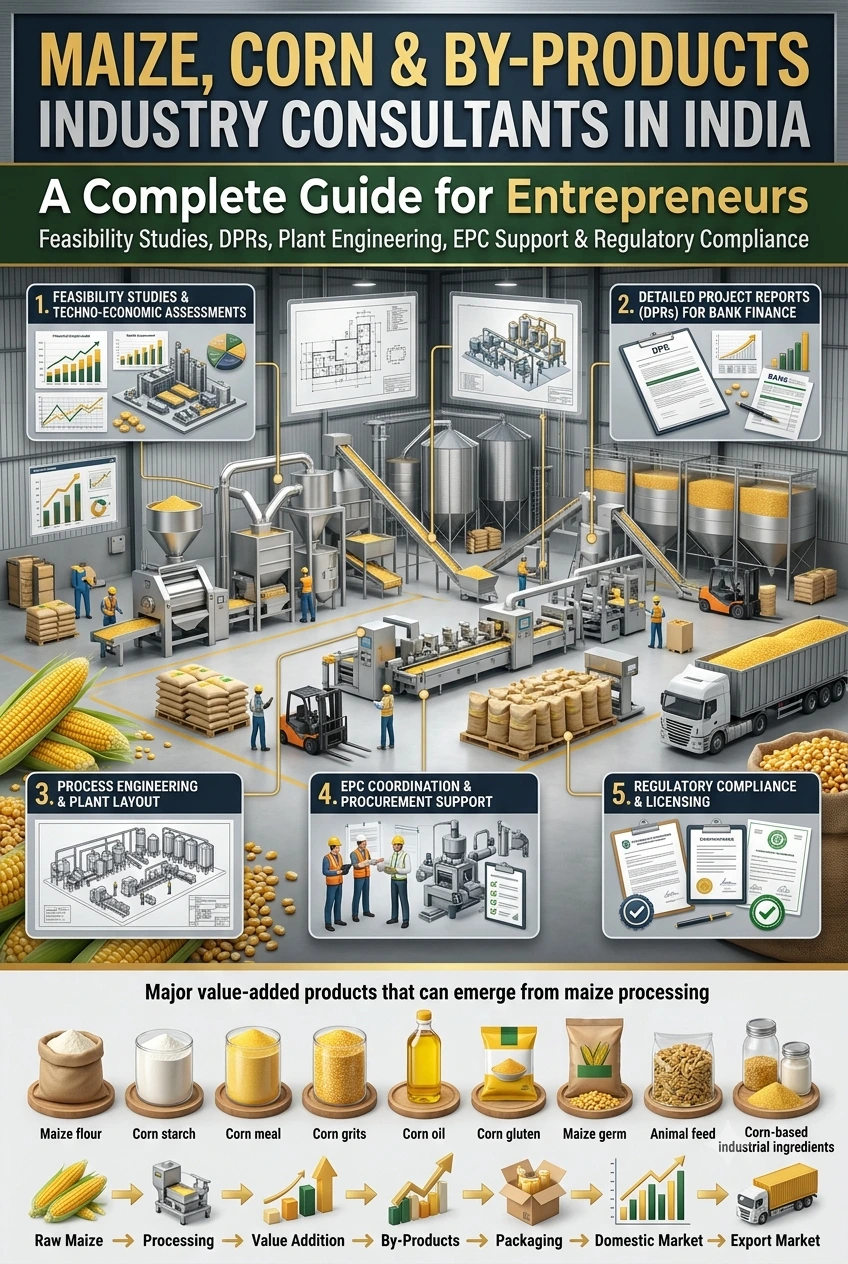
Feasibility Studies and Techno-Economic Assessments
Any serious maize processing consultant will first present a comprehensive feasibility study. This document reviews the technical feasibility of the proposed product, the demand-supply imbalance and the availability of raw materials and their prices, capital cost estimates, working capital requirement and the projected profitability. A sound feasibility study can help the entrepreneur avoid costly pitfalls before he invests a penny in fixed assets. It also assists investors in deciding which product category is more appropriate for the capital position and target market for their investment, such as deciding whether to invest in a liquid glucose plant or a sorbitol unit.
Detailed Project Reports (DPRs) for Bank Finance
Banks and NBFCs financing manufacturing projects under MSME schemes, Mudra Yojana or the MoFPI PLI scheme require a Detailed Project Report (DPR) that adhere to given technical and financial norms. Typical items that a DPR for a maize starch plant would include would be the manufacturing process flow, plant layout, equipment list with suppliers and equipment pricing, raw material sourcing strategy, utilities requirement, compliance roadmap, break-even analysis, and IRR/NPV projections. A well-prepared DPR is the basis for the sanction of a loan. Thus, the DPR is not only a document, it’s the biggest artefact in an entrepreneur’s project launch trajectory.
Process Engineering and Plant Layout
Process plant consultants plan the production flow, from grain intake to packaged output. This refers to the design of wet-milling, the specification of the steeping system, the number of hydrocyclone stages, the dosing of enzymes in the glucose and maltodextrin conversion, evaporation and drying systems and the design of the effluent treatment plant for use in maize processing. Consultants in this specialty must have a solid background in maize processing technology. Companies that use a food engineering approach without wet-milling expertise often waste utilities, oversize equipment, and reduce process yield, causing serious problems after they build the factory.
EPC Coordination and Procurement Support
Engineering, procurement, and construction (EPC) consultants get involved in the implementation phase. They help identify vendors, evaluate vendors, purchase equipment from local and overseas, oversee civil layout, install utilities, and conduct commissioning trials. Maize processing plants require stainless steel vessels, centrifuges, evaporators and driers, which are prone to corrosion, and therefore procurement support from an experienced EPC consultant can help to speed up timelines and minimise cost and schedule overruns. It’s a mix of technical input and commercial coordination that sets up the best engineering consultants in India apart from generalist advisory firms.
Regulatory Compliance and Licensing
Maize processing plant in India is regulated by several regulations. Food Safety and Standards Authority of India (FSSAI) regulates starch, glucose, dextrose, sorbitol, and HFCS as food ingredients. The certification of a food ingredient specification is for the standardised specification. The State Pollution Control Board (SPCB) requires consent to establish and consent to operate for wet-milling operations that produce corn steep liquor and process effluents, per Environment Protection Act. The Factories Act is the control of work places, labour compliance. As experts in their field, consultants can outline the entire licensing process and guide entrepreneurs to navigate the regulatory challenges without costly delays.
Why India Has Become a Hub for Maize and Corn Processing Consultancy
Multiple factors have made India one of the most appealing countries for investment in maize processing, and thus for specialised consultancy services that assist these investments.
First, the raw material supply is now very strong. India is the third largest producer of maize starch and in 2024-25, the domestic maize production was more than 43 million tonnes. The government’s ethanol blending policy, which aims to get to 20% blending in 2025-26, has put corn on the high pedestal within the strategic basket. According to IBEF, the food processing sector will generate USD 535 billion worth of revenues in India by 2025–26. Maize derivatives directly enter this value chain both in the food and the pharma area, in the textile value chain, as well as in the paper value chain.
Second, there is a growing demand in the end market from multiple sectors. In the confectionery and baking industries, liquid glucose is a key ingredient. Dextrose is used in drugs and ORS solutions. Sorbitol is used in personal care and as a sugar substitute in the manufacture of sugar-free food products. Modified starches provide sizing for textiles and production of paper. This diversity of demand minimizes the likelihood that any one product segment will become the stumbling block for new players.
Get Detailed Project Report (DPR): Maize Processing Industry & Corn Starch Projects
Thirdly, government policy actively promotes the creation of new plants. Invest India has listed 100% FDI under the automatic route, priority sector lending for food and agro-processing loans, and 100 percent profit exemption for food processing units in their first five years. Project viability also gets a boost from PMKSY grants, which include grants for Mega Food Parks and cold chain infrastructure. All these are equally important for a proactive pipeline of fresh project enquiries with qualified leaders of the top maize, corn and by-products industry consultants in India.
How to Evaluate and Shortlist the Best Maize, Corn and By-Products Industry Consultants in India
Some consultancies are more equal than others. A difference between a credible and working company and a generic report-vendor can be the difference between a bankable project or a non-loaned application. This is the way to evaluate candidates in a systematic way.
Domain Expertise in Wet-Milling and Maize Processing Technology
Direct experience with maize wet-milling process engineering (not general food processing) is the most important. Inquire with potential consultants on finished projects for corn starch, liquid glucose, dextrose and sorbitol production. Ask the operators or investors that they have worked with for references. Consultants without this field specialty often create technically incorrect DPRs, so banks may refuse them or require expensive rework after commissioning.
DPR and Feasibility Track Record
The best plant consultants have a proven track record of preparing DPRs that commercial banks, cooperative banks, and financial institutions accept under MSME and PLI schemes. Question on the number of maize or starch processing DPRs the company has developed and the number of these that became funded projects. It is the outcome rather than the production of mere reports that defines a serious process plant consultant from a mere report aggregator.
Related Article: Maize Processing Industry in India: Starch, Sorbitol & Value-Added Products Market Opportunity
Engineering and EPC Capability
When planning investment projects with a plant value exceeding ₹2 crore, it is essential to hire a consultant who has knowledge and experience in the field of real engineering — execution of process flow design, sizing the equipment, calculation of utilities, and civil layout. In India, boutique management consulting firms specializing solely in market research are not an adequate replacement for this technical component. Likewise, the pure engineering company that has no financial modelling expertise is also not complete in project finance. The perfect consultant is one that has both in one.
Regulatory and Compliance Know-How
A consultant who has gone through the process of licensing by FSSAI, and SPCB consent-to-establish for several maize or starch plants will save you months of delays. Specifically ask their experience of EIAs for wet-milling facilities that have large effluent volumes and need strong ETP design for regulatory clearance.
Client Base and Industry Networks
The added value of the consultants goes well beyond what is stated in their formal scope of work and includes those who have established strong connections in their fields of expertise such as All India Starch Manufacturers Association (AISMA) ecosystem, All India Food Processors’ Association (AIFPA) and machinery suppliers including domestic and international. These networks help to speed up vendor discovery, lower procurement expenses, and in some instances form strategic alliances a first-generation entrepreneur may not otherwise be able to start.
Role of NPCS in Maize, Corn and By-Products Project Consultancy
Niir Project Consultancy Services (NPCS), Delhi based and established in 1994, has a proven track record of work in the field of established Indian consultancy firms ably supporting maize processing entrepreneurs. The maize/corn by-products manufacturing projects are prepared by NPCS for Detailed Project Reports and techno-economic feasibility studies separately. The scope includes every aspect ranging from documentation of the wet-milling process, details of the machinery, raw material sources, process flow diagrams, product mix, capacity planning, market research and demand analysis, project financial details and profitability projections. To know more about NPCS, visit its web page at https://www.niir.org/
What makes NPCS unique for maize processing entrepreneurs is the wide variety of project profiles it contains related to the maize processing including corn starch, liquid glucose, sorbitol, HFCS, corn gluten meal, and germ oil extraction. For entrepreneurs at the project identification stage, they can access a collection of project profiles and DPR outlines at NPCS’ maize, corn and by-products project profiles catalog on niir.org. This is one of the easiest first steps any new investor in this sector can take before investing in a product or increasing capacity.
As certified service providers in over 85 countries, having served more than 150,000 projects and having over 30 years of industrial consultancy experience, NPCS is the kind of depth that is essential when structuring a maize processing project for the entrepreneurial investor – particularly for first generation promoters seeking financing from banks for MSME or PLI schemes. With 30 years of operation, the firm has built strong institutional confidence, and chartered accountants and bankers regularly use its DPRs when appraising loans.
do Identify high-growth industries before others
Furthermore, NPCS is a full-service consultancy, and does not only prepare reports, but also helps clients in the process of project scoping, technology selection, machinery sourcing and financial structuring advice. It’s difficult to achieve this integrated approach to entrepreneurial support from a firm with proven credibility in a second-tier city where local consulting is available.
Regional Landscape: Best Maize, Corn and By-Products Industry Consultants in Delhi and Beyond
Delhi and the National Capital Region (NCR) form India’s primary consultancy hub for industrial project development, including maize and corn processing. The concentration of financial institutions, government ministries — including MoFPI — and procurement networks in Delhi makes it the natural base for consultancy firms serving national and state-level clients. Many of the best maize, corn and by-products industry consultants in Delhi serve projects across Haryana, Punjab, Uttar Pradesh, and Bihar — all significant maize-producing and processing belts.
Outside Delhi, consultancy activity for maize processing is significant in Ahmedabad (serving Gujarat’s growing wet-milling cluster), Hyderabad (serving Andhra Pradesh and Telangana, both major maize-producing states), and Bengaluru (serving Karnataka’s processing belt). However, for DPR preparation, regulatory liaison with central government ministries, and bank finance structuring, Delhi-based process engineering consultants offer the advantage of proximity to the decision-making machinery.
Entrepreneurs outside these metros need not compromise. Most leading maize plant consultants and process plant consultants now operate nationally, conducting remote feasibility assessments, preparing DPRs from data collected on-site, and coordinating regulatory submissions electronically. What matters more than physical location is domain expertise, regulatory knowledge, and a proven delivery track record.
Consulting Service Types for Maize, Corn and By-Products Projects: A Comparative Overview
| Service Type | Core Focus | Key Deliverables | Best-Fit Client |
| Feasibility & Market Study | Demand-supply analysis, cost estimation, product-market fit | Pre-feasibility report, market research brief, investment sizing | Early-stage investor evaluating product options |
| DPR / Techno-Economic Study | Manufacturing process, machinery, financials, bankable project report | Detailed Project Report for bank finance, IRR/NPV model | Entrepreneur seeking MSME or PLI scheme loan sanction |
| Process Engineering | Wet-milling or dry-milling process flow, equipment sizing, utility design | PFD, P&ID, equipment list, utility load calculations | Investor commissioning a new maize starch or glucose plant |
| EPC Consulting | Procurement, civil layout, vendor coordination, commissioning support | Tender documents, vendor shortlist, commissioning checklist | Project needing end-to-end implementation oversight |
| Regulatory & Compliance Advisory | FSSAI, SPCB, Factory Act, GST registration, APEDA export compliance | License applications, ETP design brief, compliance calendar | New plant or operational unit seeking regulatory clearances |
| Diversification / Expansion Advisory | Capacity expansion, new by-product identification, technology upgradation | Technology options report, CapEx-OpEx analysis, revised DPR | Existing starch or glucose manufacturer scaling up |
Conclusion: Your Consulting Partner Determines Your Project Outcome
India’s maize, corn and by-products processing sector sits at an inflection point — strong raw material base, growing multi-sectoral demand, active government policy support, and expanding export potential all point to sustained investment opportunity. However, the complexity of maize processing technology, the depth of regulatory requirements, and the rigour demanded by bank financing mean that the quality of your maize, corn and by-products industry consultants in India will directly determine the quality of your project outcome.
Therefore, Start with a structured feasibility study before committing to any product or capacity decision. Engage consultants who can demonstrate direct experience with wet-milling process engineering and starch derivative projects. Furthermore, Verify their DPR track record with banks and financial institutions. Factor in regulatory compliance from day one — FSSAI licensing, SPCB consent, Factories Act registration, and APEDA enrolment for export-oriented units. If you are still in the project identification phase, use resources like NPCS’s maize, corn and by-products project profiles on niir.org to understand the full spectrum of investment options before you narrow your focus.
Ultimately, The entrepreneurs who succeed in India’s maize processing industry are not necessarily those with the most capital. Instead, They are the ones who invest early in the right expertise, structure their projects correctly from the feasibility stage, and work with consultants who understand not just the industry — but the Indian manufacturing ecosystem in its full regulatory, financial, and market-facing complexity. Therefore, Choose your consulting partner as carefully as you choose your product, your technology, and your market.
Key References: MoFPI PLI Scheme | APEDA Maize | IBEF Food Processing | AISMA | AIFPA | Invest India | NPCS Maize Project Profiles