
Mahua Processing Industry Consultants
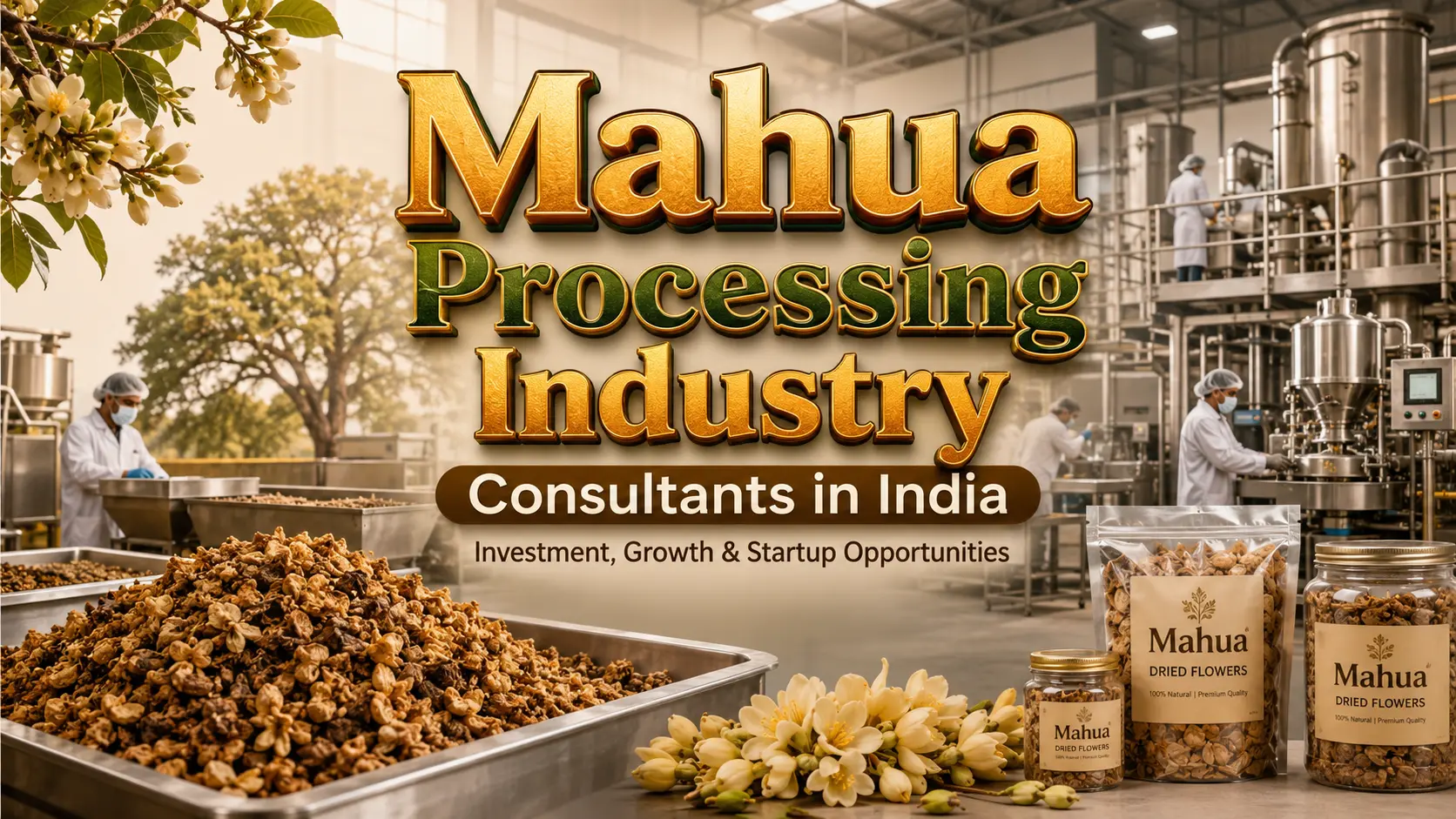
India forest economy is silently changing its paradigm and the key changers are the forest economy processing industry consultants in India. Madhuca indica tree, popularly called the ‘Kalpavriksha’ of Central India has been providing sustenance to the tribal communities for centuries with its nutrient-rich flowers, oil bearing seeds and fermentable sugars. The opportunities for entrepreneurs, MSME investors and agri-food start-ups to tap this historic resource today are as a commercially viable industrial opportunity. The product range is broad and the market is organising up, from Mahua spirits, to cold-pressed seed oil, functional food ingredients to confectionery and cosmetic grade extracts. The first and most important step is to get a good and knowledgeable consultant from the Mahua industry in India who comes with the forest economics and a knowledge of the legislative framework of the country.
Mahua is a cross-section of food technology, tribal economy policy, and India’s rapidly growing craft beverage industry. The Ministry of Food Processing Industries (MoFPI), with the aid of various schemes, such as PM-FME and PMKSY, and the PLI for Food Processing, is promoting value addition in forest and agro-produce. The Van Dhan programme of TRIFED has already proved that value-added Mahua products like jams, sharbat and rab can sell for two-three times the price of raw material. Technical depth to make this policy momentum into a viable manufacturing facility, however, can only be offered by experienced consultants in Mahua processing.
Access Complete Business Plan: Mahua Processing and Value-Added Products
What Do Mahua Plant and Process Consultants Actually Do?
A Mahua processing consultant is more than a typical project report. The best Mahua industry consultants in India start with a detailed techno-economic feasibility study which includes an assessment of the availability of raw materials, seasonal availability of raw material, the collection economics, and capacity planning for the proposed unit that is viable. Mahua is not a commodity as such having a standardised supply chain. The time of hand-picking flowers is from March to April, sun drying them and storing them in the stores create the commercial logic of any plant, so the procurement planning, drying facilities and inventory management become crucial.
Process engineering consultants for Mahua projects often span the entire range from flower cleaning, sorting and drying lines, through fermentation vessel design, distillation column specification, seed expelling and refining equipment and all the way to co-product recovery systems. Mahua spirit projects also need extra regulatory gymnastics since liquor production in India is regulated at the state level. The consultant should be well aware of excise licensing in the state, compliance with FSSAI to use by-products in food, and effluent treatment plant (ETP) design as per the requirement of State Pollution Control Board.
Further, detailed project reports (DPRs) are prepared by top Mahua processing consultants in India, which includes process flow diagrams, product mix and capacity planning, machine and utility layout, detailed and complete capital cost estimates, working capital estimates, profitability analysis, and break-even analysis. In addition to bank financing, these DPRs are also required for applying for government grant schemes under PM-FME or Tribal Sub-Plan funding, and are technically validated by NABARD, SIDBI and state level DFIs. The value addition takes place at this stage with the involvement of process plant consultants with past experience in Mahua or allied forest produce.
Why India Is Becoming a Hotspot for Mahua Processing Consulting
There are a few strong tailwinds making Mahua processing one of the most interesting niche consulting ‘charges’ in the food/beverage industry in India today. First, the policy environment is more conducive than ever. The appetite of investment is beginning to grow in value-added indigenous products due to the MoFPI’s Production Linked Incentive scheme for the food processing industry. The MoFPI’s Production Linked Incentive scheme for food processing is opening up investment appetite in value-added indigenous products. The food processing industry in India is valued at around ₹30.5 lakh crore and accounts for around 7.9% of manufacturing GVA, as per IBEF’s food processing industry report. At the same time several State governments, mainly Madhya Pradesh, Chhattisgarh and Odisha, are working towards liberalisation of excise policies to enable commercial production of Mahua liquor and mainstreaming of tribal liquor.
Second, Indian craft spirits are gaining popularity and are sought after by consumers. Ethnic and botanical spirits, similar to Mexican mezcal and Japanese sake, have been among the most talked-about spirits in the world recently, making Mahua India’s most unique indigenous spirit. Enquiries are already coming in from domestic brand owners as well as NRI investors interested in the food and beverage niche in the boutique management consulting firms in India. The opportunity to tap into a new market, the opportunity to tell a brand story rooted in culture, and today’s retail channels make the timing even more appealing for entrepreneurs getting into the Mahua spirits business.
Explore This Book: Tropical, Subtropical Fruits & Flowers Cultivation
Thirdly, TRIFED has successfully documented that small level of value addition to Mahua flowers by processing them into jams, juices and concentrates can triple the farmer level price from about ₹50/kg to ₹100-150/kg. Strong tribal community networks in six important states ensure that Mahua processing projects have a natural raw material advantage in accordance with this supply-side economics. As per Invest India page on the food processing industry, exports of food products from India touched the USD 10 billion mark, which also validates the export potential for premium locally available products such as Mahua.
Last but not least, the global interest in functional ingredients such as antioxidants, natural sugars, plant-based extracts dovetails with Mahua’s phytochemical profile. The study validates Mahua flowers as a rich source of phenolics like gallic acid, catechin, epicatechin which can be exploited for extraction as nutraceutical and cosmetics. This presents new opportunities for consulting which are not in the traditional food processing industry but in the specialty chemical and personal care sectors — expanding the commercial field for Mahua plant consultants.

How to Evaluate and Shortlist the Best Mahua Industry Consultants in India
It is not a short job to select the ideal consultant for Mahua project. The category of Mahua processing is so wide-ranging, from food grade processing, liquor manufacturing, seed oil refining, tribal economy compliance, and so on, that founders should use a structured evaluation process to narrow down their list of the best Mahua processing industry consultants in India.
1. Domain Expertise in Agro-Forestry and Food Technology
Seek consultants with practical experience in Minor Forest Produce (MFP) industries, tribal agri-processing or at least the food technology sector in general. Mahua is not an ordinary FMCG crop. The consultant with vegetable or dairy experience might not have this detailed knowledge of seasonal availability, drying requirements, and quality differences of Mahua raw material. Seek specific references for past projects for Mahua, forest produce or allied indigenous crops. Their technical fluency, in the realm of fermentation, distillation, seed expelling, oleochemistry and nutraceutical extraction, is a good proxy for true domain expertise.
2. DPR and Feasibility Track Record
The single most critical project deliverable for all investors and bankers in a DPR project is the DPR. Assess shortlisted consultants based on the quality of their previous Detailed Project Reports, rather than the mere fact that they produce one, but how well they cover raw material economics, process flow, machinery selection and financial modelling. In India, sample DPR structures or completed anonymised DPRs may be offered by the top engineering consultant on food processing. Weak consultants create template documents that contain abstracted cost data. The strong one’s tailor each part to the product mix, geography, and size of the project.
3. Regulatory Know-How
The regulatory situation for Mahua processing projects is more complicated than most food manufacturing enterprises. All food grade Mahua products like jams, juices, confectionery, seed oil are covered under FSSAI licensing. The spirit and liquor stream is regulated by State excise licensing and the rules vary widely from State to State – Madhya Pradesh, Chhattisgarh, Odisha and Jharkhand. Effluent treatment compliance is required by the State Pollution Control Board. Any unit employing more than the specified number of employees must register under the Factory Act. It is not a full advisory resource for this sector if one does not have a fluent understanding of all three compliance tracks.
4. EPC and Plant Layout Capability
Many boutique management consultancy firms in India and best Mahua industry consultancy firms in Delhi are offering DPR and feasibility services, but are not having in-house EPC (Engineering, Procurement and Construction). It is essential that a process engineering consultancy is able to deliver EPC, or at least has one company working with the other for distillation, seed oil and food processing equipment, in order to give a single point of responsibility from project report to plant commissioning to the founders. Specifically inquire about their sourcing network for machinery and if they are able to offer any layout and utility engineering services in addition to the DPR.
5. Client Base and Verified References
Credible client portfolio should be evident in case of established Mahua processing consultants in India in MSME and first-generation entrepreneur projects. Recommendations from tribal cooperative processing units, state government sponsored projects or NABARD sponsored Mahua project are more reliable in this field. In India, there are many generalists out there and for Mahua processing industry experience and a proven track record of projects, are more important than brand value or firm size.
Related Article: Top 25 Mahua Processing Business Ideas
Role of NPCS in Mahua Processing Project Consultancy
Niir Project Consultancy Services (NPCS) of Delhi has emerged as one of the recognized industrial consultancy organizations in India and has established a niche for itself in the field of techno-economic feasibility studies and Detailed Project Reports for Mahua processing and allied projects of forest produce industry. NPCS is a global entity with operations in 85 countries that has successfully delivered over 150,000 projects in food processing, agro-industry, chemicals and tribal produce-based manufacturing since 1994.
In the Mahua segment, NPCS’ consulting activities cover the entire spectrum of value-added products the tree can produce – Mahua spirit/ country liquor production, seed oil extraction and refining, value-added food product development (jams, confectionery, beverages), and nutraceutical ingredients. All DPR prepared by NPCS consist of manufacturing process description and flow diagrams, list of machinery and equipment with capacity specifications, raw material procurement and costing, market research and demand analysis, complete financial projections which include capital cost, working capital, revenue model and profitability analysis.
For founders and investors exploring multiple project options within the broader Mahua and tribal forest-produce space, NPCS’s Mahua project profiles catalog offers a curated library of pre-prepared feasibility profiles covering mahua processing, Mahua oil and country liquor, value-added flower products, and Madhuca indica-based enterprises. These profiles help entrepreneurs shortlist the most viable project idea before commissioning a full custom DPR.
As an India-based consultancy firm in Delhi, NPCS can effectively serve founders in the Mahua-belt states of Madhya Pradesh, Chhattisgarh, and Jharkhand, as well as NRI investors entering this sector from across India. Practical differentiators include its ability to bring together food technology skills with financial modelling capabilities – something that most consultants would provide one or the other, if they provide either.
Best Mahua Processing Industry Consultants in Delhi and the Broader India Landscape
Delhi serves as India’s industrial consultancy hub, with countless consulting companies, EPC advisory firms, and DPR consultants operating around industrial estates and government ministry zones. Mahua industry consultants in Delhi are most likely to have a background in agro-industrial technology or food technology, especially for the processing of Mahua. The APEDA (Agricultural and Processed Food Products Export Development Authority) portal also has information regarding market access which will be beneficial to consultants trying to position Mahua from products for export markets.
But Delhi is not the sole market for the India consultancy services for Mahua processing. Often state-specific consultants with local expertise about the state excise licensing and tribal community procurement systems are available in the cities of Bhopal, Raipur, Ranchi and Bhubaneswar. The most successful consulting activities for Mahua projects typically involve the DPR from Delhi along with state level implementation on plant site selection, Pollution Control Board clearances and TRIFED or state government linkages to schemes.
Boutique management consulting firms in India are also entering this space as Mahua gains commercial traction. Smaller, sector-focused firms with 5–15 person teams often deliver faster turnaround and more personalised service than large generalist consultancies. For an MSME-scale Mahua unit — a common entry point for first-generation entrepreneurs — a boutique firm with agri-food specialisation and proven bank-linkage experience is frequently the better choice. The typical ₹50 lakh to ₹3 crore Mahua processing investment range may fall below the minimum engagement threshold of larger corporate consultancies.
Identify high-growth industries before others do
Comparing Consulting Service Types for Mahua Processing Projects
| Service Type | Core Focus / Deliverables | Key Benefit | Best-Fit Client |
| DPR / Feasibility Consultant | Techno-economic feasibility study, Detailed Project Report, market demand analysis, financial modelling, process flow | Bank-ready documentation; validates project viability before investment | First-generation entrepreneurs, MSME investors, NABARD/SIDBI loan applicants |
| Process / Plant Engineering Consultant | Process design, equipment selection, plant layout, utility engineering, capacity optimisation | Technical accuracy in plant design; avoids costly equipment mismatches | Founders commissioning a new Mahua spirit, oil, or food processing plant |
| EPC Consultant | End-to-end project execution — design, procurement, civil work, and commissioning | Single-point accountability; faster commissioning timelines | NRI investors and medium-scale projects wanting turnkey delivery |
| Regulatory & Compliance Consultant | FSSAI licensing, state excise licensing, Pollution Control Board clearances, Factory Act registration | Reduces licence delays and regulatory risk | Any Mahua unit crossing food, liquor, and environmental compliance requirements |
| Market Research & Business Plan Consultant | Market sizing, consumer demand analysis, competitive benchmarking, go-to-market strategy | Validates commercial viability before plant investment | Brand founders and traders entering Mahua spirits or functional food market |
Key Government and Industry References for Mahua Processing in India
Entrepreneurs and consultants working in the Mahua processing space should draw on the following verified government and industry resources. The Ministry of Food Processing Industries (MoFPI) administers PMFME, PMKSY, and PLI schemes directly relevant to Mahua food product manufacturing. The Food Safety and Standards Authority of India (FSSAI) governs all food-grade Mahua product manufacturing and retail licensing. TRIFED provides policy frameworks and market-linkage support for Mahua-based tribal enterprises. The India Brand Equity Foundation (IBEF) offers regularly updated market data on India’s food processing sector. Invest India provides investor-facing sector intelligence and scheme navigation, while APEDA covers export statistics and trade data relevant to value-added Mahua products seeking international markets.
Conclusion: Your Next Steps as a Mahua Processing Entrepreneur
Mahua is no longer just a forest resource. It is an emerging commercial opportunity sitting at the intersection of India’s craft beverage boom, tribal economy mainstreaming, functional food ingredient demand, and oleochemical manufacturing. The business case is compelling, the policy environment is supportive, and the raw material base — across six major Mahua-belt states — is ecologically and economically robust.
However, the transition from a promising idea to a bankable, operationally viable Mahua processing unit requires expert navigation. The right Mahua processing industry consultant in India will save you from costly equipment misjudgements, regulatory delays, and financial projections that do not survive contact with real market conditions. Start your search with the evaluation criteria outlined in this article — domain expertise, DPR quality, regulatory fluency, and EPC capability.(Mahua Processing Industry Consultants)
As a practical next step, explore NPCS’s Mahua project profiles catalog to review pre-prepared feasibility summaries across the full product range — from Mahua spirit and seed oil to value-added food products. For investors ready to commission a custom DPR or full project consultancy, visit niir.org to initiate an engagement. The Mahua economy is ready — and India’s top Mahua processing consultants are ready to help you navigate it.