


Kenya County Industrial Parks: Agro-Processing Business
The agro-processing industrialisation movement is gaining momentum in East Africa and it is indeed generating a substantial and imminent demand for food processing machinery, cold chain facilities, packaging equipment, industrial flavour technology, and allied food manufacturing companies. Eight industrial parks are being built at the county level, with the most commercially viable agricultural produce in each county forming the core of the industrial park. It involves macadamia processing, tomato paste manufacturing, avocado oil extraction, camel milk processing, leather tanning, cassava starch production, sunflower oil refining, and fish feed manufacturing, showing a high diversity among the value addition verticals, each having different infrastructure needs and technologies.
The move creates a unique set of business opportunities for the Indian entrepreneurs, MSMEs, and manufacturers. India has been a source of food processing machinery, vegetable oil refining equipment, technology for starch extraction and allied industrial inputs for the markets in Africa. The government has been moving forward with developing shared industrial infrastructure at the county level and actively seeking private-sector investments in these parks, creating clear business opportunities for Indian firms that possess manufacturing know-how, machinery or technology.
This is not a chance far off, or something you never anticipated. Technical teams have already completed preparedness reports for the first eight parks and publicly announced operational timeframes, while they are finalising frameworks with the private sector. Entrepreneurs who consider export market opportunities, or seek to invest in agro-processing in Africa, have no better moment than now to consider, position and engage.
What This Development Means for Indian Businesses
The county-level industrialisation programme in Kenya is a structural change in the flow of agricultural produce in the Kenyan economy. In the past, farmers harvested raw commodities, such as macadamia nuts, tomatoes, avocados, sunflower seeds, fish and cassava, and sent them to farms with little processing. This practice lowered farm-gate prices and removed value from the supply chain before products reached overseas processors. The government is trying to change this supply chain with its new policy by bringing shared industry infrastructure directly to the counties where farmers source the raw materials. The impact on the commercial side is significant as a place of local processing capacity is emerging which had very little in place prior to now.
In the context of India businesses, there are three different types of opportunity categories that arise from this transformation. The first one is the supply of machinery and equipment: in each of these parks, there should be food processing lines, oil extraction and refining machines, starch processing machines, fish feed pellet mills, cold storage systems, and packaging lines. Indian manufacturers of food processing equipment have an interesting mix between price, technical capability and existing food processing equipment distribution networks in Africa to be able to provide these parks.
Second, food-grade packaging materials, industrial enzymes, processing aids, laboratory testing materials, and quality-control consumables are used by processing parks in huge quantities. Indian MSMEs in these categories have a track record in working with buyers from Africa.
Third, investment and technology partnership: the finalisation of private-sector participation model for these parks opens doors for Indian companies to become operators, technology licensors, or joint-venture partners in particular processing areas.
Why Agro-Processing in East Africa Could See Stronger Growth
The agro-processing industry is being driven swiftly by several structural factors, with the most recent, and most concrete, being Kenya’s county parks programme.
The most direct demand stimulus is infrastructure investment by the government. The KSh 2.5 billion public allocation provides physical processing capacity (factory buildings, power connections, water supply, cold rooms, road access), which each private operator would have to fund separately. Shared-facility models significantly reduce the entry barriers for MSMEs which would otherwise not have been able to invest separately in industrial premises.
The demand for packaged processed foods in the Middle East is rising at a very fast pace in Africa. Kenya, Uganda, Tanzania, and Ethiopia are undergoing a transition toward packaged branded shelf-stable products, instead of raw commodity buying. Foods such as tomato paste, edible oils, processed nuts and packaged starch products are the categories where formal processing capacity has been found to be below the growth in demand.
Another factor is export market access. Kenyan avocado oil, macadamia products and special leather are already selling in the Europe and the Gulf markets. Consistent quality standards in processing, within county parks, can improve the export quality of these products which in turn will help to bring in premium prices. The structured cold-chain infrastructure also creates the potential for chilled and frozen product exports, which are stymied by logistical shortcomings.
Import substitution is another opportunity. Currently, Kenya imports largely processed tomato products, edible oils and starch derivatives. This import reliance may be eliminated with the introduction of domestic processing on a large scale, and may, in the future, sustain regional export.
Government Policies and Incentives Supporting This Opportunity
It is crucial for Indian entrepreneurs who are considering the agro-processing market in Kenya to understand the policy context. The government of Kenya has introduced several instruments in its industrialisation programme and Indian businesses can also take advantage of bilateral trade and investment agreements available.
The Kenya Investment Authority (KenInvest) is the main government agency that promotes private investments in Kenya, such as manufacturing and agro-processing. KenInvest offers investment licences and details on incentives on offer, and facilitation services for foreign investors considering the investment in the county parks opportunity.
The Ministry of Commerce and Industry is responsible for export promotion and development of trade, and it will also look at supporting Indian companies to gain a foothold in the East African region. The ministry has several export promotion councils for food processing machinery exporters.
The Agricultural and Processed Food Products Export Development Authority (APEDA) is established to facilitate the export of processed food products such as fruit-based products, edible oils and starch derivatives which directly impact on the opportunities of the county parks in Kenya.
The Ministry of Food Processing Industries, Government of India provides for various schemes for supporting the MSMEs in the field of food processing such as Production Linked Incentive (PLI) scheme for food processing or can benefit Indian companies who are interested to scale up their production capacity for export.
Related Article: Kenya’s Ksh 2.4 Billion Industrial Parks Are Open for Business — Here’s How Entrepreneurs Can Cash In
The MSME Ministry of India offers technology upgradation assistance, market development assistance and export facilitation, which can assist MSME’s entrepreneurs to effectively access African markets.
India Africa Forum Summit (IAFS) framework and bilateral trade agreements are the broad-based diplomatic and trade structure to enable Indian business presence in African markets.
Indian Startups and new ventures can receive project advisory on Startup India including provisions for internationally oriented businesses.
The Engineering Export Promotion Council of India (EEPC) specifically supports Indian manufacturers of industrial machinery and equipment, including food processing lines — a category in direct demand across Kenya’s county industrial parks.
For companies involved in leather processing technology — relevant given Wajir county’s leather-focused park — the Central Leather Research Institute (CLRI), Chennai provides technology support and industry linkages for Indian leather technology businesses seeking international engagement.
Manufacturing Business Opportunities Emerging From This Development
There are eight county parks and their specific processing focus areas which will bring distinguishable manufacturing opportunities to Indian MSMEs and entrepreneurs:
1. Food Processing Machinery and Equipment Manufacturing
The processing lines for each county park must be available for different commodities, such as tomato paste, oil extraction and refining, starch processing, fish feed pellet mill and nut shelling and grading. Food Processing Machinery Manufacturing units in India, especially in Punjab, Maharashtra, Rajasthan and Gujarat are in competitive position to supply this segment. Sub-Saharan Africa has an expanding market for county infrastructure procurement, supported by government initiatives. The park procurement process also creates aggregated demand that can generate meaningful export opportunities. MSMEs involved in manufacturing activities in this space should focus on design and customisation opportunities. They will need compact, modular equipment that allows multiple businesses to operate within a single facility.
Target customers: County Park operators, private agro-processors, anchor tenants in parks. The investment scale of manufacturers: medium business manufacturing unit. High export potential because replicated demand within the planned extension of the park in Kenya.
Read the Complete Book Here: Handbook on Fruits, Vegetables & Food Processing with Canning & Preservation
2. Edible Oil Refining Equipment and Processing Technology
Garissa and Kisii are two of the eight parks that will concentrate on processing edible oils (sunflower and avocado, respectively). The sunflower processing is a fully developed and mechanised technology and the avocado oil processing, especially the cold-pressed premium quality for export, needs special machinery that keeps the oil in its nutritional and sensory characteristics. Indian manufacturers of solvent extraction plants, winterisation systems, expellers for extracting oil etc. and refinery equipment has an established track record of providing edible oil processors in Africa. An increased European and Gulf avocado oil market offers further incentive for investing in processing technology that emphasizes quality.
Target customers: county park anchor processors, private Kenyan edible oil companies. The investment range is for MSME compatible machinery fabrication. Repeat business: High as parks grow, export potential.
Get Detailed Project Report (DPR): Edible Oils & Fats Manufacturing Projects
3. Starch Extraction and Processing Plant Manufacturing
The cassava washing, grating, dewatering, drying, and milling equipment are needed in Busia County due to the cassava starch focus. India has high technical capacity to process starch and there is an industrial experience of processing similar cassava-based starch in tapioca processing industry in Tamil Nadu and Kerala. Indian manufacturers can provide cassava starch processing lines at costs competitive with those available from Europe, and have the technical support infrastructure more readily available in East Africa than equipment from further away. Starch products can be made into additional exportable products for regional food manufacturers.
Audience: Busia County Park Operators, cassava producing cooperative clusters. Operating cost: MSME. Potential for exports: moderate, with high demand for food grade starch in the region.
Explore This Book: The Complete Technology Book on Starch and Its Derivatives

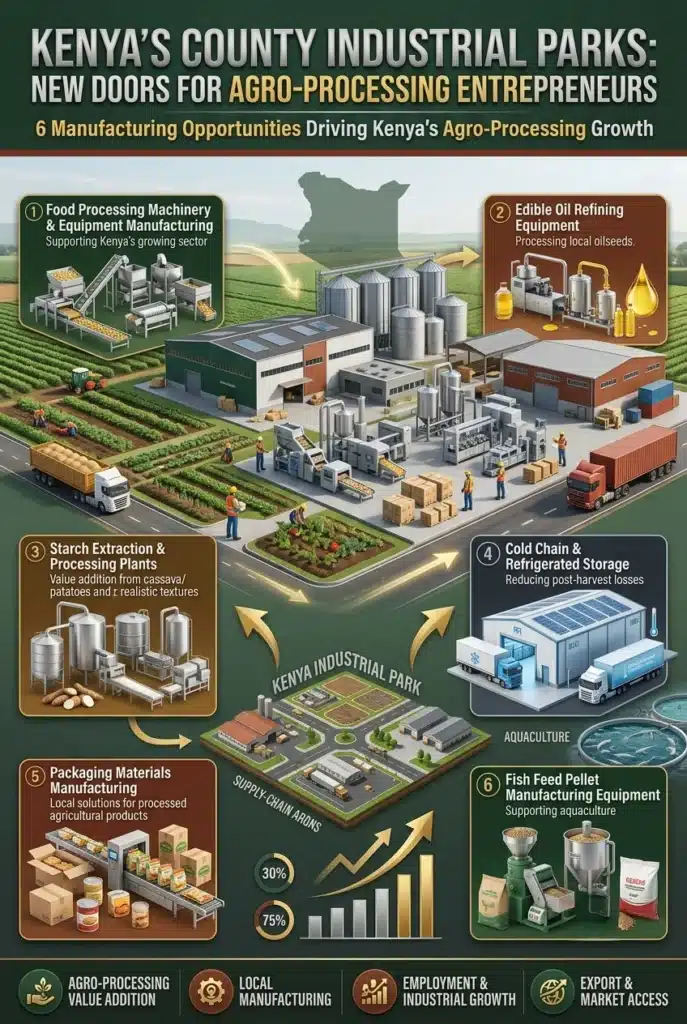
4. Cold Chain and Refrigerated Storage Equipment
The government has specifically planned for the installation of cold room as part of the infrastructure in all the eight parks. Cold storage is important for temperature sensitive agricultural products such as avocado, fresh tomatoes and fish. Indian manufacturers of prefabricated cold room panels, refrigeration compressors, blast chillers and temperature monitoring systems are catering to the expanding cold chain market in the country and have already developed export capability. The Kenya parks programme is a focus of demand for cold chain equipment suppliers in India who can supply directly or through Kenyan distributors.
Target customers: county governments, park facility managers, private operators. Investment: medium-scale manufacturing. Export capacity: high, and will improve easily as the cold chain expands.
5. Packaging Materials Manufacturing
Processed Products, including tomato paste, fish feed, macadamia products and cassava starch, all need to be packaged appropriately, both primary and secondary. Agro-processors use a lot of flexible packaging, rigid packaging and industrial bulk packaging, in the form of pouches, sachets and woven PP sacks, respectively. The Indian packaging material manufacturers particularly BOPP, HDPE and laminated packaging with Gujarat and Rajasthan are ready to cater Kenyan agro-processors. As county parks move towards premium-grade production, food-grade packages, that meet export market standards, are especially sought after.
Target customers – county park processors, branded FMCG companies and exportable processors. Investment: MSME friendly flexible/rigid packaging manufacturing unit. Export potential: high.
Check Out This Recommended Book: Handbook on Modern Packaging Industries
6. Fish Feed Pellet Manufacturing Equipment
The specialisation on fish feed manufacturing in Migori county generates demand for fish feed formulation technology, drying systems, quality testing equipment as well as pelleting mills. The aquaculture industry in Kenya is growing, as a result of the increasing demand for fish by the growing urban population, as well as government support for aquaculture. Fish feed is an important import substitution opportunity: at present, only a few local feed manufacturers produce high quality formulated feeds. There are Indian companies with aquafeed pellet mill and extrusion technology which can provide these technologies in the Kenyan aquaculture industry and to the operators of the Migori park.
The target customers are the operators of fish feeding stations in Migori county and the aquaculture cooperatives. Investment: Manufacturing equipment for MSMEs. Moderate to high export market potential in East African aquaculture markets.
Import-Export and International Market Opportunity
Export Opportunity for Indian Manufacturers
The agro-processing parks in each county in Kenya are a single-source procurement platform for industrial equipment, processing technology, packaging materials and other inputs. For Indian manufacturers, the export opportunity is relevant in a number of product categories such as food processing machinery (expellers, dryers, graders, pellet mills, refinery equipment), cold chain infrastructure (panels, compressors, monitoring systems), packaging materials (flexible, rigid, industrial) and quality-testing consumables.
India has already established a good base for providing technically competent and cost-effective equipment to Africa. The existing linkages of East African buyers, including the Kenyan industry, with Indian suppliers include machinery exhibitions, buyer-seller meets through trade bodies and distributor networks. The county parks offer a way to institutionalise and scale up these connections.
If successful in the market, the county parks model may be replicated in other East African economies that are seeking to embark on similar agro-industrialisation approaches, apart from Kenya. Establishing a strong presence in Kenya’s county parks market is an ideal opportunity for an Indian supplier to benefit from this regional expansion.
Import Substitution Opportunity Within India
Another dimension to the county parks story is for Indian entrepreneurs with regards to import substitution. Kenya will be exporting processed macadamia oil, avocado oil and leather products.Countries such as India have demand for macadamia oil, avocado oil and leather products. Indian food manufacturers, speciality food retailers and leather goods manufacturers can consider direct sourcing from county park processors in Kenya as an alternative sourcing option. If Indian buyers establish early relationships with county park operators, they might gain preferential access to competitively priced, traceably produced East African agricultural commodities.
Indian MSMEs and Startups in Related Industries
Bühler India Pvt. Ltd., Pune (Food Processing Machinery) is a strong presence in the Grain Processing, Oil Seeds Processing & Food Ingredients Manufacturing equipment in the Indian market, which is an arm of the global Swiss Equipment company. Although Bühler’s Indian operations are not of the same scale, they provide a good example of the technical standard in food processing machinery. Smaller fabricators in India specializing in specific equipment categories such as oil expellers, dryers, pellet mills, can consider engaging in Africa, similar to how Bühler India did, by establishing longterm technical support relationships with the country’s MSMEs, and providing packages of equipment which fits the needs of MSME park operators, for small batch processing.
Phenomenal Engineering Works (Oil Expeller Manufacturer, Jaipur) — Jaipur has become a center for the Oil Expeller and Edible Oil Processing Machinery Manufacturers who cater to both domestic and African markets. The small and medium sized fabricators in this cluster have developed exporting capacity through competitive pricing advantage, customisation in commodity types and easy after-sales service support. The processing industry cluster in Kenya is based on avocado and sunflower oil, which matches the Kenyan expeller manufacturers’ capacity. Entrepreneurs in this sector should consider specific avocado cold-press extraction equipment needs rather than normal seed oil pressing equipment.
Discover business ideas that actually make money
Tinytech Udyog, MSME Agro-Processing Machinery, Rajkot is an example of a well-documented MSME who has created a good export business in agro-machinery, small scale edible oil processing and biodiesel processing. They operate on a business model that is very convenient for shared facility county park operators in Kenya — low-cost, simple-to-use, locally sustainable technology that is appropriate to developing market conditions. If you’re thinking of joining this machinery exports arena, you can research how Tinytech has simplified their products and how they have established credibility with their agricultural show participation and demonstration units for customers in the developing world.
What Entrepreneurs Should Evaluate Before Investing
When considering the agro-processing equipment export opportunity or a direct investment in the agro-processing equipment sector in the county parks in Kenya, a structured evaluation is needed in the following dimensions:
- Market Demand Verification: Ensure that each county park has specific equipment requirements, procurement procedures, and timeframe. There are generally longer procurement cycles with government programmes.
- Use of Technology: Technology should be specifically calibrated to the commodity, e.g., avocado cold-press machine needs very different needs than sunflower hot-press.
- After Sales Support Capability – African machinery buyers value suppliers who can offer local support, spare parts and operator training. Determine if you have the ability to create or partner with credible technical support in country.
- Regulatory Requirements: Be familiar with import duties, machinery certification requirements and food safety standards in Kenya for the machinery you wish to supply or as a finished product.
- Payment Terms & Working Capital: Assess working capital needs, including factors such as longer payment terms and possibly Letter of Credit or Trade Finance requirements in export trades.
- Competition Assessment: Know the Chinese, European and Indian equipment suppliers that are in the Kenyan market, and understand how your value proposition differs.
- Scalability: Discuss whether the Kenya parks opportunity can be a means of engaging the East African market (Uganda, Tanzania, Ethiopia) where there are various stages of development of similar industrialisation programmes.
- Currency and payment risk: Assess foreign exchange considerations such as stability of the Kenyan shilling, repatriation of currency and payments.
- Quality Standards: Ensure that the machine or processed products are certified by Kenyan Bureau of Standards (KEBS) and if applicable; to export market standards for the European or Gulf markets.
- Partnership Options: Consider whether it would be easier to enter through a Kenyan distribution or manufacturing partner, or a direct export model.
How NPCS Can Help Entrepreneurs Evaluate the Opportunity
NPCS – Niir Project Consultancy Services has been catering to the needs of entrepreneurs, MSMEs, manufacturers and investors of the country and abroad for more than 20 years in the field of industrial consultancy, preparation of project reports and feasibility studies. NPCS provides structured support to entrepreneurs evaluating any of the business opportunities discussed in this article, including: Manufacturing of food processing machinery; Processing of edible oils in cold chain; East African agro-processing; Packaging material manufacturing; and Investment in East African agro-processing.
The services offered by NPCS to this opportunity are: Detailed Project Reports (DPRs) for food processing machinery manufacturing, edible oil processing plants and starch extraction plants; Market Research reports on trends in the agro-processing industry in India and the export market; Technology and Process Consultancy for selected manufacturing verticals; Plant and Machinery Assessment to identify appropriate specification of plant and machinery and their suppliers; Investment Evaluation frameworks that help entrepreneurs assess the commercial viability before investing.
NPCS can offer to entrepreneurs at the early evaluation stage the structured industry intelligence and project planning that will help them take the next step from an identified opportunity to a commercially sound investment decision.
Business Opportunity Snapshot
| Industry | Agro-Processing, Food Processing Machinery, Cold Chain Equipment, Packaging |
| Market Driver | Kenya county industrial parks programme — KSh 2.5 billion government investment in 8 shared agro-processing facilities |
| Key Development | 8 County Aggregation and Industrial Parks (CAIPs) operational before end-2026, each anchored to a regional commodity: macadamia, tomato paste, avocado oil, camel milk/leather, cassava starch, sunflower oil, fish feed |
| MSME Opportunity | Food processing machinery export, cold chain equipment supply, packaging materials, agro-processing investment and technology partnership |
| Manufacturing Potential | High — food processing equipment, oil refining machinery, starch plants, pellet mills, cold room panels, flexible packaging |
| Export Potential | High — Indian machinery and packaging manufacturers have competitive advantage in African agro-processing markets |
| Import Substitution | Moderate — domestic Indian sourcing of East African macadamia, avocado oil, and specialty leather from Kenya park processors |
| Government Support | India: APEDA, MoFPI PLI scheme, EEPC, Startup India, MSME Ministry; Kenya: KenInvest, county government facilitation |
| Investment Consideration | MSME-scale machinery fabrication units; medium-scale for cold chain; low-capital for packaging consultancy and trading |
| Risk Level | Moderate — government programme timeline risk, currency risk, after-sales support logistics |
| Growth Outlook | Positive — Kenya plans to roll out CAIPs across all 47 counties; regional replication likely |

Conclusion
County-level agro-processing industrialisation programme in Kenya is one of the most tangible and supported agro-industrial projects implemented in East Africa today. The 8 county parks sit at a point of attachment with a particular commodity cluster, with government infrastructure investments behind them, and a concrete demand signal for food processing machinery, cold chain equipment, packaging materials and allied manufacturing inputs – with each set of parks in operation by the end of 2026.
For Indian entrepreneurs and MSMEs with capabilities in food processing equipment manufacturing, edible oil machinery, starch processing technology, cold chain systems, or food-grade packaging, this development creates commercial pathways that deserve serious evaluation. The export opportunity is not speculative — the parks are being equipped now, and procurement processes will follow technical commissioning. Indian manufacturers that establish early relationships with Kenyan park operators and government facilitation bodies position themselves advantageously for both the initial eight parks and the broader programme expansion.
The opportunity also extends beyond machinery supply: technology licensing, joint-venture processing investment, and sourcing partnerships for specialty East African agricultural commodities are all viable commercial models to explore.
Entrepreneurs should begin with structured market research and a detailed feasibility study, evaluate technology and product fit for specific county park requirements, develop a DPR before committing capital, and engage with APEDA, EEPC, or KenInvest for facilitation support. The convergence of government commitment, established commodity clusters, and active private-sector participation frameworks makes this an opportunity worth investigating thoroughly.