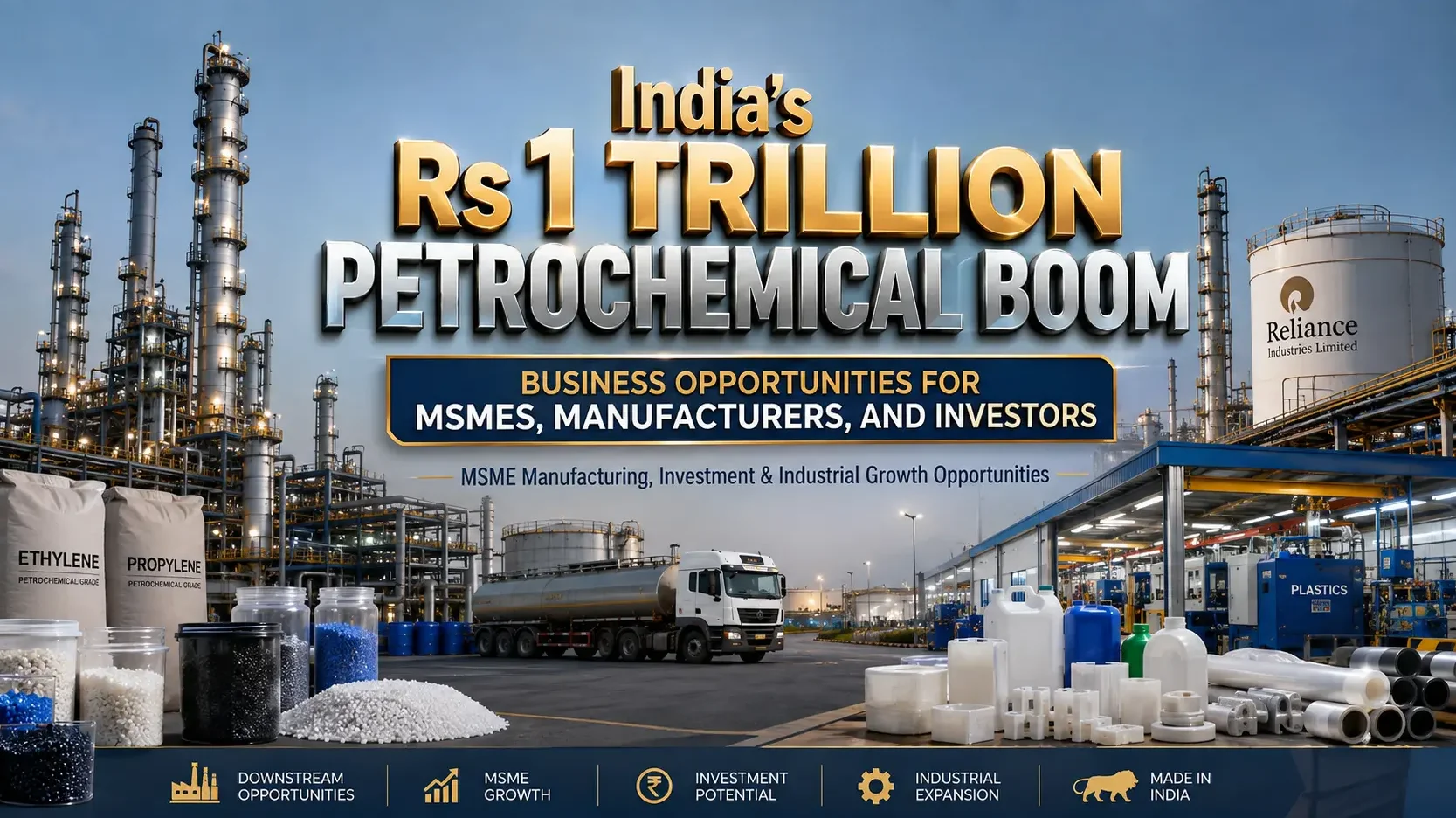

India’s biggest publicly owned refinery re-drew the industrial map of India. India’s national oil major Indian Oil Corporation Ltd (IOCL) has unveiled a capital expenditure programme of Rs 1 trillion (Rs 1 lakh crore) for petrochemical projects in the next five to six years, one of the largest single-sector capital outlays in the history of Indian public-sector enterprises.
Disclosures by the IOCL management in an investor call led to the news being picked up by Rediff.com on 4 August 2026. The plan is not just an upgrade to the refinery. IOCL plans to increase its Petrochemical Intensity Index (PII) from the current 6.5 per cent to 16 per cent by 2030, where 100 per cent of crude oil is used for value added chemicals and 0 per cent for fuels.
That will see IOCL’s annual petrochemical output grow from 4.3 million tonnes per annum (MTPA) to 13 MTPA. This is a structural change in the market for the entrepreneurs, MSME manufacturers, the startup founders and investors! The demand for downstream polymer products, chemical intermediates, specialty resin, rubber products and industrial raw material will see a massive growth in India as it moves from an economy that exports fuel to an economy that exports chemicals. The window of opportunity to get into the petrochemical supply chain is open wide now.
What Recent Reporting Means
IOCL is looking to spend Rs. 30,000-40,000 crore on annual capex, which will go largely towards its petrochemical projects in the coming fiscal year, said its Finance Director Anuj Jain in a statement to Rediff.com. The projects are at various stages of approval and the total expenditure in the next five to six years will be on the order of Rs 1 lakh crore.
The short-term targets are already materializing on the ground. The complex of PX-PTA (Para-Xylene and Purified Terephthalic Acid) in Odisha’s Paradip Refinery is 94.6 per cent complete and will be commissioned by August 2026. The expansion of the Panipat refinery has reached 94 per cent completion, with the company planning to put the phase into operation by December 2026. The company will also commission a Polybutadiene Rubber (PBR) plant and a Polypropylene unit at the same time. A new Styrene Monomer Project is also envisioned at Panipat, while IOCL is developing a Lube Integration Project at Gujarat Refinery.
Why This Matters for Different Stakeholders
- Entrepreneurs: At competitive domestic prices, output from IOCL will make available the following feedstocks – polypropylene, PTA, ethylene glycol, styrene, LAB – which are affordable. Downstream companies turning these feedstocks into finished products will have access to relatively inexpensive raw material and an increasingly demand.
- Downstream converters like pipe manufacturers, woven sack producers, moulders and film extruders are required for every tonne of polypropylene produced by the MSME Manufacturers. Close proximity to IOCL refinery areas brings in substantial cost and logistic benefits to MSMEs.
- Investors: The petrochemical industry is expected to reach $190 billion today, $300 billion by 2025 and $1 trillion by 2040. The downstream processing investments made now ride the wave of infrastructure investments being created by IOCL as well as other PSUs.
- Exporters: India is keen to aggressively pursue petrochemical exports. Indian downstream manufacturers can compete in the markets of Southeast Asian, African and Middle Eastern countries with improving availability of feed.
- Smaller, agile companies can compete with larger manufacturers on application-specific quality within specialty chemicals – adhesives, masterbatches, TPE blends, coating resins and rubber compounds.
Rediff.com also mentions that BPCL and HPCL are planning for an expansion programme simultaneously. India is not constructing isolated projects, but rather an entire eco-system of petrochemicals. That ecosystem must have hundreds of downstream manufacturing units to absorb its output.
Related Article: India’s Petrochemicals Boom: Manufacturing Business Opportunities for MSMEs
Why This Industry Is Growing
Petrochemicals consumption in India is around 25-30 million metric tonnes per year and is on the rise. Rubber, plastics, synthetic textiles, detergents and coatings are increasing in consumption as a result of the urbanisation. The trend to lightweight polymer components in the automotive industry is increasing new demand. Use of PVC pipe, waterproofing chemicals and adhesive are increasing.
According to the IBEF data, India’s refining capacity is slated to grow from 260 MTPA to more than 300 MTPA in the short term and is expected to increase to 450-500 MTPA by 2030. Today India has the fourth largest refining capacity and is well on its way to becoming a world class refining and chemicals hub.
The critical gap ran down the road. The large refiners can manufacture commodity polymers and base chemicals. However, turning these materials into hundreds of finished industrial and consumer products requires a long chain of smaller, specialised manufacturers. In India that network is not developed. This is where the opportunity of MSME exists.
Government Policies and Incentives
The policy regime in India is actively encouraging entrepreneurs to venture into the petrochemical downstream industries. Invest India and the Department of Chemicals & Petrochemicals have launched a number of specific schemes:
PCPIR: Petroleum, Chemicals and Petrochemicals Investment Regions
Get Detailed Insights from This Book: The Complete Book on Distillation and Refining of Petroleum Products (Lubricants, Waxes and Petrochemicals)
Plastic Parks Scheme
The Plastic Park Scheme is operated by the Ministry of Chemicals & Fertilizers to develop modern industrial park for the plastic processors. Several Plastic Parks are in the process of development across States, confirmed PIB. They can especially help MSMEs involved in polymer processing, moulding or film extrusion.
PLI Scheme for Chemicals and Petrochemicals
A special Production-Linked Incentive (PLI) scheme for chemicals and petrochemicals is being actively formulated, the PIB announcement said. Businesses that establish units prior to the official opening of the PLI will be on the better side of the crib. Businesses that set up before the official launch of the PLI will have an advantage for incremental sales from day one.
MSME Credit and Technology Schemes
Credit guarantee cover is provided by the MSME Ministry through the CGTMSE (up to Rs 2 crore without any collateral), the Technology Upgrade Fund, and Cluster Development Funding (applicable to downstream of the petrochemical manufacturing units).
State-Level Incentives: Odisha Focus
There is a unique PCPIR policy for Odisha and a 120-acre Plastics Park at Paradeep, Odisha. The state offers power subsidies, land at discounted rates, stamp duty exemption, employment generation grants etc. IOCL’s key investments in the petrochemical sector lie in the Paradeep, Odisha-based downstream plants, thus giving them the proximity advantage of feedstocks.
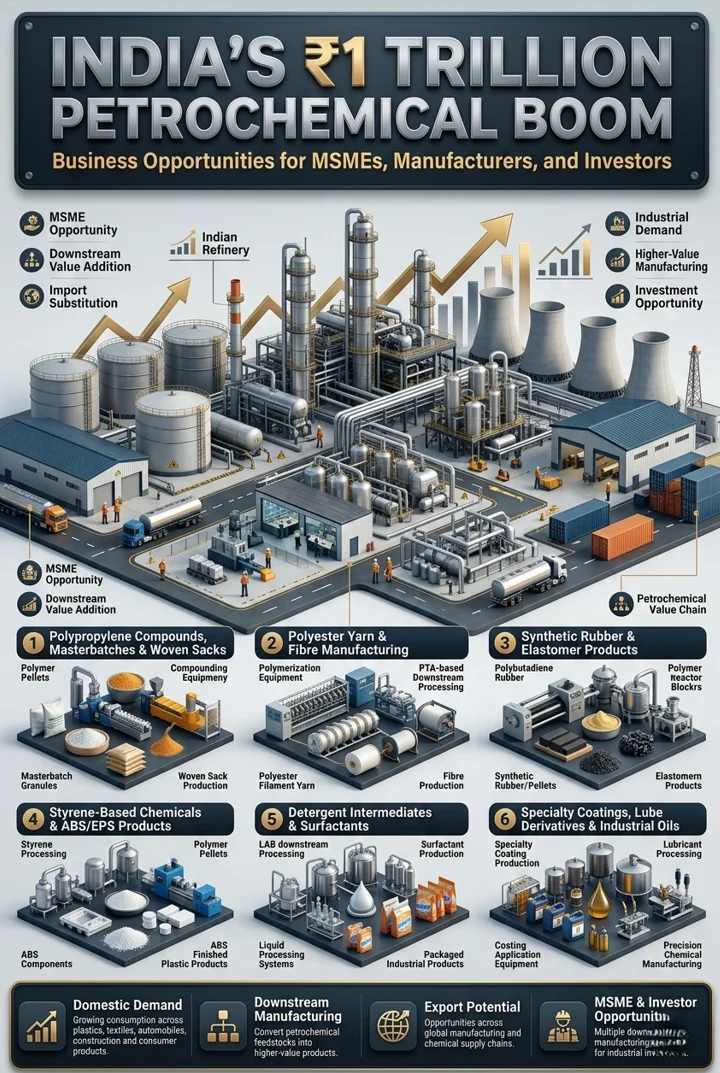
6 Manufacturing Business Ideas Arising from the IOCL Investment
IOCL is building capacity in polypropylene, PTA, polybutadiene rubber (PBR), styrene monomer and LAB, the Rediff.com report said. Every one of these upstream commodities will provide MSME founders and entrepreneurs with dozens of downstream manufacturing opportunities.
1. Polypropylene Compounds, Masterbatches, and Woven Sacks
IOCL has two large polypropylene (PP) plants coming up in Panipat and Gujarat. Polypropylene is the workhorse polymer of Indian industry, and Indian manufacturers use it in automotive parts, woven bags, FMCG packaging, labware, furniture components, pipes, and more. MSME manufacturers who install PP compounding or masterbatch plant in the vicinity of IOCL’s plant will receive the feedstock at the best-in-class price.
One of the entry points of woven PP sack manufacturing is agriculture and cement, which is a high demand and low capex category and the investment required is Rs 25 to 75 lakhs for a small unit. The cost of bigger PP injection moulding machines for automotive and consumer products can run Rs 2-5 crore. Increase in PP availability in North India to a great extent due to IOCL’s Panipat expansion (IOCL plans to commission the expansion in December 2026), opportunity note.
2. Polyester Yarn and Fibre Manufacturing (PTA Downstream)
The Project of Xerox at Paradeep of IOCL commissioned on August 2026 is a game-changer for the textile and packaging industry in India. In the processing of PET bottles, PTA is the main raw material used to process PET bottles, polyester fibre, polyester yarn, and PET chips. India has been a net importer of PTA in the past. Today the domestic supply is increasing and entrepreneurs can profitably establish polyester yarn texturising units (Draw Texturised Yarn / DTY), PET chip manufacturing or plants for manufacturing food grade PET preforms.
Investment size: Rs 50 lakh to Rs 5 crore as per the scale. Key textile clusters of Surat (Gujarat), Panipat (Haryana) and Tirupur (Tamil Nadu) are the ones who benefit the most. There is also considerable export potential to Bangladesh, Vietnam and the garment manufacturers in Southeast Asia.
View Full Project Details: Cotton Yarn from Waste Yarn – Complete Manufacturing Guide
3. Synthetic Rubber and Elastomer Products (Polybutadiene Rubber)
IOCL will be setting up a 60,000-tonne Polybutadiene Rubber (PBR) plant in Panipat simultaneously with the expansion of the refinery. Tyres, footwear soles, conveyor belts, rubber moulded parts and industrial hoses are areas where PBR is used. India imports considerable amounts of synthetic rubbers. IOCL’s addition of domestic PBR capacity provides downstream rubber product manufacturers with a cost competitive import substitution benefit.
Business opportunities: manufacture of tyre retreading compounds, rubber moulded industrial parts, rubber-to-metal bonded components, rubber-seal and rubber-gasket parts for the automotive industry, manufacturing of conveyor belts. Investment size: Rs 30 lakh to Rs 3 crore in medium sized rubber processing units.
Get Detailed Project Report (DPR): Rubber and Rubber Products Industry
4. Styrene-Based Chemicals and ABS/EPS Products
The Styrene Monomer Project had said that India will have local supply of styrene soon in the form of Styrene signals in Panipat. The base of Expanded Polystyrene (EPS / thermocol), Acrylonitrile Butadiene Styrene (ABS) resin, High-Impact Polystyrene (HIPS) and Styrene Butadiene Rubber (SBR). All of these are highly sought after by the electronics, automotive, appliance, packaging and construction markets.
Planning for EPS packaging block manufacturing, ABS compounding for electronics enclosures, or HIPS sheet manufacturing for signage and displays are all possibilities for entrepreneurs. The investment varies from Rs 40 lakh to Rs 4 crores. The early movers who will create supply tie-ups with IOCL’s Panipat complex will get long-term security of raw materials.
5. Detergent Intermediates and Surfactants (LAB Downstream)
IOCL has the biggest Linear Alkyl Benzene (LAB) plant in the country at Gujarat Refinery with a production capacity of 1,20,000 MTPA. The main raw material of biodegradable synthetic detergents is LAB. The availability of LAB increases as IOCL adds more refinery units in Gujarat. Entrepreneurs can set up detergent powder manufacturing units, liquid detergent blending units or specialty detergent manufacturing units for production of specialty surfactants for industrial cleaning, personal care, agriculture, etc.
The market signal: India’s rural and semi-urban detergent markets are on the fast track and FMCG companies have regular demands for region-based contract manufacturers. The investment required is in the range of Rs 15 lakh (small blending plant) to Rs 1.5 crore (automated detergent powder line). This is one of the easiest to access points of MSME in the entire Petrochemical value chain.
Explore This Book: Modern Technology of Soaps, Detergents & Toiletries (with Formulae & Project Profiles)
6. Specialty Coatings, Lube-Derivative Products, and Industrial Oils
IOCL’s Lube Integration Project at Gujarat Refinery will produce 235,000 tonnes of Lube Oil Base Stock (LOBS). Specialty products derived from LOBS serve applications in specialty coatings, printing inks, adhesive formulations, and cable-filling compounds.
Businesses that establish Specialty Lubricants Packaging, Resin Blending or Industrial Adhesive Manufacturing Plants in proximity to Gujarat refinery complexes benefit from cost-competitive feedstocks. The cost of investment is Rs. 20 lakhs to Rs. 2 crores. The ideal locations are GIDC industrial estates near Vadodara, Surat and Dahej.
Import-Export Opportunity Analysis
Import Substitution
ABS resin, acrylonitrile, EVA copolymers, specialty rubbers, LLDPE, and dozens of specialty intermediates make up a large petrochemical import bill in India. The bill runs into hundreds of thousands of crores annually. IOCL’s entry into base polymers and feedstocks strengthens the domestic market. It also creates more opportunities for downstream manufacturers to substitute imports. IOCL management has publicly pointed out that initiatives such as the Styrene Monomer Plant and Lube Integration Project will help reduce India’s reliance on imports.
Export Markets
Import of polymer compounds, synthetic rubber products, PTA-derivative textiles, and specialty chemicals is a significant import to Southeast Asia, especially to Bangladesh, Vietnam, Indonesia, and Thailand. Indian manufacturers that use IOCL feedstock will remain cost-competitive with Chinese manufacturers in these markets. There are significant opportunities for growth in demand for detergent intermediates, woven polypropylene packaging and construction plastics in the Middle East and Africa.
Trade Opportunities
The Union Budget 2026 also introduced customs duty exemptions for 40 critical petrochemical items. This will reduce the cost of imported feedstock for manufacturers using imported specialties with base polymers. Therefore, manufacturers have a unique opportunity to produce hybrid specialty compounds in India. They can blend IOCL-based polymers with specific imported additives and export finished products at competitive global prices.
Indian MSME and Startup Success Stories in Petrochemicals
Supreme Industries Ltd (Nashik, Maharashtra)
Supreme Industries began as a small plastics processing company. It has since emerged as India’s largest plastic pipe and product manufacturer. The company remains closely linked with polymer manufacturers such as IOCL and Reliance. Its success model focuses on producing standard polymer products at scale. It also brings production closer to polymer clusters and feedstock. MSMEs can easily replicate this model for woven sacks, irrigation pipes, plastic moulded components, and similar products.
Garware Technical Fibres (Pune, Maharashtra)
Garware, originally a yarn texturising unit, scaled into a global specialty nets and ropes manufacturer serving fisheries, agriculture, and sports netting sectors worldwide. It demonstrated that PTA-derivative processing, starting from polyester yarn, can reach international export markets by building consistent quality systems. The polyester yarn texturising and conversion pathway remains viable for new entrants.
Fine Organics Industries (Mumbai, Maharashtra)
Fine Organics built a specialty oleochemicals and polymer additives business serving global FMCG, plastics, and cosmetics customers. Starting from petrochemical-adjacent raw materials, the company now exports specialty additives to over 75 countries. This trajectory — specialty chemical manufacturing feeding into polymer processing supply chains — is highly relevant for founders targeting the masterbatch, stabiliser, and polymer additive segment.
Identify high-growth industries before others do
About Niir Project Consultancy Services (NPCS)
For entrepreneurs planning to enter the petrochemical downstream space, Niir Project Consultancy Services (NPCS) provides end-to-end industrial advisory:
- Detailed Project Reports (DPR): techno-economic feasibility for polymer processing, rubber product, and specialty chemical plants — accepted by banks and SIDBI for loan processing
- Market Research: demand studies, competitive landscape analysis, and pricing surveys for petrochemical downstream segments
- Feasibility Studies: investment viability, payback period, and profitability projections for MSME-scale units
- Technology Consultancy: plant layout, equipment selection, and process technology guidance for new entrants
- Project Finance Support: loan documentation preparation for banks, SIDBI, and state finance corporations
NPCS has assisted thousands of Indian entrepreneurs in setting up manufacturing businesses across the chemical, polymer, and specialty materials sectors. With IOCL’s expansion creating unprecedented feedstock availability, NPCS can help you convert market opportunity into a bankable project plan.
Industry Snapshot: IOCL Petrochemical Expansion – Key Parameters
| Parameter | Details |
| Industry | Petrochemicals and Downstream Polymer Processing |
| Market Driver | IOCL Rs 1 trillion capex; PII rising from 6.5% to 16% by 2030 |
| Production Target | IOCL: 4.3 MTPA to 13 MTPA by 2030; India: 260 to 300+ MTPA refining capacity |
| Investment Range | Rs 15 lakh (detergent blending) to Rs 5 crore (PP compounding / yarn texturising) |
| MSME Opportunity | Polymer compounding, rubber products, polyester yarn, ABS/EPS, surfactants, specialty coatings |
| Export Potential | High – SE Asia, Middle East, Africa; PTA-derivative textiles, polymer compounds, rubber goods |
| Government Support | PCPIR zones, Plastic Parks, PLI for chemicals (under formulation), MSME credit schemes |
| Key Locations | Paradeep (Odisha), Panipat (Haryana), Dahej / Vadodara (Gujarat), Vizag (Andhra Pradesh) |
| Risk Level | Low to Medium for downstream; higher for capital-intensive upstream conversion units |
| Growth Outlook | Indian chemicals sector projected to reach $300 billion soon and $1 trillion by 2040 |
Conclusion: The Petrochemical Window Is Open – Act Now
India’s petrochemical sector is at an inflection point. IOCL’s Rs 1 trillion investment, as reported by Rediff.com in August 2026, is the clearest signal yet that India is transitioning from a petroleum economy to a chemical’s economy. The government’s PCPIR zones, Plastic Parks, and anticipated PLI scheme are creating the infrastructure. PSU refiners are building the feedstock supply. The only missing piece is a deep, dense downstream manufacturing ecosystem — and that is precisely where the MSME opportunity lies.
Entrepreneurs who position themselves in polymer processing, rubber product manufacturing, PTA-derivative textiles, specialty surfactants, or styrene-based materials today will capture first-mover advantages in feedstock pricing, customer relationships, and capacity. Those who wait will face a more competitive, more crowded market with less room to establish supply agreements.