India Namkeen Market Growth
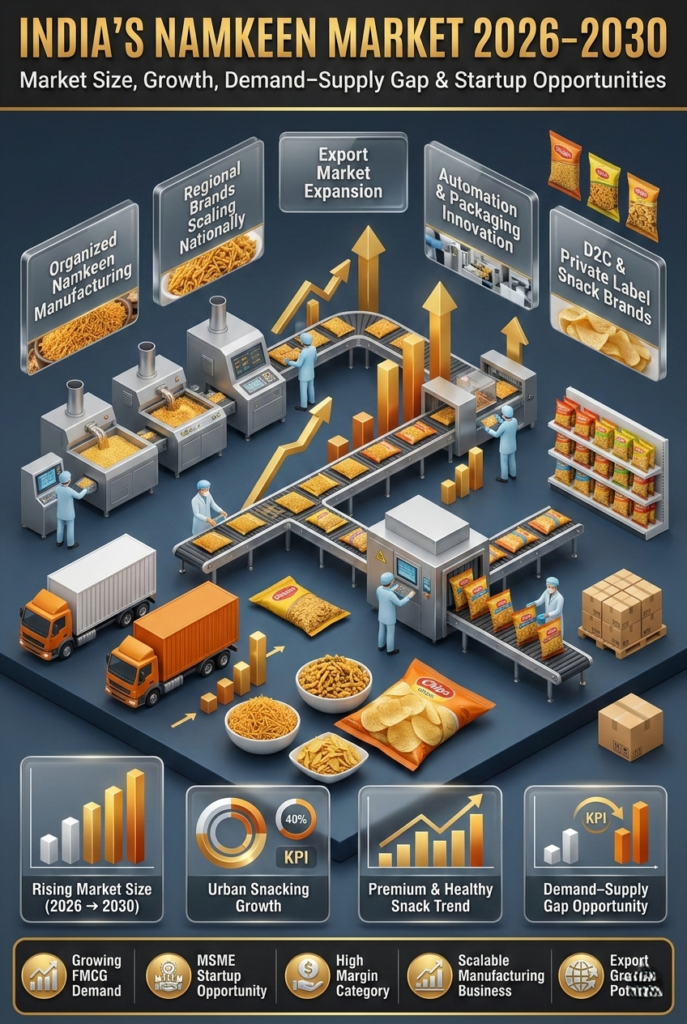
India’s namkeen industry has been a part of the daily consumption for a very long time with local preferences and regional food habits. For decades, unorganized players and small scale manufacturers dominated the market. Today, that picture is quickly changing. The Indian namkeen market will grow from 2025 until 2030 by almost USD 4.88 billion with a CAGR of approximately 10.2%. This growth indicates that consumers are shifting from traditional snacks to structured FMCG products which operate at scalable, standardized levels.
This transformation is being driven by changes in consumer behaviour, retail expansion, digital distribution as well as rising expectations around quality and food safety. The years from 2026 to 2030 will be particularly significant years since demand is still outpacing organized supply, which is providing excellent opportunities for startups and investors.
Read More: 55 Most Profitable Micro, Small, Medium Scale Food Processing (Processed Food) Projects and Agriculture Based Business Ideas for Startup
Namkeen Market Growth Outlook Indian
Namkeen remains the biggest contributor in ethnic snacks segment of India. However, the nature of growth is changing. Earlier, growth was mainly volume-led and price-driven in nature. Going forward, a significant portion of market expansion will be attributed to branded packaging, premium versions and increased geographical reach.
Significant features of the present growth stage are:
- Increasing consumption in Tier-II and Tier-III cities because of modern retail penetration
- Nearly all of the households preferred packaged and branded, instead of loose, products.
- Willingness among consumers to pay more for taste consistency, hygiene and shelf life
This shift is massively in favour of organized manufacturers with scalable production and standardized processes.
Structural Demand Drivers Driving the Market
One of the greatest influences on demand is lifestyle change. The daily life has transformed into essential snack consumption due to urban development and nuclear family structures and busy work routines. Namkeen fits easily into this pattern because it is known to the people and it is inexpensive.
Another major force is the sudden growth of the retail infrastructure. Supermarkets, hypermarkets, and wholesale chains are now common even in small cities so branded namkeen has a consistent presence on their shelves. At the same time, the rise of online grocery platforms and quick-commerce’s have made namkeen a high-frequency digital purchase.
From the standpoint of the consumer, three distinct preferences are emerging:
- Hygiene and food safety compliance
- Longer shelf life that is suitable for online delivery
- New Flavors and better for you snack options
These preferences are changing what products are successful in the market.(India Namkeen Market Growth)
Read More: From Seed to Success: A Startup’s Guide to Dominating India’s Vegetable Seed Market
Demand-Supply Gap: Where the Opportunity Is
Despite a strong demand, the supply is uneven. Large brands are the predominant owners of mass-market SKUs, but organized capacity is still limited in a number of fast-growing subsegments. The online market faces a shortage of premium namkeen products which focus on health and meet export standards.
The reason for this gap is that many manufacturers are still working with:
- Hindered by: – Limited automation and outdated frying technology
- Inconsistent quality control systems
- Poor compliance for multi-state or export distribution
The need for high-quality standardized namkeen products has increased at a pace that exceeds what the market can provide. This imbalance provides a healthy environment for new manufacturing units that were designed with modern technology and compliance from the first day.(India Namkeen Market Growth)
Read More: NAMKEEN (DALMOTTH, BHUJIA, CHANA CHUR, KHATTA MEETHA)- Manufacturing Plant, Detailed Project Report, Profile, Business Plan, Industry Trends, Market Research, Survey, Manufacturing Process, Machinery, Raw Materials, Feasibility Study
Competitive Landscape Leading Players in India
The organized market for namkeen is dominated by a few well-consoned companies that have developed trust with respect to scale and consistency. Haldiram’s name remains the best-known brand with very strong domestic coverage and an increasing export profile.
Balaji Wafers provides a good example of how a regional player can become a national force by efficient cost management and deep distribution. Bikaji Foods has been successful in its effort to blend traditional recipes with contemporary retail and institutional sales.
Other organized players like Bikanervala and Gopal Snacks are strengthening the ecosystem and accelerating the consolidation and the quality benchmarks across the industry.
Startup Opportunities – 2026 to 2030 Period
The greatest opportunities for startups are in places where consumer preferences are shifting at a faster pace than large brands can adapt. Health oriented namkeen is a prime example. Products that are baked and low fat or oil based or adulterated grains are gaining ground in urban consumers and have better margins.
Digital first brands are also becoming strong contenders. By zeroing in on e-commerce and quick commerce platforms, startups can:
- Reach customers across different states in a short period of time
- Reduce dependence on traditional distributor networks
- Test and refine products quicker based on real-time feedback
Export-oriented manufacturing is another area of growth. Indian namkeen enjoys increasing acceptance in the diaspora markets, and manufacturers who meet international food safety standards have the opportunity to tap into stable and premium-priced markets.
Read More: Project Reports & Profiles
Practical Information for Investors and Entrepreneurs
From an investment perspective, the namkeen sector has predictable demand and structural gaps. Manufacturing units with automation capabilities, good quality assurance and flexible product portfolio are in good shape to scale.
Key success factors include:
- Omnichannel (retail and online distribution)
- Clear differentiation in terms of health, flavour or regional positioning
- Investment in food safety, shelf life and packaging technology
These things directly affect brand trust and long-term profitability.
Read More: Top 4 Manufacturing Opportunities in Concrete Poles, Baby Food, Pasta and Coal Washery Units
Final Thought
India’s namkeen industry will undergo a major transition between 2026 and 2030 as it transforms from an unregulated food category into an established organized FMCG sector. Startups and investors in the food industry need to focus on building scalable businesses that meet consumer demands while maintaining legal compliance and establishing unique market positions.
The modern growth of a traditional snack product will benefit early adopters the most.(India Namkeen Market Growth)
Frequently Asked Questions (FAQs)
What is the growth in the Indian market of namkeen?
Growth is propelled by increasing incomes, lifestyle changes, expansion of modern retail and rapid adoption of online grocery and quick commerce platforms.
Is there any presence of unmet demands in the namkeen industry?
Yes. Premium, health-focused, export, and online exclusive segments of namkeen are under-supplied.
Can startups compete with established brands of Namkeen?
Yes. With differentiated focus, quality distribution of digital content, and quality-backed positioning, startups can successfully capture niche segments.
Why is e-commerce important for the brands of Namkeens?
The e-commerce channel grows rapidly because it provides companies with national distribution access while enabling them to launch products quickly at reduced distribution expenses.
Is Namkeen Manufacturing a good Investment Opportunity?
The strong demand for namkeen products together with existing supply deficiencies and export market possibilities make this industry an attractive investment opportunity.