India Ferroalloys Industry
Market Insight at a Glance
India’s ferroalloys industry accounts for one of the largest subsectors of the country’s metals and mining industry. The industry is valued at over USD 15 billion, which is forecast to grow by over USD 23 billion by 2035 and at a CAGR of 3.8%-5.8% across different product segments. India, having the second largest crude steel production capacity with the target of 300 million tonnes by 2030, is likely to go even further in the years to come and increase its consumption of ferroalloys (both bulk and noble) to a greater extent.
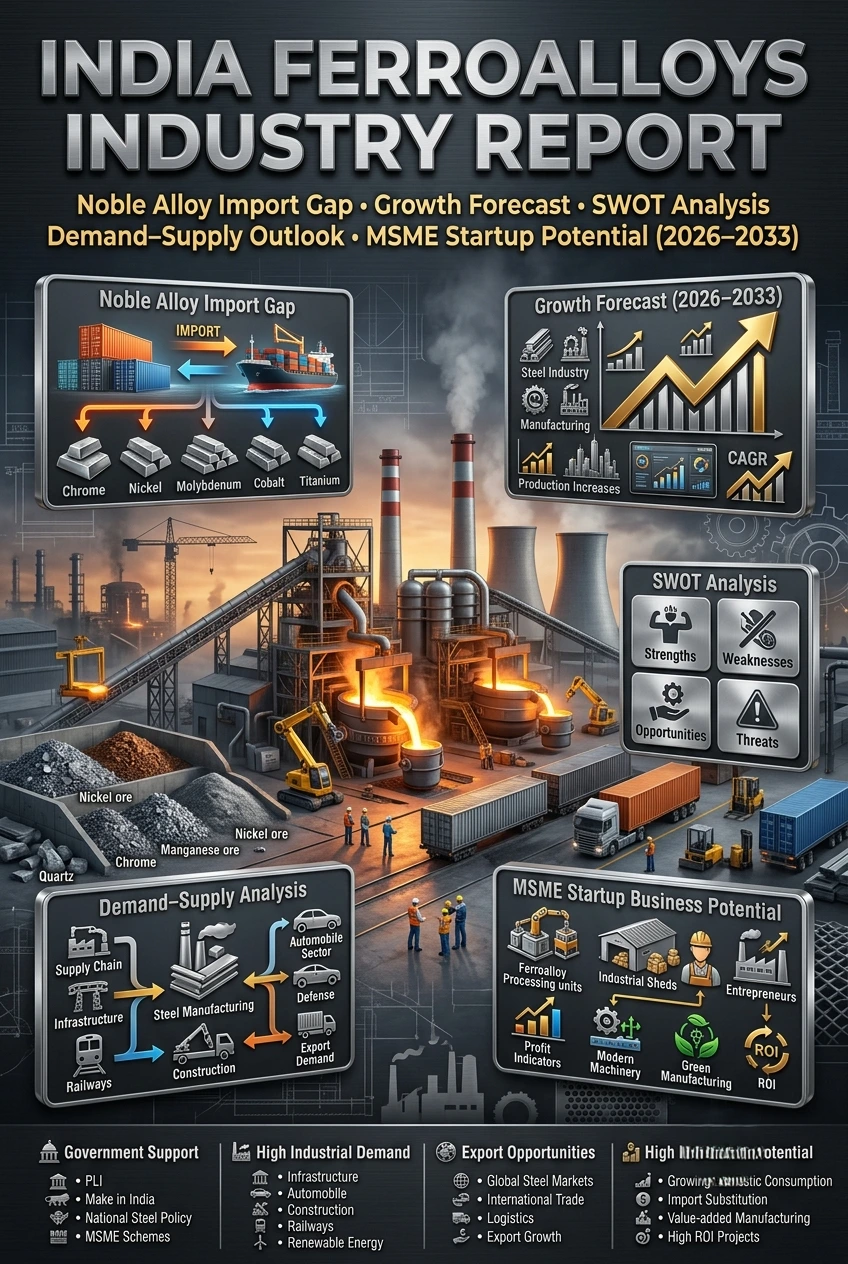
Demand–Supply Gap: India has substantial installed capacity to produce bulk ferroalloys (manganese and chrome alloys) but the segment of the production of noble ferroalloys (ferro vanadium, ferro molybdenum, ferro titanium and ferro tungsten) is extremely underdeveloped and domestic production is far less than the requirement for specialty steels. The installed capacity of the noble ferroalloy industry is only 50,000 tonnes per annum, whereas demand from defense, aerospace and automotive industry is increasing at a rapid pace for high performance steels. This gap thus keeps India highly import dependent and is certainly a desirable one for new comers.
Why Ferroalloys Are the Backbone of India’s Steel Ambition
Ferroalloys Ferroalloys, a class of iron-based master alloys that are made in the submerged arc furnaces, contain one or more elements like manganese, silicon, chromium, molybdenum, vanadium, tungsten, titanium, and others at various percentages and levels. Moreover, As a deoxidizing, desulfurizing and alloying element, the ferroalloys have played a crucial part in steel-making which impacts a lot on the final product like steel’s physical characteristics. Furthermore, without ferroalloys, the world could not produce high-tensile steel to support bridges, corrosion-resistant rebars to protect coastal structures, high-temperature steel for jet engine turbines, or stainless steel for surgical tools.
Currently, India is the 2nd largest crude steel producer in the world. Additionally, Steel Ministry is working on the capacity to touch 300 MT by the end of FY’31, based on National Steel Policy 2017. As of FY 2025-26, the total steel capacity of India was already at around 220 million tonnes per annum, with a notable increase in crude steel production of 14.09 million tonnes in April 2026 alone, which is 5.8% higher than the previous year. Therefore, A calibrated combination of ferroalloys is needed for each incremental tonne of steel. This elevates the ferroalloy industry, from an ancillary to a structural component, at the core of the Indian industrial growth.
Meanwhile, Since 1961, the Indian Ferro Alloy Producers’ Association (IFAPA) has been representing and guiding the Indian ferroalloy industry, comprising more than 85 member companies as the policy interface between the industry and Government of India. Furthermore, There are a number of ways in which one needs to carefully dissect the production data, trade flows, regional concentration and the new application trends which are changing the demand landscape, to gain a clear understanding of the sector both from a supply chain and an investment perspective.
Get Detailed Insights from This Book: The Complete Book on Ferroalloys
Market Size and Growth Trajectory: 2026–2033
The Indian ferroalloys market is estimated to be worth USD 15–16 billion. Furthermore, It is expected to grow steadily through 2033. Additionally, Several factors are driving this growth. For instance, The government plans major infrastructure investments through PM Gati Shakti and the National Infrastructure Pipeline. Moreover, Automotive production is also increasing. In addition, The Production Linked Incentive (PLI) scheme supports specialty steel manufacturing. In addition, rising urbanisation in Tier-2 and Tier-3 cities is increasing per capita steel demand.(India Ferroalloys Industry
Overall, The overall Ferroalloys market is witnessing positive growth. Meanwhile, investments in decarbonization technologies and growing demand for high-quality steel from electric vehicle (EV) manufacturers, renewable energy equipment producers, and defense procurement programs worldwide will drive the global electric arc furnace (EAF) market, which is expected to exceed USD 150 billion and grow at a CAGR of approximately 5.6% through 2035. Therefore, India can leverage its rich raw material base and cost-effective manufacturing to capture a larger share of the global value chain.
| Ferroalloy Type | Primary Use | India’s Installed Capacity | Key Challenge |
| Ferro Manganese | Deoxidation, structural steel | ~2.1 million TPA (bulk) | High-grade ore import dependency |
| Silico Manganese | Carbon and alloy steel | Part of 5.1 million TPA (bulk) | Power cost competitiveness |
| Ferro Chrome | Stainless steel production | ~1.3 million TPA (bulk) | Chrome ore quality variability |
| Ferro Silicon | Structural steel, deoxidation | Part of bulk capacity | Increasing import pressure |
| Noble Alloys (FeMo, FeV, FeW, FeTi) | Specialty, alloy & defense steel | ~50,000 TPA | Severe capacity shortfall |
The total installed capacity of the bulk ferroalloy industry in India has been estimated at 5.10 million tonnes per annum and the capacity of the noble ferroalloy industry is limited to 50,000 tonnes per annum as per the IFAPA data on noble ferroalloy. This imbalance between the two categories is the story of opportunity that is the focal point of this market analysis.
Production and Consumption: The Real Story Behind the Numbers
India produced an estimated 5.2 million metric tonnes (MT) of ferroalloys in FY 2023–24. Manganese alloys—including ferromanganese and silicomanganese—accounted for 3.5 million metric tonnes of this total, making India the world’s largest exporter of manganese alloys. Additionally, India was the third largest exporter of ferrochrome in the world with 1.50 lakh MT of chrome alloy production.
However, The headline production figures, however, hide a structural imbalance. Nearly half of all ferroalloys produced in India are exported instead of being consumed locally. During the same fiscal year, India exported around 1.8 million metric tonnes of manganese alloys. Furthermore, It also exported approximately 0.75 million metric tonnes of chrome alloys. As a result, This export-oriented structure exists alongside a growing reliance on imports. Moreover, The dependence is particularly high for noble ferroalloys and raw materials used to produce bulk ferroalloys.(India Ferroalloys Industry)
Meanwhile, Industry capacity utilisation for manganese and chrome alloys is around 65% due to high power tariffs in the country. In addition, The cost of power represents 35–40% of total cost of ferroalloy production, and price of electricity in India is far higher than in other competitive geographies like South Africa, Kazakhstan, and China where ferrochrome and silico manganese are also major exporters to international markets, including India.
Get Detailed Project Report (DPR): Ferro Alloys Industry Projects Guide
Demand–Supply Gap Analysis: Where the Real Opportunity Lies
The demand-supply gap in India’s ferroalloy industry is uneven. Specific product categories experience different levels of shortages or surpluses, while regional variations further influence market conditions. The gap also differs significantly between bulk ferroalloys and noble ferroalloys.
In the case of bulk ferroalloys, the competition is one of availability of raw materials rather than one of capacity. India has rich deposits of manganese and chromite but the production of high-grade manganese ore in the country is inadequate to satisfy the all the demands of the alloy industry.
The limited availability of high-grade manganese ore forces producers to rely on imports, while the 2.5% customs duty on imported manganese ore reduces the cost competitiveness of Indian exporters in the international market, according to IFAPA chairman Manish Sarda’s public statement.
The gap is deeper for noble ferroalloy products, as at the very least, there is a low manufacturing capacity in the domestic market. India currently has an installed noble ferroalloy capacity of only 50,000 tonnes per annum, while the specialty steel industry is rapidly expanding under the PLI Scheme for Specialty Steel. The government has approved 54 applications from 26 companies and aims to add 26 million tonnes of specialty steel capacity with an investment outlay of ₹10,000 crore. 30,000 crores of investment). Ferro Vanadium, Ferro Molybdenum, Ferro Titanium, and Ferro Tungsten are virtually all imported, from China and Central Asian countries as well as Europe.
The case of ferro silicon is especially illustrative. IFAPA’s 2026 conference programme highlighted a separate session on “depleting domestic production and dependence on imports,” underlining the fact that ferro silicon, once a surplus product, is now becoming a ‘shortfall’ in Indian silicon manganese production.(India Ferroalloys Industry)
Ferroalloy trade figures are collected by Directorate General of Commercial Intelligence and Statistics (DGCI&S) in the Ministry of Commerce for HS Code 7202. India has been increasing its imports of ferroalloy and China has become the largest importer for most of the ferroalloy subcategories. In one reporting year, India imported about USD 94 million worth of Ferro Alloy, mainly from China, but in some product, categories import from Malaysia, Zambia and Bhutan is also quite significant.
SWOT Analysis of India’s Ferroalloys Sector
Strengths
- Exports the most manganese alloys in the world
- Top third largest exporter of ferrochrome in the world
- Total installed bulk capacity of 5.1 million TPA
- There are good amounts of chromite and manganese in Odisha, Maharashtra and Madhya Pradesh.
- Existing industry organisation (IFAPA) that offers policy interface
- Rapid growth of domestic demand for steel (captive demand)
Weaknesses
- Distortionary high-power tariffs (35-40% of production cost) affect competitiveness across the world
- In the ferroalloy industry, the capacity utilisation rate is only ~65% for bulk ferroalloys.
- The capacity of noble ferroalloy is not in good condition, and only about 50,000TPA.
- The high-grade manganese ore is imported.
- Geographic focus of plants in 8–9 states does result in supply chain risk.
- The production process of Ferro silicon is carried out under the structural pressure.
Opportunities
- The 300 MT iron and steel production target of the Government of India by 2030 will significantly boost the demand for ferroalloy. The scheme used for driving noble alloy requirements for specialty steel is called PLI scheme.
- he growing EV and aerospace markets driving premium alloy demand.
- The CBAM exposure of China is opening the gate for Indian producers.
- The greenfield opportunity of producing noble ferroalloy is almost unrivalled and is a space where MSMEs can thrive.
- Indian government’s push on import substitution through Make in India and Atmanirbhar Bharat is welcomed.
Threats
- Overcapacity in China is driving down global ferroalloy prices.
- The EU Carbon Border Adjustment Mechanism (CBAM) has been introduced to impact export margins.
- Volatility of commodity prices of manganese and chrome ore in the world market\
- Competition from South Africa, Kazakhstan in ferrochrome and silico manganese
- Mineral inputs include raw materials, such as nickel, molybdenum and vanadium, where security issues exist in the raw material supply chain.
By Application: Where Ferroalloys Are Consumed in India
In India, ferroalloy demand mainly comes from the steel industry. Moreover, The steel sector accounts for more than 50% of total ferroalloy consumption. Stainless steel production uses the largest share of ferrochrome. Furthermore, Steel production also consumes significant quantities of manganese alloys and ferrosilicon. Additionally, The construction industry is India’s largest consumer of finished steel. Therefore, it indirectly drives demand for ferroalloys. The automotive, rail, and defence sectors also support ferroalloy demand.
Furthermore, The construction and infrastructure application is expected to continue to be the major growth segment till 2033. India’s capital expenditure on road, rail, ports and urban infrastructure has surpassed Rs. in the National Infrastructure Pipeline and PM Gati Shakti scheme. At the same time, the central government alone spends ₹11 lakh crore annually, while state governments also invest substantial amounts in infrastructure and development. As a result, This directly affects the demand for TMT bars, structural steel and plates, all of which are dependent on the inputs from manganese alloys and ferro silicon.(India Ferroalloys Industry)
Meanwhile, The automotive and transportation segment is the fastest-growing application category with an estimated market value of USD 1.5 billion in India. In addition, The automotive industry is expanding rapidly, especially with the growing adoption of electric vehicles, which will drive a higher demand for specialty ferroalloys, such as ferro vanadium (high strength low alloy steel) and ferro molybdenum (heat resistant grades) and ferro titanium (grain refining) compared to the overall market growth. Similarly, The construction industry will be around USD 4.9 billion by 2035.
Moreover, The electronics and electrical equipment business, which currently generates USD 2.0 billion, will increase to USD 3.1 billion through 2035. India’s semiconductor ambitions, investments in power transmission infrastructure, and the rapid growth in transformer and switchgear production are key factors behind this increase. Additionally, Ferro silicon and silicon manganese are key components of electrical grade steel, which manufacturers use in transformer laminations. Therefore, This application segment will see a sharp rise in demand as India expands its renewable energy generation capacity to achieve the 500 GW non-fossil power target.
Finally, The noble ferroalloy consumption for defense and aerospace applications is currently relatively small in volume but has the highest value per tonne. Furthermore, The push on indigenisation under Make in India and the Atmanirbhar Bharat Defense Production Policy is generating long-term demand for specialty alloy steels which are virtually fully dependent on imported noble ferroalloys. Therefore, This is definitely one of the most critical missing links in the Indian Ferro Alloys value chain.(India Ferroalloys Industry)
Choose the right startup backed by real market demand
By Region: The Geography of India’s Ferroalloy Production
India’s ferroalloy production mainly takes place in mineral-rich eastern and central Indian states, shaping the geographical distribution of the industry. Odisha dominates the chrome ore sector with its Sukinda deposits, which rank as the second-largest chrome ore reserve in the world, along with several major ferrochrome and ferromanganese plants. The state is the base of operation of FACOR, Tata Steel FAMD and some medium size producers.
Andhra Pradesh, especially the Vizianagaram belt, has a long history of ferroalloy manufacturing. FACOR established its first base there in 1956. Submerged arc furnace capacity is also available in West Bengal, Chhattisgarh, Jharkhand, Karnataka, Maharashtra, and Madhya Pradesh. These locations benefit from access to coal, ore, and reliable industrial power.
The development of ferroalloy industry in the North-Eastern region is an emerging one. A few entrepreneurs have set up small-scale ferro silicon and ferro silico manganese units in Meghalaya, leveraging the state’s mineral resources and attractive government policies for industrial development in the North-East. This emerging trend is spreading across the country, and experts will monitor it as PM Gati Shakti strengthens logistics infrastructure in the North-East.
| State/Region | Primary Products | Key Advantage |
| Odisha | Ferrochrome, Ferro Manganese | Sukinda chromite deposits; FACOR & Tata Steel presence |
| Andhra Pradesh | Ferro Manganese, Silico Manganese | Historical industry base; port proximity |
| West Bengal | Manganese Alloys, Ferro Silicon | Coal access; port logistics via Kolkata |
| Chhattisgarh & Jharkhand | Bulk Ferroalloys | Iron ore and manganese ore proximity |
| Maharashtra | Ferro Chrome, Manganese Alloys | FACOR’s Nagpur base; industrial ecosystem |
| Meghalaya (North-East) | Ferro Silicon, Silico Manganese | Emerging hub; government incentives |
Import–Export Trade Dynamics: A Structural Reading
India’s Ferro Alloy trade history could be divided into two parts. India has a structural export deficit of around 2.6 million metric tonnes in bulk ferroalloys, about 49% ofthe total production, which includes manganese alloys and ferrochrome. The main export destinations are South Korea, Japan, China, the Netherlands, Germany and the USA. The value of Indian ferro alloy exports to U.S. alone was about USD 122 million, which indicates the increasing demand for Indian alloys by EAF steel producers in the U.S.
For noble ferroalloys, the trade is the other way round. India is virtually dependent on China, Europe and mineral rich economies for ferro vanadium, ferro molybdenum, ferro tungsten and ferro niobium imports. The ferroalloy import unit price has fluctuated, with the import price averaging per tonne of ferroalloy showing large swings year on year, due to the fluctuations of commodity prices globally and the influence of the Chinese production decisions and the price of energy in countries of import.(India Ferroalloys Industry)
Even though India was traditionally self-sufficient, the import basket of Ferro Silicon has also been increasing. This “ferro silicon — depleting production and increasing reliance on imports” has been identified as a structural concern in the own sessions of IFAPA. The increased domestic power cost is behind the increasing cost competitiveness of Indian ferro silicon producers over the lower cost imports from China, Norway and Brazil.
The import bills of ferro alloys have been on the rise year-on-year despite the scale of production in India, according to trade data from the Ministry of Commerce and Industry. The Herfindahl-Hirschman Index shows that India’s ferroalloy import market has a concentrated structure, with China, Bhutan, Malaysia, and Zambia serving as the key import sources. This dependence highlights potential geopolitical and supply chain risks for India’s ferroalloy imports.(India Ferroalloys Industry)
Major Indian Players in the Ferroalloys Sector
In India, a small number of major producers and about 135 companies support the organized ferroalloy industry. These companies operate 256 submerged arc furnaces across the country’s ferroalloy belt. The organized players with the biggest impact on the competitive landscape in the sector are the following:
Tata Steel — Ferro Alloys & Minerals Division (FAMD): Tata Steel’s FAMD is one of the most advanced ferroalloy business operations in India and has an integrated business, ranging from chromite mining in Sukinda Village of Odisha’s Kalahatta valley to Ferrochrome smelting, to developing value added products. The division aims to generate 70–80% of its sales from value-added ferroalloy products, including specialty ferrochrome derivatives. This strategy signals a shift toward higher-value products and will increase future demand for noble alloy inputs while encouraging domestic partnerships in noble alloy production.
Ferro Alloys Corporation Limited (FACOR): A name synonymous with history and credibility, FACOR is India’s oldest and most reputed Ferro Alloy manufacturer, founded in 1955-56, and holding significant strategic value. The company has diversified to produce Ferrochrome, Ferromanganese and Silico Chrome with a manufacturing plant in Andhra Pradesh and Odisha, starting with the production of Ferromanganese at Garividi in Andhra Pradesh. FACOR’s 100MW captive power plant in Bhadrak, Odisha is a direct solution to the industry’s persistent problem of power costs, partially protecting it from the volatility of power tariffs from the grid.
Maithan Alloys Limited (MAL): It is one of the largest listed companies in the domestic ferroalloy business and is known to be one of the largest domestic producers of manganese-based ferroalloys with over 5% market share in the entire domestic ferroalloy industry. The company manufactures all three types of bulk ferroalloys namely ferro manganese, silico manganese and ferro silicon and has a captive wind power plant for managing energy cost. The company has a history of exporting, and it serves as a model for the achievement of cost competitiveness by organized Indian medium scale ferroalloy producers by adopting energy management and operational efficiency.(India Ferroalloys Industry)
Other important organized manganese alloy producers and bulk ferroalloy makers in central India include Sarda Energy & Minerals Limited and C.B. Jindal Group. Steel Authority of India Limited (SAIL) has ferroalloy plants that have captive plants to manufacture manganese and silicon alloys for its own consumption in the integrated steel plants—so it is a big but possibly unnoticed contributor to domestic consumption.
Related Article:Top Ferro Alloys Industry Consultants in India: A Complete Guide for Entrepreneurs
Startup and MSME Opportunity: The Import Substitution Play
The noble ferroalloys sub-segment offers strong opportunities for first-generation entrepreneurs and MSME investors. It also presents a major import-substitution opportunity in India’s metallurgy ecosystem.
Demand is rising due to the PLI Scheme for specialty steel, defence indigenisation initiatives, and the automotive industry’s need for high-strength steel grades. However, India’s domestic noble ferroalloy capacity remains limited at around 50,000 TPA. This capacity is insufficient to meet the growing demand.(India Ferroalloys Industry
This business case is structured in four structural pillars. First, demand is captive and growing. In India, specialty steel producers require ferro vanadium, ferro molybdenum, and ferro titanium as essential functional ingredients. Global price fluctuations have little effect on this demand because manufacturers cannot replace these materials in certain steel grades. Second, supply chain risks exist for the import options, China is the dominant supplier of several noble alloys, and geopolitical disruptions or export restrictions by China (as experienced in the rare earth and strategic minerals sector) provide powerful incentives for domestic sourcing.
Third, government provides supportive policy architecture, Ministry of MSME the Government of India has launched schemes such as credit-linked capital subsidy, collateral-free credit under CGTMSE scheme and priority sector lending can help in reducing the capital cost in establishing a noble ferroalloy manufacturing unit. Fourth, MSMEs can set up these plants at a relatively low capital cost compared with bulk ferroalloy production facilities, which often require investments of several hundred crore rupees. Small-scale plants can also produce noble ferroalloys, such as ferrovanadium and ferromolybdenum, using the thermite reduction method.(India Ferroalloys Industry)
In addition to noble alloys, the market is emerging for new small-scale plants for making ferro silicon in geographies which do not have the same power cost pressures, in particular states where captive power sources, such as solar or small hydro, can lower the power cost burden for the producer. Startups in this space are recognised, given tax holiday benefits and regulatory fast-track benefits through Startup India portal.
Ferroalloy scrap recycling and secondary production offer promising business opportunities. Manufacturers can recover valuable alloying elements from specialty steel scrap, EAF dust, and smelting by-products. The development of India’s steel recycling ecosystem will support this opportunity. It can also make secondary ferroalloy production economically viable for MSMEs. The Ministry of Steel introduced the Steel Scrap Recycling Policy to strengthen this ecosystem. The policy supports the recovery of valuable elements, including silicon and manganese.
Entrepreneurs can obtain a techno-economic view and also the process selection and environmental clearances for green field ferroalloy plants through environmental clearance documents available at the ministry of environment, forest and climate change (MoEFCC) that publishes pre-feasibility reports for proposed ferroalloy plants.
A research paper published through ResearchGate on manganese, chrome ore and ferro-alloys in India underscores the long-term structural demand growth for ferroalloys as India’s steel industry expands, noting that the country’s significant chromite and manganese reserves hold untapped potential even as import dependence grows for high-grade ores — a clear signal for investors in beneficiation and value-added processing.(India Ferroalloys Industry)
Policy Landscape and Government Drivers
The ferroalloy industry is one of several priority government initiatives. Under the Ministry of Steel, the National Steel Policy 2017 has laid down the framework of demand (300 MT of steel capacity by 2030-31 and per capita steel consumption of 160 kg) with huge headroom for steel demand growth and consequently for growth of ferroalloy demand.
The PLI scheme for specialty steel, approved by the Union Cabinet with an overall incentive outlay of Rs. Indirectly stimulates noble ferroalloy demand through a total of 6,322 crore and 54 approved applications from 26 companies. Specialty steel producers use high-purity noble ferroalloys for electrical, bearing, high-strength structural, and tool steel grades to achieve precisely controlled alloy additions. When domestic specialty steel production starts to pick up, the demand for domestic noble ferroalloys will become both economically and strategically very attractive.
Under the Make in India scheme, under the Department for Promotion of Industry and Internal Trade (DPIIT), the metals and mining sector is one of the focus ones. The production of Ferroalloy from the country, especially for substitution of noble alloys, is directly related to the Atmanirbhar Bharat policy of limiting single-source supply of strategic materials for industries.
On 1 April 2025, the Government of India updated its policy on Domestically Manufactured Iron & Steel Products (DMISP). The update further emphasized local sourcing in government procurement. It may also increase demand for domestically produced ferroalloys. By supporting demand for iron and steel, the policy could indirectly create a demand floor for ferroalloys.(India Ferroalloys Industry)
Outlook 2026–2033: The Industry in Transition
The Indian Ferroalloy industry is set to undergo three significant changes within the next seven years. Firstly, The first is the capacity transition as India is moving towards achieving its goal of 300 MT within steel sector, the consumption of ferroalloy should grow on a proportional basis, which means there should be a significant increase in the production capacity of bulk ferroalloy as well as a step-change increase in the production capacity of noble ferroalloy. Secondly, The second trend is the transition toward sustainability. The EU’s Carbon Border Adjustment Mechanism (CBAM) will fully take effect over the next few years. It will introduce carbon pricing for Indian ferroalloy and steel imports to Europe. This change will encourage investments in cleaner smelting technologies, renewable energy-powered furnaces, and low-carbon production methods.
The third transition involves changes in the ferroalloy product mix. Demand will shift from commodity-grade manganese alloys to higher-value noble and specialty ferroalloys. This shift will occur as the steel industry moves up the value chain under the PLI framework.
According to the World Steel Association’s Short-Range Outlook released in April 2026, India will increase its steel demand by 7.4% and 9.2% over the next two years. This is the highest growth rate among major steel-consuming economies. Rising steel demand will directly increase ferroalloy procurement by major steel companies across India. As a result, investment opportunities in the ferroalloy industry are likely to become more attractive.(India Ferroalloys Industry)
About NPCS: Your Industrial Feasibility Partner
Niir Project Consultancy Services (NPCS) provides professional consulting services for entrepreneurs, MSMEs, and industrial investors evaluating new manufacturing ventures — including detailed techno-economic feasibility assessments for ferroalloy projects across the value spectrum. Our Market Survey cum Detailed Techno-Economic Feasibility Reports (DPRs) for ferroalloy projects typically include:
- Detailed manufacturing process descriptions for bulk and noble ferroalloy production
- Market research and demand-supply analysis aligned with current steel industry dynamics
- Process Flow Diagrams (PFD/BFD) for submerged arc furnace and thermite reduction routes
- Product mix recommendations and capacity planning at MSME and large-scale levels
- Machinery specifications and raw material sourcing strategies
- Import–export dependency analysis with trade data and substitution opportunity mapping
- Project financials: capital cost estimates, working capital assessment, profitability projections, and IRR/NPV evaluation
Our objective is to support entrepreneurs in evaluating the technical feasibility, financial viability, market demand, and scalability potential of new ferroalloy manufacturing projects — from greenfield noble alloy units to expansion of existing manganese or chromealloy capacity.To explore project profiles and connect with our consulting team, visit www.niir.org.
Frequently Asked Questions (FAQ)
Q1. What are the main types of ferroalloys produced in India, and which ones are import-dependent?
India produces bulk ferroalloys such as ferromanganese, silicomanganese, ferrochrome, and ferrosilicon on a significant scale. The country has an installed bulk ferroalloy capacity of 5.1 million tonnes per annum. In contrast, noble ferroalloys are produced in limited quantities. These include ferrovanadium, ferromolybdenum, ferrotungsten, ferrotitanium, and ferroboron. Their combined installed capacity is only 50,000 TPA. As a result, India relies heavily on imports, mainly from China and European suppliers.
Q2. What is driving the growth of India’s ferroalloy market through 2033?
India’s steel expansion plans are the primary growth driver. The National Steel Policy targets 300 million tonnes of steel-making capacity by 2030–31. Current capacity is approximately 220 million tonnes.
Other growth drivers include the PLI Scheme for Specialty Steel and government infrastructure spending under the National Infrastructure Pipeline. Demand for high-performance steel grades is also increasing in the automotive and defense sectors. In addition, electric vehicle manufacturing requires strong and lightweight steel components.
Q3. Why is capacity utilization in India’s ferroalloy industry only around 65%?
The primary constraint is the high cost of electricity in India. Power costs account for 35–40% of total ferroalloy production costs. India’s industrial electricity tariffs are higher than those in competing countries, including South Africa, Kazakhstan, and China. This cost disadvantage reduces margins on exports and disincentivizes full-capacity operations, particularly during periods of depressed global alloy prices.
Q4. What is the most attractive startup opportunity in the Indian ferroalloy sector for MSMEs?
Noble ferroalloy manufacturing presents the clearest and most differentiated opportunity for new entrants. Domestic capacity is only 50,000 TPA, while demand for specialty steel is growing rapidly. This creates a large and persistent import substitution gap. MSMEs can produce ferro vanadium and ferro molybdenum using the thermite reduction route. These projects require manageable capital investment. The Ministry of MSME supports such ventures through credit schemes, Startup India tax benefits, and priority sector lending.
Q5. How will the EU Carbon Border Adjustment Mechanism (CBAM) impact Indian ferroalloy exports?
CBAM will impose a carbon pricing charge on Indian ferroalloy and steel exports to EU markets based on the embedded carbon intensity of the production process. Indian producers relying on coal-fired power for furnace operations will face additional costs when exporting to Europe. This makes it imperative to invest in captive renewable power (like what Maithan Alloys has done in wind power), energy-efficient smelting, and green production routes. Those who lead in the greening race today, will secure a lasting competitive advantage in the EU.
Q6. Which states in India offer the best locational advantage for setting up a new ferroalloy plant?
Odisha leads in ferrochrome and ferromanganese production. The state benefits from abundant chromite resources in Sukinda and established industrial facilities. Andhra Pradesh, Maharashtra, and Chhattisgarh offer location advantages for manganese alloy production. These states provide access to ore sources and reliable industrial power.
Noble ferroalloy production requires less raw material but involves more complex processes. Gujarat, Rajasthan, and some Northeastern states offer strong potential in this segment. Their renewable energy resources and MSME incentives can provide competitive advantages.