
Why Industrial Gases Matter to India’s Industrial Economy
Oxygen, nitrogen, hydrogen, argon, carbon dioxide, acetylene, helium and other specialty blends are the unseen fuel that drives modern industrial manufacturing. They are essential to the operation of steel furnaces that produce steel in Basic Oxygen Furnace (BOF) or Electric Arc Furnace (EAF); to the sterility of pharmaceutical clean rooms; to the deposition of atomic layers with the precision needed for semiconductors; and to the extension of food shelf life through Modified Atmosphere Packaging (MAP) methods. In all important respects they are as essential to the production of industry as electricity or water.
Especially for India, the stakes are high. It’s also the second biggest steel producer and the third biggest pharmaceutical manufacturer in the world, and is one of the fastest growing electronics markets. The consumption of industrial gas in each of these sectors is huge. With growth in most manufacturing sectors due to the upcoming manufacturing decade, industrial gases demand is structurally growing beyond domestic industrial gases manufacturing capacity for years to come, with various Production Linked Incentive (PLI) schemes being extended to 14 sectors in the country, the National Green Hydrogen Mission mobilizing nearly ₹19,744 crore of investments and the India Semiconductor Mission attracting global investments in chip manufacturing.
Explore This Book: The Complete Book on Industrial Gases
The India Gas Market Report by IEA estimates that India has passed its ‘tipping point’ in gas consumption and is set to see significant growth over the next decade, led by industrial demand, which will make up 40% of total natural gas demand growth. This path directly feeds into the industrial gas theme, where a significant number of industrial gas consuming processes rely on feedstock gases supplied and utilized in conjunction with the natural gas supply chain.
The industrial gas market offers entrepreneurs and MSMEs an attractive mix of predictable demand for their gas products, alignment of government incentives, and clearly identified gaps in domestic supply. This report focuses on that opportunity in a systematic way.
India Industrial Gas Market: Size, Scope & Forecast 2026–2033
Indian industrial gas market is a multi-billion-dollar market with an established growth trajectory. The size estimates provided in this research are absolute and vary among methodologies and scope definitions, but all credible industry analysts agree that the market is growing at a CAGR between 5.76% and 6.83% from 2026 to 2033, based not on cyclical economics, but on structural demand from end-user industries.
The primary application is in manufacturing, which accounts for more than a third of the domestic market. Steel production is the primary demand anchor – oxygen is used in quantity to make steel in the BOF and EAF furnace, and nitrogen is used for blanketing and inerting, and argon is used for high specification weld quality in steel fabrication. The gas demand of the steel sector alone is a multi-hundred-thousand tonne per day demand base as India aims to reach the national target of 300 million tonnes of steel production per year as per the Ministry of Steel.
Under the National Steel Policy, Government of India, the Ministry of Steel had identified the industrial gases industry as a critical input industry, and declared that without adequate industrial gas infrastructure, there will be a systemic production bottleneck in steel capacity development.
Healthcare is the second largest and fastest growing demand segment. The scale up of the Indian public health infrastructure by establishing Ayushman Arogya Mandirs (AAMs) and adding hospital beds under the National Health Mission (NHM) has led to an extended demand for medical grade oxygen and nitrous oxide across geographies which were previously poorly serviced. Tier-2 and Tier-3 cities, especially, are a distribution gap which can be beneficially catered by private MSME scale oxygen filling stations and small air separation units.
Access Complete Business Plan: Industrial Gases Projects
The biggest demand vector with the highest growth rate is in the electronics and semiconductor fabrication sector. The India Semicon Mission with its focus on bringing in foreign chip makers like Micron Technology, Tata Electronics and CG Power-RENESAS will need ultra-high purity nitrogen (99.9999%+), argon, helium, and various process gases in large quantities that domestic suppliers are not well suited to supply. This presents a particular and imminent need for speciality gas blending units capable of delivering semiconductor grade purity.
Application Segment Analysis
| Application Sector | Key Gases | Market Share | Driver Insight |
| Steel & Metallurgy | Oxygen, Nitrogen, Argon | ~35% | Largest end-use; EAF/BOF steelmaking |
| Healthcare & Medical | Medical Oxygen, Nitrous Oxide | ~20% | Hospital infrastructure expansion |
| Food & Beverage | CO₂, Nitrogen, N₂O | ~12% | MAP packaging, carbonation, cooling |
| Chemicals & Refining | Hydrogen, Oxygen, Syngas | ~11% | Hydrotreating, ammonia, methanol |
| Electronics & Semicon. | Ultra-High Purity N₂, Ar, He | ~9% | India Semiconductor Mission push |
| Pharma & Biotech | N₂, CO₂, Medical O₂ | ~7% | PLI pharma scheme beneficiary |
| Others (Welding, Glass) | Acetylene, CO₂, Ar | ~6% | MSMEs; distributed demand |
Source: Compiled from industry research across multiple market intelligence firms; percentages are indicative and reflect consensus-range estimates.
SWOT Analysis: India Industrial Gas Sector
| STRENGTHS | WEAKNESSES |
| • Rapidly expanding steel, pharma & electronics base • Established air separation infrastructure in metro hubs • Growing on-site gas generation capacity • Strong multinational presence with technology transfer | • Infrastructure gaps in Tier-2 and Tier-3 industrial zones • High energy dependency for cryogenic operations • Limited domestic specialty gas manufacturing • Fragmented distribution chain in smaller markets |
| OPPORTUNITIES | THREATS |
| • National Green Hydrogen Mission (₹19,744 crore outlay) • PLI schemes for electrolyser manufacturing • Semiconductor & EV supply chain gases demand • Rural healthcare oxygen infrastructure expansion | • Global LNG price volatility impacting feedstock • Dominance of 4–5 multinationals limiting MSME space • Geopolitical supply chain disruptions • Power tariff hikes escalating production cost |
The SWOT picture for India’s industrial gas sector is broadly positive for new entrants who approach the market with a focused strategy. The key insight is that the strengths and opportunities significantly outweigh the weaknesses and threats for projects that are geographically well-positioned, targeting underserved application niches, and structured to access government incentive frameworks.
Demand–Supply Gap: The Core Investment Thesis
The most significant factor that makes new industrial gas manufacturing investments exciting in India is the widening structural demand-supply imbalance in various gas types and geographies. This gap is seen at three levels:
1. Specialty Gas Import Dependency
India has to import almost all its requirements for specialty and ultra-high-purity gas. Semiconductor grade neon, krypton, xenon, ultra-high-purity helium (UHP) and calibration gases for analytical instruments are obtained virtually exclusively from the U.S., Germany, Taiwan, and China. This dependence compounded in the Russia-Ukraine conflict, as the price of neon, a key component, increased more than 500% globally, putting a temporary strain on semiconductor manufacturing supply chains around the world. Neon gas is not available in India.
Specialty gas production for the domestic electronics, defence and pharmaceutical markets is an opportunity with virtually no competition and high margins for entrepreneurs, who have access to air separation technology and knowledge of gas chromatography or cryogenic purification, and have a captive market with no other choice but to import.
2. Geographic Distribution Gaps
Most of the industrial gases production capacity in India is available in the following industrial corridors: Hazira – Surat in Gujarat, where INOX Air Products has a 7,900 metric tonne per day complex for ArcelorMittal Nippon Steel; Pune – Nashik – Mumbai in Maharashtra; Chennai – Hosur – Bengaluru in electronics corridor; and Durgapur – Rourkela in Eastern India.
The bulk of the country, including the majority of Uttar Pradesh, Rajasthan, Madhya Pradesh, Chhattisgarh and the North-East, rely on long-distance cylinder transport or merchants’ liquid cylinder supply. If the gas is a medical oxygen or a food grade CO₂, transport over a distance more than 400 km would be not economically feasible compared to local production. Modular (50-200 tonnes per day) Pressure Swing Adsorption (PSA) plants can be economically viable for a group of hospitals, metal workshops, and food processing facilities within a 100 km radius with no proven local oxygen supply in the markets.
3. Green Hydrogen Production Deficit
The National Green Hydrogen Mission aims to achieve the target of 5 million metric tonnes of green hydrogen production annually by 2030 in India. At mid-2026, the commissioned green hydrogen capacity was around 0.3 MTPA, quite a small percentage of the targeted capacity. The SIGHT (Strategic Interventions for Green Hydrogen Transition) programme, with an investment of ₹17,490 crore, directly incentivises the manufacturing of electrolyser, as well as green hydrogen production. The opportunity is the gap: For every tonne of green hydrogen that India imports, a tonne of domestic production can take its place.
Related Article: Green Hydrogen, Methanol & Syngas Manufacturing Business in India: Investment, Government Schemes & Profit Guide
Major Indian Players: Competitive Landscape
The Indian industrial gas market is highly concentrated, with a small number of major players dominating the market. These companies have established technology partnerships with global gas majors and maintain strong customer relationships and infrastructure. It is important to recognize this competitive landscape to determine the niche and geography in which differentiated competition is possible.
1. Linde India Limited (Market Leader ~26% Share)
Linde India, which is part of Linde plc, the world’s largest industrial gas company, with the merger of two companies, Linde AG of Germany and Praxair, USA in 2018, holds the maximum share in the Indian market. The company has air separation units, hydrogen plants and acetylene production plants in major industrial clusters. Linde’s customer base extends to steel, refining, chemicals, healthcare, among others, and the company has announced investments of more than USD 150 million in adding 30 percent capacity to air separation units to meet the rising demand for air in the country. It’s technology advantage in the field of cryogenic engineering and gas purification is hard to replicate, but its geographical presence leaves gaps for which smaller players can fill.
2. INOX Air Products Private Limited (~25% Share)
The world’s biggest industrial gas complex in India operated by INOX Group and Air Products and Chemicals, USA is a 7,900 metric tonne per day plant at Hazira, Gujarat providing oxygen and nitrogen to ArcelorMittal Nippon Steel India. The company is a prime example of the on-site supply model, with the construction and operation of dedicated air separation units within or in the vicinity of big industrial consumers in long-term supply contracts. Inox is the standard for the steel industry in terms of size and dependability.
3. Ellenbarrie Industrial Gases Ltd
In the Eastern Indian region, Ellenbarrie is a significant domestic player whose niche is the industrial gas market, showing that Indian-promoter firms can make a significant market mark with industrial gas production. It is located in the steel belt of Durgapur-Rourkela and is a classic example of industrial gas development based on a geographical approach. Ellenbarrie’s story shows that a narrow-minded regional gas firm can serve underserved areas by cutting out big multinational gas companies, creating a viable and bankable business model for MSME entrepreneurs.
Other Notable Players
Other active companies include Bhuruka Gases Limited (Southern India focus), SOL Group (pharma and electronics gases), and Air Liquide India (chemicals and healthcare). The top five companies account for about 50% of revenue, while a diverse group of smaller regional producers, cylinder distributors, and specialty gas blenders share the remaining 50% and offer greenfield entry points and acquisition opportunities.
Government Incentives, Subsidies & Policy Support
The government of India’s policy framework on industrial gases is multi-layered, with direct policies in the gas sector and indirect policy measures to encourage demand in end-use sectors. These combined effects make one of the most enabling regulatory regimes for investment in industrial gas in decades.
National Green Hydrogen Mission (NGHM)
The NGHM, which is managed by the Ministry of New and Renewable Energy (MNRE), is the largest direct policy enabler for industrial gas investments for hydrogen. SIGHT programme under NGHM provides ₹4,440 crores for manufacturing electrolyzers in India and ₹13,050 crores for incentive for production of green hydrogen and green ammonia. Under Component I, there are 15 companies that have already received approval for cumulative electrolyser manufacturing capacity of 3,000 MW per annum, with the government setting a target of 15 GW of electrolyser capacity installed by 2030.
Other NGHM incentives include 25-year waiver of inter-state transmission charges for renewable energy for green hydrogen production; single-window clearance for permitting; open access & banking of renewable energy; and hydrogen production facility support through the Special Economic Zone. The Union Ministry of New and Renewable Energy has specifically urged MSMEs to join the green hydrogen ecosystem, indicating a focus on involving MSMEs in the policy framework.
Production Linked Incentive (PLI) Schemes
PLI schemes do not have a dedicated category for industrial gases but the industry sees benefits from PLI schemes in various downstream industries. The PLI scheme for Specialty Chemicals, PLI for Pharmaceuticals, PLI for Food Processing, PLI for White Goods and the PLI for Semiconductors and Display Fabs account for more than ₹1,50,000 crore of incentive outlay for industrial sectors that are important consumers of industrial gases. PLI-backed manufacturing units will guarantee captive, growing gas demand, providing new gas producers with bankable offtake contracts.
MSME Ministry Support
Ministry of Micro, Small and Medium Enterprises offers Credit Guarantee Cover under the Credit Guarantee Fund Trust for Micro and Small Enterprises (CGTMSE) for the MSME Scale Industrial Gas Projects, which allows MSME scale Industrial Gas projects to avail of collateral free working capital. The Pradhan Mantri MUDRA Yojana (PMMY) covers smaller gas distribution and filling station businesses, while the Technology Upgradation Fund Scheme (TUFS) covers machinery purchases for manufacturing.
State-Level Industrial Policies
Several targeted state-level incentives further drive the economics of gas manufacturing investments better than the incentives proposed at the national level. For example, Gujarat’s government provides incentives for the industrial corridor, Maharashtra’s government provides infrastructure support for manufacturing units, Rajasthan’s government offers land at nominal cost for hydrogen projects, Andhra Pradesh’s government provides incentives for gas manufacturing projects using renewable energy, and Tamil Nadu’s government provides incentives for renewable energy capacity above 20 GW.
Regional Analysis: Where the Demand Is
| Region | Key States | Market Share | Primary Industry Driver |
| Western India | Gujarat, Maharashtra | Highest (~38%) | Petrochemical, steel & pharma hubs |
| Southern India | Tamil Nadu, Telangana | High (~27%) | Electronics, semicon. & healthcare |
| Northern India | UP, Haryana, Rajasthan | Growing (~20%) | Defence, fertilisers, food processing |
| Eastern India | West Bengal, Odisha | Emerging (~15%) | Steel, mining, port-linked chemicals |
According to data from the India Brand Equity Foundation (IBEF), FDI inflows into India’s petroleum and natural gas sector alone stood at over USD 8 billion between 2000 and mid-2025, underscoring the scale of long-term industrial investment commitment in gas-intensive industries that drive demand for downstream industrial gas production.
Western India—particularly the Gujarat industrial corridor encompassing Hazira, Vadodara, Ankleshwar, and Dahej—remains the most gas-intensive geography in India. The region has a heavy concentration of petrochemical plants, specialty chemical manufacturers, steel units, and pharmaceutical companies. It is the most competitive market for gas supply and also the most technologically advanced. This makes it the benchmark for understanding what best-in-class industrial gas infrastructure looks like in India.
Southern India is emerging as a semiconductor and electronics manufacturing destination. The India Semiconductor Mission is driving investments in Hyderabad, Bengaluru, and Chennai. This growth is creating a new category of ultra-high-purity gas demand. However, the existing supplier base is not structured to serve this demand at scale. This is the most attractive greenfield opportunity for specialty gas ventures in the near term.
Import–Export Analysis & Trade Dependency
India is highly dependent on imports for specialty and high purity industrial gases. The Petroleum and Natural Gas Regulatory Board (PNGRB) has reported that India’s natural gas production covers about 50% of the country’s gas consumption, the remaining 50% being imported as LNG. In the industrial gas derivatives market, specialty gases are imported from the USA, China, Singapore, Germany and Taiwan. These include neon, krypton, xenon, ultra-high purity helium blends, electronic calibration gases and rare gas mixtures.
Specialty gas imports lack open aggregation and have significant downstream industry impact. Each FAB requires several million dollars’ worth of specialty gases every year. The India Semiconductor Mission supports the construction of India’s semiconductor fabs. Unless domestic producers start manufacturing these gases, companies will have to import them. The same applies to high-purity analytical gases. Companies that take advantage of PLI-pharma incentives need these gases in their quality control laboratories.
Currently, the industrial gas industry in India is not export oriented. The key export potential is green hydrogen, green ammonia, and specialty gas blends. The NGHM targets 1 MMTA of green ammonia exports by 2030. India already has expertise in manufacturing pharma-grade specialty gases. This could serve the domestic electronics industry and support exports to Southeast Asian semiconductor hubs. A domestic specialty gas blender with ISO 17025 and SEMI certification can ensure the required gas purity.
The Confederation of Indian Industry (CII) has identified three areas of gas self-sufficiency for industry, namely medical oxygen, specialty electronic gases and green hydrogen, as strategic areas where targeted investment facilitation and cluster-based gas infrastructure development are needed to boost the competitiveness of India’s manufacturing sector.
Startup & MSME Opportunity: Where to Enter
The industrial gas market offers multiple value addition opportunities for new players—startups or MSMEs. These businesses need not compete in commodity oxygen or nitrogen against Linde India or INOX Air Products. Instead, they can focus on opportunities that suit MSME-level capital investment.
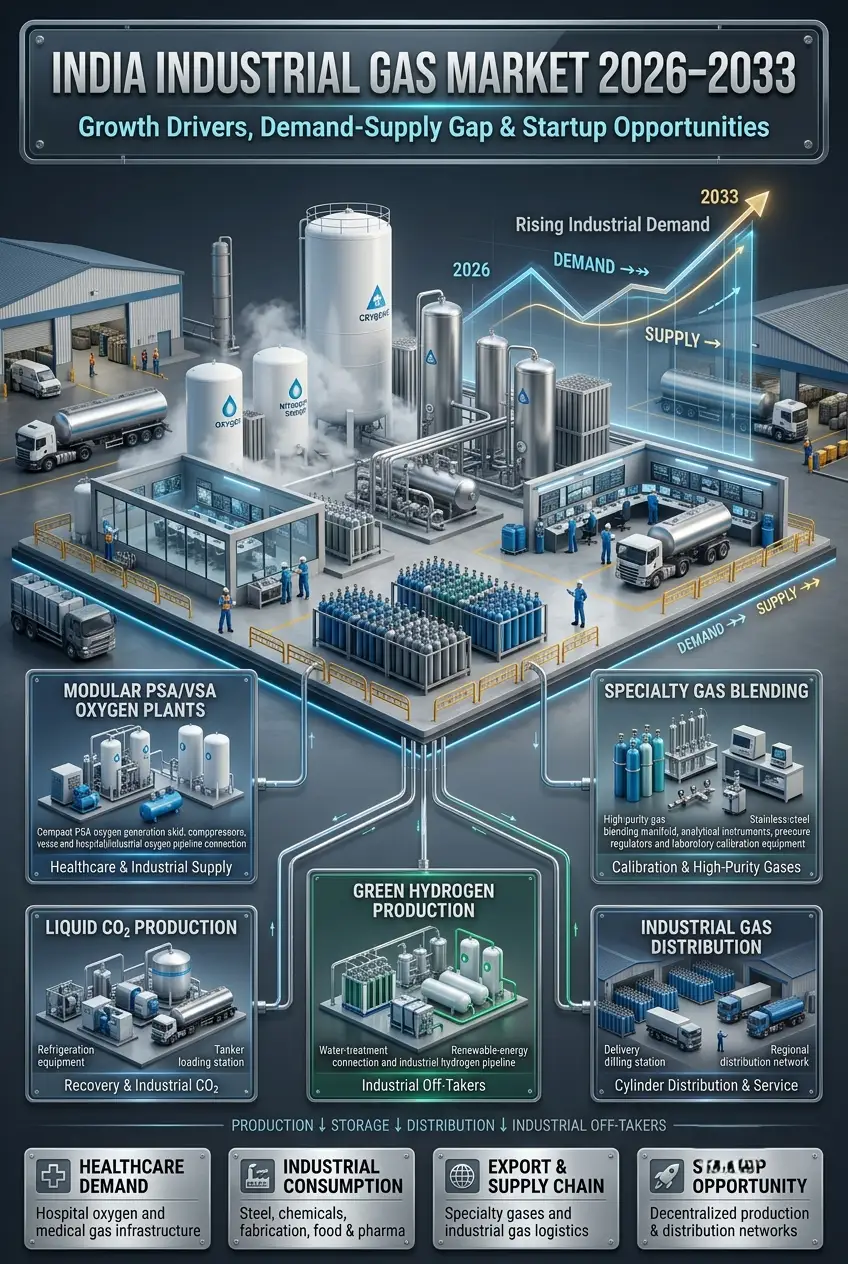
Entry Vector 1: Modular PSA/VSA Oxygen Plants for Healthcare & Industry
The technologies that manufacturers use to produce oxygen through pressure swing adsorption (PSA) and vacuum swing adsorption (VSA) are advanced and well proven. They can produce oxygen with a purity of 90–95% at a scale of 10–500 tonnes per day. The cost of capital for a 50 TPD PSA Plant ranges from ₹2.5–5 crore. This cost depends upon the location and utilities and is easily eligible for financing through MSME credit facilities. The target market consists of clusters of hospitals, small steel units, glass manufacturing, or water treatment plants. These markets are located in geographies over 200 km away from larger producer facilities.
Entry Vector 2: Specialty Gas Blending & Calibration Gases
Specialty gas blending is the preparation of base gases to high precision for use in pharmaceuticals, automotive emissions testing, environmental monitoring, food quality control and electronics. The capital cost of a gravimetric gas blending plant, analytical verification and cylinder handling plant begins from ₹1.5–3 crore. The distinguishing feature isn’t production technology, but analytical certification capability. This means the ability to certify gas purity to ISO 17025, SEMI or pharmacopoeial standards. There is a premium pricing opportunity for an MSME investing in NABL accredited gas analysis infrastructure. This opportunity exists in a specialty gas cylinder market dominated by imports.
Entry Vector 3: Liquid CO₂ Production from Industrial Waste Streams
Entry Vector 4: Green Hydrogen Production for Industrial Off-Takers
The SIGHT programme under the National Green Hydrogen Mission is offering monetary benefits for large and small green hydrogen production projects. A bankable renewable energy project should have a committed industrial off-taker. This could be a City Gas Distribution Company, Fertiliser Plant, or Refinery. An MSME-scale green hydrogen electrolyser project with good renewable energy access in the state can also become bankable. Such projects can benefit from government support for revenue. The PLI for electrolyser production also helps lower the capital cost of core technology through increased domestic production.
Entry Vector 5: Industrial Gas Cylinder Distribution & Service Networks
It is the lowest capital/lowest volume (1st generation) option for start-ups. A vast informal network of gas distributors and organized small network of regional distributors operate the cylinder-based gas distribution market in India. This network provides service to welding shops, small welding fabrication shops, hospitals, laboratories, and food processing units. The cylinder-owned distribution network, cylinder tracking, regular refilling contracts, and basic quality assurance can give a good return on investment. This model can support a profitable and scalable gas distribution business with capital deployment of ₹50 lakh to ₹2 crore in a region.
Your investment deserves the right opportunity
How NPCS Can Support Your Industrial Gas Project
Niir Project Consultancy Services (NPCS) www.niir.org offers professional consulting services to entrepreneurs, investors and industrial promoters who are considering a new manufacturing project in the industrial gas and chemicals industry. Having served over 30 years as a Techno-economic Consultant for MSMEs, First Generation Entrepreneurs, Banks and Investment Agencies, NPCS provides you with Market Survey cum Detailed Techno-Economic Feasibility Reports (DPRs) specifically designed to cater to the needs of project financing and regulatory clearances.
An industrial gas project NPCS Market Survey cum DPR usually includes:
- Description of the manufacturing process in detail for the oxygen (cryogenic ASU or PSA/VSA), nitrogen, hydrogen (SMR or electrolysis), CO₂ recovery and specialty gas blending types.
- The specific application fields and project geography required for this project have undergone market research and demand analysis.
- Process Flow Diagrams (PFD) and Block Flow Diagrams (BFD) of the production process will be produced.
- The product mix and capacity planning have been consistent with the absorption of local product markets and financing requirements.
- Capabilities for generating the required products
- Import–export dependency analysis and competitive benchmarking
- Project financials including capital cost estimation, working capital requirement, revenue projections, IRR, NPV, and break-even analysis
- Government incentive identification and application guidance including PLI, SIGHT, CGTMSE, and state-level scheme eligibility
NPCS supports entrepreneurs in evaluating the technical feasibility, financial viability, market demand, and scalability of new industrial and manufacturing projects. It enables informed investment decisions based on real-world data rather than generic estimates.
Conclusion: A Sector Built for the Decade Ahead
India’s industrial gas sector sits at the intersection of India’s major manufacturing growth stories. These include steel capacity expansion, the semiconductor mission, pharmaceutical PLI, food processing modernisation, and the green hydrogen transition. Each narrative has its own momentum. Together, they guarantee substantial growth in industrial gas demand through 2033 and beyond.
The structural demand–supply gap is most acute in specialty gases, geographically underserved regions, and green hydrogen. This gap is not a temporary market inefficiency. It reflects the capital intensity of cryogenic infrastructure and the concentration of production among a handful of large players. India’s industrial base is diversifying faster than its gas supply infrastructure can keep up. For investors and MSMEs willing to make targeted, well-studied bets in this sector, the gap is the opportunity.
As the Federation of Indian Chambers of Commerce and Industry (FICCI) has noted in its manufacturing competitiveness analyses, industrial gas self-sufficiency—particularly in medical oxygen, specialty electronic gases, and green hydrogen—is not merely a commercial opportunity. It is a strategic necessity for India’s industrial sovereignty. For the entrepreneurs who move first, strategically, and with rigorous feasibility analysis behind them, this sector offers exactly the kind of durable, essential business that India’s manufacturing decade will reward.