
Import Export Code Registration
There is one problem that every entrepreneur who aspires to export within India is facing; and that is, without IEC no movement of shipment and no foreign payment get cleared. This is only the beginning of a large discussion on business ideas for manufacturing, agro-processing and specialty exports. It can be important to get the IEC right, fast and without the rejection that may lead to a founder who would have been shipping the product this quarter but is still stuck in paperwork six months later. This guide explains the registration process from start to finish, the benefits of exporting today and a list of specific business ideas that can be realized once your IEC is in place.
What Is an IEC, and Why Does Every New Exporter Need One
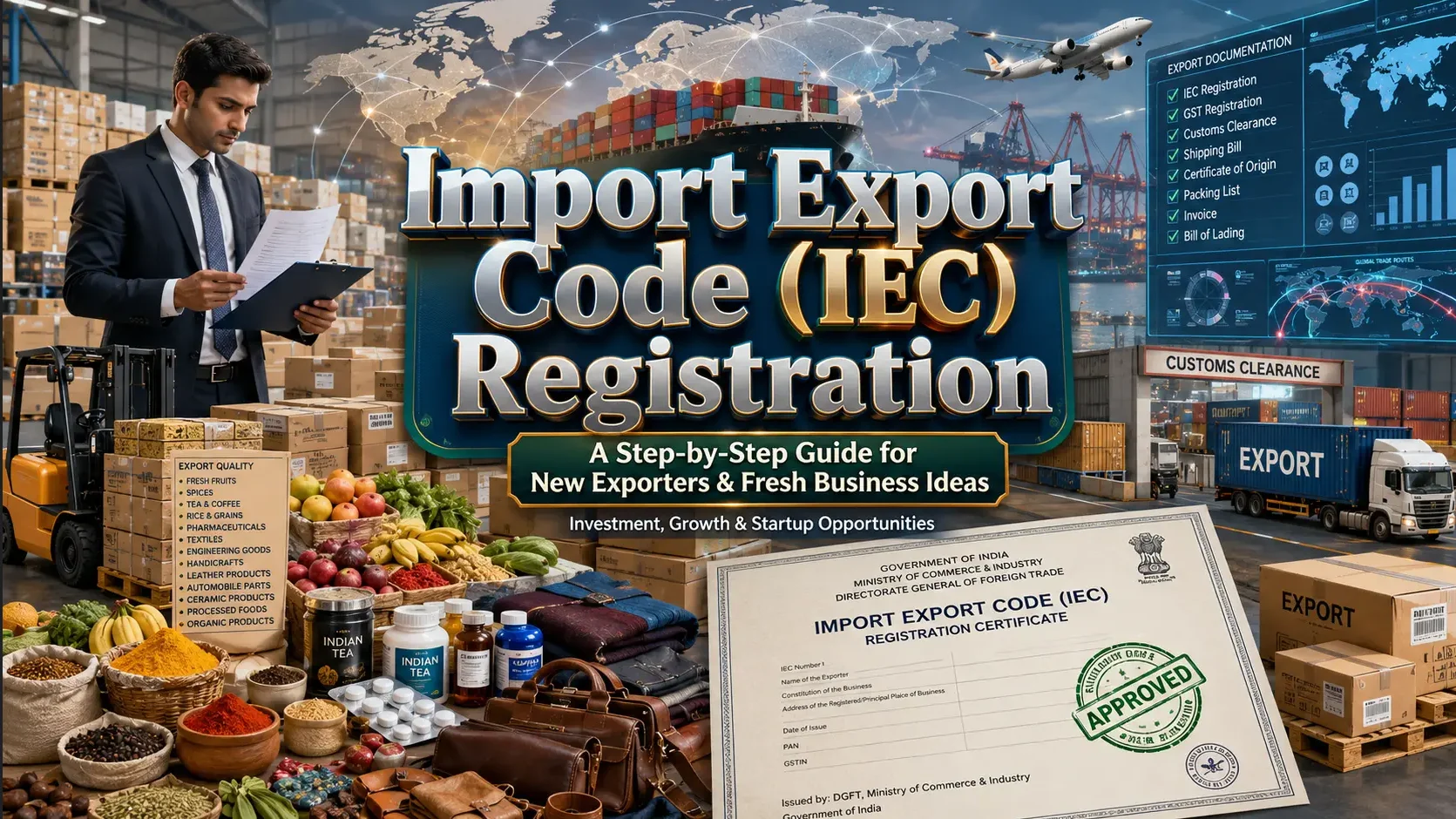
Importer Exporter Code (IEC) is a 10-digit identification code, allotted by the Directorate General of Foreign Trade (DGFT), which is a ministry of Commerce and Industry. It is based on PAN so there is only one IEC per PAN (for proprietorship, partnership firm or private limited company).
If you don’t have an IEC, your goods won’t be cleared at any customs. Foreign remittance will also not be allowed to be processed by the bank. No shipping bill can be filed on ICEGATE, and no registration can be done from any of the Export Promotion Council portals. To sum up, the IEC is not the document per se. It is an operating licence for cross border trade.
It is also required for service exporters, especially when they reach the level where they are required to provide an IEC reference on the GST refund or bank remittance certificate. freelance consultants, IT exporters and Design Studios, which get dollars as their clients from abroad are increasingly registering early, just to ensure banking remains smooth.
Discover business ideas that actually make money
Step-by-Step IEC Registration Process on the DGFT Portal
All of the application is conducted online. The following is the order that a first-time applicant should follow.
Step 1: Create a DGFT Portal Account
Go to dgft.gov.in and register by entering your PAN, a valid mobile phone number and a working email address. OTP is sent to both channels on the portal and after verification, the portal connects your PAN directly with your profile.
Step 2: Open the IEC Application Form (ANF-2A)
Log in, click on Services and then on IEC Profile Management. Select Apply for IEC, and Form ANF-2A will appear. This is a form that requires the constitution of your firm, the registered address, the names of directors/partners, and details of your bank account.
Step 3: Upload the Required Documents
For most of the applications, the generally accepted documents are: Entity PAN card, proof of address of your place of business, canceled cheque book or a bank Certificate, proprietor or authorised signature digital photographs, and GST Certificate if obtained for the entity. The address proof should be in sync with the address provided in your PAN and GST records, because it’s the top reason for rejection of applications for clarification.
Step 4: Pay the Application Fee
Settlement fee by the Government is paid once, through net banking, debit card or UPI, for the amount of ₹500. This fee is non-refundable, so it’s best to review each field carefully before submitting.
Step 5: Sign and Submit
Depending on the type of the applicant, the application must be digitally signed or have an OTP authentication from Aadhaar. Submit the form signed to DGFT for processing.
Step 6: Download the IEC Certificate
Application for clean is typically processed in 1-3 working days and many are processed in 24 hours. You receive the certificate by email, and you can also download it anytime from Services, IEC, Print IEC. The certificate has a QR code for easy verification.
What Comes Right After the IEC
You can’t clear customs using the IEC. Still, you have to register on Indian Customs EDI Gateway (ICEGATE) where shipping bills and bills of entry are filed. Meanwhile, you need to register your bank’s Authorised Dealer (AD) Code at all ports where you are shipping. This is a one-off action per port and your bank will send the AD Code letter to customs.
Each year, one catch is given to exporters who are new. The IEC is valid for a lifetime, but even if there has been no change in any information, the IEC has to be updated annually by DGFT between April and June. Your IEC will be automatically disabled if you close this window. Once a deactivated IEC, you are unable to receive foreign remittances, pending incentive claims will be frozen and you’ll be unable to access the Export Promotion Council portals until the overdue update is completed.
Why Exporting Is a Smart Business Move Right Now
Despite the global headwinds, India’s merchandise and services exports have continued to rise and the government has been making efforts to strengthen the incentive framework for these. This is important for the first time exporter as it reduces the initial cost of exporting and the possibility of being outcompeted by a competitor with a better subsidy package overseas.
There are three forces in favor of a new exporter today. Firstly, there has been a shift in the global buyers’ preference for diversifying away from relying on a single country, and Indian MSMEs have been prominently featured in areas such as textiles, engineering goods, processed food, and pharma intermediates. Second, since the time of an overseas customer being found via traditional methods, digital export opportunities have reduced the cost from B2B marketplaces to direct-to-buyer e-commerce channels. Third, the regulatory regime in India has speeded up considerably; the processing of documents, issuance of the GST refunds and the IEC have become a matter of days, rather than weeks.
All this does not imply that exporting is without difficulty. Margins are slim, developed market quality standards are demanding, and logistics is a swing and a miss. However, for a Founder who does the product-market fit homework and is on compliance, it is really dropped.
Government Policies and Incentives Supporting New Exporters
The India Foreign Trade Policy 2023-28 is a living policy and is not fixed for the next 5 years, hence it is updated by way of notifications. That means that the incentive landscape is constantly changing as a new exporter and it’s worth keeping up.
Export Promotion Mission and Niryat Protsahan
The Export Promotion Mission, announced with a multi-year outlay running into thousands of crores, merges several fragmented schemes into one digitally administered framework. Its Niryat Protsahan component offers an interest subvention for MSME manufacturer-exporters, easing the cost of pre-shipment and post-shipment credit. Its Niryat Disha component helps exporters set up overseas warehousing and part-reimburses the cost of international quality certifications, which matters enormously for food, pharma, and engineering exporters chasing markets in the EU or US.
RoDTEP and RoSCTL
The Remission of Duties and Taxes on Exported Products, or RoDTEP, refunds embedded central and state taxes that GST does not cover, such as mandi tax, fuel duty on transport, and electricity duty. It now covers a large share of tariff lines, and the benefit gets credited as a transferable duty scrip. Textile exporters also receive RoSCTL, which covers state levies for the sector. However, they cannot claim both schemes for the same shipment.
MSME and Startup-Focused Support
The Ministry of MSME has schemes of credit guarantees and subsidised technology upgradation and cluster development, all of which boost export preparedness indirectly. The Districts as Export Hubs concept builds upon this, identifying export-ready products in every district and handholding/building infrastructure around them, mostly using the Export Facilitation Centres. The Interest Equalisation Scheme, meanwhile, gives MSME manufacturer-exporters a subsidised interest rate on export credit, which directly improves working capital economics for a new venture.
For services exporters, there is no RoDTEP-style rebate, since RoDTEP applies to goods only. The real benefit for a services business is GST zero-rating on exports, which, handled correctly, means no GST charged and a refund of accumulated input tax credit.
Business Ideas You Can Launch Once You Hold an IEC
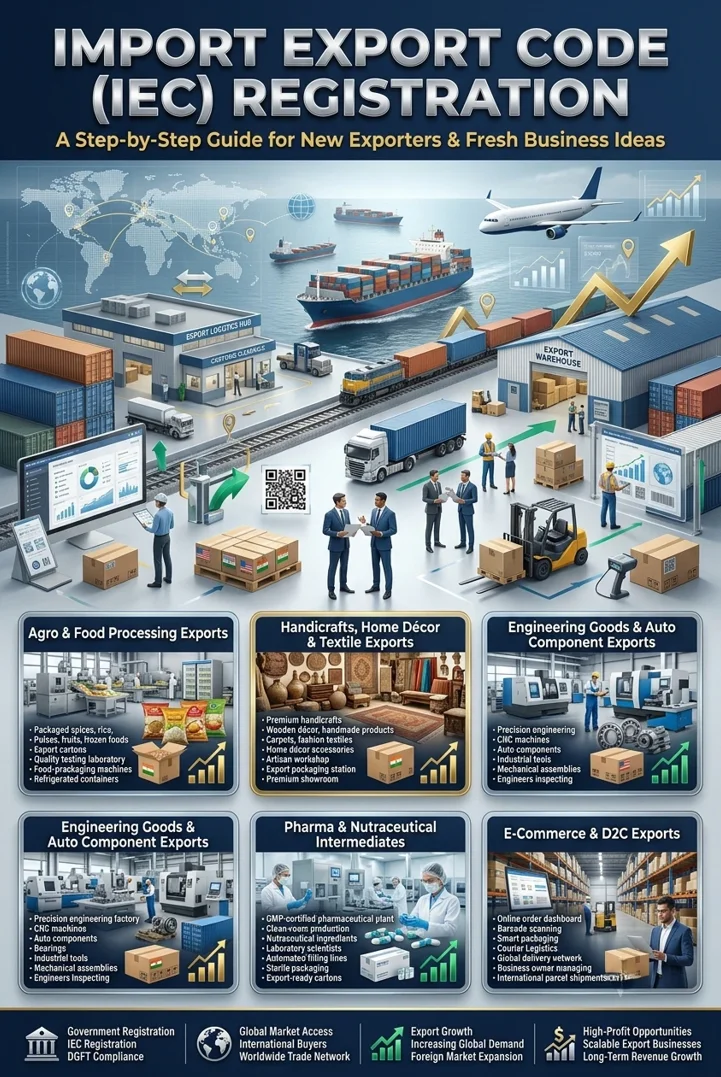
Agro and Food Processing Exports
India’s raw agricultural base, from spices to millets to processed fruit pulp, gives a new exporter a genuine cost advantage over competitors sourcing the same inputs internationally. For someone setting up even a simple plant-a single product line like processed & packed dehydrated onions or freezing plant for okra-he can sell into Gulf countries & South-East Asian markets that are already well-disposed to branded food from India. APEDA registration is usually completed alongside IEC registration for most agri-export products. Proper IEC documentation also helps speed up the APEDA registration process.
Download the Full Guide: Handbook on Fruits, Vegetables & Food Processing with Canning & Preservation
Handicrafts, Home Decor, and Textile Exports
There remains a solid appetite in both Europe and North America for small-batch design-lead production in home dcor & home textiles via B2B platforms that enable a shop operating out of just one facility to sell to overseas retail buyers directly; IEC opens up this market on day one, while textile sector ROSTC incentives reduce land cost relative to buying from Bangladesh or Vietnam. A founder starting here typically needs modest capital, since much of the value lies in design and craftsmanship rather than heavy machinery.
View Full Project Details: Access the Complete Textile Processing
Engineering Goods and Auto Component Exports
Precision components, fasteners, and light engineering goods are among India’s most consistent export categories. Global automotive and industrial buyers are actively reducing their dependence on China-based supply chains. This shift creates strong opportunities for new manufacturers. Businesses entering this sector can benefit from RoDTEP incentives on most tariff lines. They can also receive support through Niryat Disha for quality certifications such as ISO and IATF. Overseas buyers usually require these certifications before placing their first order.
Pharma and Nutraceutical Intermediates
India’s pharmaceutical manufacturing base creates strong opportunities for smaller businesses. These companies can supply intermediates, excipients, and nutraceutical extracts instead of finished formulations. Finished formulations require stricter regulations and a longer approval process. RoDTEP expanded its coverage to the pharmaceutical sector in recent years. The move strengthened the export competitiveness of Indian manufacturers. Demand from both regulated and semi-regulated markets continues to grow. Global buyers are also diversifying their sourcing, creating more export opportunities for Indian suppliers.
Related Article: Top Pharmaceutical Industry Consultants in India: A Practical Guide for Entrepreneurs
E-Commerce and D2C Exports
Cross-border e-commerce offers a fast way for first-time founders to start exporting. It eliminates the need to build relationships with overseas distributors and has remained an overlooked opportunity. RoDTEP concessions now apply to shipments shipped out under courier mode of export, bridging a previous discrepancy that had kept couriers relatively excluded from existing incentives. Anyone shipping ethinic clothing, ayurvedic personal products or niche food items could in theory, begin shipping after obtaining their IEC in weeks.
Import-Export Opportunity Analysis for New Entrants
The IEC is bidirectional by design, and importing raw material or machinery under the same code often makes as much commercial sense as exporting finished goods. A founder setting up a food processing unit, for example, may need to import specific packaging film or processing machinery not yet made competitively in India, while exporting the finished, processed product. The same IEC covers both legs of that business.
Free Trade Agreements add another layer of opportunity. India’s expanding FTA network, alongside the Common Digital Platform for Certificate of Origin, makes it considerably easier for an exporter to prove origin and claim preferential tariff treatment in partner countries. For a new entrant, this is worth checking product-by-product before finalising a target market, because the tariff differential under an FTA can be the entire margin on a shipment.
On the import side, a founder should also watch input costs closely. Many manufacturing business ideas depend on imported raw material, resin, specialty chemicals, or components, and currency movement against that import bill can erode export margins faster than most founders expect. Building a landed-cost model before committing to a product line saves painful surprises later.
Indian MSME Export Success Stories
Amul, founded by The Gujarat Co-operative Milk Marketing Federation with leaders like Dr. Verghese Kurien, is an example of what disciplined cooperative manufacturing can deliver in terms of exporting products. A dairy cooperative looking at procuring milk locally originally is now importing its dairy products in the Gulf, in US, across various parts of Africa. A message for aspiring founders: Success comes from patience and disciplined execution. Amul spent decades building strong quality control before global buyers trusted it for large-scale exports.
Aravind Melligeri had one clear vision: manufacture complex aircraft components in India instead of relying on fragmented global supply chains. He chose Belagavi, Karnataka, instead of a major metropolitan city. He believed the region offered affordable, trainable talent for aerospace manufacturing. Through Aequs, he built India’s first notified aerospace Special Economic Zone, supplying precision components to Airbus and Boeing. His success showed that choosing the right location and building a skilled workforce are just as important as developing a high-quality product, especially for businesses targeting global export markets.
Sameer Mehra founded Suminter India Organics in 2003. Instead of owning farms, the company built a contract farming network with smallholders. It invested more in organic certification and traceability than in processing equipment. This “sourcing first” strategy helped Suminter earn premium prices from buyers in Europe and the US. These buyers specifically look for certified organic products. This approach offers an important lesson for new agro-exporters. Higher profit margins come from certification and traceability, not from expensive processing equipment alone.
About NPCS
We at Niir Project Consultancy Services (NPCS) provide professional consulting for the preparation of Market Survey cum Detailed Techno-Economic Feasibility Reports (DPRs) for setting up new industries or businesses. Our reports include detailed manufacturing processes, market research and demand analysis, process flow diagrams, product mix and capacity planning, machinery and raw material details, and complete project financials with profitability analysis. For a founder evaluating one of the export-oriented business ideas above, a DPR is often the document a bank or investor asks for before releasing funding, and our objective is to help entrepreneurs evaluate feasibility, profitability, and long-term scalability before they invest.
IEC Registration at a Glance
| Parameter | Detail | Parameter | Detail |
| Issuing Authority | DGFT, Ministry of Commerce and Industry | Application Fee | ₹500 (one-time, non-refundable) |
| Code Format | 10-digit number, same as business PAN | Processing Time | 1 to 3 working days for clean applications |
| Validity | Lifetime, subject to annual update | Annual Update Window | 1 April to 30 June every financial year |
| Application Mode | Fully online via dgft.gov.in | Core Documents | PAN, address proof, bank certificate/cancelled cheque, digital photo |
| Follow-on Registration | ICEGATE and AD Code at the customs port | Consequence of Missed Update | IEC gets deactivated; trade and incentive claims freeze |
Frequently Asked Questions
Is IEC registration mandatory for every exporter?
Yes, for goods trade. Certain categories, like personal use imports or exports by government departments and notified charitable institutions, are exempt, but any commercial import or export needs an active IEC.
Can one person hold more than one IEC?
No. IEC is PAN-based, so only one IEC is issued for each PAN. This rule applies regardless of the number of product lines or business names operating under the same entity.
How long does IEC approval take?
Most clean applications are approved within 1 to 3 working days. Some are approved within 24 hours when PAN, GST, and bank records match exactly.
What happens if I miss the annual update window?
Your IEC gets deactivated automatically. You cannot trade, banks will not process related remittances, and any pending incentive claim freezes until you complete the update and reactivate the code.
Do service exporters need an IEC too?
It depends on the transaction. However, most banks now ask for an IEC reference before processing export remittances or issuing GST refund certificates. Registering early helps avoid delays.
Is a GST number required before applying for IEC?
Not strictly, since a small number of applicants can register without GST. In practice, though, GST registration makes address verification and bank linkage far smoother, so most consultants recommend completing it first.
Conclusion
The IEC takes only a few days to obtain and costs just ₹500. However, it is the key to entering the import-export business. Success depends on what comes next. The right product, target market, quality systems, and proper use of government incentives matter far more than the IEC itself. For first-time founders, the best step after getting an IEC is to conduct a proper feasibility study. It helps test the business model and financial projections before investing in machinery or inventory.
References: DGFT Portal | Ministry of Commerce and Industry | Ministry of MSME | ICEGATE | FIEO | APEDA | PIB Press Release on Export Measures