

Analyzing the market trading data has become the norm for every entrepreneur today. The employment of agricultural and ancillary stills in India reveals a global trading imbalance with high potential for startups.
According to the ministry of food processing industries annual report sets for 2024-2025, the export of India agro food products is USD 46.43 billion while the imports are USD 31.7 billion. In addition, the processed food export is 23.4% of total processed food exports, which shows a notable addition of value and profit to the economy.
Thus, New Startups focusing on the processed food export and substitution imports from local production are bound to grow at a much faster pace. Thus, trading data assists startups in devising marketing strategies that facilitate first contact with the international marketplace.
Read More: Export Opportunities for Indian Businesses
Food and the Chemicals Industry Imports and Exports
India’s Imports and Exports of Food and Chemicals is a growing sector with, new business opportunities. Moreover, the country exports a range of high value food items while importing certain essential items which indicate a potential market gap.
Exports from Food for the Period of Financial Year 2023 2024
The revenue brought In from the sale of agricultural products was 46.43 billion dollars with an 11.7 split of total exports. Processed food exports were 10.88 billion dollars and accounted for 23.4 of the country’s total exports.
The exports included 10.9 billion dollars worth of cereals, 4.7 billion dollars worth of spices, 10 billion dollars worth of seafood and meat, 3.29 billion dollars worth of sugar, and 1.15 billion dollars worth of processed fruits and vegetables.
Imports of Food for the Period of Financial Year 2023 2024
India has imported food worth 31.7 billion dollars with imported edible oil worth nearly 15 billion dollars, fruits and nuts worth 4.19 billion dollars, 1.54 billion dollars worth of beverages, and cocoa worth 513 million dollars. These can easily be replaced by local production due to the straightforward nature of the Startups.
Imports and Exports of Chemicals
As for the Startups, they can import specialty chemicals oleoresins and other food-grade chemicals, and in turn, export spices, essential oils, and edible oil derivatives to the nutraceutical industry.
Read More: A Startup’s Guide to India’s Plantation Industry Export Market
Business Activities in Import Export
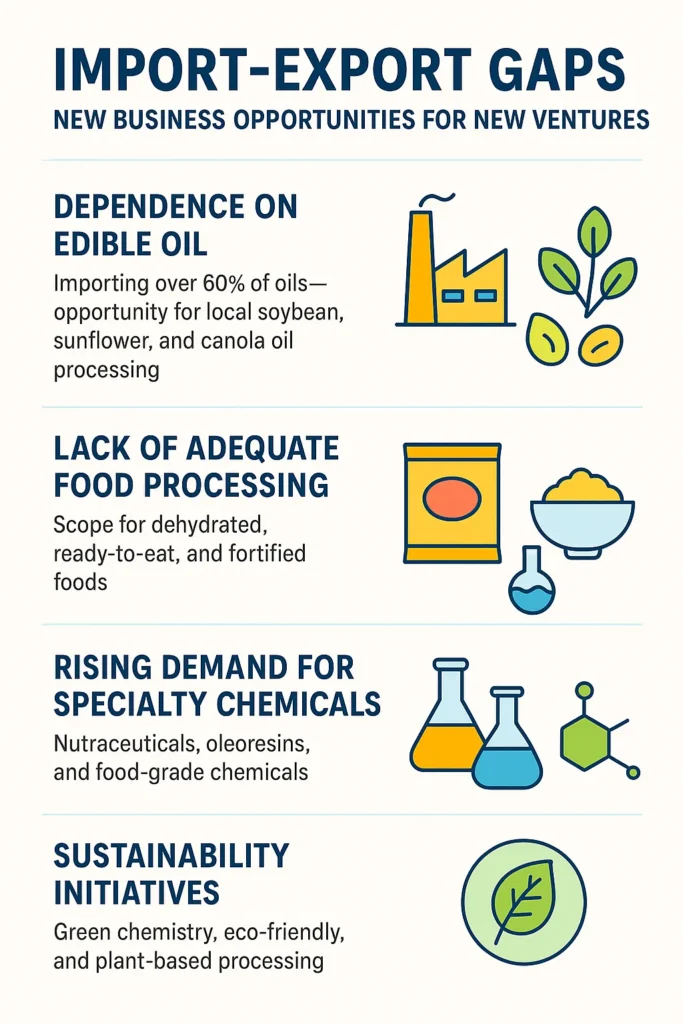
Concerned with the import of edible oil, new entrepreneurship can be started in processing plants for soybean, sunflower, and canola oil, since over 60% of edible oil is imported to India.
Unsuitable Food Processing: New productions can focus on ready to eat dehydrated foods and fortified foods.
Changing Dynamics of Specialty Chemicals: New productions can address the emerging needs of nutraceuticals, export grade oleoresins, and food grade chemicals.
Sustainability: There is an increasing need for the integration and processing of food using green chemistry, eco friendly and plant based chemistry.
New Business Opportunities in Food Sector
The tremendous expansion in the food sector of the country is indicative of the new business chances and ventures for start up firms to command in the international arena.
The growth of each subsector is accompanied with high demand and the growth of the entire sector supports the claim of extensive value added innovation as the next shift.
India, with an export value of $10.9 billion, stands second in the export of cereals. This has generated a demand in the Africa- Middle East region for value added products such as fortified instant rice and millet, which can be catered by new ventures.
New ventures can also capitalize on the domestic availability of grains along with innovative packaging and cook-technology to set up disruptive global food brands.
Spices and Oleoresins
India has an edge over its competitors regarding the export of organic clean label spices and spices in general, as it profits $4.7billion, which is simultaneously an opportunity.
New firms can set up plants for spice oleoresins extraction, spice oils and natural flavorings production, and oleoresins production. There is an increased demand for exporting organic spices, making this a highly sought after, untapped market.
The Meat and Seafood Preparing Industry
New firms can utilize food parks and other cold chain facilities for the processing of ready to eat meals, halal meat, and frozen seafood. This industry possesses a large profit potential, making it very easy and ideal to invest in.
The successful operation of this business vertical can generate 10 billion dollars in exports for the region, primarily targeting the Gulf and South East Asia.
The Vegetable and Fruit Processing Industry
The exportation of fruit, from the processing of pulps, powdered fruits, and vegetables, as well as dehydrated powders, and tomato paste, can produce a revenue of 1.15 billion USD.
The partnership with farmers has allowed better quality and less wastage with our available exportable surplus as a result of our cold storage facilities.
The Exported Products
The total export value stands at 3.29 billion USD. New players in this market can buy ghee, jaggery, other natural sweeteners, and even sugarless products.
Food park amenities lower the operation costs and broaden the access to excess international market with whole some products. This improves the operational control and makes it easier to broaden the operational market.
Read More: Booming Business of Trading Of Spices
Entrepreneurial Opportunities in the Chemical Sector
Similarly, the chemicals industry in India is poised to gain from import substitutions and export growth. New businesses can focus on the growing market for edible oil derivatives, cocoa extracts, food-grade chemicals, and nutraceuticals.
Edible Oil Derivatives
New businesses can establish oilseed extraction and oil refining units in case of oilseed imports which is 15 billion dollars worth. Oilseed imports include soybeans, mustard, and sunflowers, causing the production of imported and specialty oils using cold-pressed and net exported.
Cocoa and Chocolate Processing
India imports cocoa at the value of 513 million dollars. New businesses can establish units for processing cocoa and for making artisanal chocolates to promote premium Indian brands.
Food-Grade Chemicals and Additives
The rising importation of local emulsifiers, stabilizers, and natural preservatives is an unmet demand in this country. FSSAI and ISO certifications can enhance local and international commerce.
Plant Based Nutraceuticals
The rich and rising area of the global economy relates to the extraction of botanicals and the production of ayurvedic herbal proteins and powders and oleoresins. The fusion of health, nature, and trade makes this a novelty area for booming export.
Read Our Book: Click Here
Government Aid Provided to Startups
PMKSY: Infrastructural support for all other boutiques and subsidizes mega food parks with cold chains and integrated agro clusters.
PMFME: Within the complicated One District One Product Policy, local food products are promoted, along with an additional 35% subsidy.
PLISFPI: There is a subsidy for the export of ready to eat food, and also for the export of dairy and seafood. There is also grant assistance for the new ventures.
DPIIT & Make in India: A policy on the Make in India Program encourages the manufacture of chemicals and also encourages required start-ups.
Notable Startups
LT Foods (Daawat Rice): Rapid climb from local trader to exporter and now a global brand.
Everest & MDH Spices: The combination of aggressive marketing and quality of products drove the MSME over a billion dollar in revenue.
Paper Boat: International acclaim for the simple fusion of rich Indian cuisine and modern aesthetic.
Godrej Agrovet: Diversification in the business of agrochemicals enhanced the value chain.
Lesson: To sum up, the combination of value addition with operational support, and an effective brand strategy stands as unmatched for achieving global success.
Read Our Project Report: Click Here
How NPCS Can Help You
For a startup, Niir Project Consultancy Services (NPCS) takes the client from an idea to a fully operational industry. We create detailed manufacturing surveys for every project, including the processes, raw-material cost estimations, and complex predictive economic models.
NPCS assesses financially viable product investments based on the expected monetary returns and the export potential. With us, the risks of unnecessary delays and the paradox of low market entry barriers are averted.
Roadmap for Entrepreneurs
- Data Collection and Analysis: Target markets for export within countries that have a deficit of cocoa and oils.
- Choose Government Schemes: Opt for PMKSY, PLISFPI, and PMFME.
- Develop the Necessary Facilities: Unit for dehydration, refining, and extraction processes.
- Confirm the Necessary Licenses: FSSAI, HACCP, and ISO.
- Brand Development: Target the global campaign to “Proudly Made in India” branded products.
- Export Development: Target as initial markets Africa, the Middle East, and the European Union.
- Engage with NPCS: To formulate the particular industry and its corresponding feasibility reports.
Find the Best Idea for Yourself With our Startup Selector Tool
How Do You Propose the Industry of the Future for India?
The sectors of food and chemicals in India still remain untapped. However, the rise in demand for processed food, spices, and cereals, indicates there is growth potential.
On the other hand, the imports of cocoa and edible oils indicates a gap in domestic production which can be profitably utilized.
However, the startup local value addition and export gaps are the most important gaps that sustain the growth of these new ventures, which makes investment in these new ventures extremely fruitful.
New business opportunities are visible where imports are open. Similarly, the underdeveloped set of new businesses points to the ease of doing business in the country. Investment in ventures of this type is the action that is most lacking at this moment.
Import Export Business Opportunities: FAQ
Why is it necessary for the beginner businesspersons in import and export activities with India to ‘Spend’?
That data also identifies potential lessons as it relates to the country target to export and import which might prove valuable to the Case of the food entrepreneurs.
What food items can we export from India which have significant demand in the overseas market?
We can export processed food items and other food products such as spices, seafood, cereals, and different kinds of fruits.
Which government schemes are there for food entrepreneurs in India?
Food entrepreneurs can avail the capital, fund and, and infrastructure and subsidy schemes like under PMKSY, FME, and PLISFPI schemes.
What are the possible routes for Startups to enter the Chemical industry?
They can opt to produce nutraceuticals, food grade chemicals, or, derivatives of edible oils.
How does NPCS help potential business owners?
NPCS covers overall business decisions with regards to the market, investment and, movement in the business including planning and doing research with the aim of maximizing profit.