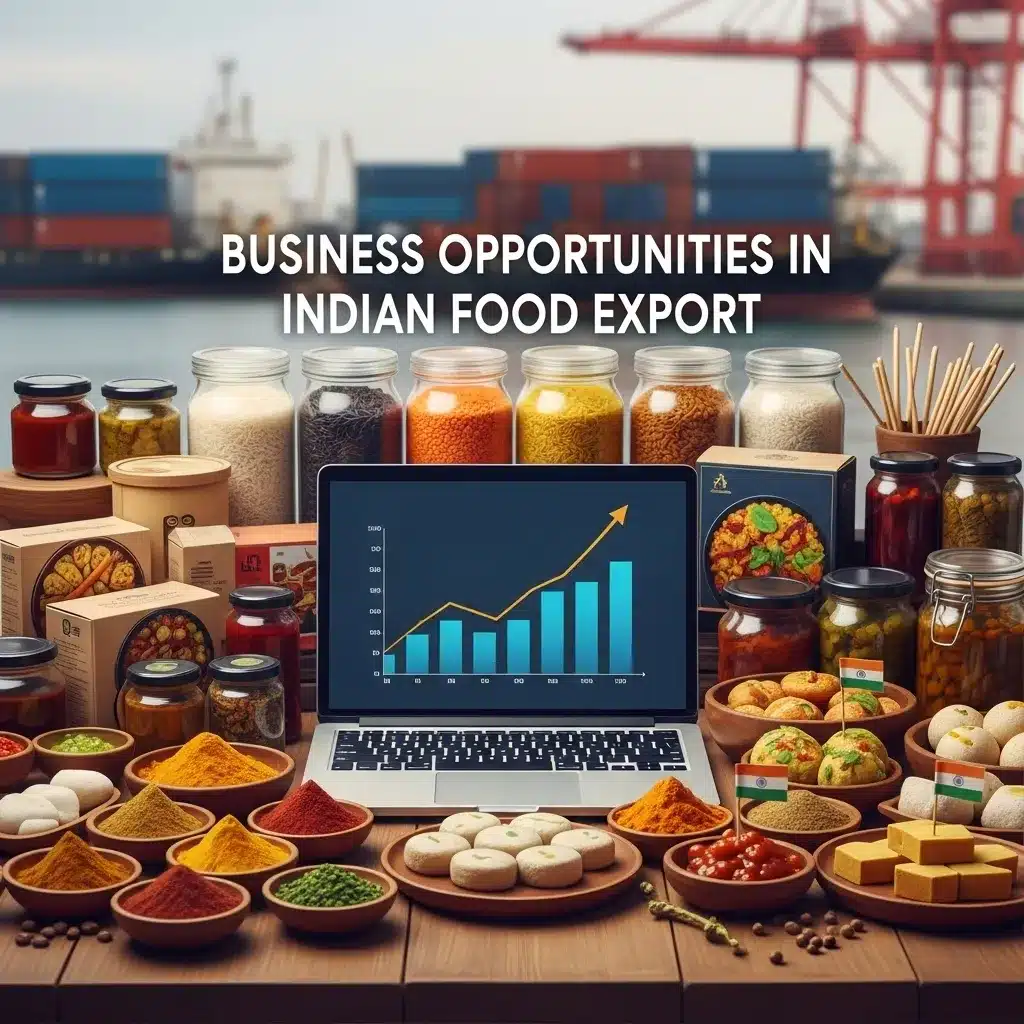

Opportunities in Indian Food Export: India’s Food Export saga is entering into an exciting phase. In the Annual Report of the MoFPI for the FY 2024-25, India was classified as a net exporter in 2022 with a share of 2.55% in global food exports and 1.66% in food imports.
During the fiscal year 2023-24, India exported agri-food products worth USD 46.43 billion, which highlights India’s position in the global food supply chain.
Although there has been a phenomenal increase in the figures mentioned above, something as simple as India’s participation in exports is still an underdeveloped market.
This leaves open a highly lucrative opportunity for entrepreneurs to build new ventures in food processing, and food specialty and high-value products.
Read More: How to Start a Food Export Business
Current Scenario: A Snapshot on India’s Trade
For the past five years, India has been steadily increasing its share in global food exports. For instance, in 2018, India’s share of food exports was 2.28%, which grew to 2.55% in 2022. Imports grew from 1.29% to 1.66% as India positioned itself as a net exporter.
In processing agri–food products, the volume of exports of processed foods reached USD 10.88 billion in 2023–24, which is equal to 23.4% of the agri-food exports.
However, the total agri-food exports in 2023–24 were USD 46.43 billion. Processed food exports are valued at USD 10.88 billion. Major exports are rice, marine products, spices, sugar, processed fruits and vegetables, and dairy products.
Apart from exports, India is the world’s largest exporter of rice and is positioned in the top 5-7 exporters of spices, seafood, and other dairy products.
India, on the other hand, is netting food imports the value of which has reached USD 31.7 billion, which comprises 4.7% of the total imports. However, there is considerable potential for new local start-up companies to replace imports such as cocoa, nuts, specialty drinks, and high-value dairy products currently available in the country.
The emerging markets expansion potential is the foundational strength of India.
Entrepreneurial Opportunity Structuring: Lines of Products with High Margins for New Business Development
Rice and Specialty Grains
India is the leading country in the export of rice; thus, startups can invest in ready-to-cook rice, millet mix, and fortified grain blends. The ODOP database is useful for identifying clusters with rice and millet with high opportunities, thus easing the setting up of processing units within the value chain.
Export Potentials: Asia Pacific, Africa, and the Middle East.
Spices and Value-Added Seasonings
India is a dominant country in the spice export market, however, a large portion of this is unbranded and sold in a raw state. This provides opportunities for startups to develop ready spice mix, sauces, and seasoning cubes to penetrate into the market that is thirsty for Indian food.
Export Potentials: Europe, United States, and ASEAN.
Additionally, the ability to market products with a premium organic claim, provides a competitive advantage in comparison with other market players.
Read More: Food Processing Sector: Growth Opportunities
Dairy and Nutraceuticals
With the highest volume of milk production in the world, India has the proficiency to advance in the processed milk and whey protein concentrate markets. However, in concordance with the current state of health and fitness, lactose-free milk products and whey protein supplements are highly sought after.
Export Potential: Middle East, Africa, and Southeast Asia.
Export viability is in line with the current health and fitness tendencies of the world.
Seafood and Aquaculture Products
With India’s seafood export totaling to an astounding USD 6.12 Billion in 2023, there is much unexplored potential in the nutraceutical industry along with ready-to-cook fish, seaweed snacks, and shrimp.
Export Potential: US, EU, and Japan.
A significant investment into cold chain technology to preserve quality and ensure freshness is crucial.
Processed Fruits and Vegetables
Startups may experiment with freeze dried products, beverage pulps, and purees to enhance the value of fresh produce with significant spoilage.
Export Potential: GCC countries, East Asia.
Longer product shelf life adds to the competitive edge on the market due to the technologies required.
Plant Based and Functional Foods
A rising trend in global vegan-consumerism opens a market for strong upcoming brands to produce functional drinks, protein bars, and komucha.
Exporting Potential: Europe and North America.
Through its advantages, PLISFPI can attract innovation and scaling.
Cocoa Products
India imports cocoa but there is a possibility for localization of intermediate and finished products. They can produce chocolates, cocoa butter substitutes and cocoa blends using the bean to bar chocolate technique.
Export Potential: Europe and the Middle East
Indian specialties premiumize, providing a global perspective on packaging.
Government Initiatives Facilitating The Export Of Start-Ups
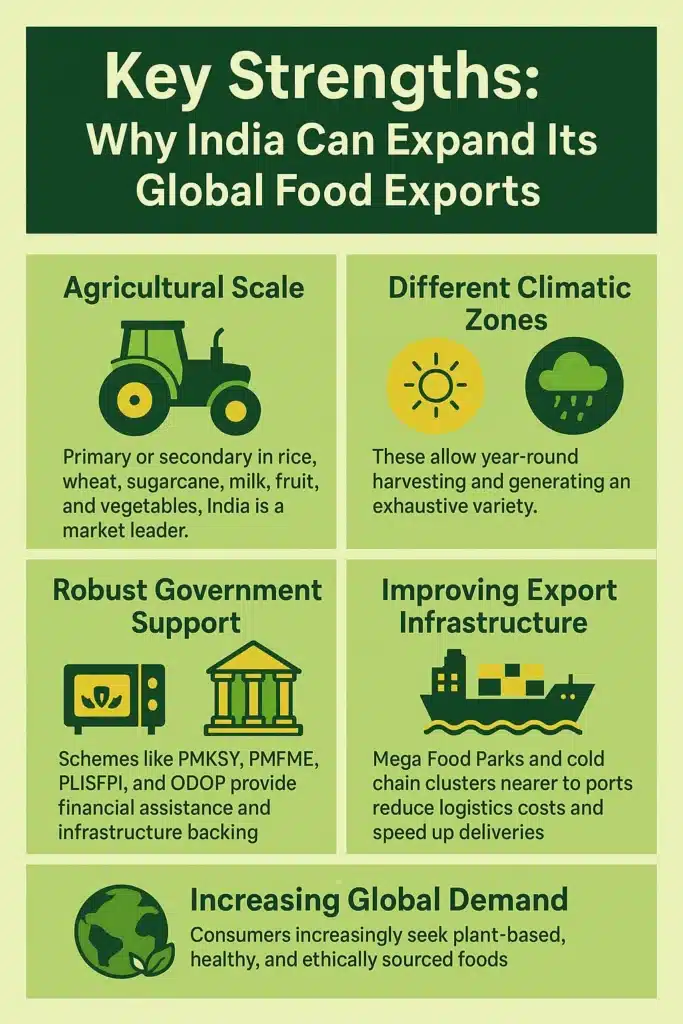
- PMKSY: Funds for the development of Mega Food Parks, Cold Chains, and Agro-Processing Clusters.
- PMFME: Offers 35% credit-linked subsidy and assistance under the One District One Product (ODOP) initiative.
- PLISFPI: Focused on value-addition and Export-oriented ready for use Food Production.
- APEDA: Provides quality certificates, facilitates entry to the market, and promotes exports.
- NABARD and State Policies: Provide concessional loans and funding for infrastructure development.
Thus, there is a possibility for start-ups to merge these two schemes which will allow reduced investment risks and better investment reach.
Read Our Book: Click Here
How NPCS Can Help You
Niir Project Consultancy Services (NPCS) helps start-ups to convert their ideas into highly competitive projects which assist in building their market presence.
NPCS is currently preparing market surveys and Detailed Project Reports (DPRs) which, apart from welding these aspects to the overall project, include trend projections, machinery, finances, and profitability.
Case Studies: Successful Indian MSMREs
- LT Foods (Daawat)- From local rice to international ready to eat products.
- Marico- From oils to healthy snacks and beverages.
- ITC Foods- Fully integrated farm to fork supply chain for exports.
- Sea6 Energy & AquAgri- Import of seaweeds and nutraceuticals
There are some really interesting examples which convey to us the message that with innovation and quality control, effective marketing strategies can turn traditional agri products into successful international products.
Read Our Project Report: Click Here
Action Plan for New Startup Founders
- Go Digital: Platforms like Amazon Global or Flipkart Wholesale or other B2B platforms.
- Intelligent Use of Data: Find potential clusters using ODOP and APEDA database.
- Increase Shelf Life: Freeze-drying, vacuum packing and cold chain.
- Sustainability: Organic, traceable, eco-friendly.
- FSSAI, HACCP, BRC, ISO 22000: These are the export standards that need to be met.
- Branding: Recognized products as Indian authentic origins.
- Start Small: Contract manufacture before branding.
Find the Best Idea for Yourself With our Startup Selector Tool
Conclusion: The Road Ahead
Countries hold very different shares of international trade, and India’s comes to 2.55%. However, since the international market is buoyant and we have plenty of raw materials as well as supportive government policies. This figure can realistically be lifted to 4 – 5% by the year 2030.
FAQs
What percentage of food exported in the world does India occupy now?
In 2020, India occupied approximately 2.55% of the world total food exports.
What sectors mainly provide opportunities for growth in export?
Potentially, exports in rice, spice, dairy, seafood, fruits and plants will grow tremendously.
In what ways does MoFPI assist startups?
The schemes of PMKSY, PMFME and PLISFPI provide grants to encourage action in facility construction and facility upgrades to promote innovation.
What NPCS does to startups?
NPCS is in charge of conducting market analytics, financial forecasting, and feasibility studies for the entire duration.
What business certifications are relevant to exports?
Startups require BRC, HACCP, and ISO22000 certifications along with FSSAI to comply with international standards.