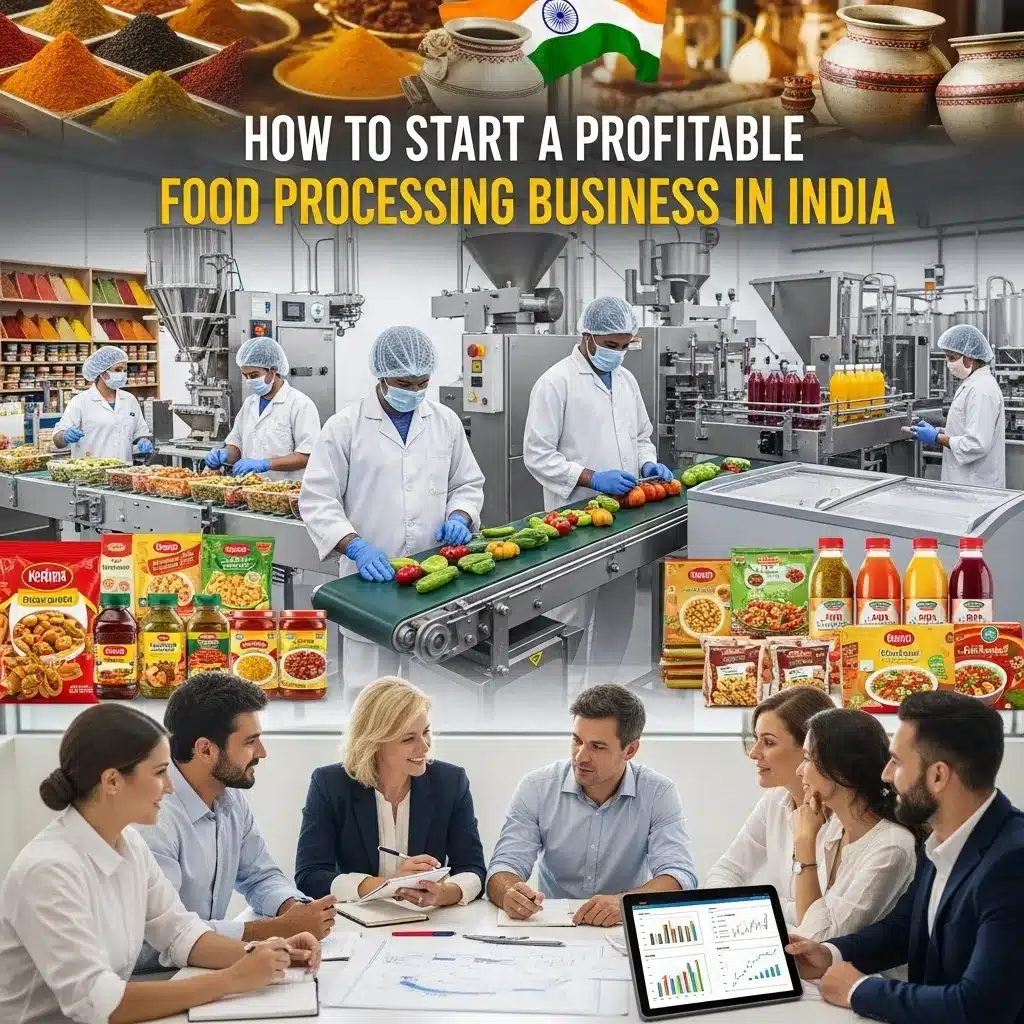

The processing industry in India has grown exponentially and is currently at 400 billion US dollars.
While spanning from agriculture to manufacture and finally consumption, This ecosystem in its entirety is far from efficient, accounting for less than 5 percent of the total processed fruits and vegetables and only one third of the total processed milk.
Such scenario is lamentable and represents a grave opportunity for post-harvest loss and under-utilisation of staggering potential.
However, in a wave of enthusiasm for US-style entrepreneurship in an unrestricted and burgeoning market, unrestricted consumer behavior, and increasing family business promotes, this starnge scenario should be considered report.
The Ministry of Food Processing Industries- MoFPI seems to be the most favorable body in this case with its entrepreneurial driven strategies for infrastructure development, inter-firm support, and incentive based modular approaches.
Read More: List of 33 Profitable Food Manufacturing Business Plans
How to Start a Food Processing Business
Indeed the schemes shall fall indifferently under major three heads. Infrastructure Development Mega Feet Parks, additionally Cold Chains and Agro Processing Clusters.
Incentives for Scale Production Linked Incentives Schemes PLISFPI. Support for Micro Enterprises Formalization and credit for the smaller food units under PMFME.
Schemes of these types currently offer a synergistic growth environment in the form of micro units with exports ready industries.
Pradhan Mantri Kisan SAMPADA Yojana-PMKSY
With a budget of ₹6,000 Crores, the goal would be to create an ecosystem of value addition while minimising wastage. An entrepreneur who invests in processing and preservation facilities will be provided a maximum of a grant of 35 – 50 percent, on the terms of the entrepreneur credit.
Mega Food Parks
Food parks are to be commercial or industrial clusters with a common facility, such as cold storage, pack houses and testing labs. These facilities can be developed by the members of the park, so the start-ups can spend more time on innovation rather than spending a lot of resources on facility development-How to Start a Food Processing Business.
Integrated Cold Chain & Value Addition
For perishable products like fruits & vegetables, dairy, seafood the grant for setting up pre-cooling, freezing, and the rest of the cold chain with transport, up to ₹10 crores can be provided for refrigerated transport.
Creation/Expansion of Food Processing Capacities-CEFPPC
These programmes will assist Small and Medium Enterprises, SMEs to upgrade/ expand their factories by providing a grant of up to ₹5 crores.
Agro-Processing Clusters
Agro-Processing Clusters, APC develops industrial amenities in a miniature form, near to the farms by providing a grant up to ₹10 crores to rural entrepreneurs to set up modern facilities-How to Start a Food Processing Business..
Operation Greens
The achievemets under Operation Greens have, till now, been the inclusion of an array of 22 perishables, having disbursed grants for the construction of Processing and Storage Infrastructures of 35 to 50 percent range for various perishables including the unofficial staple- tomatoes, onions, and potatoes.
Food Safety & Quality Development
By granting funding to the labs and training centers, the aim is for the entrepreneurs to satisfy both domestic and foreign quality requirements.
Read Our Book: Click Here
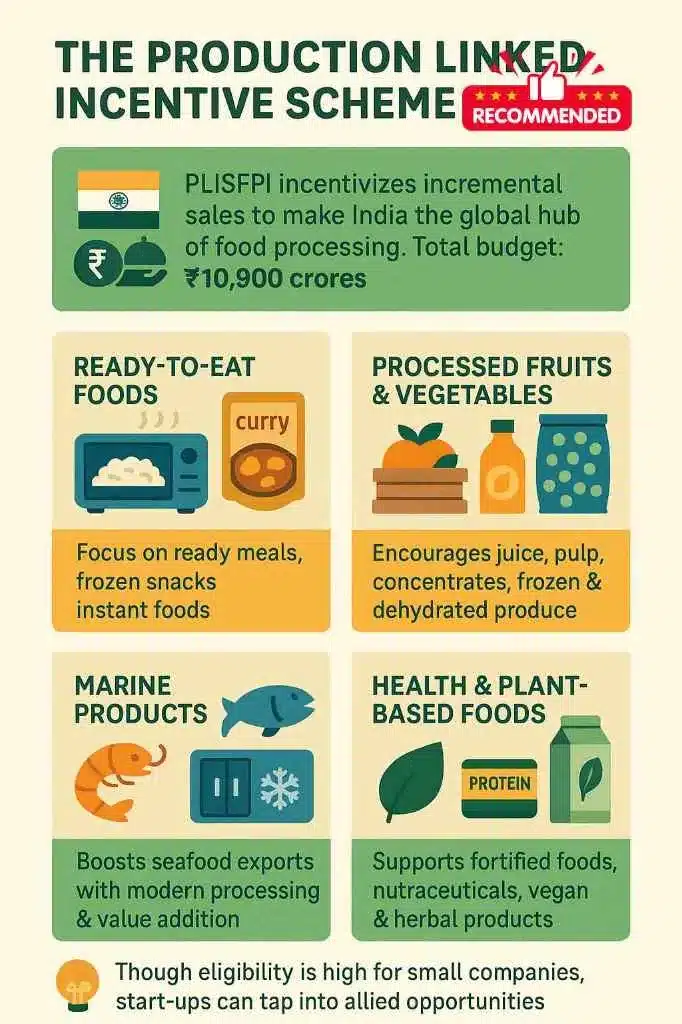
Production Linked Incentive Scheme for Food Processing Industry (PLISFPI)
In an effort to catapult India to be the capital of food processing in the world, this scheme will provide incentives for incremental sales. The scheme has been allocated an outlay of ` 10,900 crores, which has been tentatively earmarked for the following categories:
- Ready-To-Eat Foods
- Processed fruits & vegetables
- Marine products
- Health and plant-based foods
Regardless of the scheme’s stringent eligibility criteria, coupled with the scale-too-high-to-measure grading system, small companies still have an opportunity if they partner with PLI beneficiaries as contract manufacturers, or if they have the propensity to be level foster advanced technology and export networks-How to Start a Food Processing Business.
Micro Food Processing Enterprises (PMFME)
The strategy aims to address approximately 2.5 million micro units and seeks to formalize and upgrade micro and small food businesses by the following provisions:
- 35% subsidy (maximum exempt subsidy-₹10 lakh, per unit)
- Support for FPOs, SHGs, and cooperatives
- One District One Product (ODOP) for local area specializations
This benefits small units in modernization, food safety, and integration into larger value chains.
Emerging Food Processing Infrastructure
India has undergone drastic changes in its agriculture sector as a result of MoFPI’s implementation of over 40 mega parks and around 400 cold chain projects. In addition, 100 food testing laboratories are being established to assess and enhance food quality and promote exports.
The main benefits of starting a business in a cluster include reduced costs as well as shared resources and logistics-and certifications.
Read More: Startup Guide to Building Global Food Processing Business
Import & Export Opportunities
India still imports chocolates, cheeses, and several other processed foods. They are all relatively simple to manufacture domestically, making imports a target for startups to fulfill, such as:
- Bean to bar chocolates
- Nut butters & spreads
- Dairy products (mozzarella/greek yogurt)
- Vegan options
There is a budding demand for Indian snacks, condiments and ready to eat meals in Asia, Africa, and Middle East which provides immense potential for exports. Moreover, trade agreements like the India-UAE CEPA result in low tariffs making the market ideal for startups.
Prime Business Prospects for Food Startups
Foods that are ready-to-eat and convenience foods like frozen meals, instant mixes, and wholesome snacks for busy urban consumers.
Millet and Associated Health Foods – Cereal bars, gluten free bakery products, and millet based drinks made from indigenous grains-How to Start a Food Processing Business.
Plant-Based and Vegan Products – Meat alternatives, milk from almonds, vegan cheese, and other products for health-focused consumers.
Processing of Fruits and Vegetables along with Beverages – Juices, canned products with a long shelf life, dehydrated fruits, and other products.
Blended Spices and Masala, Ethnic Snacks, and Value Added Dairy Products – Hygienic papad, masala mixes, cheeses, probiotic yogurts, and other products.
Success Stories
- Amul – A cooperative model that generated millions of dollars for farmers.
- Lijjat Papad – A quality focused women enterprise grown due to massive collaboration and partnerships.
- Paper Boat – Innovative packing for traditional Indian drinks.
- Haldiram’s – A regional snack with added value became popular around the world.
Every history shows that with a small touch of quality and strategic marketing, innovation of any type can become a gigantic success story.
Read Our Project Report: Click Here
How NPCS Can Assist You
Starting a food processing business requires more than passion. It requires meticulous attention to both elements of strategy and finance.
Niir Project Consultancy Services (NPCS) is regarded as a one-stop partner for the aspiring entrepreneur wishing to set-up or grow food businesses within the frameworks of the MoFPI-How to Start a Food Processing Business.
For you, NPCS prepares detailed techno-economic feasibility reports and market surveys, which include machinery, process flow diagrams, market research, cost estimates, and financial projections-How to Start a Food Processing Business.
This approach will provide you an insight into the feasibility, investors’ acceptance, and bank financing confidence.
NPCS will not only assist you in devising an action plan and executing it, but will also ensure that you avail of government incentives and sustainability targets that are set.
Find the Best Idea for Yourself With our Startup Selector Tool
Conclusion of How to Start a Food Processing Business
There is an “ under change” food processing future India and NPCS and the MoFPI’s joint schemes will provide the means to create food brands for export, while also reducing agricultural waste and pushing for employment.
However, success requires synchronization of product offerings and purpose with the demands of the target market, availability of government funding, and ensuring compliance with quality and sustainable practices.
FAQS-How to Start a Food Processing Business
Who qualifies to be a participant under the schemes of MoFPI?
Eligibility criteria hinges on the individual schemes. Individuals, food processing business operators, cooperatives, companies, FPOs, and SHGs can apply under any of the schemes.
What are the subsidy rates under PMKSY?
Depending on the type of project and the location, the funding of entrepreneurs ranges anywhere between 35 to 50 percent of the eligible project cost.
Are startups entitled to apply under PLISFPI?
Startups can take indirect advantage of the PLI scheme by supplying their products or contracting manufacturing works to other, larger approved entities under the PLI scheme.
In what way does the PMFME assist small food enterprises?
The PMFME scheme provides funding of up to 10 lakh INR and with added support for training, branding, and formalization, it allows small enterprises to achieve a competitive level.
Where can one obtain project reports for the purpose of an application?
NPCS prepares comprehensive project reports for food based startups covering both the technical and financial aspects which aids the entrepreneurs in project planning and financing.