High Quality White Quartz Processing
High quality white quartz has become one of the most strategically significant industrial minerals in modern manufacturing. Its applications range from glass and ceramics to electronics, construction and engineered stone. For entrepreneurs and startups, processing white quartz is a rare series of factors: stable demand, scalable processing, export opportunities, and long-term profitability.
White quartz, as a replacement for silica, has been used in the traditional industries and also in the advanced technological industry in the form of silica granules, quartz powder, and quartz sand. High purity quartz products have gained higher market value because of global infrastructure development, rising renewable energy production, and increased electronic demand together with high performance material requirements.
Get Detailed Insights from This Book: India High Silica Quartz Grit Market
Understanding High Quality White Quartz
White quartz exists as a crystalline form of silicon dioxide (SiO2) which displays hardness and chemical stability together with heat resistance. High-quality quartz exhibits distinct characteristics which include low iron content and stable crystal structure and minimal impurities. The combination of these characteristics creates suitability for both industrial purposes and advanced technological industries.
Raw quartz undergoes processing to create three main product types:
- Quartz silica granules – Coarse particles for glass, ceramics and foundries
- Quartz powder – finely ground quartz for electronics, coatings, plastics and engineered stone.
- Quartz sand – fine particles for use in construction, glassmaking, water treatment, and specialty ceramics
The processing of quartz delivers significant value increments which enable access to premium markets that include solar glass and semiconductors and engineered stone products.
Important Products And Their Uses
Quartz silica granules are used extensively in glass manufacturing, ceramics and refractory materials and water filtration. Their even size and chemical inactivity are the guarantee for high-quality glass clarity and thermal stability in the industrial casting process.
Quartz powder is very versatile and is used in paints, coatings, plastics, adhesives, ceramics and electronics. Ultra-pure quartz powder is the key for silicon wafer and photovoltaic cells.
Quartz sand is one of the most used quartz products in the world. It is an important part of construction materials, solar glass, optical glass, water filtration, and specialty ceramics. Its hardness and consistent grain size make it indispensable in industries.
Get Detailed Project Report (DPR): Quartz Slabs Manufacturing Plant Project Report
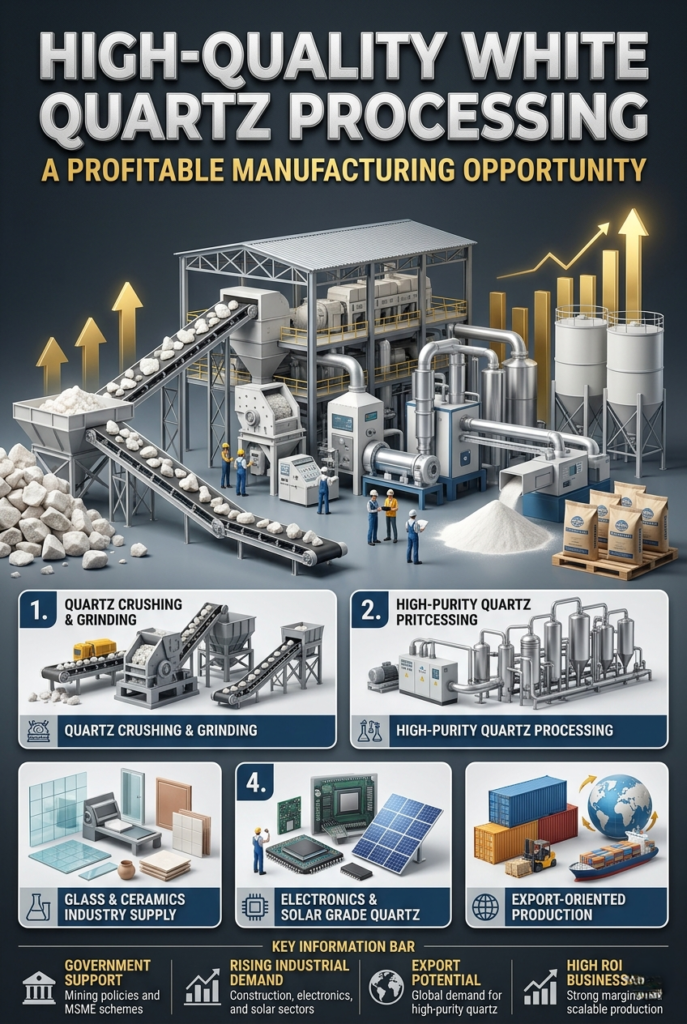
How White Quartz is Processed
The production of good quality quartz follows an orderly workflow:
- Raw quartz sourcing and manual inspection to remove visible impurities.
- Crushing and grinding to get particle sizes.
- Washing and separation of magnetic to remove dust, clay and iron particles.
- Chemical Treatment for Ultra High purity Grades (optional).
- Drying, grading and packaging according to specifications from customers.
Automation in crushing, grinding, and purification has a direct impact on the quality of products, the cost of operations, and market positioning. A single plant can often produce many products – sand, powder and granules – using flexible grading systems.
Market Demand and Growth
The global quartz market has seen steady growth during the past decade, from the construction, electronics, solar energy, and engineered stone industries. High-quality white quartz products are often traded at premium prices because of their low availability and high standards.
- Asia-Pacific is the leading region in terms of demand because of the growth in infrastructure, manufacturing, and solar energy investments.
- When looking at high-purity and specialty quartz used for electronics and precision applications, we have: – Europe and North America.
Entrepreneurs enjoy a number of structural drivers: rapid urbanization, the growth of renewable energy, rising electronics and semiconductors production and export opportunities for good quality quartz.(High Quality White Quartz Processing)
Related Article: 10 Best Manufacturing Business Ideas in India for 2026 (Low Investment & High Profit)
Profitability Insights
The economics of operating a quartz processing plant depend on a number of factors: quality of the raw material, plant capacity, level of automation and target markets. Major costs are procurement, machinery, labour, energy costs, and logistical costs.
Mid-scale processing units tend to have healthy margins because of the steady industrial demand. Value addition by purification, micritization and customized grading add further to improved profitability. Revenue distribution usually appears like:
- Quartz sand: 42%
- Quartz powder: 35%
- Quartz silica granules: 23%
Premium grades and export-oriented products have the highest margins and specializing in them is a profitable strategy.
Uniformity of quality is important. Particle size, purity, and moisture content must meet the industry standards. Environmental compliance such as dust control, water management and waste disposal are also important. Certifications and traceability increase credibility, particularly in export markets and with industrial clients.
Future Trends
The quartz processing industry will develop through the combination of purity requirements and energy-saving technologies and customized solutions for different applications. Solar-grade and electronic-grade quartz is likely to grow faster than conventional construction grades. Automation, digital quality monitoring and sustainability practices will be the characteristics of competitive advantage. Early investment in quality control and process optimization sets startups up for long term contracts and premium markets.
Conclusion
High-quality white quartz processing is a resilient, scalable, and future-ready industrial opportunity. The sector maintains stability and expansion possibilities because it experiences continuous market growth together with rising demand for advanced products across all its different use cases. Quartz processing firms can be successful and survive the market over time by being run by entrepreneurs who constantly maintain high quality standards and maximize the Process efficiency while tailoring the products to market requirements and expectations.
Frequently Asked Questions
What is the minimum investment for the establishment of the quartz processing unit?
Investment is based on capacity and automation, but small to mid-scale units require a moderate capital requirement.
What is the best profit margin on quartz products?
High-purity quartz powder and specialty grades offer the highest margins as compared to standard sand or granules.
Is quartz processing a good option for export oriented businesses?
Yes, good white quartz products have a good export demand in glass industry, solar industry and electronics.
What are the key dangers of quartz processing?
Raw material inconsistency, quality control issues and energy costs are major risks. Mitigation in them is done by proper planning and process management.
Can a single plant produce several products containing quartz?
The facility uses flexible processing methods together with grading systems to produce three different product types which include sand and powder and granules.