Introduction: High-Capital Manufacturing India
India’s manufacturing ecosystem is changing its structure. Entrepreneurs and MSMEs today investigate capital-heavy industrial sectors which require continuous operation instead of their previous focus on standard consumer products and light manufacturing operations. Government focus on infrastructure, import substitution, mineral beneficiation, and policy stability has strengthened the case for investments in metals, minerals, and chemical manufacturing.
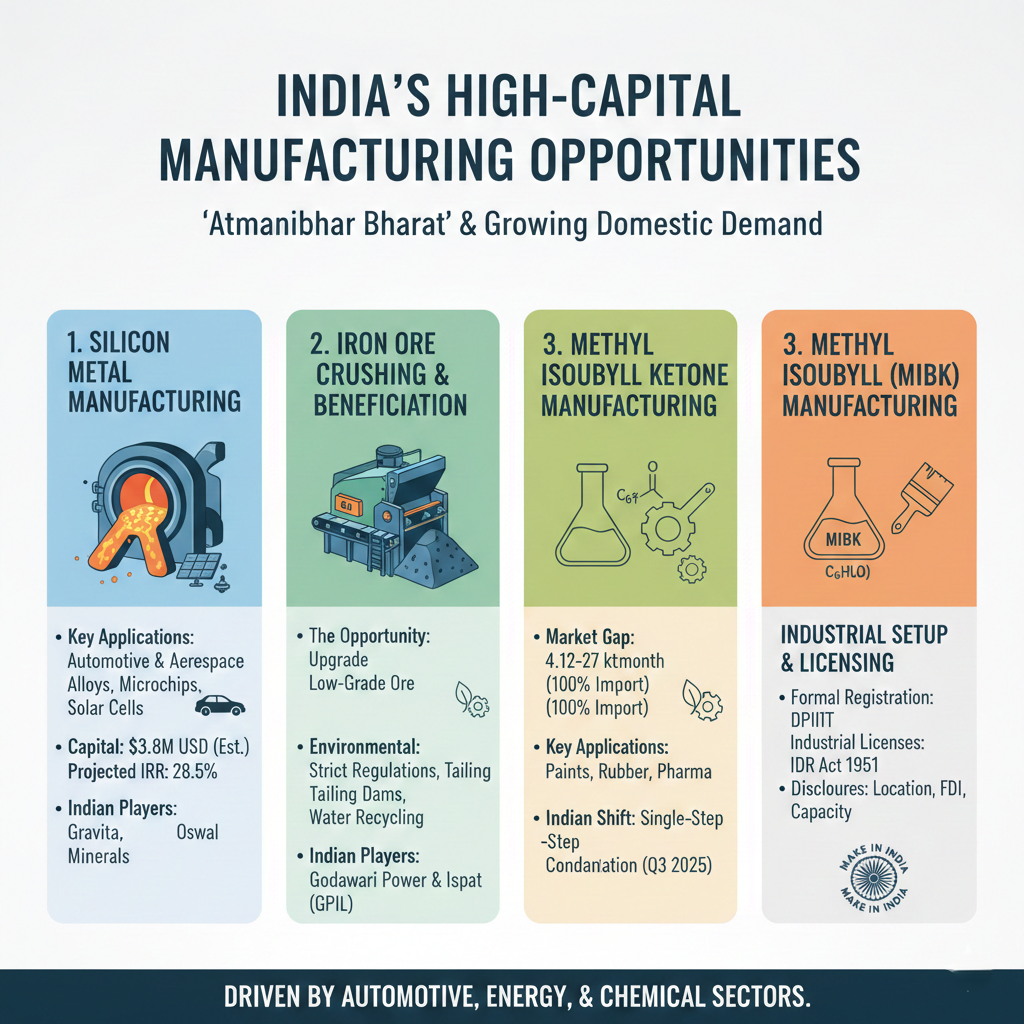
Among the most promising opportunities in this space are Metallurgical Grade Silicon Manufacturing, Iron Ore Crusher Plant Operations, and Methyl Isobutyl Ketone (MIBK) Manufacturing. These sectors vary in terms of capital need, technical complexity and scaleability, but all share the common traits of good industrial demand and long-term relevance.
This article gives a professional, investor perspective overview of these three manufacturing businesses including applications, operational considerations, market outlook and profitability potential.
Read More: Silicon Metal – Manufacturing Plant, Detailed Project Report, Profile, Business Plan, Industry Trends, Market Research, Survey, Manufacturing Process, Machinery, Raw Materials, Feasibility Study, Investment Opportunities, Cost and Revenue, Plant Economics
1. Metallurgical Grade Silicon Manufacturing in India
Industry Overview
Metallurgical Grade Silicon which people commonly know as silicon metal serves as a vital industrial raw material that exists in its common form with 98 to 99 percent purity. It serves as the primary material used in downstream production of aluminum alloys silicones solar photovoltaic systems and advanced chemical products.
India maintains its position as a silicon metal net importer because domestic silicon consumption continues to increase. This supply gap is a clear opportunity for good manufacturers with access to good power and raw materials.
Key Applications
The main fields of application of silicon metal are:
- Aluminum alloy production for automotive and engineering components
- Silicone rubber, seal, adhesive and specialty chemicals
- Solar wafer and photovoltaic module manufacturing
- Semiconductor and electronic precursor materials
Growth in electric vehicles, renewable energy, and construction continues to drive long-term demand.
Manufacturing Process and Cost Drivers
Silicon metal production occurs through submerged electric arc furnaces which work at very high temperature levels. High purity quartz reacts with carbon-based reductants such as coal, coke or charcoal to form molten silicon, which is then tapped, cast, crushed and sized.
The most critical cost and operational factors include:
- Electricity cost and power reliability (power can account for 30–40% of production cost)
- Quality and consistency of quartz and carbon reductants
- Furnace lining life and maintenance practices
- Availability of skilled metallurgical and electrical manpower
Plant location, therefore, becomes a key factor in long-term profitability.
Market Outlook and Profitability
Domestic demand is increasing because of the growth in aluminum alloys and renewable energy. Medium scale and well-managed plants often have EBITDA margins of 18-25% with payback periods of four to six years.
The possibility of exporting products enhances the project’s feasibility which becomes especially crucial when global supply shortages occur.
Read More: Canning of Fruits (Pine Apples slices, Litchee, Cherries, Straw berries in syrup)-Manufacturing Plant, Detailed Project Report, Profile, Business Plan, Industry Trends, Market Research, Survey, Manufacturing Process, Machinery, Raw Materials, Feasibility
2. Iron Ore Crusher Plant Business in India
Business Model Overview
Iron ore crusher plants are not end products but processing and service-oriented businesses. Their duty is to reduce run of mine iron ore into standardised sizes needed by steel plants, sponge iron and pellet plants.
Demand for crushing services is tied closely to steel production that is structurally strong in India given the infrastructure and urban development.
Plant Configuration and Operations
A typical iron ore crusher plant includes Primary jaw crushers and secondary cone crushers Screening and classification systems Conveyor belts and stockpiling yards Dust suppression and environmental control systems Operational success depends on high equipment uptime and efficient wear-part management and disciplined preventive maintenance
Raw Material Sourcing and Location Advantage
Crusher plants may operate through:
- Captive iron ore mines
- Long-term supply agreements
- Toll-crushing contracts for mining companies
The main factors that determine site selection include distance to mining sites or steel usage locations and the consistent hardness of ore and effective transportation systems.
Read More: METHYL ISOBUTYL KETONE (MIBK) – Manufacturing Plant, Detailed Project Report, Profile, Business Plan, Industry Trends, Market Research, Survey, Manufacturing Process, Machinery, Raw Materials, Feasibility Study, Investment Opportunities, Cost and Revenue
Profitability and Scalability
Well-run crusher plants generally achieve EBITDA margins of 20 to 35 percent which depends on their operational effectiveness and facility size. The modular nature of crushing equipment enables phased capacity expansion and hence makes this business appealing for entrepreneurs who would like to get a steady cash flow with manageable technical risk.
3. Methyl Isobutyl Ketone (MIBK) Manufacturing in India
Industry Overview
Methyl Isobutyl Ketone MIBK serves as an industrial fluid which demonstrates high solvency power and low evaporation speed. It is a critical input in paints, coatings, rubber processing, pharmaceuticals, and specialty chemicals.(High-Capital Manufacturing India)
The Indian market currently relies on imported MIBK products which creates possibilities for local manufacturers who focus on producing high-quality products that meet safety requirements and regulatory standard.
Key End-Use Industries
Major consumers of MIBK include:
- The paint and industrial coating industry
- The rubber and tire production sector
- The pharmaceutical industry which produces intermediates
- The sector that manufactures specialty and fine chemicals The demand for
products increases at a stable rate which matches the construction and automotive and industrial manufacturing processes.
Read More: Top 5 Profitable Metal Alloy Businesses to Start in India
Process of Manufacture and Technical Requirements
compound through acetone condensation and hydrogenation and fractional distillation. The established method needs complete control of its production processes together with effective security protection mechanisms.
Critical operational requirements are:
- Sustained supply of acetone and hydrogen
- Efficient solvent recovery and recycling systems
- Compliance with fire safety, pollution control, and environmental norms
- Skilled chemical engineers and trained operators
Revenue, Market Potential and Returns
MSMEs with technical expertise can establish profitable MIBK production facilities through import substitution and long-term supply agreements. Companies experience improved profit margins during periods of supply disruptions and logistics difficulties that affect the global econom.
Read More: 10 High-Demand Downstream Steel Product Manufacturing Ideas in India
Strategic Lessons from Indian Manufacturing Leaders
India’s leading industrialists have some useful insights to offer new manufacturers:
- Ratan Tata focused on capacity building in the long run and backward integration
- Pankaj Patel (Cadila Healthcare)
- Baba Kalyani (Bharat Forge) invested early in automation and global quality standards
Their success highlights the importance of patience, technology ownership, operational discipline, and export readiness.
Policy Environment and Institutional Support
Manufacturing in these sectors fits well with India’s industrial priorities, in particular:
- Import substitution and self-reliance initiatives
- Mineral beneficiation and value addition
- Environmentally compliant chemical manufacturing
Improved regulatory clarity, faster approvals, and supportive infrastructure policies have reduced entry barriers for serious manufacturing investors.(High-Capital Manufacturing India)
Conclusion
Metallurgical grade silicon manufacturing, iron ore crusher plant operations and MIBK manufacturing are all unique and long end industrial opportunities in India’s changing manufacturing landscape.
Silicon metal offers two benefits because it delivers energy efficiency and enables businesses to develop their strategic plans while crusher plants generate steady cash flows which increase their capacity to operate and MIBK production provides value through its technical expertise and ability to replace imported materials.(High-Capital Manufacturing India)
For entrepreneurs the process of achieving success requires them to align their funding resources with their managerial competencies and their ability to follow regulations while maintaining their business operations. In a capital intensive economy towards industrial deepening, well-planned manufacturing venture continues to provide sustainable and scalable growth.