Food Parks Projects: The paradigm shift in the Indian food processing industry has gained unprecedented momentum. What used to comprise a few scattered non-mechanized units is now transitioning into an organized sector where technology is an integral element and exports are concentrated.
Such a radical transformation can be attributed to two important institutions and the strong assistance they provide – the Ministry of Food Industry and the National Bank for Agriculture and Rural Development.
According to the MFP Annual Report 2024-25, India’s food exports for 2023-24 are recorded at USD 46.43 billion. The food industry now accounts for 7.93% of manufacturing VAT and 8.45% of agricultural VAT. The growth potential is huge and there are competitive advantages in the market.
However, good ideas are not enough. The growth potential is huge and there are competitive advantages in the market; investment, robust infrastructure and proper policy frameworks are more needed.
This is the problem that NABARD and MoFPI are trying to solve. Together, they have structured financing schemes in excess of ₹ 800 crore to support Mega Food Parks, Agro Processing Clusters and standalone processing units.
This translates into readily available capital, supportive infrastructure and a thriving business environment for startups in the growing Indian food industry.
Read More: Mega Food Park Manufacturing Plant Detailed Project Report
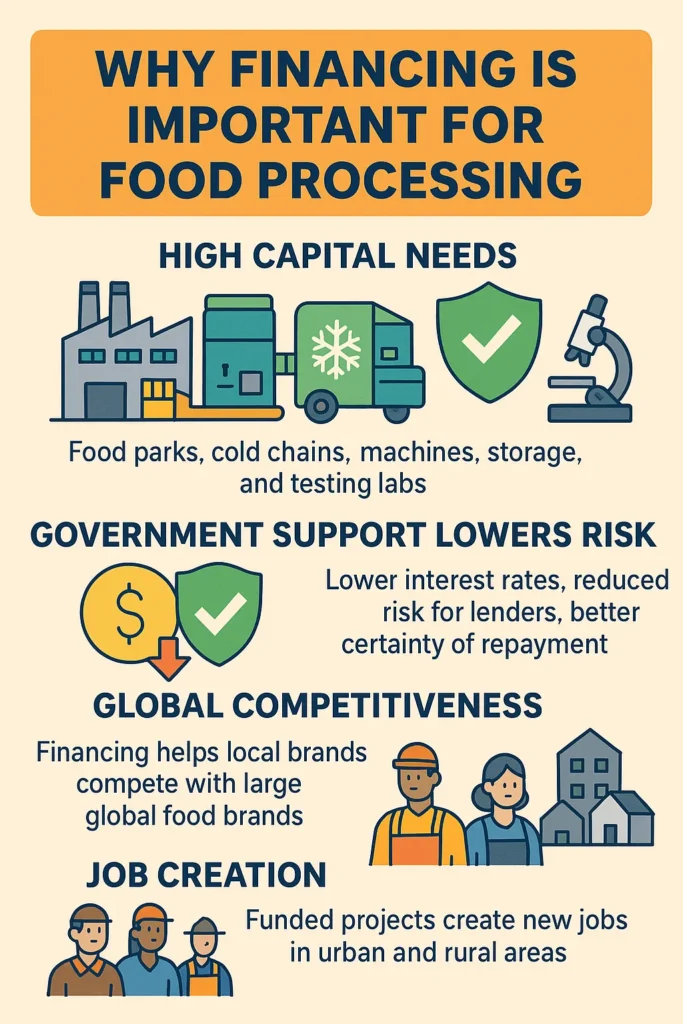
1. Why Financing is Important for Food Processing
Here is the situation. Startups need financial support and scale to grow.
Capital requirements are extensive: Food parks and cold chains have high capital requirements due to the high cost of complex machinery, storage and testing laboratories.
Lower risk: Government support reduces risk and cost of capital, provides lenders with increased certainty of repayment and subsidizes interest rates. Global Competitiveness: Available financing enables competition with global food brands.
Job creation: Each funded project creates new jobs in both urban and rural areas.
Thus, startups can benefit and grow with the support provided by NABARD and MoFPI in a safe and sustainable manner.
2. Role of NABARD in Powering Food Parks
2.1 NABARD Food Processing Fund
NABARD manages the Food Processing Fund, which finances state bank-led projects by lending up to 95% of the total project cost to promoters and 75% to private promoters.
According to NABARD’s 2024-25 MFPI report so far:
- 14 Mega Food Parks sanctioned to the tune of ₹549.35 crore,
- 9 agro-processing clusters worth ₹92.07 crore,
- 14 individual units at ₹ 204.30 crore a
- 3 Industrial Food Parks worth ₹333.99 crore.
NABARD thus disbursed more than ₹800 crore for food processing projects across the country.
Read More: Mega Food Park – Encouraging Food Projects in India
2.2 Why It Helps Startups
- Startups can benefit from long-term loans, which are additionally subsidized by low interest rates.
- Less collateral is required due to government guarantees.
- They can benefit from food parks with shared facilities such as cold storage, warehouses and testing laboratories.
3. MFPI Infrastructure Policy and Support
The Ministry of Food Industry (MoFPI) provides a foundation that simplifies financing and facilitates business expansion.
3.1 Lower Taxes and Duties
The basic duty on refrigeration and cooling equipment is thus reduced to 5%.
Under the advance authorization system, import duties on raw food products or intermediate products are waived.
3.2 Mega Food Parks
- Development of cold chains, warehouses and packaging equipment.
- There are more than 22 Mega Food Parks in operation in India.
3.3 Agro-processing clusters
- Small to medium district level food processing centers under the One District One Product (ODOP) framework.
- For example, mango pulp units in Uttar Pradesh, spice centers in Kerala and orange processing facilities in Nagpur.
3.4 Operation Greening
- Support the cultivation and processing of tomatoes, onions and potatoes.
- It equalizes the price of these crops in favor of producers and consumers.
4. Startup Opportunities in the Food Industry
There are several new food processing businesses to watch.
4.1 Fruits and Vegetables
- Preparation of dehydrated powders and lyophilized snacks.
- High demand in the Middle East and Europe.
4.2 Legumes and Oil Seeds
- Production of protein isolates, cold-pressed oils, gluten-free flour.
- High Demand in USA, Canada and Europe.
4.3 Dairy products
- Production of whey protein, lactose-free milk and cheese.
- High level of demand from global healthcare markets.
4.4 Meat and Seafood
- Production of frozen seafood and prepared meals with halal certification.
- Mainly exports to the Persian Gulf and Southeast Asia.
4.5 Spices and Cocoa
- Production of spice extracts, oil resins and chocolate.
- Great demand in exports to the EU and USA.
4.6 Jaggery and Natural Sweeteners
Jaggery and other natural sweeteners are becoming popular in North America and Europe.
Read Our Project Report: Click Here
5. Use Data Import and Export to Find Opportunities
India is still lacking in food self-sufficiency, which is a big opportunity for local start-ups:
- Edible oils: India imports $15 billion, indicating a big opportunity for local oil companies.
- Cocoa Products: Imports worth $513 million, indicating a strong opportunity for domestic chocolate production.
- Beverages: Imports worth $1.5 billion, indicating significant opportunities for craft juices, fruit wines and vinegars.
Startups can avail NABARD loans and MoFPI schemes to start projects and reduce import burden.
6. Real Success Stories
- LT Foods: Started small but has now become a global rice exporter.
- Everest & MDH: Grown into a billion dollar spice company thanks to strong marketing and abundant raw materials.
- Paper Boat: Created new demand for Indian traditional drinks.
- Amul: Became the largest dairy company in the world by leveraging cooperative and government support.
These examples clearly show that Indian startups can capture international markets if given the right support and innovative ideas.
Read Our Book: Click Here
7. The Role of NPCS in Helping You Set Up a Food Park Business
NPCS assists entrepreneurs in realizing their potential and helping them achieve profit. They create comprehensive market surveys and DPRs that cover the entire value chain from manufacturing process, required machinery, cost planning, market research and financial forecasting.
Additionally, NPCS assists start-ups in linking their projects with NABARD financial instruments and MFP infrastructure schemes. Following industry best practices, entrepreneurs will be able to minimize their risks, speed up credit approval, and launch a food business ready for international trade.
8. Simplified Process for Business Owners
- Product Selection – Focus on products that are in high demand internationally
- Feasibility study – to involve NPCS in the development of a comprehensive DPR.
- Loan Applications – Leverage NABARD and MoFPI resources.
- FSSAI Registration – Achieve internationally recognised standards, including HACCP and ISO.
- Tax Benefits – Import equipment of a certain value at reduced duties.
- Food Park Integration – Leverage Food Park resources for rapid deployment.
- International Markets – Focus on the Middle East, Africa, Europe and the US.
Find the Best Idea for Yourself With our Startup Selector Tool
Conclusion: The Future of Food Finance
The food sector in India is growing rapidly and undergoing transformational development. Startups can now create strong, modern and global food markets with the infrastructure built by MoFPI coupled with easy funding from NABARD. The business ecosystem is ready with Mega Food Parks, Agro Clusters, concessional loans and export incentives.
With NPCS’s expert guidance, startups can plan, finance and integrate more efficiently and on a global scale. The time to invest in food parks and processing is now. The future of food will be held by those who innovate in intelligent packaging and processing.
Food Parks Projects: Frequently Asked Questions
1. What is Mega Food Park?
A. Mega Food Parks are large industrial units for food processors that have cold storage, packaging and laboratory facilities.
2. How NABARD helps food startups?
A. NABARD provides subsidized loans for food parks, food clusters and food processing units.
3. What schemes does MFP provide?
A. MFPI provides subsidized loans, infrastructure support and tax benefits for entrepreneurs in the food industry.
4. What types of food businesses can benefit?
A. The programs benefit those involved in fruit and vegetables, dairy, meat, spices and many more, including traditional products such as jaggery.
5. In what ways can NPCS help me with my food processing project?
A. NPCS prepares comprehensive project reports, assists in obtaining funding and offers advice during project implementation, including compliance, planning and export.