Electronics Component Manufacturing Business
There are 13 Semiconductor Projects currently working or in development in India. Four are projected to go into commercial production this year. The government has allocated ₹8,000 crore in this financial year under the Modified Programme for Development of Semiconductor and Display Manufacturing Ecosystem. The Electronics Component Manufacturing Scheme (ECMS) has sanctioned 75 projects with a total value of about ₹61,000 crore in eight states.
This headline number isn’t enough to tell you: Every chip fab, every PCB assembly line, every smartphone plant requires thousands of supporting inputs — anti-static packaging, precision fasteners, cleanroom consumables, specialty chemicals, calibration services. India presently imports nearly all of them from China, Taiwan, South Korea and Japan. The government is constructing the anchor factories. The ancillary supply chain is very loose.
The ₹61,000 Crore Signal — And the Component Gap Nobody Is Talking About
The opportunity lies in understanding what India’s electronics manufacturing sector really requires.
Medium and high-tech sectors now account for 46.3% of the manufacturing value added in India, according to India Electronics Manufacturing Report by IBEF. The outlay for ECMS has been raised from ₹22,919 crore to ₹40,000 crore, an increase of 74%, as per the Budget 2026–27, indicating the government’s commitment to the matter. The government is establishing three dedicated chemical parks under the plug-and-play cluster model to reduce import dependency on specialty chemicals used for PCB assembly.
The first semiconductor plant outside the India Semiconductor Mission (ISM) operates in Bhiwadi, Rajasthan. The plant has started operations. Thousands of tonnes of ancillary goods will support this facility each year, including epoxy compounds, bonding wire, carrier tape, anti-static packaging, cleanroom garments, and calibration services. All of these are imported at the moment.
Get Detailed Project Report (DPR): Transistor and Semiconductor
| State | Electronics/Semiconductor Cluster | Component Gap | Proximity to Fab |
| Karnataka | Bengaluru Electronics City, Mysuru | PCB chemicals, precision fasteners | High — multiple EMS companies |
| Tamil Nadu | Oragadam Chennai, Krishnagiri | Anti-static packaging, cleanroom PPE | High — Samsung, Foxconn supply chain |
| Maharashtra | Ranjangaon MIDC Pune, Aurangabad | Calibration services, epoxy compounds | Medium — automotive electronics |
| Gujarat | Sanand GIDC, Ahmedabad | Stencil printing materials, solder paste | Medium — new semiconductor parks |
| Andhra Pradesh | Tirupati Electronics Cluster | PCB assembly materials, conformal coatings | High — new fabs in development |
| Rajasthan | Bhiwadi (ATMP/OSAT fab) | All ancillaries — zero local supply currently | Direct — first fab active |
Why the Entry Window Is Specifically Now
The Startup India programme MoU with Vultr India offers DPIIT recognised startups cloud computing credits and technical infrastructure support, which allows a DPIIT recognised start-up in electronics components to operate their quality management systems and ERP platforms without incurring any significant IT expenses. This is ₹60,000–1.5 lakh a year that can be saved for a unit which requires NAD CAP equivalent quality documentation.
According to Business Today’s analysis of India’s semiconductor supply chain, the combined value of electronic component import substitution available to domestic SME suppliers across PCB assembly, packaging, and cleanroom consumables exceeds ₹8,000 crore annually — a market that is, today, almost entirely served by imports.
This is not the chip making business. It is the parts, supplies and packaging that the chipmaker purchases each week. A first-generation entrepreneur of ₹20-50 lakhs can create a thatched supply relation with an anchor fab or EMS company and get 3 years supply contracts before the other people in the market even know the market exists.
Setting Up an Anti-Static Packaging Production Unit
This is the most easily accessible point in the electronics component supply chain.
Product: ESD (Electrostatic Discharge) safe packaging — anti-static bags, trays and bubble wrap. All PCB, IC chips and assembled modules should be packaged to be ESD safe. Most of India’s imports have come from China and South Korea.
Investment: ₹18–28 lakh total.
Anti-static film slitting machine, ₹6.5 lakh for width 1.2 m and speed 500 m/min; Heat sealer and bagging line (semi-auto) ₹2.8 lakh and ESD test equipment (lab grade) ₹1.8 lakh.
Certification: BIS certification under IS 11673 and ANSI/ESD S20.20 standards can be obtained within 60 days. No electronics manufacturer can be approached without first consulting a NABL-accredited lab test report.
Location: Industrial zone and within 20 km from any EMS center in the industrial zone: either Sriperumbudur (Samsung), Oragadam (Foxconn), Bengaluru Electronics City, or Bhiwadi (ATMP fab).
Timeline: 4–6 months from registration to first supply batch.
Get Detailed Insights from This Book: Our Books
| Item | Specification | Cost (INR) |
| Anti-Static Film Slitting Machine | 1.2 m width, 500 m/min | ₹6,50,000 |
| Heat Sealer + Bagging Line | Semi-automatic | ₹2,80,000 |
| ESD Test Equipment | Lab grade | ₹1,80,000 |
| Civil Modifications (2,000 sq ft) | AC/cleanroom partition | ₹3,00,000 |
| Raw Material Stock (3 months) | Anti-static film, labels | ₹2,50,000 |
| Working Capital Buffer | 2 months opex | ₹3,00,000 |
| BIS + NABL Certification Fees | All fees | ₹80,000 |
| Contingency (10%) | ₹2,04,000 | |
| Total Project Cost | ₹22,44,000 |
The Margin Structure in Electronics Component Supply
Anti-static packaging unit producing 80,000 units/month:
Capital Expenditure: ₹20–25 lakh Monthly Operating Cost: ₹2.5–3.5 lakh Revenue at 60% Capacity (48,000 units): ₹2.8–3.5 lakh/month Revenue at 100% Capacity (80,000 units): ₹4.8–6 lakh/month Gross Margin: 38–44% Net Margin: 18–26% Payback Period: 20–28 months at 70% utilisation
Proximity and response time are the competitive advantages that are durable. A Sriperumbudur-based EMS plant will never choose a supplier 15 km away over another in Shenzhen if the former orders 20,000 bags for a production order that starts within 48 hours.
| Scheme | Ministry | Eligibility | Max Benefit | Apply At |
| Electronics Components Manufacturing Scheme | MeitY | Electronics manufacturing units | Capital subsidy on approved products | meity.gov.in |
| PMEGP | MoMSME / KVIC | New MSME manufacturing | ₹25 lakh + 25–35% margin subsidy | pmegp.kvic.org.in |
| PLI (Electronics) | MeitY | Incremental production | 4–6% incentive on production value | meity.gov.in |
| CGTMSE | MoMSME / SIDBI | MSME loans up to ₹5 crore | 75–85% credit guarantee | cgtmse.in |
| Startup India (DPIIT) | DPIIT | Recognised startups | Vultr cloud credits, mentoring | startupindia.gov.in |
| MUDRA Tarun | Finance Ministry | Loans ₹5–10 lakh | Collateral-free loan | mudra.org.in |
Entrepreneur Spotlight Meenakshi Subramaniam, Chennai, Tamil Nadu Started an anti-static packaging unit in Sriperumbudur adjacent to Samsung India with ₹16 lakh in capital. Within 18 months she secured a supplier code with Samsung, supplying 1.5 lakh ESD bags per month. Annual revenue at full capacity: ₹52 lakh. Her critical lesson: “Get your ESD test report from an NABL lab before approaching any electronics manufacturer. They won’t talk to you without it. The certification costs ₹8,000 and saves you six months of rejection.” Reference: Women Entrepreneurship Platform, NITI Aayog
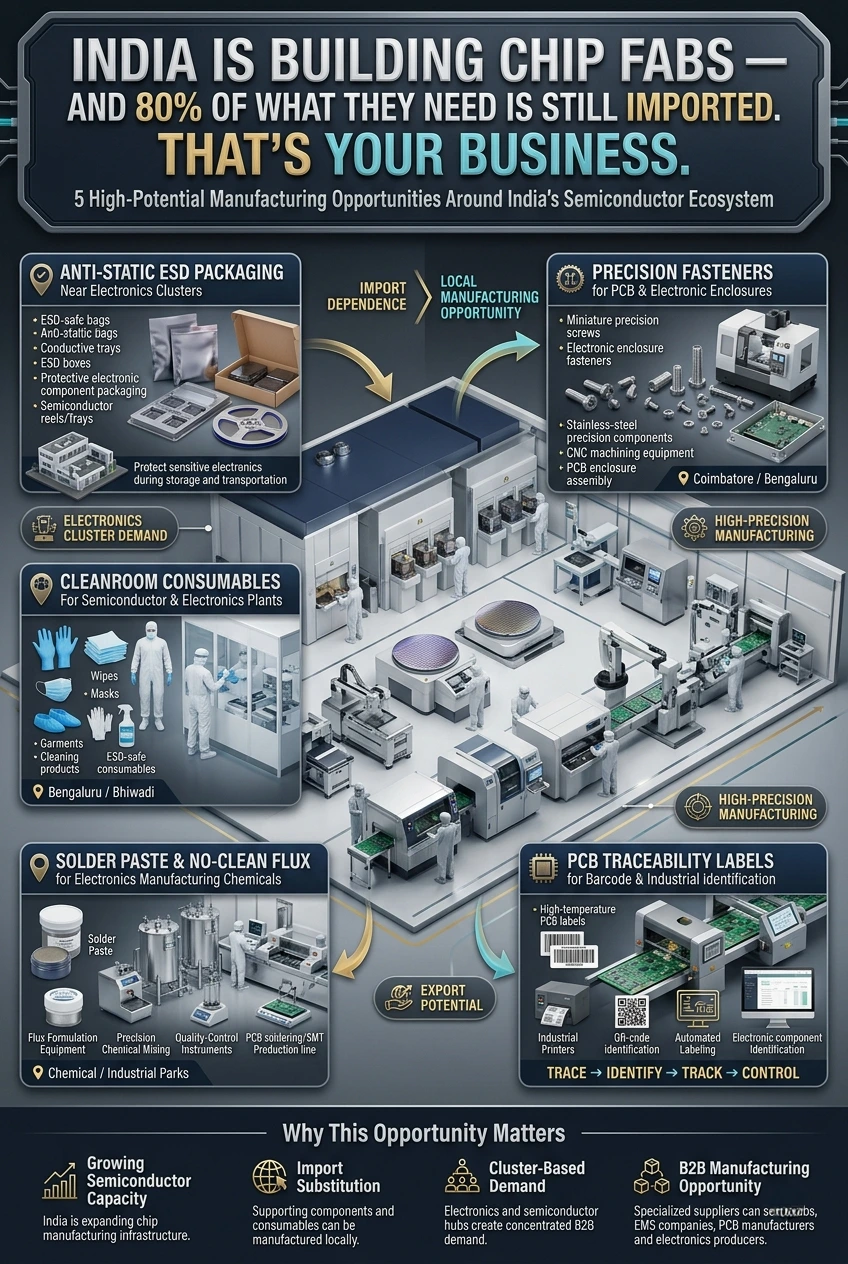
5 Electronics Supply Chain Businesses You Can Start
Anti-Static ESD Packaging Production (Near Any Electronics Cluster)
Every electronics manufacturer in India consumes ESD packaging, including bags, trays, moisture barrier bags, and static-dissipative bubble wrap. A production unit near Bengaluru Electronics City, Chennai’s Oragadam, Pune’s Ranjangaon MIDC, or Bhiwadi can supply this demand locally. The technology barrier is low; the certification barrier (BIS + ESD S20.20) is achievable in 60 days; and the market is growing at 15–20% annually as India’s electronics output scales. Net margin: 20–28%.
Precision Fasteners for PCB and Electronic Enclosures (Coimbatore/Bengaluru)
Every electronic enclosure uses dozens of M2–M5 screws, standoffs, and spacers — India imports the majority from Taiwan, Japan, and China. A CNC precision fastener unit with two Swiss-type turning machines can produce 50,000–100,000 precision fasteners per day. The Tamil Nadu Engineering Cluster in Coimbatore has the densest existing precision machining ecosystem for buyer relationships. Net margin: 18–24%.
Related Article: India’s PCB Manufacturing Revolution: 5 High-Growth Business Opportunities Worth ₹40,000 Crore
Cleanroom Consumables Manufacturing (Bengaluru/Bhiwadi)
Semiconductor fabs and ATMP units operate in Class 100–Class 1000 cleanrooms where every garment, wipe, and tool must meet contamination specifications. Nitrile cleanroom gloves and cleanroom wipes see thousands of units consumed per shift, with overseas suppliers meeting almost all of this demand. TA cleanroom consumable manufacturers can establish production units targeting fabs in Bengaluru, Hyderabad, and Bhiwadi. Rajasthan RIPS 2022 offers 30% capex subsidy for units proximate to the Bhiwadi fab. Net margin: 22–30%.
Solder Paste and No-Clean Flux Formulation (Chemical Park)
India’s PCB assembly industry uses approximately 2,000 tonnes of solder paste and flux annually, almost entirely imported. A specialty chemicals unit under technology licence from a European or Japanese partner can formulate no-clean flux and lead-free solder paste domestically. The three chemical parks in development under Budget 2026–27 are specifically designed for this category. Target buyers: Dixon Technologies, Foxconn India, Flextronics, and defence electronics manufacturers. Net margin at scale: 22–32%.
Industrial PCB Traceability Labels and Barcode Solutions
Every electronic component shipped from India requires traceability labels — barcode/QR, RoHS compliance declarations, lot number stickers. An industrial label printing unit requires a digital label printer, labelling software PC, and a packaging station. Revenue from 15–20 steady electronics clients: ₹40,000–80,000/month. The fastest entry in the sector with the lowest capital requirement and zero raw material complexity.
Identify high-growth industries before others do
NPCS: Your Electronics Component Entry Guide
Before approaching Samsung’s or Dixon’s procurement team, you need technical product documentation and a credible supply capability statement. Niir Project Consultancy Services (NPCS) publishes project reports for electronics components — anti-static packaging, precision fasteners, specialty chemicals, and cleanroom consumables — available at entrepreneurindia.co. Their reports include ECMS scheme eligibility analysis, BIS certification requirements, and buyer qualification process documentation specific to India’s electronics manufacturing clusters.
The Fab Is Here. The Ancillary Supply Chain Is Not. Yet.
India’s semiconductor industry will produce chips at scale within this decade. Every chip, every PCB, every assembled module needs components that India currently imports. The entrepreneur who sets up a local supplier today — with the right certification, proximate to the right fab — will be the preferred supplier when procurement managers start qualifying domestic sources. Pick one product. Get one certification. Secure one anchor customer. The rest follows.