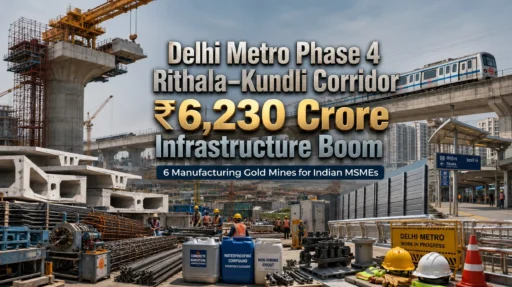


The Delhi Metro Rail Corporation (DMRC) has launched its first construction tender for a 15 km stretch of Rithala–Kundli corridor in Phase 4 of the Delhi Metro, according to a report by Navbharat Times. This is a turning point. This marks the official launch of a ₹6,230 crore infrastructure project. The Cabinet approved it, the PM inaugurated it, and contractors can now begin construction at the ground level.
This 26.463-km elevated avenue will connect Rithala in northwest Delhi to Kundli in the Haryana border and will traverse areas of Narela, Bawana and Rohini. It will cover 21 overground stations and is slated for completion in four years since sanction.
This first tender is not only a headline but a market signal for the entrepreneurs, MSMEs, manufacturers, and the startup founders. Each of these large-scale projects fosters an important, long-term supply chain stretching from raw material suppliers to technology vendors, from chemical manufacturers for construction to manufacturers of fittings for metro stations. Works have officially commenced and a clock started ticking, reports said Navbharat Times.
What Recent Navbharat Times Reporting Means for Business
The Navbharat Times article on Rithala–Kundli corridor construction makes it clear: DMRC has moved from approval to action. The first construction tender for the 15-km section has been issued. This is the critical trigger that procurement teams, subcontractors, and material suppliers wait for.
What happened, precisely? In December 2024, the Union Cabinet approved the route of the Rithala-Kundli corridor. The foundation stone was laid by PM Narendra Modi. In 2025, DMRC has released its first civil construction tender for 15 kilometres of the entire 26.463-kilometre alignment. This translates the project from a policy paper to actual excavation, formwork and steel.
How does this relate to entrepreneurs? Due to the vast amount of:
- Pre-cast concrete segments and precast viaduct component
- The metal products are structural steel, rebar, and high strength fasteners.
- Construction chemicals, such as waterproofing, admixtures, epoxy grouts
- Coatings and compounds for anti-corrosion, fireproofing, and sealant.
- Cable management systems and electrical conduits.
- Additionally, material for safety equipment, scaffolding and temporary works.
It is not demand in the future.It is not demand for the future. The tender has been issued. When a contractor is awarded these tenders, they start to order materials from all within the supply chain. MSMEs stocked and prepared to supply will benefit through direct livelihood benefit.
Why India’s Metro Infrastructure Industry Is on a Historic Upswing
Delhi Metro Phase 4 is not a standalone project. The future of the metro rail sector is promising and it is in the exponential growth phase in India. The Ministry of Housing and Urban Affairs has announced that there are 29 states with metro rail networks either in operation or under construction. The total length of the metro rail network in India is currently nearing 1000 kilometres and has become the third largest metro rail system in the world, after the USA and China.
Delhi Metro will be the longest single city metro system in the world with 399 km length when the extension of the Blue and Orange Lines becomes operational. During Phase 4, 86 kilometres of new lines are being built in five corridors by DMRC. The Rithala–Kundli corridor is the next in the series, with the reports from Navbharat Times indicating that it has entered active construction, bringing the total length of the project to 26.5 kilometres.
It’s a closed, long-term buying cycle for business owners. Construction projects in Metro run over 3–5 years, creating long-duration and predictable supply contracts that help MSMEs invest in capacity.
Besides this, the corridor will also open up vast opportunities for commercial and residential development at its 21 stations, especially in Bawana, Narela and Kundli industrial belt in Haryana. This opens an additional business opportunity: retail, logistics, warehousing and last mile services in new connected zones.
Government Policies & Incentives Fuelling This Opportunity
Smart entrepreneurs take advantage of government policy to finance their entry into the supply chain. There are various programmes at national and state level which directly cater to MSMEs who are providing to metro rail projects.
All the metro rail projects are under the Ministry of Housing and Urban Affairs (MOHUA). For the procurement, DMRC abides by the policy laid down by GFR and ensures that there are reliable timelines for payment which MSMEs can bank on.
Udyam Registration Portal (Ministry of MSME) offers MSME registration and access to priority credit, government tenders and subsidy schemes. All MSME suppliers to DMRC suppliers should be registered with Udyam.
The SIDBI — Small Industries Development Bank of India provides infrastructure financing for supply chain of particular industries. For MSMEs who are supplying to large infrastructure projects, they can avail credit based on confirmed purchase order from Tier-1 contractors.
Make in India and Atmanirbhar Bharat framework, which is being enforced by DPIIT — Department for Promotion of Industry and Internal Trade, has introduced the domestic sourcing requirement for certain categories of metro components.
Haryana Enterprise Promotion Centre (HEPC) provides investment facilitation, allotment of land in industrial estates, and MSME support for the Haryana section of the corridor, specifically for the Kundli–Sonipat corridor.
Discover business ideas that actually make money
Delhi State Industrial & Infrastructure Development Corporation (DSIDC) is providing assistance to the manufacturers of the city in getting industrial plots in areas like Bawana and Narela, directly on the new metro line corridor.
Tender Notifications, Eligibility conditions and procurement Notices are generally published on the main portals of the National Highways & Infrastructure Development Corporation Limited (NHIDCL) and the DMRC Official Tender Portal. Monitor these actively.
The Startup India Portal — DPIIT offers recognition and tax exemptions to tech-driven startups in metros and gives access to government infrastructure institutions for pitches.
The Government e-Marketplace (GeM) has enabled MSME manufacturers to supply their products directly to the government for procurement like metro safety products, signage, station furniture etc. without the cumbersome tendering processes.

6 Manufacturing Business Opportunities Directly Unlocked by This Corridor
The number of materials required for each km of elevated metro corridors is in the thousands. Six manufacturing firms directly connect to the Rithala–Kundli corridor and the entire Phase 4 extension, according to reports from Navbharat Times and the ongoing construction reality.
1. Precast Concrete Segment Manufacturing
Precast concrete box girders, precast segments are used in construction of elevated metro viaducts, which are assembled on pillars off-site. It is a high-volume manufacturing business, B2B. The precast plant required for DMRC’s Phase 4 corridor is 2-5 acres, casting bed, mould and concrete batch plant. Usually, contractors at DMRC look for suppliers within the radius of 80-120km as it reduces the transportation expenses. Both Bawana and Narela are industrial areas on this corridor with land available.
Why now: There’s a first tender. Contractors are now busy and searching for precast suppliers. The window of opportunity before supply chains lock is the best time to go after Tier-1 contractors.
Get Detailed Insights from This Book: The Complete Book on Cement & Concrete Products Manufacturing
2. Construction Chemical Manufacturing: Admixtures, Waterproofing & Grouts
The number of concrete admixtures (plasticisers, superplasticisers, retarders), waterproofing membranes and epoxy/polyurethane grouts used in the construction of metro are huge. India is presently importing considerable quantity of specialty construction chemical products from Korea, Japan and Germany. A domestic manufacturer with BIS certification is able to fulfil the demand of the metro project as well as the national market for infrastructure.
The investment required in a mid-size plant to manufacture construction chemicals is ₹1.5-4 crore. Relevant certifications: BIS IS 9103 (admixtures) and ISO 9001. Market: not just DMRC, but all 29 states developing metro networks across the country.
View Full Project Details: Construction Chemicals Projects
3. High-Tensile Steel Fabrication & Rebar Processing
The steel component of an elevated metro project represents about 15-20% of the total cost. There is a huge secondary market for:
- Steel rebar bending machines (rebar processing machines)
- Fabrication of structural steel for station canopies and roofing.
- The above are all fastener types that are used in steel structures.
- Galvanised cable trays and conduit systems
The shearing and bending machine, storage area and sourcing of IS-certified raw material are necessary for an MSME rebar processing unit. Bawana Industrial Area, which will have a station on this corridor, is a natural cluster area.
Related Article: How to Start a Steel Fabrication Business in India: Plant Setup, Investment & Profit Guide
4. Noise Barrier & Vibration Damping Component Manufacturing
Products include acoustic concrete panels, fibre-reinforced noise barrier boards, HDPE/EPDM rail pads and under-sleeper pads. The Atmanirbhar Bharat policy actively encourages DMRC to go for local suppliers of these components.
5. Metro Station Fittings & Urban Furniture Manufacturing
There are 21 elevated stations on this corridor that will each need a full set of manufactured components:
- Platform edge doors (PEDs) and automatic gate parts
- Handrails and balustrades of stainless steel with stainless steel grab rails
- Accessibility equipment and tactile paving tiles.
- Canopy roofing systems, FRP panels and cladding materials.
- Steel benches, ticket counter furniture and information kiosks
- Signage boards, LED display frames and directional panels.
The station fitout phase has a start from 18–24 months after the start of civil work, which is while new manufacturers are setting up, certifying and are in the process of engaging contractors for the civil works.
6. Safety Equipment & Temporary Works Manufacturing
DMRC has specified the mandatory safety equipment requirement for Metro construction worksites in its HSE codes. This makes consistent B2B demand for:
- Safety helmets (IS 2925) and fall protection gear and harnesses
- Safety netting systems and edge protection barriers to protect both people and property.
- Scaffolding systems: cup-lock, ring-lock and frame systems
- Temporary precast barricades and traffic management equipment,
- Personal Protective Equipment (PPE): gloves, vests, safety shoes
An MSME safety equipment manufacturing unit with IS-certified products can serve this corridor, as well as the entire Phase 4 expansion and parallel infrastructure projects across NCR and beyond.
Import–Export Opportunity Analysis
Export Markets: India’s Metro Manufacturing as a Global Product
India is becoming the hub of manufacturing metros. However, components produced for the needs of Indian metros are also starting to find their way in to export markets in Southeast Asia, Africa and the Middle East, where metro expansion is picking up pace.
Entrepreneurs can produce metro-grade manufacturing quality and meet the demand for India’s network and be able to supply the demand of Bangladesh, Sri Lanka, Nepal, Vietnam and the countries of Africa building urban rail. The Rithala-Kundli corridor does provide domestic fill to build scale and the exports follow.
Import Substitution: The Domestic Opportunity
Currently India imports a large number of metro-specific products such as:
- Under-sleeper pads (Germany and Japan) and vibration isolation rail pads.
- China’s Specialty noise barrier materials (from Korea)
- These are waterproofing membranes that provide high performance, and are mostly European brand.
- Escalator components and elevator shaft equipment
The components of an escalator and elevator shaft equipment used in elevators.Parts of escalators and elevator shaft equipment of elevators.
Many of these components are now mandatory under the government’s ‘Make in India’ initiative, which also covers railway and metro procurement. The government has provided an MSME a preference, rather than competition, to fill this void.
Indian MSME Success Stories in Metro Infrastructure Supply
1. Kernex Microsystems, Hyderabad
Kernex Microsystems is one of the few listed MSMEs that have successfully provided train protection and anti-collision systems to Indian Railways and metro projects. Initially it was a small electronics company and then it developed expertise in the rail signalling and won big government orders proving niche technical manufacturing in the rail infrastructure space is possible for Indian MSMEs.
2. Capacit’e Infraprojects, Mumbai
Founded as a specialist civil contractor, Capacit’e Infraprojects has grown its first motors and infrastructure civil work ammunition from Mumbai and Delhi. The path it has taken shows the growth of MSME contractors in this area, in terms of specialization in precast, foundation and station superstructure under metro civil packages.
3. Rail Spring Karkhana Cluster, Agra
The country has a number of MSME-based manufacturers in Agra, Ludhiana and Pune that provide rail fastening systems, spring washers, and track hardware to DMRC and other metro companies. The businesses have been steadily expanding due to growth in order volumes from metro expansions, proving that traditional metal component manufacturers can secure recurring government infrastructure business by proving quality certification by BIS and RDSO.
How Niir Project Consultancy Services (NPCS) Can Help You Enter This Market
Niir Project Consultancy Services (NPCS) is one of India’s most respected industrial consultancy organisations, with over four decades of experience preparing Detailed Project Reports (DPRs), feasibility studies, technology assessments, and market research for entrepreneurs, MSMEs, banks, and government bodies.
If you are considering entering any manufacturing segment described in this article — precast concrete, construction chemicals, safety equipment, metro station fittings, or noise barrier products — NPCS can deliver:
- Detailed Project Reports (DPR) with plant layout, machinery list, capital cost estimates, and financial projections
- Market Research Reports covering demand-supply analysis for metro infrastructure materials
- Technology Consultancy — identifying the right process technology and machinery vendors for your product
- Feasibility Studies — breakeven analysis, IRR, NPV, and bank-submission-ready financial models
- Turnkey Project Setup Support — from site selection to production start
NPCS project reports are used by banks, NBFCs, SIDBI, and state financial corporations to evaluate MSME loan proposals. Visit: www.niir.org
Quick Reference Data Table
| Parameter | Details |
| Industry | Metro Rail Infrastructure — Civil Construction & Component Supply |
| Project | Delhi Metro Phase 4 — Rithala–Kundli Corridor (26.463 km, 21 stations) |
| Project Cost | ₹6,230 crore (Union Cabinet approved, December 2024) |
| Stations | Narela, Bawana, parts of Rohini, Kundli (Haryana) — all elevated |
| Market Driver | First construction tender issued by DMRC for 15-km section (2025) |
| MSME Opportunity | Precast concrete, construction chemicals, steel fabrication, safety equipment, station fittings, noise barriers |
| Export Potential | Metro components to Southeast Asia, Africa, Middle East — growing rapidly |
| Government Support | Make in India, Atmanirbhar Bharat, MSME Udyam, SIDBI infra finance, HEPC Haryana, DSIDC Delhi, GeM Portal |
| Key Certifications | BIS, ISO 9001, RDSO approval (for rail-specific products), NABL test reports |
| Risk Level | Low–Medium (government-backed, confirmed tender, phased payments) |
| Growth Outlook | Strong — 86 km under Phase 4 alone; 29 states building metro networks across India |
| Timeline | 4 years to completion; supply windows open immediately post-tender |
Conclusion: Act Before the Concrete Sets
The first construction tender for the Delhi Metro Phase 4 Rithala–Kundli corridor is not just infrastructure news. As reported by Navbharat Times, this is the moment when a ₹6,230 crore project transitions from announcement to active construction — and that is the single most valuable business signal for entrepreneurs who know how to read it.
Six manufacturing segments — precast concrete, construction chemicals, steel fabrication, noise barriers, station fittings, and safety equipment — offer real, near-term, government-backed revenue opportunities for MSMEs with the right certifications and production capacity. These are not speculative bets. They are supply chain gaps that DMRC and its contractors must fill in the next 36–48 months.
Beyond construction, the 21 stations and the connectivity boost for Bawana, Narela, and Kundli will unlock a second round of business development — in warehousing, retail, logistics, and commercial real estate — that will sustain economic activity for decades.